The phrase “college basketball on an aircraft carrier” sounds like something a sports marketer invented after drinking too much espresso near a Navy pier. Yet the USS Abraham Lincoln hosting Gonzaga and Michigan State was not a gimmick tossed together for a quick television moment. It was a full-scale Veterans Day spectacle, a tribute to U.S. service members, and one of the most visually unforgettable settings in modern college basketball.
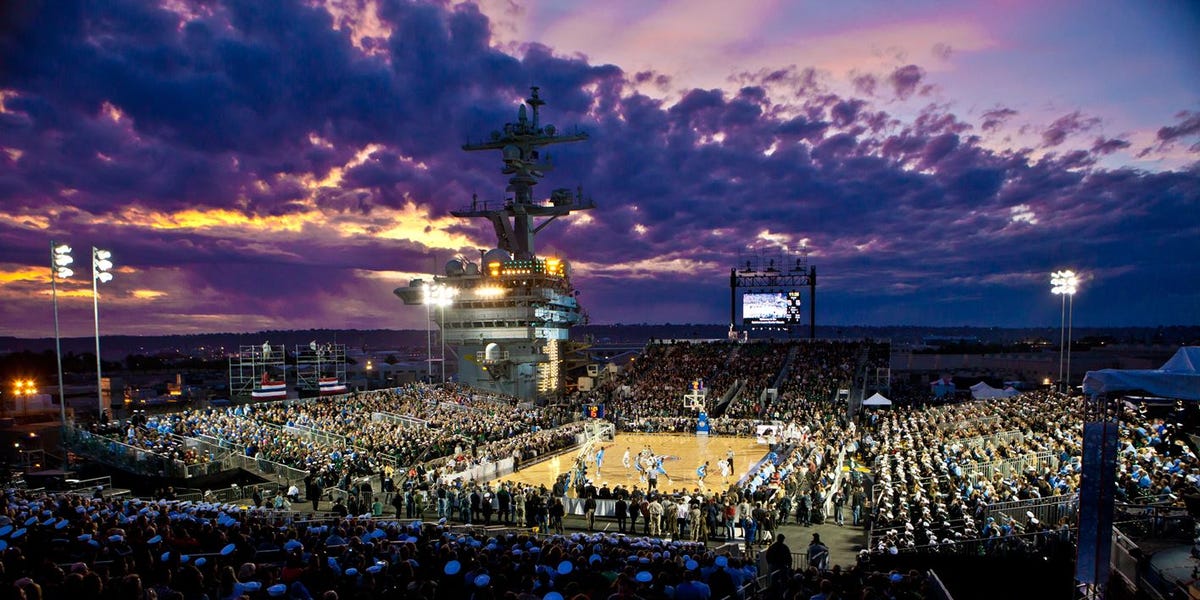
On November 11, 2022, the Gonzaga Bulldogs and Michigan State Spartans met on the flight deck of the USS Abraham Lincoln in San Diego for the Armed Forces Classic. The game brought together two powerhouse programs, a massive Nimitz-class aircraft carrier, a national ESPN audience, and the kind of atmosphere that makes even casual fans stop scrolling and say, “Wait, are they really playing on a ship?” Yes, they were. And somehow, the basketball lived up to the scenery.
Gonzaga defeated Michigan State 64-63 in a dramatic finish, with Drew Timme leading the Bulldogs through a second-half comeback. But the final score tells only part of the story. This was a game about logistics, symbolism, military appreciation, program prestige, and the unique challenge of turning a working aircraft carrier into a basketball arena. It was less “neutral-site game” and more “March Madness meets Top Gun, but with fewer beach volleyball montages.”
Why the USS Abraham Lincoln Game Mattered
The Gonzaga-Michigan State matchup aboard the USS Abraham Lincoln mattered because it combined elite college basketball with a meaningful national tribute. The Armed Forces Classic is designed to honor service members by bringing major college basketball programs to military-related venues near Veterans Day. Holding the game on an active U.S. Navy aircraft carrier gave the event extra emotional weight.
For fans, the attraction was obvious. A basketball court placed on a flight deck creates instant drama. The Pacific sky becomes the ceiling, the carrier island becomes the backdrop, and every wide camera shot looks like it belongs in a movie trailer. For players, however, the setting was more than picturesque. It was a reminder that their ordinary game-day routine was happening in an extraordinary place built for national defense, not pick-and-roll coverage.
Michigan State coach Tom Izzo had experience with this kind of event. His Spartans played North Carolina on the USS Carl Vinson in 2011, a landmark game attended by President Barack Obama and First Lady Michelle Obama. That earlier contest helped establish aircraft carrier basketball as one of the most ambitious ideas in the sport. More than a decade later, Michigan State returned to the deck, this time facing Gonzaga on the USS Abraham Lincoln.
The Matchup: Gonzaga vs. Michigan State
The game itself had serious basketball credibility. Gonzaga entered as one of the nation’s top-ranked programs, with Mark Few’s Bulldogs known for efficient offense, disciplined player development, and a national brand built far from the traditional power-conference spotlight. Michigan State, meanwhile, brought its familiar toughness, rebounding edge, and Tom Izzo’s reputation for building teams that enjoy difficult assignments the way some people enjoy coffee.
This was not a ceremonial scrimmage with a scenic background. Both programs approached the game as a real test. Gonzaga needed to prove it could handle a physical Big Ten opponent. Michigan State wanted to show it could trade punches with one of the country’s elite teams. The result was a tight, competitive matchup that looked less like a novelty and more like an early-season NCAA Tournament preview.
Michigan State controlled much of the first half and led 38-31 at halftime. The Spartans used physical defense, interior pressure, and confident guard play to make Gonzaga uncomfortable. On a court surrounded by sailors, cameras, and a naval environment that was not exactly “your local gym,” the Spartans looked settled early.
Then Gonzaga adjusted. Drew Timme became the central figure, using footwork, patience, and veteran poise to pull the Bulldogs back into the game. Timme finished with 22 points and 13 rebounds, numbers that mattered even more because of the conditions and stakes. When a game is played outdoors on a carrier deck, rhythm is not guaranteed. Timme gave Gonzaga something stable when the setting was anything but ordinary.
Final Score and Key Moments
Gonzaga’s 64-63 victory came down to execution in the final minutes. Michigan State had a chance to win at the buzzer, but the last shot missed, allowing the Bulldogs to escape with a one-point win. It was exactly the kind of finish ESPN and event organizers would have ordered if basketball games accepted scripts. Fortunately for everyone watching, the drama arrived naturally.
The Bulldogs’ comeback from a double-digit deficit showed why Gonzaga had become one of college basketball’s most consistent national contenders. They did not panic when Michigan State made the game physical. They did not treat the unusual setting as an excuse. Instead, they leaned on their best player, tightened their defense, and found just enough offense to win.
Michigan State also left San Diego with reasons for confidence. The Spartans lost, but they pushed a top-ranked opponent to the final possession. Mady Sissoko was productive inside, A.J. Hoggard created pressure, and the team’s toughness was obvious. For an early November game, it offered the kind of information coaches love and fans overreact to with great passion. In other words, college basketball was officially back.
Turning an Aircraft Carrier Into a Basketball Venue
Hosting a college basketball game on the USS Abraham Lincoln required much more than rolling out a court and hoping the ocean behaved. Aircraft carriers are built for military operations, not baseline out-of-bounds calls. Every part of the event had to be planned around security, weather, television production, seating, player movement, lighting, and the realities of working on a ship.
The court had to be assembled on the flight deck with enough stability for Division I competition. Temporary seating had to accommodate service members, invited guests, staff, media, and broadcast crews. Lighting had to work for television and for athletes tracking a basketball against a changing sky. Even simple details, like where teams warm up or how equipment is moved, became major logistical questions.
Weather was another concern. Outdoor basketball is charming until moisture appears on the court. Earlier carrier games showed that condensation and rain could become serious issues. A slick court is not just inconvenient; it is dangerous. That is why organizers had to think carefully about timing, surface conditions, and contingency planning. Basketball fans may complain about arena parking, but at least most arenas do not involve maritime humidity.
The Veterans Day Connection
The game’s Veterans Day setting was central to its meaning. The USS Abraham Lincoln was not merely a backdrop. It represented the sailors who serve aboard it and the broader military community being honored by the Armed Forces Classic. The event gave players, coaches, and fans a chance to connect college sports with service, sacrifice, and national appreciation.
For the athletes, the experience included more than playing forty minutes of basketball. Teams had opportunities to tour the ship, meet sailors, and learn about daily life aboard a carrier. That kind of exposure can stay with players long after they forget a missed free throw or a scouting-report detail. It reminds them that discipline, teamwork, and pressure exist far beyond sports.
The symbolism worked because it was grounded in a real environment. A carrier flight deck is a place where coordination matters. Everyone has a role. Mistakes can be costly. In that sense, it was a fitting location for two basketball programs built on preparation, structure, and trust. The difference, of course, is that a missed defensive rotation does not usually involve jet engines.
Why Gonzaga Was a Perfect Fit
Gonzaga’s presence made sense because the Bulldogs had become one of the defining programs of modern college basketball. Once viewed as a charming mid-major underdog, Gonzaga evolved into a national heavyweight. By 2022, the Bulldogs were no longer sneaking up on anyone. They were a program that attracted premium opponents, national broadcasts, and early-season showcase events.
Mark Few’s teams are known for offensive clarity, player development, and consistency. The USS Abraham Lincoln game offered Gonzaga a chance to show those traits under unusual pressure. The Bulldogs did not play a perfect game, but their resilience was impressive. They trailed, absorbed Michigan State’s physicality, and found a way to win without turning the event into a style contest.
Drew Timme’s performance also fit the stage. Timme was already one of the most recognizable players in college basketball, famous for his post moves, confidence, and mustache energy. On the carrier deck, he gave Gonzaga the veteran anchor it needed. His 22-point, 13-rebound effort was not just statistically strong; it was the difference between a memorable win and a scenic loss.
Why Michigan State Was a Perfect Fit
Michigan State was equally appropriate for the occasion. Few coaches embody tough scheduling better than Tom Izzo. The Spartans regularly play demanding nonconference games because Izzo believes early challenges harden a team for March. Facing Gonzaga on an aircraft carrier was very much on-brand: difficult opponent, unusual environment, national attention, and no easy path.
The Spartans also brought historical continuity. Michigan State had participated in the 2011 carrier game against North Carolina, so its return connected the USS Abraham Lincoln event to the earlier era of shipboard college basketball. That gave the 2022 matchup a sense of revival, not just novelty.
Although Michigan State lost, the performance showed the team’s competitive foundation. The Spartans defended hard, rebounded, and nearly beat one of the best teams in the country. In a long season, close losses can become teaching tools. This one came with a pretty unforgettable classroom.
How the Game Looked on Television
As a television event, the USS Abraham Lincoln game delivered exactly what broadcasters want: spectacle with substance. The aerial shots of the carrier, the court framed by Navy equipment, and the sunset-to-night transition gave the broadcast a cinematic feel. It was the kind of visual presentation that makes even non-basketball fans understand why the event was special.
But the broadcast also had a real game to sell. A blowout might have turned the night into a postcard. Instead, the one-point finish gave the visuals competitive meaning. The setting attracted viewers; the basketball kept them watching. That balance is difficult to manufacture, which is why the Armed Forces Classic remains such a compelling concept when the matchup and logistics align.
The Challenges of Carrier Basketball
Aircraft carrier basketball is exciting, but it is not simple. The same features that make it beautiful also make it difficult. Wind can affect shooting. Outdoor lighting can alter depth perception. Temperature changes can influence grip and footing. The court surface must remain safe. Security requirements are significant. The ship’s operational schedule matters. And unlike a normal arena, an aircraft carrier cannot exactly be booked on a whim between a concert and a monster truck show.
That is one reason these games are rare. They require cooperation among the military, universities, broadcasters, sponsors, and event organizers. The USS Abraham Lincoln game worked because all those moving parts aligned. When they do, the result is unforgettable. When they do not, weather and logistics can quickly remind everyone that basketball was invented indoors for a reason.
What the Game Meant for College Basketball
The Gonzaga-Michigan State game on the USS Abraham Lincoln showed that college basketball can still create moments that feel genuinely different. In an era of transfer portal news, conference realignment, media deals, and endless bracket projections, the sport benefits from events that feel human and memorable.
This game was not only about rankings. It was about place. It was about honoring service members. It was about giving players a story they will tell for decades. It was about showing fans a familiar sport in an unfamiliar setting. That is valuable because sports are at their best when they create shared memories, not just statistics.
For Gonzaga, it became another signature nonconference win. For Michigan State, it became another example of the program’s willingness to play anyone, anywhere, even on a floating runway. For the Navy and the Armed Forces Classic, it reinforced the power of pairing sports with military appreciation when the tone is respectful and the execution is strong.
Experience: What It Feels Like to Watch a Game Like This
Watching the USS Abraham Lincoln host Gonzaga and Michigan State felt different from watching a normal college basketball game. A typical arena has bright lights, student sections, polished hardwood, and the familiar squeak of sneakers echoing under a roof. This game had open air, naval steel, military personnel, and the strange thrill of seeing a basketball court placed where aircraft usually operate. It made the sport feel both smaller and bigger at the same time.
The first experience that stands out is the atmosphere. Even through a television screen, the setting changed the emotional temperature of the game. The players were not simply walking out of a tunnel; they were stepping onto a flight deck. Coaches were not pacing in front of ordinary courtside seats; they were standing in one of the most unusual venues college basketball has ever used. Every camera angle reminded viewers that this was not just another November matchup.
There was also a sense of careful respect. The Veterans Day connection gave the event a tone that was bigger than school colors. Gonzaga fans wanted to win. Michigan State fans wanted to win. Neutral fans wanted a close game. But underneath all of that, the event carried a shared appreciation for the service members in attendance and the sailors connected to the ship. It was competitive without feeling ordinary.
From a fan’s perspective, the changing light made the game especially memorable. Early shots had that late-afternoon San Diego glow, while later possessions unfolded under artificial lighting against the darker outline of the ship. It gave the game a beginning, middle, and end visually, almost like a documentary. You could feel the event moving from ceremony into competition and then into drama.
The basketball experience was also fascinating because the players had to solve real conditions. Shooters did not have the same background they would see in an arena. The environment was open, unusual, and probably a little distracting. That made every made jumper feel more impressive and every missed shot understandable. Nobody watching from a couch had much credibility yelling, “How did he miss that?” while the player was shooting on an aircraft carrier in front of a national audience.
The final minutes created the perfect ending. A one-point game forces everyone to forget the novelty and focus on the possession. Suddenly, the ship was not just a backdrop. It was the stage for pressure, defense, decision-making, and a potential game-winner. Gonzaga survived, Michigan State nearly stole it, and the audience got the rare sports experience that delivered both a memorable setting and a memorable finish.
For anyone who loves college basketball, the USS Abraham Lincoln game was a reminder that the sport still has room for imagination. Not every game needs to be played in a palace of luxury suites. Sometimes the best venue is the one that makes players look around, take a breath, and realize they are part of something they will never forget. And if that venue happens to be a nuclear-powered aircraft carrier, well, that certainly beats another neutral-site court with beige curtains behind the basket.
Conclusion
The USS Abraham Lincoln hosting the Gonzaga-Michigan State game was more than a clever scheduling idea. It was a rare collision of elite basketball, military tribute, ambitious event planning, and national television spectacle. Gonzaga’s 64-63 win gave the night competitive drama, while the setting gave it lasting meaning.
The Armed Forces Classic proved that sports can honor service members without losing the intensity fans expect from a major college basketball matchup. Gonzaga and Michigan State delivered a serious game in an unforgettable place, and the USS Abraham Lincoln provided a stage unlike almost anything else in American sports. In the end, the event worked because it respected both sides of its identity: it was a basketball game, and it was a tribute. That combination made it memorable long after the final buzzer.