Note: This article is written for web publishing and synthesizes standard math definitions commonly taught in U.S. classroom resources, open textbooks, math encyclopedias, and educational learning platforms. Source links are intentionally omitted for a clean publishing format.
Some math topics walk into the room wearing sunglasses and acting mysterious. Rational and irrational numbers are not like that. They sound dramatic, almost like one number calmly brought a spreadsheet while another number forgot its shoes, but the difference is actually very clear once you know what to check.
Learning how to tell if a number is rational or irrational is one of the most useful skills in middle school math, pre-algebra, algebra, and beyond. It helps you classify real numbers, understand decimals, simplify square roots, compare values on a number line, and avoid the classic “everything with a decimal must be scary” mistake. Spoiler: many decimals are perfectly well-behaved.
In this guide, we will break down rational numbers, irrational numbers, easy identification rules, common examples, and the sneaky traps students often miss. By the end, you will be able to look at a number like 0.75, √2, π, or -8 and confidently say, “I know what you are.” Very detective. Very mathematical.
What Is a Rational Number?
A rational number is any real number that can be written as a fraction:
p/q, where p and q are integers and q ≠ 0.
That last part matters because division by zero is not allowed. Math is flexible about many things, but dividing by zero is where it throws a tiny chair across the room.
Examples of Rational Numbers
Here are common rational numbers:
- 5, because it can be written as 5/1
- -12, because it can be written as -12/1
- 3/4, because it is already a fraction of integers
- 0.5, because it equals 1/2
- 0.75, because it equals 3/4
- 0.333…, because it equals 1/3
- 2.454545…, because the digits repeat
- √9, because it equals 3
The key idea is simple: if the number can become a neat fraction made from integers, it is rational. It does not have to look like a fraction at first. Integers, terminating decimals, and repeating decimals are all rational numbers.
What Is an Irrational Number?
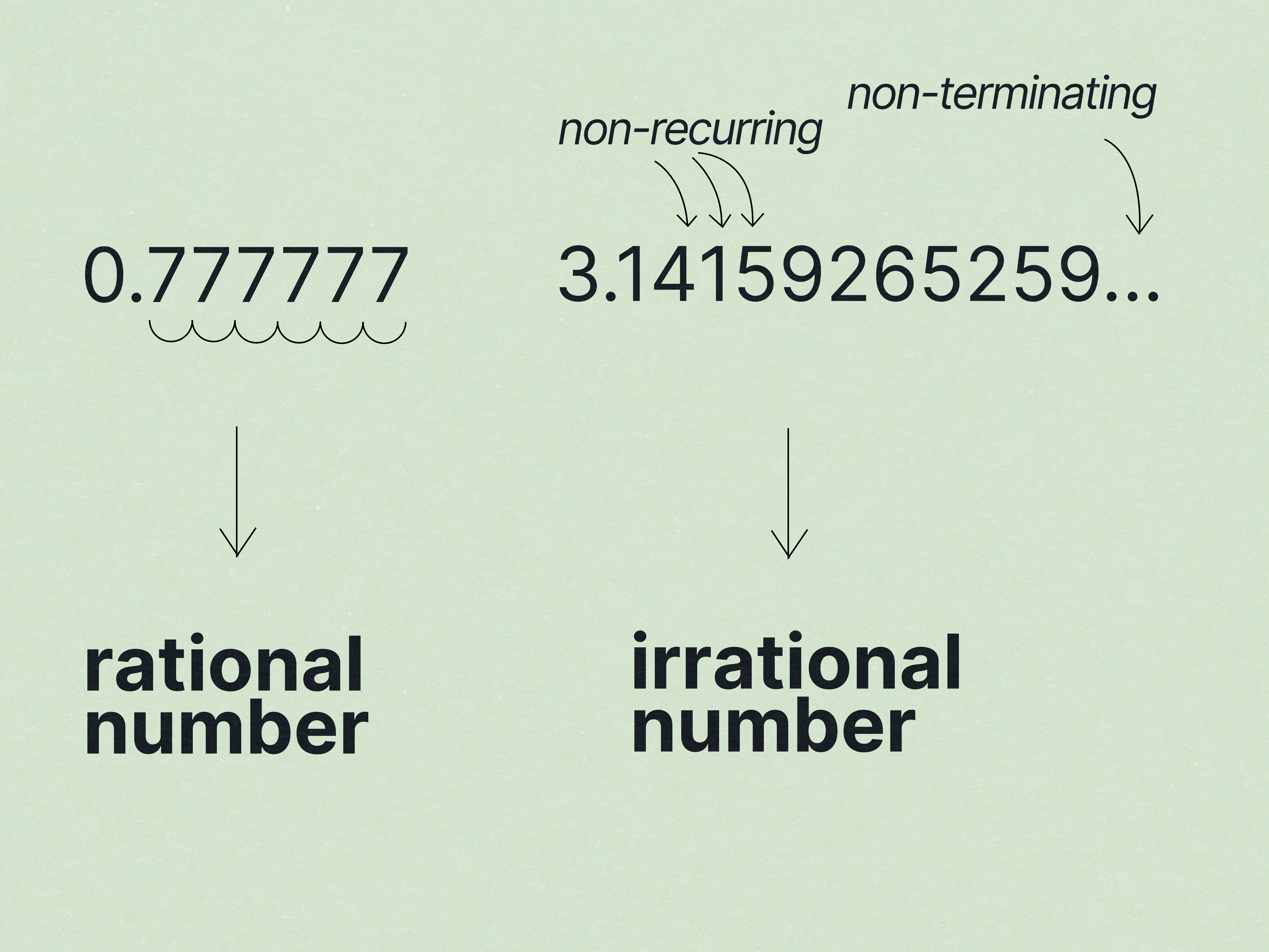
An irrational number is a real number that cannot be written as a fraction of two integers. Its decimal form goes on forever without ending and without repeating in a pattern.
That means an irrational number is not “weird” or “unreasonable.” The word comes from “ratio.” A rational number has a ratio form; an irrational number does not. So no, √2 is not making bad life choices. It simply cannot be expressed as an exact fraction of integers.
Examples of Irrational Numbers
- π, because its decimal continues forever without repeating
- √2, because 2 is not a perfect square
- √3, because 3 is not a perfect square
- √5, because 5 is not a perfect square
- e, the natural base used in advanced math
- 1.101001000100001…, if the pattern never repeats regularly
The most famous irrational numbers are π, e, and square roots of non-perfect squares. If you see a radical like √7, your first question should be: “Is 7 a perfect square?” Since it is not, √7 is irrational.
The Quick Test: Rational or Irrational?
When you are asked to classify a number, use this simple checklist.
1. Is It an Integer?
If the number is an integer, it is rational.
Examples:
- 8 is rational because 8 = 8/1
- -4 is rational because -4 = -4/1
- 0 is rational because 0 = 0/1
Many students forget that whole numbers and integers are rational. They see “rational” and think it must involve a visible fraction. Not true. Integers are just fractions wearing casual clothes.
2. Is It a Fraction of Integers?
If the number is written as a fraction with integers on top and bottom, and the denominator is not zero, it is rational.
Examples:
- 7/9 is rational
- -11/5 is rational
- 100/3 is rational
- 0/8 is rational
However, 5/0 is not rational because it is undefined. The denominator cannot be zero.
3. Does the Decimal End?
A decimal that ends is called a terminating decimal. Every terminating decimal is rational because it can be written as a fraction with a power of 10 in the denominator.
Examples:
- 0.6 = 6/10 = 3/5
- 2.75 = 275/100 = 11/4
- -4.125 = -4125/1000 = -33/8
If the decimal stops, it is rational. The number may look fancy, but it is still fraction-friendly.
4. Does the Decimal Repeat?
A decimal that repeats forever is also rational. The repeating part may be one digit, two digits, three digits, or more.
Examples:
- 0.777… is rational
- 0.121212… is rational
- 3.145145145… is rational
- -8.636363… is rational
Repeating decimals can always be converted into fractions. For example, 0.333… equals 1/3, and 0.090909… equals 1/11.
5. Does the Decimal Go Forever Without Repeating?
If a decimal never ends and never settles into a repeating pattern, it is irrational.
Examples:
- π = 3.14159265…
- √2 = 1.41421356…
- √3 = 1.73205080…
Be careful: you cannot prove a number is irrational just because your calculator shows many decimal digits. Calculators round. A displayed decimal may be only an approximation. To classify a number correctly, use its exact form whenever possible.
Square Roots: The Most Common Trick
Square roots are where rational and irrational numbers love to play hide-and-seek. The rule is usually straightforward:
The square root of a perfect square is rational. The square root of a non-perfect square integer is irrational.
Perfect Square Roots Are Rational
- √1 = 1, rational
- √4 = 2, rational
- √9 = 3, rational
- √16 = 4, rational
- √25 = 5, rational
- √100 = 10, rational
Non-Perfect Square Roots Are Irrational
- √2, irrational
- √6, irrational
- √10, irrational
- √15, irrational
- √99, irrational
Some square roots can be simplified but are still irrational. For example, √12 = 2√3. Since √3 is irrational, √12 is irrational too.
Rational vs. Irrational Examples Table
| Number | Rational or Irrational? | Why? |
|---|---|---|
| 14 | Rational | It can be written as 14/1. |
| -3/8 | Rational | It is a fraction of integers. |
| 0.625 | Rational | The decimal terminates. |
| 0.818181… | Rational | The decimal repeats. |
| √49 | Rational | √49 = 7. |
| √50 | Irrational | 50 is not a perfect square. |
| π | Irrational | It cannot be written as a ratio of integers. |
| 3.14 | Rational | It is a terminating decimal, even though it approximates π. |
| e | Irrational | Its decimal expansion does not terminate or repeat. |
Common Mistakes Students Make
Mistake 1: Thinking All Decimals Are Irrational
This is probably the biggest misunderstanding. A decimal is not automatically irrational. If it ends or repeats, it is rational. Only decimals that continue forever without a repeating pattern are irrational.
Mistake 2: Thinking Negative Numbers Cannot Be Rational
Negative numbers can absolutely be rational. For example, -5, -2.75, and -3/7 are all rational. The negative sign does not change the classification.
Mistake 3: Confusing π With 3.14
π is irrational. But 3.14 is rational because it ends. The number 22/7 is also rational because it is a fraction, even though it is sometimes used as an approximation for π. Approximations are not the same as the exact number.
Mistake 4: Assuming Every Radical Is Irrational
Not every square root is irrational. √64 is rational because it equals 8. √81 is rational because it equals 9. Before labeling a radical irrational, simplify it first.
How Operations Affect Rational and Irrational Numbers
When you add, subtract, multiply, or divide rational and irrational numbers, the result depends on the situation.
Rational + Rational
The result is always rational.
Example: 1/2 + 3/4 = 5/4
Rational × Rational
The result is always rational.
Example: 2/3 × 9/5 = 6/5
Rational + Irrational
The result is irrational, as long as the rational number is truly rational and the other number is truly irrational.
Example: 5 + √2 is irrational.
Nonzero Rational × Irrational
The result is irrational.
Example: 3√5 is irrational.
Irrational + Irrational
The result may be rational or irrational. This is where math says, “Plot twist.”
Examples:
- √2 + √2 = 2√2, irrational
- √2 + (-√2) = 0, rational
Irrational × Irrational
The result may also be rational or irrational.
Examples:
- √2 × √2 = 2, rational
- √2 × √3 = √6, irrational
Practice: Classify Each Number
Try these before reading the answers. Be honest. Math knows when you peek.
- 11
- 0.404040…
- √18
- -7.25
- π/2
- √121
- 1.234567891011…
Answers
- 11 is rational because it equals 11/1.
- 0.404040… is rational because the decimal repeats.
- √18 is irrational because 18 is not a perfect square. It simplifies to 3√2.
- -7.25 is rational because the decimal terminates.
- π/2 is irrational because a nonzero rational number multiplied by an irrational number remains irrational.
- √121 is rational because it equals 11.
- 1.234567891011… is irrational if the digits continue forever without forming a repeating block.
A Simple Decision Tree
Use this decision tree when solving homework problems or checking your answer:
- Can the number be written as a fraction of integers? If yes, it is rational.
- Is it an integer? If yes, it is rational.
- Is it a terminating decimal? If yes, it is rational.
- Is it a repeating decimal? If yes, it is rational.
- Is it a square root of a non-perfect square? If yes, it is irrational.
- Is it π, e, or a nonrepeating, nonterminating decimal? If yes, it is irrational.
- If it is rounded or approximated, find the exact form before deciding.
Why This Topic Matters
Classifying numbers may seem like a small skill, but it connects to bigger math ideas. Rational and irrational numbers make up the real number system. They appear on number lines, in geometry, in algebraic expressions, in measurements, and in scientific formulas.
For example, if you measure the side of a square as 1 unit, its diagonal is √2 units. That length is irrational. It exists, you can draw it, and you can approximate it, but you cannot write its exact value as a simple fraction. This is one reason irrational numbers are important: they describe real quantities that fractions alone cannot capture exactly.
Conclusion: The Fast Way to Tell the Difference
The easiest way to tell if a number is rational or irrational is to ask whether it can be written as a fraction of two integers. If it can, it is rational. If it cannot, and it is a real number, it is irrational.
Remember the friendly shortcuts: integers are rational, fractions are rational, terminating decimals are rational, and repeating decimals are rational. Square roots of perfect squares are rational, while square roots of non-perfect square integers are irrational. Famous numbers like π and e are irrational, but rounded versions like 3.14 or 2.718 are rational because they terminate.
Once you understand the pattern, rational and irrational numbers stop feeling like a vocabulary quiz and start feeling like a sorting game. And thankfully, this is one game where the rules do not randomly change halfway through.
Experience Notes: How Students Usually Learn This Best
In real learning situations, students often understand rational and irrational numbers faster when they stop memorizing definitions in isolation and start testing actual numbers. A definition is useful, but examples make it stick. The first “aha” moment usually happens when students realize that every integer is rational. At first, that feels strange. A number like 6 does not look like a fraction, but once you write it as 6/1, the mystery disappears. It is like finding out your quiet neighbor is secretly a fraction. Respectful, but surprising.
Another helpful experience is comparing π with 3.14. Many learners want to call both irrational because they associate 3.14 with pi. But this is where precision matters. The exact number π is irrational, while 3.14 is a rational approximation. That difference teaches an important lesson: in math, the exact form of a number matters more than what it reminds you of. A costume is not an identity. A decimal wearing a pi costume is still a terminating decimal.
Square roots also become easier with practice. Students who memorize only “square roots are irrational” often get tricked by examples like √36 or √100. The better habit is to ask, “Is the number under the radical a perfect square?” If yes, simplify it. If no, and the radicand is a positive integer, the square root is irrational. This one question prevents many wrong answers and builds confidence quickly.
Working with decimals helps too. A good classroom activity is to sort decimals into three groups: terminating, repeating, and nonterminating nonrepeating. Terminating decimals like 0.8 and 4.125 are rational. Repeating decimals like 0.666… and 2.131313… are also rational. The only decimals in the irrational group are the ones that continue forever without repeating. Once students see that pattern visually, the fear of decimals usually fades.
The most practical advice is to slow down for two seconds before answering. Ask: Can I make it a fraction? Does the decimal end? Does it repeat? Is the square root simplified? Is the number exact or rounded? These small questions turn a confusing classification problem into a checklist. With enough examples, students begin to recognize rational and irrational numbers almost instantly. The skill becomes less about guessing and more about noticing structure, which is exactly what good math thinking is supposed to do.