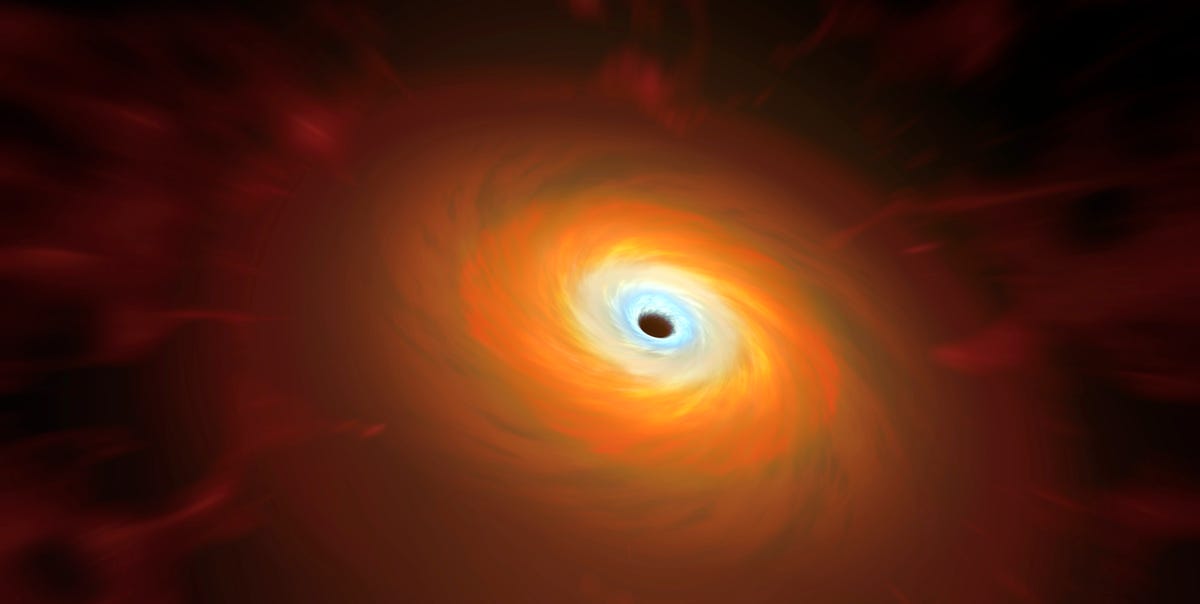
For decades, dark energy has been the universe’s most mysterious “something.” It is not a star, not a planet, not a cloud of gas, and definitely not the missing sock from your dryeralthough both are equally good at frustrating people. Dark energy is the name scientists give to the force or effect causing the universe to expand faster over time. It appears to make up roughly 68% to 70% of the cosmos, yet no one has been able to point to a cosmic object and say, “There it is. That’s the culprit.”
Now, a bold idea is gaining attention: supermassive black holes might not simply sit at the centers of galaxies like cosmic drainpipes. They might actually be connected to the expansion of the universe itselfand may even create or behave as dark energy. The theory is not fully proven, but recent studies involving black hole growth, galaxy evolution, and data from the Dark Energy Spectroscopic Instrument, or DESI, have made the idea much harder to ignore.
The phrase “new proof” should be handled carefully. In science, proof is not a movie-trailer explosion; it is a pile of evidence that survives repeated attacks from data, math, and skeptical experts with strong coffee. What researchers have found is observational evidence that black holes may grow in a way that ordinary feeding cannot explain. Even more intriguingly, that growth appears consistent with a concept called cosmological coupling, where black holes gain mass as the universe expands.
What Is Dark Energy, Really?
Dark energy is the label for whatever is driving the accelerated expansion of the universe. Astronomers discovered in the late 1990s that distant supernovae appeared dimmer than expected, meaning the expansion of space was speeding up instead of slowing down under gravity. That was a cosmic plot twist worthy of a dramatic orchestra sting.
In the standard model of cosmology, known as Lambda-CDM, dark energy is often represented by the cosmological constant, symbolized by Lambda. In simple terms, it behaves like an energy of empty space. As space expands, this energy does not thin out like matter does. Instead, it remains nearly constant, allowing its influence to dominate the universe over time.
The problem is that no one knows what dark energy physically is. It could be vacuum energy. It could be a dynamic field sometimes called quintessence. It could mean gravity behaves differently on cosmic scales. Or, if this new black hole idea is right, dark energy may be connected to the most extreme objects in the universe.
Why Supermassive Black Holes Entered the Conversation
Supermassive black holes are enormous objects found at the centers of most large galaxies. They can contain millions, billions, or even tens of billions of times the mass of the Sun. Our Milky Way has one called Sagittarius A*, weighing about four million solar masses. That sounds excessive, but in black hole terms, it is more “respectable city mayor” than “galactic emperor.”
Traditionally, black holes grow in two main ways: by swallowing gas and stars, or by merging with other black holes. This is the cosmic version of eating snacks and occasionally joining another snack enthusiast. However, researchers studying black holes in old elliptical galaxies found something puzzling. Some supermassive black holes appeared to have gained far more mass over billions of years than expected from ordinary accretion or mergers alone.
Elliptical galaxies are useful laboratories because many of them are old, quiet, and no longer forming many new stars. Their central black holes should not be feasting wildly. If those black holes still show strong mass growth across cosmic time, something else may be happening.
The Core Idea: Cosmological Coupling
Cosmological coupling is the idea that black holes may be linked to the expansion of the universe. In this model, a black hole’s mass can increase as space itself expands, even without swallowing nearby matter. That sounds strange because we usually imagine black holes as local objects: heavy, dark, and rude to anything crossing the event horizon. But general relativity allows local objects and the large-scale universe to interact in subtle ways, especially when the object is as extreme as a black hole.
The theory suggests that if black holes contain vacuum energy instead of a traditional singularity, they could contribute to cosmic acceleration. In other words, black holes may not hide an infinitely dense point at their center. They might contain a form of energy that behaves like dark energy. If enough black holes formed throughout cosmic history, their combined effect could help explain why the universe is expanding faster.
Why This Matters
This idea is exciting because it connects two of the biggest mysteries in physics: black hole interiors and dark energy. Instead of inventing a completely new cosmic ingredient, the universe may be using objects we already know exist. That is scientifically elegant. It is also slightly annoying, because it means the answer may have been lurking in the middle of galaxies all along, wearing a gravitational trench coat.
The Evidence: Black Holes Growing Too Much
One major clue came from studies comparing supermassive black holes in elliptical galaxies at different distances, which means different times in the universe’s history. Researchers found that black holes in more recent galaxies seemed much heavier relative to their host galaxies than black holes in earlier cosmic eras.
The growth was not small. Some analyses suggested that supermassive black holes could have increased in mass by factors of several over billions of years. Ordinary galaxy evolution may explain part of this, but the observed pattern looked difficult to fully account for with standard black hole feeding.
That is where cosmological coupling becomes interesting. If black hole mass grows with the scale factor of the universe, the observed growth begins to look less like an astrophysical accounting error and more like a possible signal. The data do not say, “case closed.” They say, “please investigate before we rewrite the textbooks in permanent marker.”
DESI and the New Dark Energy Twist
The Dark Energy Spectroscopic Instrument, installed on the Mayall Telescope in Arizona, is creating one of the largest three-dimensional maps of the universe ever made. It measures the positions and distances of millions of galaxies and quasars, helping scientists trace how the universe expanded over billions of years.
Recent DESI results have hinted that dark energy may not be perfectly constant. When DESI data are combined with other measurements, such as cosmic microwave background observations, supernova data, and weak gravitational lensing, models where dark energy changes over time appear to fit surprisingly well.
This matters for the black hole hypothesis because black hole formation is tied to star formation. Massive stars die and form black holes. Galaxies grow, stars form, stars collapse, and black holes accumulate. If black holes create or contain dark energy, then the dark energy density may naturally evolve with cosmic star formation history. That gives researchers a physical story rather than a mysterious number taped onto the universe.
A Cosmic Feedback Loop
Imagine the early universe as a busy kitchen. Stars form rapidly. Massive stars explode. Black holes appear. Over time, galaxies mature, star formation slows, and the population of black holes changes. If black holes are cosmologically coupled, then their effect on cosmic expansion could also change. DESI’s hints of evolving dark energy make this idea more compelling because the black hole model predicts a dark energy history tied to real astrophysical events.
Does This Mean Black Holes Are Literally Making Dark Energy?
Maybebut “literally” is doing a lot of work here. The hypothesis does not mean black holes spray dark energy into space like a garden hose with a PhD. Instead, it suggests that black holes may contain vacuum energy or behave in a way that contributes to the universe’s overall energy budget. Their interiors may produce negative pressure, the key feature needed to drive accelerated expansion.
In Einstein’s general relativity, pressure matters. Positive pressure usually helps gravity pull things together. Negative pressure can have the opposite large-scale effect, pushing cosmic expansion to accelerate. Dark energy is often described as having negative pressure. If black hole interiors create that kind of pressure, then black holes could be part of the dark energy puzzle.
The idea also challenges the traditional singularity. A singularity is where density becomes infinite and physics waves a tiny white flag. Many physicists already suspect singularities are signs that our current theories are incomplete. A black hole interior filled with vacuum energy could avoid the singularity problem while also helping explain dark energy. That is a two-for-one deal, and cosmologists love a discount.
Why Scientists Are Still Cautious
This theory is fascinating, but it is not yet the final answer. Several questions remain open. Are the black hole mass measurements accurate enough? Could selection effects make distant black holes look lighter or heavier than they really are? Can ordinary accretion and mergers explain more of the growth than currently estimated? Do stellar-mass black holes in binary systems follow the same pattern? Would cosmologically coupled black holes leave detectable fingerprints in gravitational waves?
Some studies have raised constraints using systems such as Gaia black hole binaries. If black holes grew strongly with cosmic expansion, their earlier masses might have been unusually small, potentially creating tension with standard stellar evolution models. Other theoretical work suggests that not every type of black hole would couple strongly enough to explain dark energy. In short, the universe has not handed over a signed confession.
That skepticism is healthy. Science advances when exciting ideas are forced to survive boring details. The black hole dark energy hypothesis must fit galaxy data, stellar evolution, gravitational wave observations, cosmic microwave background measurements, and DESI’s large-scale structure results. That is a difficult obstacle course, but it is also what makes the idea testable.
Specific Examples That Make the Theory Testable
1. Elliptical Galaxies
Old elliptical galaxies are key because they have relatively little new star formation. If their central supermassive black holes grow dramatically after the galaxy becomes quiet, researchers need an explanation. Cosmological coupling offers one possible mechanism.
2. Gravitational Waves
When black holes merge, they create gravitational waves. Observatories such as LIGO, Virgo, and KAGRA detect these ripples in spacetime. If black holes gain mass through cosmic expansion, their merger populations may show unusual mass trends across redshift. Future gravitational wave observatories could test this.
3. DESI’s Cosmic Map
DESI measures baryon acoustic oscillations, which are ancient sound-wave patterns frozen into the distribution of galaxies. These patterns act like a cosmic ruler. If dark energy evolves over time, DESI can help reveal that history. If the evolution matches black hole formation history, the black hole hypothesis becomes stronger.
4. The Hubble Tension
The Hubble tension is the disagreement between measurements of the universe’s expansion rate from the early universe and the nearby universe. Some models involving cosmologically coupled black holes may ease this tension. That does not prove the model, but it gives researchers another reason to investigate it carefully.
What This Could Change About Cosmology
If supermassive black holes help create dark energy, cosmology would change dramatically. Dark energy would no longer be a mysterious background property floating without explanation. It would be linked to the life cycle of stars and galaxies. The deaths of massive stars would not merely produce black holes; they could contribute to the engine of cosmic acceleration.
This would also reshape our understanding of black holes. Instead of being mathematical dead ends with singularities, black holes might be physical objects with interiors described by vacuum energy. Their event horizons would still trap light, but their role in the universe would be more creative than destructive. They would not just end stories. They might help write the biggest one.
It would also create a bridge between astrophysics and fundamental physics. Galaxy surveys, gravitational wave detections, supernova observations, and black hole theory would all become pieces of one connected puzzle. That is the kind of scientific convergence researchers dream aboutpreferably after the data behave and the error bars stop throwing tantrums.
Experience-Based Reflection: Why This Idea Feels So Powerful
For anyone who has followed astronomy for years, the black hole dark energy hypothesis feels different from many cosmic headlines. Some space stories are spectacular because they show us a beautiful image: a glowing nebula, a spiral galaxy, a star nursery glittering like powdered sugar on black velvet. This story is powerful because it changes how we think. It asks us to imagine that the darkest objects in the universe may be connected to the force pushing everything apart.
Think about the experience of standing outside on a clear night. You look up and see stars that seem fixed, calm, and almost decorative. But the sky is not still. Every galaxy beyond our local neighborhood is participating in the expansion of space. The universe is stretching on scales too large for the human mind to comfortably hold. Meanwhile, at the centers of galaxies, supermassive black holes sit quietly, unseen unless gas, stars, or light reveal their presence. They look like local monsters, but this research suggests they may have a cosmic job description.
That shift is emotionally striking. Black holes have long been treated as symbols of endings. They consume. They trap. They erase information, or at least appear to. They are the universe’s most dramatic “do not enter” signs. Dark energy, on the other hand, is the symbol of expansion, distance, and cosmic future. Connecting the two feels almost poetic: the objects we associate with collapse may help explain acceleration.
For students, writers, science fans, and curious readers, this topic is a reminder that science is not a warehouse of completed facts. It is a living argument with evidence. One year, black holes are mostly discussed as gravitational traps. Another year, they become candidates for solving the dark energy mystery. The facts do not become meaningless; they become deeper. That is part of the joy of cosmology. Every answer opens a door, and behind the door is usually another door, a chalkboard, and someone saying, “Actually, it’s more complicated.”
The best way to experience this discovery is not to treat it as a final verdict but as an invitation. Follow DESI results. Watch for new gravitational wave catalogs. Pay attention to how scientists measure black hole masses in distant galaxies. Notice how often cautious language appears: “may,” “could,” “consistent with,” “if confirmed.” Those words are not weakness. They are the grammar of honest science.
Personally, the most fascinating part of this topic is how it changes the emotional shape of the universe. A cosmos driven by an unexplained constant can feel abstract. A cosmos whose acceleration may be connected to black holes feels almost biological, as if the universe has a metabolism: stars are born, stars die, black holes form, and space itself responds. That does not make the theory true by itself, but it makes the search unforgettable.
Conclusion
The idea that supermassive black holes might create dark energy is one of the most daring possibilities in modern astrophysics. It brings together black hole growth, vacuum energy, galaxy evolution, DESI’s cosmic map, and the long-standing mystery of why the universe is expanding faster. The evidence is intriguing, especially because some black holes appear to grow more than standard feeding models predict, and recent dark energy data may favor an evolving cosmic influence.
Still, this is not a finished story. Scientists need stronger measurements, better models, and independent tests. The hypothesis must survive scrutiny from galaxy surveys, gravitational wave astronomy, stellar-mass black hole observations, and theoretical physics. If it does, the reward could be enormous: dark energy may not be an exotic unknown substance after all. It may be tied to black holesthe very objects we once thought of as cosmic endings.
That would be a spectacular twist. The universe, apparently, enjoys irony on a scale of billions of light-years.
Note: This article synthesizes current scientific understanding and recent research trends available as of May 2026. The black-hole dark-energy connection remains an active hypothesis, not a settled scientific conclusion.