Note: This article is written as an evergreen, publish-ready piece inspired by the original NextWorld Capital and SaaStr event announcement. The “Tuesday” referenced in the title comes from the original event context, while the business lessons remain highly relevant for SaaS founders, operators, investors, and revenue leaders today.
Why NextWorld’s 1 to 100 in ARR Event Still Matters
In the software world, going from $1 million to $100 million in annual recurring revenue sounds beautifully simple when written on a conference slide. It is just two numbers, one arrow, and a lot of optimism. In real life, of course, that arrow contains pricing mistakes, hiring drama, product pivots, customer calls, board meetings, late-night spreadsheet therapy, and at least one moment when someone says, “Maybe we should just add AI to the homepage.”
That is exactly why an event like NextWorld’s 1 to 100 is so valuable. It focuses on the part of the startup journey that separates promising software companies from durable businesses. Many SaaS startups can find early traction. A smaller group can turn that traction into a repeatable go-to-market motion. A much smaller group can scale sales, customer success, product, finance, and leadership without turning the company into a very expensive group project with snacks.
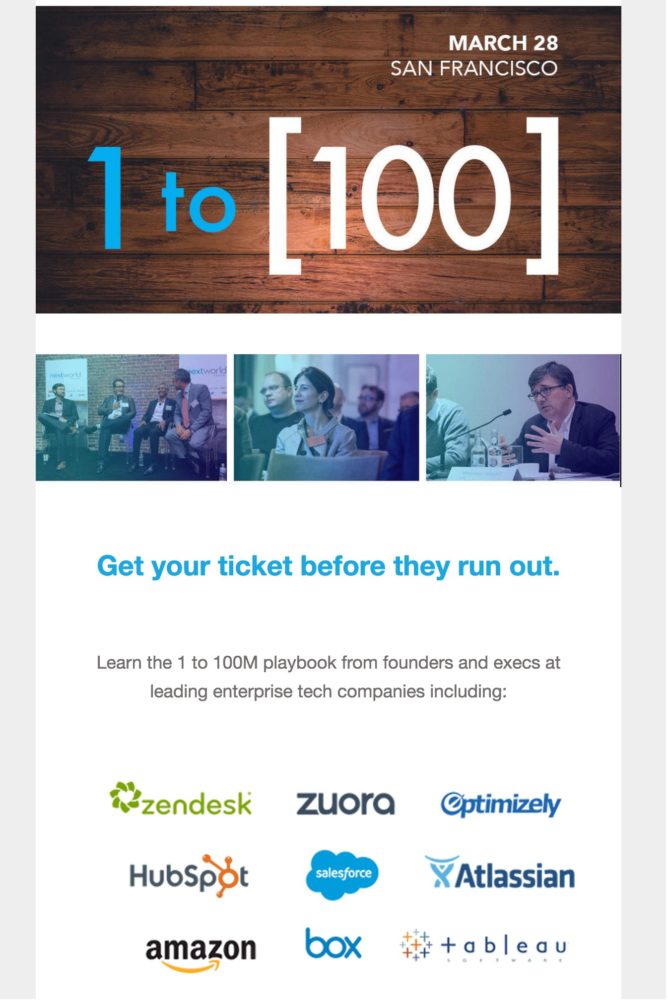
The original event brought together a lineup of enterprise software leaders and operators connected to companies such as MuleSoft, Zuora, Box, RingCentral, and others. That mix matters because the path to $100 million ARR is not a theory exercise. It is built by leaders who have fought through enterprise sales cycles, customer churn, pricing resets, product complexity, international expansion, and the daily challenge of making growth look calmer than it feels.
What “1 to 100 in ARR” Really Means
Annual recurring revenue, or ARR, is one of the most important metrics in SaaS because it measures predictable subscription revenue over a year. Put simply, ARR helps founders, executives, and investors understand how much revenue is expected to repeat. That makes it useful for forecasting, valuation conversations, hiring plans, sales capacity modeling, and deciding whether the company is growing like a rocket ship or merely wearing a rocket ship costume.
But ARR is not magic. A company can have ARR and still have weak retention. It can grow quickly and still burn too much cash. It can close impressive enterprise deals and still struggle with implementation. The journey from $1 million to $100 million ARR is really the journey from “we found something customers will pay for” to “we built a company that can repeatedly sell, deliver, renew, expand, and innovate.”
The $1 Million ARR Stage: Proof, Not Perfection
At around $1 million ARR, a SaaS company usually has evidence of demand. Customers are paying. The product solves a problem. The founding team has probably learned which buyers care, which features matter, and which sales promises should never again be made without asking engineering first.
Still, this stage is often fragile. Sales may depend heavily on the founder. Onboarding may be manual. Customer success may be handled by whoever answers Slack the fastest. Pricing might be more art than science. The goal is not to pretend everything is mature. The goal is to identify what is repeatable.
The $10 Million ARR Stage: Process Enters the Chat
By $10 million ARR, the business needs stronger systems. Sales teams require defined territories, clearer quotas, better enablement, and a reliable pipeline engine. Marketing must move beyond “we published three blog posts and hoped for the best.” Customer success has to protect renewals and expansion. Finance needs sharper visibility into burn, runway, gross margin, and hiring pace.
This is where many SaaS companies hit a wall. What worked through founder hustle does not automatically work through organizational scale. The product roadmap gets crowded. Customers become more demanding. Competitors start noticing. Internal communication becomes harder. The company needs leadership, not just energy.
The $100 Million ARR Stage: Durability Becomes the Game
At $100 million ARR, a company has crossed into rare territory. It is no longer enough to grow; the business must grow responsibly. Leaders must balance new customer acquisition with retention, product expansion, operational efficiency, compliance, security, brand trust, and long-term market positioning.
This is why the “1 to 100” theme is so powerful. It is not just about revenue. It is about transformation. A $1 million ARR company is often a tight group of believers. A $100 million ARR company needs to become an institution without losing the urgency that made it special in the first place.
Why Founder-Led Sales Cannot Carry the Whole Journey
Founder-led sales is one of the most effective early-stage advantages. Founders know the product, the pain, the story, and the customer better than anyone. They can bend the roadmap in real time, build trust with early buyers, and close deals that a normal salesperson might not touch with a 30-slide pitch deck.
But founder-led sales has a ceiling. If every important deal requires the founder, the company does not have a sales motion; it has a very busy founder. To scale, the business must turn instinct into process. That means documenting the ideal customer profile, defining qualification criteria, creating repeatable discovery questions, building proof points, and training account executives to sell value without accidentally promising a feature scheduled for “someday, maybe, please do not ask engineering.”
Events like NextWorld’s 1 to 100 help founders understand when to professionalize the revenue engine. That includes hiring the right VP of Sales at the right time, building sales operations, aligning marketing with pipeline, and creating compensation plans that reward healthy growth rather than heroic chaos.
The Real Role of Customer Success in ARR Growth
ARR growth is not only about signing new customers. It is also about keeping and expanding the customers you already won. In SaaS, churn is the sneaky villain. It does not always arrive with dramatic music. Sometimes it appears quietly through low adoption, poor onboarding, weak executive alignment, or a customer who says, “We love the product,” right before canceling.
Customer success becomes a major growth engine as a SaaS company scales. At first, customer success may focus on support and onboarding. Later, it must become more strategic: driving adoption, mapping customer outcomes, identifying expansion opportunities, reducing risk, and feeding product insights back into the roadmap.
The best SaaS companies treat customer success as a revenue function, not a help desk with friendlier fonts. They measure gross revenue retention, net revenue retention, product usage, health scores, expansion pipeline, and time to value. They know that a happy customer is good, but a successful customer with measurable outcomes is much better.
Go-to-Market Lessons Founders Should Listen For
A strong go-to-market strategy is not a slogan. It is the operating system for how a company finds, wins, and grows customers. For SaaS companies moving from $1 million to $100 million ARR, the go-to-market motion often changes several times.
1. Know Your Ideal Customer Profile
Early revenue can be misleading. A startup may close customers across multiple industries, company sizes, and use cases. That feels exciting until the team realizes every segment needs different messaging, onboarding, integrations, support, and product features. A tight ideal customer profile helps the company focus its sales and product energy where it has the strongest chance to win.
2. Build Pricing That Matches Value
Pricing is one of the most powerful growth levers in SaaS, yet many startups treat it like a menu designed five minutes before dinner. As companies scale, pricing needs to reflect customer value, expansion potential, packaging clarity, and sales simplicity. The right pricing model can improve revenue growth, customer fit, and retention. The wrong one can turn every sales call into a philosophical debate with procurement.
3. Align Sales, Marketing, Product, and Success
At scale, departments cannot operate like separate islands connected only by calendar invites. Marketing must attract the right audience. Sales must close the right customers. Product must build for the right use cases. Customer success must make sure those customers achieve the right outcomes. When these teams align, ARR compounds. When they do not, the company develops a very polished way to waste money.
What Makes Enterprise Software Scaling Different?
Enterprise software has its own personality. It is powerful, lucrative, complex, and occasionally allergic to speed. Large customers bring larger contracts, but they also bring security reviews, legal negotiations, procurement steps, implementation requirements, integrations, stakeholder committees, and decision cycles long enough to make everyone check whether the original champion still works there.
That is why enterprise SaaS companies need more than a clever product. They need credibility. They need reference customers. They need security, compliance, professional services, customer success, executive sponsorship, and a roadmap that can support bigger deployments without collapsing under custom requests.
The presence of leaders from major enterprise software companies at a 1 to 100 ARR event is valuable because enterprise scale is learned through scars. The best advice usually comes from operators who have lived through the awkward middle: too big to improvise, too small to move slowly, and too ambitious to coast.
ARR Growth in the AI Era
Today’s SaaS landscape is different from the 2017 environment that shaped the original event. AI has changed product expectations, development cycles, pricing models, and investor narratives. Some AI-native companies are reaching major revenue milestones faster than classic SaaS companies did, while others are discovering that usage-based costs can make gross margins more complicated than expected.
Still, the core questions remain familiar. Are customers getting measurable value? Is revenue repeatable? Can the company retain and expand accounts? Does the product create a durable advantage? Can the team scale without burning capital irresponsibly? AI may change the speed and shape of the journey, but it does not remove the need for disciplined execution.
For founders attending or studying events like NextWorld’s 1 to 100, the best approach is to combine ambition with realism. Fast growth is wonderful. Efficient, durable growth is better. The goal is not simply to sprint toward $100 million ARR; it is to build a company strong enough to deserve it.
What Attendees Should Take Away
The best startup events do not leave attendees with a notebook full of motivational fog. They create clarity. A founder should leave thinking, “Here are the three things we need to fix next quarter.” A revenue leader should leave with sharper questions about pipeline quality, sales productivity, and expansion motion. A product leader should leave thinking about customer value, roadmap discipline, and the dangers of building every feature requested by the loudest account.
For a 1 to 100 ARR event, the most valuable takeaways are practical. What breaks at each stage? When should you hire senior leaders? How do you avoid scaling a broken sales motion? What metrics should the board actually care about? How do you maintain culture while adding layers of management? How do you move upmarket without abandoning smaller customers too soon?
These questions are not glamorous, but they are the questions that build enduring software companies. Startups do not fail because they lack inspirational quotes. They fail because the market is harder than expected, the team scales unevenly, retention weakens, acquisition costs rise, or the product does not stay essential. The right event helps leaders see those risks before they become expensive surprises.
Experience Notes: What a 1 to 100 ARR Event Feels Like
Attending a serious SaaS growth event feels different from scrolling through startup advice online. Online, every lesson arrives polished, compressed, and suspiciously confident. In the room, the advice has texture. You hear the pause before a CEO admits a hiring mistake. You notice which metrics make investors lean forward. You see founders quietly taking notes when someone explains why their first sales team failed. That is where the real learning happens.
The first experience that stands out at an ARR-focused event is the energy. Everyone is ambitious, but not everyone is at the same stage. One founder may be trying to reach $1 million ARR. Another is fighting churn at $8 million. A VP of Sales may be rebuilding pipeline after a rough quarter. An investor may be looking for companies with strong retention and efficient growth. That mix creates practical conversations because nobody is speaking from a textbook. They are speaking from pressure.
The second experience is realizing that growth problems are often similar across companies, even when the products are completely different. A cybersecurity startup, a workflow automation platform, and a customer data company may sell to different buyers, but they can all struggle with pricing, onboarding, sales handoffs, product adoption, and expansion. This is oddly comforting. It reminds founders that scaling pain does not mean they are uniquely doomed. It means they are building something complex.
The third experience is the value of hallway conversations. Panels are useful, but the best insight sometimes comes while standing near the coffee, pretending not to eat a second pastry. Someone might share how they changed their sales qualification process. Another person might explain why they stopped chasing small accounts. A customer success leader might describe the moment they realized adoption metrics mattered more than cheerful check-in calls. These small details often become more useful than the headline session.
The fourth experience is humility. Events about scaling to $100 million ARR can sound glamorous from the outside. In person, the message is usually more grounded: growth is hard, timing matters, hiring is risky, customers are demanding, and the company you need at $30 million ARR may look very different from the company that got you to $3 million. That is not discouraging. It is clarifying.
Finally, a great ARR event gives attendees a better sense of sequence. Founders often want to solve every problem at once: brand, sales, product, hiring, pricing, partnerships, international expansion, and maybe a podcast because apparently everyone has one now. The better lesson is prioritization. At each stage, only a few constraints matter most. The trick is identifying them early enough to act.
That is the lasting value of NextWorld’s 1 to 100 theme. It does not celebrate scale as a vanity milestone. It treats scale as a discipline. For anyone building, operating, funding, or advising a SaaS company, that discipline is worth studying carefully.
Conclusion
NextWorld’s 1 to 100 in ARR event is more than a gathering for SaaS insiders. It represents one of the most important conversations in enterprise software: how promising companies become enduring ones. The path from $1 million to $100 million ARR requires more than a great product or a charismatic founder. It takes repeatable sales, strong retention, smart pricing, disciplined hiring, customer success, operational focus, and leadership that can evolve as quickly as the business.
For founders and operators, the message is clear. Do not worship ARR as a vanity number. Understand what creates it, what protects it, and what makes it compound. The best SaaS companies are not built by chasing every trend. They are built by solving urgent customer problems, learning faster than competitors, and scaling systems before chaos becomes company culture.
So yes, see you at NextWorld’s 1 to 100 event. Bring questions, bring curiosity, and maybe bring a comfortable pair of shoes. The road to $100 million ARR is long, but the right lessons can make it a little less mysteriousand a lot more achievable.