Faculty Department sounds like a university office where someone might ask you to submit Form 17-B before touching the stapler. In reality, it is something far more inviting: photographer Justin Chung’s ongoing study of creative people, meaningful spaces, daily rituals, and thoughtfully constructed lives.
Through intimate portraits, environmental photography, interviews, printed books, films, and online stories, Chung documents artists, designers, chefs, architects, craftspeople, educators, entrepreneurs, and other independent thinkers. His subjects are not presented as untouchable geniuses standing beneath dramatic spotlights. They are shown at work, at home, making coffee, arranging tools, walking through gardens, speaking about uncertainty, and doing the quiet things that make a creative life possible.
What Is Faculty Department?
Faculty Department is an independent photography and editorial project founded by Justin Chung in 2014. It began as a collection of personal visits with people whose work, values, and lifestyles influenced him. Over time, the project developed into a broader journal exploring the lives, spaces, and stories of visionary individuals around the world.
The name is deliberately academic. Chung once followed a pre-medical path, and the discipline of research remained with him after he moved into photography. Rather than treating “faculty” as university employees, he uses the word to describe a personal community of teachers. A furniture designer, chef, artist, surfboard maker, or neighborhood shop owner can become part of this informal faculty by demonstrating a meaningful way to work and live.
This concept gives the project its unusual warmth. Faculty Department is not a directory of famous names or a catalog of expensive interiors. It is closer to an independent school without classrooms, exams, or parking permits. Each profile becomes a lesson, while every photograph asks readers to notice how a person’s environment reflects what that person values.
Justin Chung’s Path from Medicine to Photography
Justin Chung is a Los Angeles-based lifestyle and portrait photographer whose work centers on people, the things they build, and the places that shape their memories. His professional portfolio spans portraiture, interiors, landscape, editorial assignments, and commercial campaigns. His client history includes major technology, hospitality, fashion, retail, and media organizations, but Faculty Department remains the clearest expression of his personal interests.
Photography was not initially the obvious career choice. Chung studied on a pre-med track and later completed graduate work connected to public health. During that period, he explored how photography could communicate health concerns through visual essays. The experience helped him recognize that a camera could be more than a hobby or decorative device; it could be a tool for listening, researching, and translating lived experience.
After photographing weddings and developing his portfolio, Chung faced the cheerful little crisis familiar to many creative professionals: continue along a predictable path or jump into a career with no reliable instruction manual. In 2011, he moved to New York and immersed himself in fashion, editorial photography, and portraiture. Collaborating with stylists, designers, and editors gradually helped him establish his visual voice.
His medical and research background did not disappear. Instead, it became part of his photographic method. He observes carefully, prepares thoroughly, studies his subjects, and looks for relationships between personal history, physical space, and everyday behavior. The diagnosis changed; the curiosity stayed.
The Origins of Faculty Department
The earliest Faculty Department stories grew from Chung’s studio visits and encounters with people he admired. He photographed artists, furniture makers, designers, and other independent creatives, then shared the memories and observations with Studio Faculty, the Vancouver design practice that developed the publication’s visual identity.
During the branding process, Chung repeatedly described these individuals as his faculty: people from whom he had learned practical, artistic, or philosophical lessons. That idea became the organizing principle for the entire publication. The project would borrow the seriousness of academic research without becoming stiff, cold, or buried beneath a mountain of footnotes wearing tiny glasses.
Faculty Department therefore operates as both documentation and gratitude. Chung is not simply collecting attractive homes or photogenic workshops. He is acknowledging the people who have expanded his understanding of craftsmanship, independence, family, discipline, and purpose.
A Photographic Style Built on Calm Observation
Natural Moments Instead of Heavy Staging
Chung’s images are frequently described as warm, intimate, calm, and human-centered. He favors natural gestures, available atmosphere, lived-in objects, and environments that reveal something about their occupants. Rather than forcing every subject into an elaborate concept, he often allows events to unfold and stays ready for the small moment that explains the larger story.
A pair of worn shoes by a door may communicate years of routine. A crowded workbench can reveal experimentation more honestly than a formal portrait. A kitchen table, stack of records, garden path, or half-finished object can become evidence of how someone organizes attention.
Portraits, Interiors, and Landscapes Working Together
Faculty Department stories blend portrait photography with interiors, still life, landscape, and observational details. This mixture allows readers to understand a subject through context rather than appearance alone. The person matters, but so do the room, the tools, the neighborhood, and the light arriving through the window.
This approach gives each story the feeling of a quiet visit. Readers are not merely shown what a creative individual looks like. They are invited to imagine what it feels like to spend an afternoon in that person’s world.
Faculty Department Volume 1: Establishing the Classroom
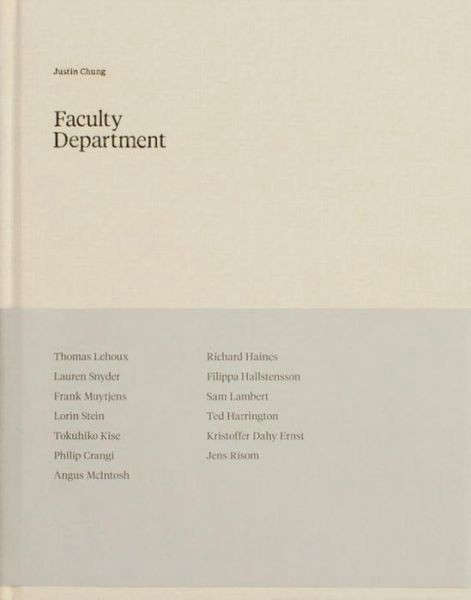
The first Faculty Department book was published in 2014. It offered glimpses into the lives of noteworthy individuals while they worked, moved through their homes, followed daily routines, or paused during reflective moments. The publication was designed by Studio Faculty and printed by Oddi Printing in Iceland.
Its physical design reinforced the project’s academic metaphor. Studio Faculty tested numerous dimensions before settling on a size resembling a comfortable textbook. The finished volume contained 265 pages and used a two-column editorial structure intended to preserve readability. Tiempos, a contemporary serif typeface with familiar literary qualities, helped establish a sincere and scholarly tone.
The paper choice mattered as well. An uncoated, naturally warm stock gave the photographs a tactile quality and prevented the publication from feeling like a glossy advertising catalog. The book could sit on a coffee table, but it also invited focused reading rather than decorative ownership.
Volume 1 included designers, makers, and cultural figures such as furniture designer Jens Risom, jewelry designer Philip Crangi, Tokuhiko Kise of TRUCK Furniture, and Sam Lambert of Art Comes First. These subjects reflected the publication’s broad definition of education: knowledge can be found in a workshop, clothing studio, design office, or conversation at home.
Volume 2 and the Idea of Simple Living with Purpose
Faculty Department Volume 2 arrived in 2019 after roughly five years of additional travel, photography, interviews, editing, and production. The second book expanded to 372 pages, 578 photographs, and 23 stories. It was Smyth-sewn, printed in Italy, and produced in a larger format than its predecessor.
The unifying theme was “simple living with purpose.” This did not mean presenting spotless houses containing one heroic wooden stool and absolutely nowhere to charge a phone. Simplicity, in this context, meant clarity: understanding what deserves attention and building a life around it.
Chung has connected the theme to his time with Japanese chef Shoichiro Aiba, who was balancing restaurant work, family life, cooking, and the creation of a country home. Observing how Aiba approached fatherhood and daily living helped Chung identify a philosophy running through many of the stories.
Volume 2 featured people across a wide range of disciplines, including educator Esteban del Río, Canyon Coffee founders Ally Walsh and Casey Wojtalewicz, Le Labo executive Deborah Royer, architect Harry Gesner, designer Evan Kinori, surfboard maker Guy Okazaki, and Cereal founders Rosa Park and Rich Stapleton.
The design also matured. More photographs were allocated to each chapter, while a flexible grid created numerous layout variations. Additional sans serif typefaces introduced an industrial, old-textbook character without abandoning the literary tone established by Tiempos. Even the green cover cloth drew inspiration from moss-covered trees photographed in Inverness, California.
Why the Book Design Is Part of the Story
Faculty Department demonstrates that editorial design is not packaging applied after the “real” work is finished. Typography, paper, sequencing, binding, captions, scale, and negative space influence how readers understand every photograph.
A small image surrounded by empty space may create stillness. A dense sequence of workshop details can reproduce the energy of a working environment. A portrait placed opposite a handwritten object, weathered wall, or landscape can connect a person to a larger personal history.
The books were created through extensive collaboration among Chung, Studio Faculty, editors, writers, printers, and production partners. The process included image selection, sequencing, physical proofs, press checks, and repeated layout refinement. In other words, the apparent simplicity required an impressive amount of complicated work, which is also a useful definition of good design.
Faculty Department Beyond the Printed Volumes
Faculty Department has grown beyond its original book format into an ongoing collaborative journal. Its website publishes interviews, photographs, films, studio visits, and personal profiles across diverse disciplines and communities. The project now involves an editorial team, designers, developers, and contributing writers while maintaining Chung’s central interest in meaningful conversations and creative processes.
Recent profiles demonstrate how flexible the concept has become. A visit with Berkeley artist Jereme Brian Mendez connects painting with cultural heritage, emotional processing, skateboarding, interior design, and the Bay Area landscape. Other stories examine writers, cooks, musicians, craftspeople, naturalists, and independent business owners.
The project also expanded through Making Sense Vol. 1, a collaboration with Le Labo. Published in 2024, the book gathered 12 California-connected stories about people who had intentionally constructed lives of their own making. Its production continued the Faculty Department emphasis on thoughtful materials, archival references, and subjects taking priority over obvious product placement.
Why Faculty Department Matters in a Fast Digital Culture
Much contemporary visual media is designed to be consumed in seconds. Faculty Department moves in the opposite direction. It asks readers to stay with a room, study a face, read a conversation, and consider how a life was assembled over many years.
The project also challenges the simplified version of creativity often presented online. A finished chair, restaurant, painting, clothing label, or photograph may look effortless on a screen. Chung’s stories reveal the routines, relationships, compromises, experiments, and accumulated knowledge behind the finished object.
That makes Faculty Department valuable for photographers, designers, writers, and entrepreneurs who are tired of advice that sounds like it was printed on a motivational water bottle. The project rarely offers a universal formula. Instead, it presents different models of meaningful work and allows readers to decide what applies to their own lives.
Lessons Creative Professionals Can Learn from Justin Chung
Curiosity Can Be a Sustainable Creative Direction
Chung built the project around genuine questions: How do people structure their days? What makes a workspace useful? How does family affect creative practice? Why do certain objects remain important? Curiosity provides continuity even when subjects, locations, and occupations change.
Personal Work Can Strengthen Professional Work
Faculty Department exists outside the usual boundaries of a commercial assignment, yet its observational style has helped define Chung’s broader photographic identity. Personal projects can become laboratories where creative professionals develop methods that later influence commissioned work.
Trust Produces Better Stories Than Control
By minimizing unnecessary staging, Chung gives people room to behave naturally. This requires patience and confidence. It also produces images that feel collaborative rather than extracted.
Quality Is Usually a Collection of Small Decisions
The books’ paper, binding, typography, sequencing, interviews, captions, printing, and photography all support the same purpose. No single decision performs a magic trick. Together, however, they create an object that feels considered from beginning to end.
The Faculty Department Experience: Spending Time with the Project
Opening Faculty Department is different from scrolling through a conventional photography feed. A social platform encourages speed: glance, react, continue, forget. The book encourages a slower rhythm. You notice the weight of the cover, the texture of the paper, and the way one image prepares you for the next. Before long, you are studying a shelf, chair, kitchen counter, coat hook, or collection of tools as though it might contain the answer to a surprisingly important question.
The most rewarding experience is the feeling of entering someone’s environment without becoming an intruder. Chung’s photographs often create the impression that the subject has briefly stepped aside and allowed the reader to look around. A workshop remains slightly messy. A table is still being used. Clothing has creases. Plants do not appear to have received emergency styling five minutes before the camera arrived.
For a photographer, the project can become an exercise in visual attention. Instead of looking only for the obvious portrait, you begin considering how secondary details build character. Which objects are repeatedly handled? Where does the subject pause? What does the morning light reveal? How does a person move between private and professional spaces? The experience may change how you approach your next portrait session, even when your available location is less “quiet Japanese studio” and more “conference room beside a humming vending machine.”
Designers may respond differently. They can study how editorial pacing, typography, margins, image scale, and paper work together. The pages show that restraint does not require sameness. A publication can be calm without becoming monotonous, and sophisticated without behaving as if smiling were against company policy.
Writers may notice how the interviews respect specific lives rather than forcing every subject into the same inspirational storyline. One person may emphasize repetition, another independence, another family, and another the value of remaining connected to a place. The lack of a single formula becomes the lesson. Meaningful work can be constructed in many ways.
For readers outside the creative industries, Faculty Department can still function as a practical reflection on daily living. Its subjects often demonstrate that purpose is expressed through routines rather than declarations. Cooking for family, maintaining tools, teaching students, walking through a neighborhood, arranging a studio, or protecting time for focused work can reveal more than a polished personal mission statement.
The experience may also produce a mild and generally harmless urge to reorganize your desk, buy a beautifully made notebook, or stare thoughtfully through a window. More importantly, it encourages honest questions. Which parts of your day feel intentional? Which objects support your work? Who belongs to your personal faculty? What have you learned from people whose names will never appear in a business textbook?
That final question captures the enduring appeal of Justin Chung’s project. Faculty Department is not primarily about admiring other people’s homes, careers, or possessions. It is about recognizing knowledge in ordinary settings and understanding that a life can teach through its shape. The photographs are beautiful, but their deeper purpose is educational: they help readers observe how values become visible.
Conclusion
Faculty Department has evolved from Justin Chung’s personal collection of studio visits into a distinctive visual journal, independent publishing project, and international archive of creative life. Its success comes from a clear combination of curiosity, patient photography, thoughtful interviews, and meticulous book design.
Chung treats artists, makers, teachers, chefs, designers, and entrepreneurs as members of a living faculty. Their classrooms are homes, kitchens, workshops, offices, coastlines, gardens, and city streets. Their lessons concern patience, purpose, craftsmanship, relationships, and the difficult art of deciding what deserves attention.
In an online culture crowded with instant advice and carefully manufactured perfection, Faculty Department offers something quieter and more durable: the opportunity to look closely, listen carefully, and learn from the way another person lives.
Note: This independent editorial overview is based on publicly available information about Justin Chung and Faculty Department. Publication details, pricing, availability, and project features may change over time.