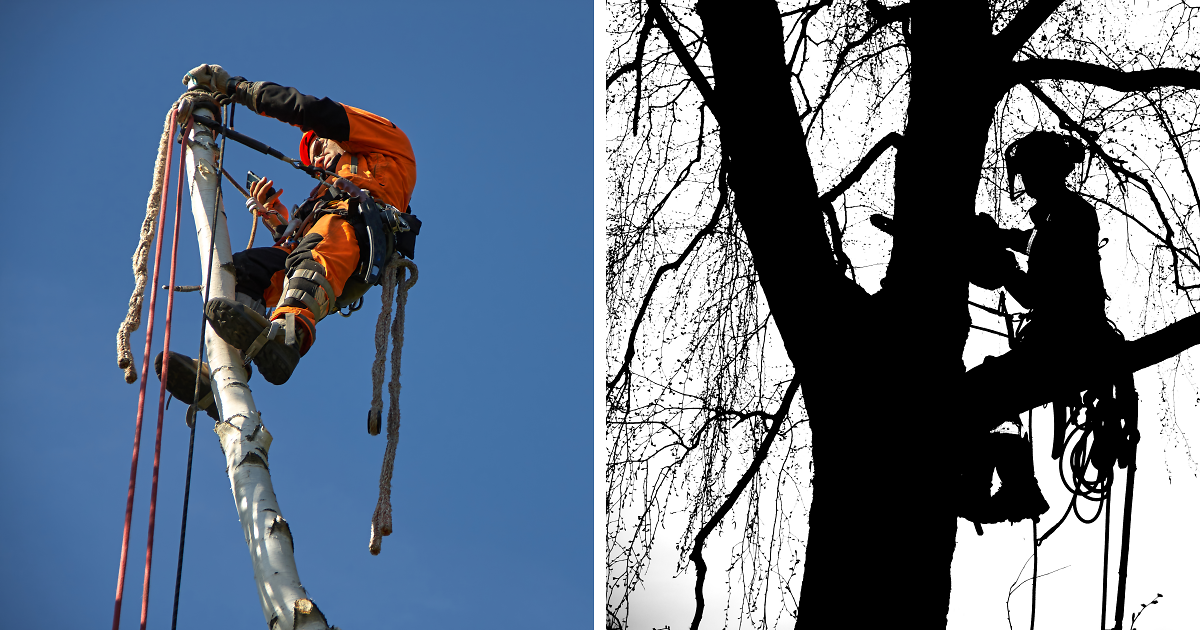
Most people carry coffee, keys, and perhaps a slightly optimistic lunch to work. Rope access technician and photographer Evgeniy Lapshin sometimes adds a camera to the listalong with ropes, carabiners, a helmet, a harness, and enough specialized equipment to make an ordinary backpack file a formal complaint.
His collection of 21 workplace photographs opens a window into a profession normally observed from far below. The images feature tree surgeons suspended among branches, the careful removal of a birch tree’s upper sections, workers installing a flag at a sports stadium, and quieter details discovered during jobs at height. Instead of photographing the finished result from the sidewalk, Lapshin records the people, equipment, textures, and strange perspectives found inside the work itself.
The result is part occupational photography, part visual diary, and part reminder that somebody has to climb up there when a tree, tower, facade, or stadium structure needs attention. These photographs make rope access look dramatic, but they also reveal something more important: behind every impressive view is a carefully planned system designed to keep a difficult job under control.
A Workplace Most People Never See
Rope access photography is unusual because the photographer is not merely visiting a dramatic location. He is already part of the crew. He understands where workers can safely position themselves, how a rope may move under load, why a branch is being removed in sections, and when a moment is worth recording without interrupting the task.
That insider position changes the photographs. A person hanging high in a tree is not presented as a stunt performer. He is a skilled worker solving a practical problem. The ropes are not decorative lines added to make the scene look adventurous. They are the transportation system, workstation, and safety infrastructure.
From the ground, tree work can appear surprisingly simple: somebody climbs, a chainsaw starts, and branches come down. Up close, the process is a moving puzzle. The climber must manage ropes, identify reliable attachment points, control tools, communicate with the ground crew, anticipate how cut wood will move, and protect buildings, vehicles, landscaping, and people below. Gravity, meanwhile, remains the strictest supervisor on the payroll.
Tree Surgeons in Their Vertical Office
Many photographs in the series focus on tree surgeons, also known as climbing arborists. Their office has no desk, no elevator, and an alarming shortage of level floors. Instead, their working environment consists of trunks, limbs, climbing lines, positioning lanyards, rigging systems, and constantly changing weight distribution.
A skilled arborist does more than climb and cut. Before leaving the ground, the crew assesses the tree, surrounding hazards, weather, escape routes, electrical exposure, drop zones, and the condition of potential tie-in points. The climber may prune damaged limbs, reduce a crown, inspect structural defects, install support systems, or dismantle a tree that cannot safely be felled in one piece.
Lapshin’s photographs capture the physical side of this work, but they also show its precision. Workers appear framed against open sky or tangled branches, with ropes running in several directions. To an untrained viewer, the setup may resemble a bowl of safety-colored spaghetti. To the crew, each line has a purpose.
Cutting Down the Top of a Birch Tree
Several photographs document the removal of the upper portion of a birch tree. Sectional dismantling is commonly used when there is not enough open space to drop a whole tree safely. The arborist works from the canopy downward, removing manageable pieces while a ground crew controls the work zone and, when required, lowers sections using rigging ropes.
This method demands planning because branches and trunk sections do not always move politely after being cut. Their weight, shape, lean, tension, and connection to neighboring limbs can produce sudden swings or rotations. A good crew predicts that movement before the saw enters the wood.
The photographs freeze moments that happen quickly in real life: a worker positioning himself against a pale trunk, a rope under tension, a cut section being prepared, or a climber pausing against a huge blue background. Seen this way, tree removal becomes less like demolition and more like taking apart a building whose architecture grew organically over several decades.
A Stadium Flag Installation From the Difficult Side
Two entries in the collection show a flag being installed at a sports stadium. Spectators usually see the fabric once it is hanging correctly, perhaps fluttering above the field as though it arrived there through administrative magic. The photographs reveal the less glamorous truth: someone had to carry equipment into position, establish secure access, manage the material in the wind, and fasten it while suspended above the structure.
Large fabric installations can become awkward in even moderate airflow. A flag that behaves like a folded blanket on the ground may become an enthusiastic sail at height. The crew must therefore consider wind, attachment sequencing, communication, and how loose material could interact with ropes or nearby structures.
Finding the “Beautiful Web” Between Jobs
Two images in the original series are titled “Beautiful Web.” These quieter observations are important because they interrupt the mechanical rhythm of ropes, saws, and helmets. A photographer working outdoors notices details that a hurried observer may miss: moisture catching light, lines crossing in geometric patterns, bark textures, leaves glowing from behind, or a tiny natural structure suspended in the same airspace as the workers.
That contrast gives the collection personality. It is not simply a catalog of dangerous-looking positions. It shows how a person can move through a demanding workday and still notice something fragile, beautiful, or unexpectedly funny.
What Rope Access Work Actually Involves
Rope access is a method of reaching difficult locations using specialized ropes and associated equipment. Technicians use it for inspection, maintenance, cleaning, painting, drilling, welding, structural repair, wind turbine service, bridge work, confined-space operations, and many other tasks where scaffolding or powered access may be impractical.
The rope system is only the access method. A technician still needs the trade skills required for the actual assignment. Being excellent at ascending a rope does not automatically make someone qualified to repair a wind turbine blade, inspect concrete, weld steel, or diagnose a hazardous tree. It merely means the worker can reach the place where that specialized knowledge must be applied.
Industrial rope access and arborist climbing also should not be treated as identical disciplines. They share equipment concepts, movement techniques, and an uncompromising need for fall protection, but tree climbers work with living structures whose attachment points, movement, and condition may vary significantly. Arboriculture has its own training, standards, hazards, and work practices.
Training Is More Than Learning a Few Knots
Professional rope access training typically covers ascending, descending, transferring between systems, passing obstructions, equipment inspection, hauling, work positioning, hazard assessment, and rescue. In North America, the Society of Professional Rope Access Technicians offers a three-level certification structure with written and performance-based evaluations.
Certification is not a decorative patch for a helmet. It verifies that a technician can perform specified maneuvers and respond to foreseeable problems. Higher-level technicians take on greater responsibility for rigging, supervision, planning, and rescue management.
Competence also grows through logged experience. Real job sites are rarely as tidy as training structures. Anchors may be offset, surfaces may damage rope, access routes may be cramped, weather may change, and the most convenient position may not be the safest one. Training provides a system for making decisions when a job refuses to resemble the brochure.
The Safety Work Hidden Outside the Frame
A dramatic photograph may show a climber against the sky, but most of the safety work happened before the camera came out. Professional work at height depends on planning, equipment inspection, suitable anchors, communication, controlled access below, rescue readiness, and a clear understanding of who is responsible for each part of the operation.
Equipment Is Checked Before Trust Is Placed in It
Ropes and personal protective equipment require regular inspection. Technicians look and feel for cuts, glazing, abrasion, chemical contamination, unusual stiffness, damaged stitching, deformed hardware, poor gate action, corrosion, and other warning signs. Equipment history matters too. A rope that looks acceptable may still need to be retired after severe loading, chemical exposure, uncontrolled heat, or an event that leaves its condition uncertain.
There is no prize for keeping a favorite carabiner until it qualifies as an antique. When life-safety equipment reaches retirement criteria, sentimental attachment does not get a vote.
Backup Systems and Rescue Planning Matter
Modern industrial rope access commonly separates the primary working system from a secondary safety system. The exact arrangement depends on the applicable regulations, standards, task, and environment, but redundancy is a central principle: one failure should not automatically become a catastrophe.
A rescue plan must also be practical rather than aspirational. “Call emergency services” is not always enough when a worker is suspended hundreds of feet above the ground, behind a structure, inside an industrial site, or in a position inaccessible to ordinary responders. Teams train to reach, support, raise, lower, or transfer an incapacitated colleague using equipment already available at the job site.
Weather Can Cancel the Show
Wind, rain, ice, lightning, heat, and poor visibility can turn manageable work into unacceptable risk. Professional crews monitor conditions and establish limits before climbing. This can be frustrating when the schedule is tight, but the atmosphere does not accept calendar invitations.
Wind deserves special attention because it affects workers, suspended materials, branches, ropes, and communication. A manageable breeze at street level may feel very different above surrounding buildings or in an exposed tree canopy.
Everything at Height Needs a Planincluding the Camera
Tools and equipment can become falling-object hazards. Work zones below must be controlled, and suitable items should be secured using appropriate retention systems. A camera taken aloft needs the same disciplined thinking. It must not interfere with climbing equipment, block access to essential controls, create an entanglement hazard, or become a very expensive meteor.
The safest photograph is taken only when the worker is stable, the task permits it, and the camera can be handled without weakening situational awareness. Work comes first. The perfect composition can wait; the laws of physics rarely do.
Why These 21 Rope Access Photos Feel Different
Workplace photography often focuses on polished results: the repaired building, trimmed tree, installed banner, or completed inspection. Lapshin’s collection celebrates the process. It shows the human scale of large trees and structures, the physical commitment required to reach difficult places, and the strange calm that can exist in an environment most people would find terrifying.
The photographs also challenge the assumption that high-risk work is driven by recklessness. Professional climbers are not safe because they lack fear. They are safer when they recognize hazards, respect limits, communicate clearly, and follow systems repeatedlyeven when a shortcut would be faster.
There is artistry in that routine. Ropes create lines through the composition. Bright protective clothing stands out against bark and sky. Workers appear both powerful and tiny, depending on the scale of the tree or structure around them. A familiar job becomes visually unfamiliar simply because the photographer is standingor hangingsomewhere the audience has never been.
Extended Experience: What a Realistic Day on the Ropes Feels Like
A typical day begins on the ground, and that is where many of the most important decisions are made. The crew unloads equipment, studies the work area, establishes an exclusion zone, and talks through the plan. The conversation may sound routine, but it prevents assumptions. Who is climbing? Who is managing ropes? Where will material be lowered? What changes if the wind increases? How will an injured worker be reached?
Every harness buckle, connector, rope, helmet, and device is checked. Equipment is organized so that critical items can be reached without a midair treasure hunt. Cameras and other nonessential gear remain secondary. If they cannot be carried securely, they stay on the ground and consider their behavior.
The first ascent often feels slower than expected. The worker is not simply climbing upward; he is reading the environment. In a tree, that means observing branch unions, decay, deadwood, movement, and possible obstructions. On a structure, it means watching sharp edges, hot surfaces, loose material, anchor direction, and potential rope contact. Small adjustments made early can prevent large problems later.
Once positioned, the world changes. Ground noise becomes softer. Familiar objects shrink into a miniature layout. Cars resemble toys, people become moving dots, and the top of a nearby buildingnormally considered “up”may suddenly sit below eye level. The view can be beautiful, but attention remains tied to the system.
Communication becomes deliberate. A misunderstood instruction on the ground may be inconvenient; at height, it can move a load in the wrong direction. Crews use clear commands, radio communication, hand signals, or agreed responses. Good communication is rarely dramatic, which is precisely why it works.
Physical fatigue arrives gradually. Hanging in a harness, maintaining balance, operating tools, gripping rope, and repeatedly repositioning can strain the hands, shoulders, back, hips, and legs. Experienced workers manage their posture and schedule pauses before exhaustion reduces judgment. Strength helps, but efficient movement and equipment setup often matter more than brute force.
The camera comes out during a stable pause. A worker framed against the sky, a pattern of crossing ropes, a glint of light on hardware, or a spiderweb between branches becomes a possible photograph. The challenge is to capture the moment without turning observation into distraction. One hand may operate the camera while the worker remains properly positioned and connected, but only when the situation allows it.
Not every day produces a spectacular image. Some shifts bring flat light, awkward angles, dirty equipment, and tasks that are more repetitive than cinematic. Yet even those days contain details worth recording: teamwork, concentration, weathered hands, careful equipment organization, or the relief of returning safely to the ground.
At the end of the shift, ropes are collected, inspected, cleaned if necessary, and packed correctly. Hardware is accounted for. The work area is checked before barriers are removed. The crew may be tired, covered in sawdust, or carrying enough grime to frighten a washing machine, but the day is not finished until the equipment and site are ready for what comes next.
That experience explains why workplace photographs like Lapshin’s feel so personal. They are not taken by a distant observer with a telephoto lens. They come from inside the routinefrom someone who understands the preparation before the climb, the concentration during it, and the satisfaction of touching the ground after completing the job properly.
Conclusion
Evgeniy Lapshin’s 21 rope access photographs reveal a hidden workplace suspended above everyday life. Tree surgeons navigate living structures, workers install stadium fixtures from exposed positions, and a photographer finds moments of beauty among ropes, branches, tools, and open sky.
The images are visually thrilling, but their deeper appeal comes from the skill behind them. Rope access is not casual climbing with a paycheck attached. It is a disciplined method supported by training, equipment inspection, planning, communication, backup systems, rescue preparation, and the ability to stop when conditions are wrong.
Most of us will never conduct a business call from the top of a tree or carry a camera into a vertical worksite. Thanks to this collection, however, we can briefly borrow the viewwithout putting on a harness or explaining to our families why we are hanging beside a birch tree.
Editorial note: This feature is an original interpretive article inspired by Lapshin’s published photo collection. It is intended to celebrate rope access photography and professional work at height, not to replace certified training, site-specific risk assessment, manufacturer instructions, or applicable safety regulations.