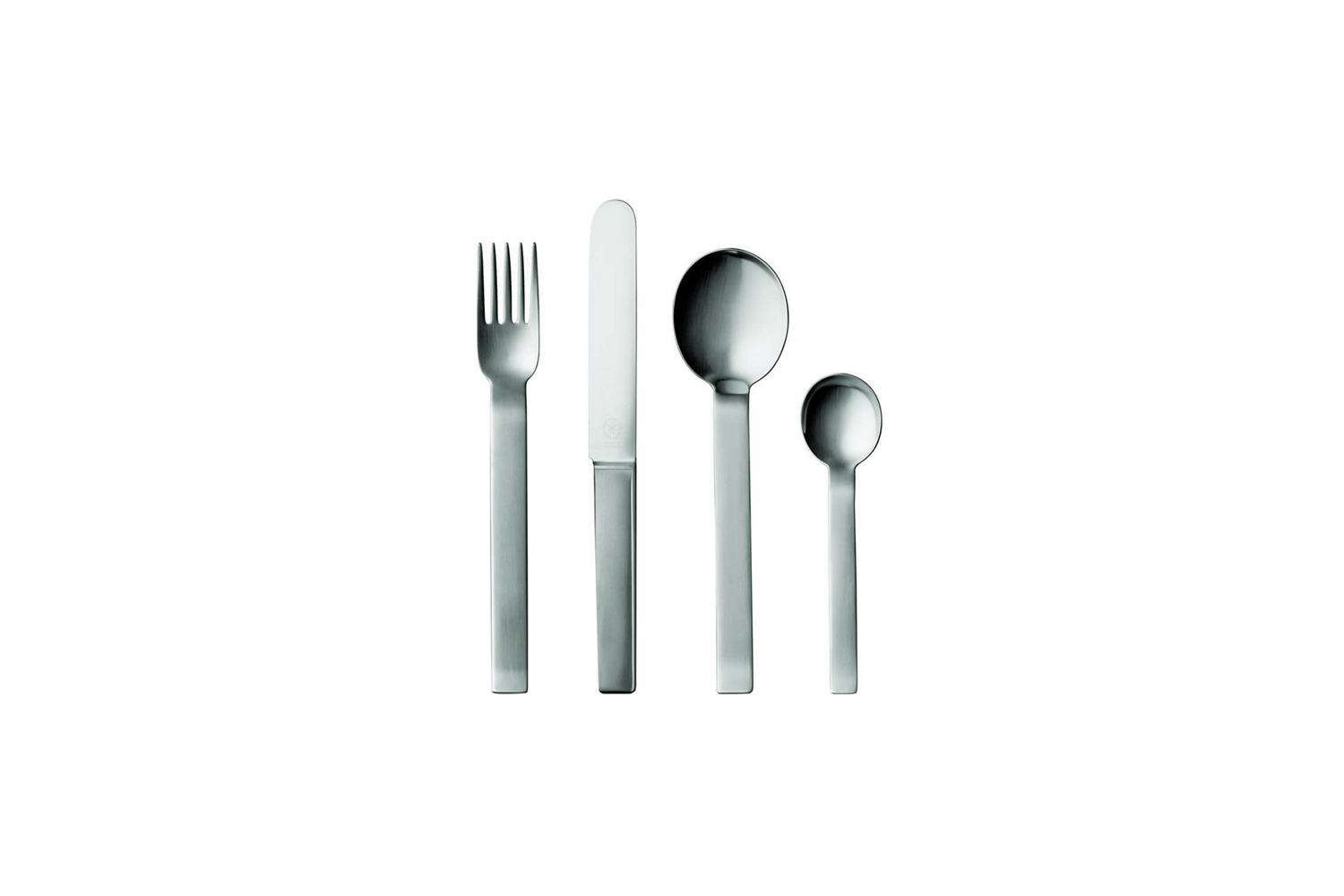
The Pott No. 35 Five-Piece Place Setting is what happens when German engineering wanders into the dining room, straightens the napkins, and politely asks the ordinary forks to leave. Designed by Carl Pott in 1979, this sculptural flatware pattern combines Bauhaus-inspired geometry, substantial proportions, and meticulous German craftsmanship.
It is also expensive enough to make you reconsider eating directly from the takeout container. Yet the price is only part of the story. Pott No. 35 is meant to be handled every day, not locked in a display cabinet while everyone eats with the “regular” silverware.
What Is the Pott No. 35 Five-Piece Place Setting?
Pott No. 35 is a modern stainless steel flatware collection created by German industrial designer Carl Pott. The pattern was developed at the request of Cologne and became associated with the city’s official cutlery. Its design follows formal Bauhaus principles: function is visible, decoration is restrained, and every line appears to have arrived with architectural blueprints.
A typical five-piece place setting contains two forks, two spoons, and one table knife. Retailers use slightly different names for the smaller pieces, so the set may be described as including a salad or dessert fork and a teaspoon, coffee spoon, or dessert spoon. The essential arrangement remains the same:
- One table or dinner fork
- One salad or dessert fork
- One table knife
- One table or dinner spoon
- One teaspoon, coffee spoon, or dessert spoon
The pieces are made from 18/10 stainless steel. Depending on the retailer and exact production configuration, listings describe the knife as micro-serrated and the overall finish as matte or softly brushed. Current U.S. product listings also identify the set as made in Germany.
The Design Story Behind Pott No. 35
More Than a Century of German Flatware Making
The Pott manufactory traces its roots to 1904, when Carl Hugo Pott established a workshop in Solingen, Germany, for processing damascened steel used by the cutlery industry. His son, Carl Pott, entered the business in 1932 and helped transform the company into one of the most influential names in modern European flatware.
Carl Pott approached eating utensils as serious industrial-design objects. He removed unnecessary embellishment and focused on proportion, balance, material, and the relationship between a utensil and the human hand. In other words, he thought very hard about spoons so the rest of us would not have to.
A Strong Bauhaus Influence
Pott No. 35 has a stern geometric quality that distinguishes it from delicate, traditional silverware. The handles are broad and substantial. The transition from handle to bowl, blade, or tines is deliberate rather than decorative. The result feels closer to a miniature piece of architecture than a floral-patterned utensil inherited from a distant aunt.
The most recognizable detail is the five-tine fork. Most household dinner forks have four tines, making the additional tine both a functional and visual signature. It widens the fork head, reinforces the collection’s bold proportions, and makes the pattern immediately identifiable to design enthusiasts.
A Pattern With Public Presence
Unlike many luxury flatware designs created primarily for private dining rooms, Pott No. 35 began with a civic purpose. It was designed in 1979 in connection with Cologne’s official city cutlery. That background helps explain why the pattern feels dignified without becoming fussy. It was intended to communicate lasting quality in a public setting, where the flatware needed to look authoritative and perform reliably.
The manufacturer also lists multiple design recognitions for the collection, including honors connected with Design Center Stuttgart, the Ljubljana Biennale of Industrial Design, the European cultural organization in Baden-Baden, and Form 85.
Materials and Construction
Why 18/10 Stainless Steel Matters
The designation “18/10” generally refers to stainless steel containing approximately 18% chromium and 10% nickel. Chromium contributes hardness and corrosion resistance, while nickel helps improve luster and resistance to staining. This composition is widely used for premium flatware because it combines durability with relatively easy care.
That does not mean 18/10 stainless steel is magically immune to every water spot, scratch, or dishwasher mishap. It does mean that, with sensible care, it is suited to frequent use and should resist rust better than lower-nickel alternatives.
Hand-Finished Manufacturing
Pott emphasizes traditional manufacturing processes rather than fully automated mass production. According to the company, a spoon or fork may require more than 30 individual operations, while a knife can take more than 90 steps to achieve its edge, finish, and balanced weight.
Those steps help explain the price. Buyers are not merely paying for five pieces of metal. They are paying for shaping, grinding, smoothing, finishing, inspection, and the accumulated experience required to make separate utensils feel like members of the same family.
Approximate Dimensions
One U.S. specialty retailer lists the following approximate dimensions for the five-piece configuration:
- Salad fork: 7 inches
- Table fork: 8 inches
- Table knife: 9 inches
- Table spoon: 8 inches
- Tea spoon: 5 inches
Another retailer gives an overall range of approximately 7 to 8.75 inches for the major pieces. Because product names and configurations can vary, buyers should review the retailer’s exact item numbers before ordering, particularly when adding pieces to an existing collection.
How Pott No. 35 Feels in the Hand
Weight and balance are central to good flatware. Independent flatware tests consistently emphasize that utensils should feel substantial without becoming clumsy, with enough balance to prevent the head of the utensil from pulling awkwardly downward. Premium 18/10 stainless steel is commonly recommended for buyers seeking durable, dishwasher-safe flatware with long-term potential.
Pott No. 35 deliberately favors visual and physical substance. Its broad handles fill more of the palm than thin café-style flatware. People who enjoy weighty utensils may find that reassuring and luxurious. Those who prefer barely-there handles may feel as though they have been handed a tiny piece of municipal infrastructure.
The wide handle can provide a stable grip, while the generously proportioned fork and spoon heads suit hearty meals. The micro-serrated knife sold in current sets is designed to improve cutting performance without requiring a separate steak knife for many everyday foods.
Everyday Performance
Using the Five-Tine Fork
The five-tine dinner fork is the star of the collection. Its wider arrangement offers plenty of surface area for foods such as roasted vegetables, pasta, composed salads, and sliced meat. The unusual tine count is noticeable, but it is not merely a visual joke. It reinforces the broad, confident proportions of the entire setting.
The smaller fork works well for salads, desserts, fruit, and appetizers. Because the pattern has substantial handles, even the smaller piece retains the visual authority of the full-size dinner fork.
Spoons With Presence
The table spoon is long and generously scaled. It is useful for soups, stews, grain bowls, yogurt, and desserts that require serious excavation. The smaller spoon handles coffee, tea, ice cream, and other civilized pursuits.
Buyers should note that retailer terminology varies. One seller may call the smaller utensil a coffee spoon, while another calls it a teaspoon or dessert spoon. The naming difference matters less during breakfast but matters quite a lot when trying to match a replacement piece years later.
The Table Knife
The long table knife balances the broad forks and spoons visually. A micro-serrated edge adds practical cutting ability for cooked vegetables, poultry, tender meat, sandwiches, and firm pastries. It will not replace a dedicated steak knife for every cut, but it is more capable than the smooth, decorative knives included in many formal place settings.
Styling the Pott No. 35 Place Setting
Pott No. 35 looks especially convincing beside modern porcelain, simple stoneware, clear glassware, and natural linen. Its matte steel surface can calm glossy white plates, while its strong silhouette brings definition to rustic ceramics.
Because the pattern already makes a statement, the rest of the table does not need to perform acrobatics. A white plate, neutral napkin, low glass tumbler, and one branch in a vase may be enough. Add three competing centerpiece themes and the table begins to look like a committee meeting.
The collection can also work in more traditional interiors. Against patterned china or antique wood, its geometry creates an intentional contrast. Good flatware does not always need to disappear into the décor; sometimes it can be the element that keeps the setting from feeling predictable.
Care and Cleaning
Pott No. 35 is generally listed as dishwasher-safe. Nevertheless, premium stainless steel lasts longer and looks better when treated with a small amount of common sense. Specialty flatware-care guidance recommends avoiding citrus-based detergents, not washing stainless steel beside reactive metals, and drying pieces promptly to reduce watermarks. Abrasive scrubbers such as steel wool should also be avoided because they can scratch the surface.
- Rinse off acidic or salty food residue rather than letting it dry overnight.
- Place utensils loosely in the dishwasher so water can circulate.
- Avoid crowding stainless flatware against aluminum, silver, or cast iron.
- Use a nonabrasive detergent and follow the manufacturer’s instructions.
- Dry promptly or buff remaining water spots with a soft cloth.
- Store pieces in a clean, divided organizer to reduce unnecessary rubbing.
Minor surface marks will eventually appear on almost any flatware used regularly. That is not necessarily a defect. It is evidence that dinner happened, which is generally preferable to owning pristine utensils and surviving entirely on crackers.
Is the Pott No. 35 Five-Piece Place Setting Worth the Price?
At the time of research, multiple U.S. retailers listed a five-piece setting at approximately $475. Prices, promotions, taxes, and availability can change, and some sellers classify the pattern as a special-order product.
That price places Pott No. 35 firmly in luxury territory. Many highly rated 18/10 stainless steel place settings cost a fraction of that amount. Independent buying guides also show that comfortable, durable flatware is available at budget, midrange, and premium price points.
The argument for Pott No. 35 is therefore not based on necessity. Nobody requires a five-tine German fork to complete the journey from plate to mouth. The value lies in distinctive design, labor-intensive production, historic pedigree, replacement-piece availability, and the pleasure of using an object that has been carefully considered.
Pott No. 35 May Be Worth It If You:
- Collect important examples of modern or Bauhaus-inspired design
- Prefer heavy, wide-handled flatware
- Want a pattern that works for everyday meals and formal tables
- Value German manufacturing and hand-finished production
- Plan to build a collection gradually over many years
- Would rather own one lasting pattern than replace inexpensive sets repeatedly
You May Want Another Pattern If You:
- Prefer lightweight or very slender utensils
- Need complete service for eight or twelve people on a limited budget
- Want ornate, traditional, gold-toned, or highly decorative flatware
- Frequently lose teaspoons to offices, lunch boxes, or mysterious household portals
- Would feel nervous placing costly utensils in the dishwasher
A Realistic Ownership Experience With Pott No. 35
The experience of owning Pott No. 35 begins before food reaches the table. Open a place-setting box, arrange the five utensils in a row, and the first impression is visual discipline. The pieces look related without being identical. Their broad handles establish a steady rhythm, while the changing heads reveal the purpose of each tool. The five-tine fork immediately draws attention, because apparently even forks can have leading roles.
The First Breakfast
At breakfast, the smaller spoon feels more deliberate than a generic teaspoon. Stirring coffee is not transformed into a spiritual awakening, but the balanced handle and smooth finish make an ordinary ritual feel considered. The smaller fork pairs naturally with fruit, pastries, or an omelet. Its substantial handle can seem oversized during the first few minutes, especially for someone accustomed to thin stamped flatware. By the end of the meal, however, the weight begins to feel normal.
The First Full Dinner
Dinner is where the pattern makes the strongest case for itself. The table fork has enough width to manage roasted vegetables, greens, pasta, or sliced meat without feeling fragile. Its five tines create a secure platform for loose foods, although they will not prevent peas from exercising their constitutional right to escape.
The knife’s length looks elegant beside a large dinner plate, and the serrated edge provides useful cutting power. The broad handle gives the hand something substantial to hold, making the knife feel more like a working tool than an ornamental placeholder. The table spoon is similarly confident. It suits soup and stew particularly well, though people with smaller hands may need time to adjust to its dimensions.
Hosting Guests
During a dinner party, Pott No. 35 contributes visual structure even when the dinnerware is simple. Place it beside white porcelain and linen napkins, and the table feels modern without becoming sterile. Pair it with handmade stoneware, and the precise geometry provides contrast against irregular glazes and organic edges.
Guests who notice design will probably ask about the five-tine fork. Guests who do not notice design will simply use it, which may be the better compliment. The pattern performs its job without demanding a lecture on twentieth-century industrial design before dessert.
After the Meal
Cleanup introduces the practical reality of premium flatware: the owner may become unusually aware of where every spoon has gone. The pieces can be washed in the dishwasher, but careful spacing and prompt drying help preserve the finish. Water spots are easy to buff away with a soft cloth. Small usage marks will develop over time, gradually replacing showroom perfection with the softer appearance of objects that belong to a household.
Living With the Cost
The largest adjustment may be psychological. At roughly the price of a small appliance, a single place setting can initially feel too precious for Tuesday-night pasta. Yet keeping it unused defeats the purpose. Pott No. 35 makes the most sense when it becomes the regular flatware: present for birthdays and holidays, but also cereal, leftovers, soup, and midnight pie.
Over years of use, the value proposition shifts. The purchase is no longer five expensive utensils. It becomes hundreds or thousands of meals served with the same familiar tools. That long relationship is the strongest argument for buying exceptionally well-made flatwareand the only argument likely to make a $475 fork set sound almost financially responsible.
Final Verdict
The Pott No. 35 Five-Piece Place Setting is bold, architectural, beautifully made, and unapologetically expensive. Its five-tine fork, broad handles, 18/10 stainless steel construction, and Bauhaus-inspired geometry give it an identity that ordinary flatware rarely achieves.
It is not the best choice for every household. Buyers seeking low-cost service for a large family can find many durable alternatives. For design collectors, modernist interiors, wedding registries, milestone gifts, and people who enjoy weighty utensils, however, Pott No. 35 offers something more memorable than standard silverware.
This is flatware designed to outlive trends and perhaps several kitchen remodels. Use it rather than worship it, care for it without becoming its full-time security guard, and it may turn even a humble bowl of soup into a small encounter with German industrial design.