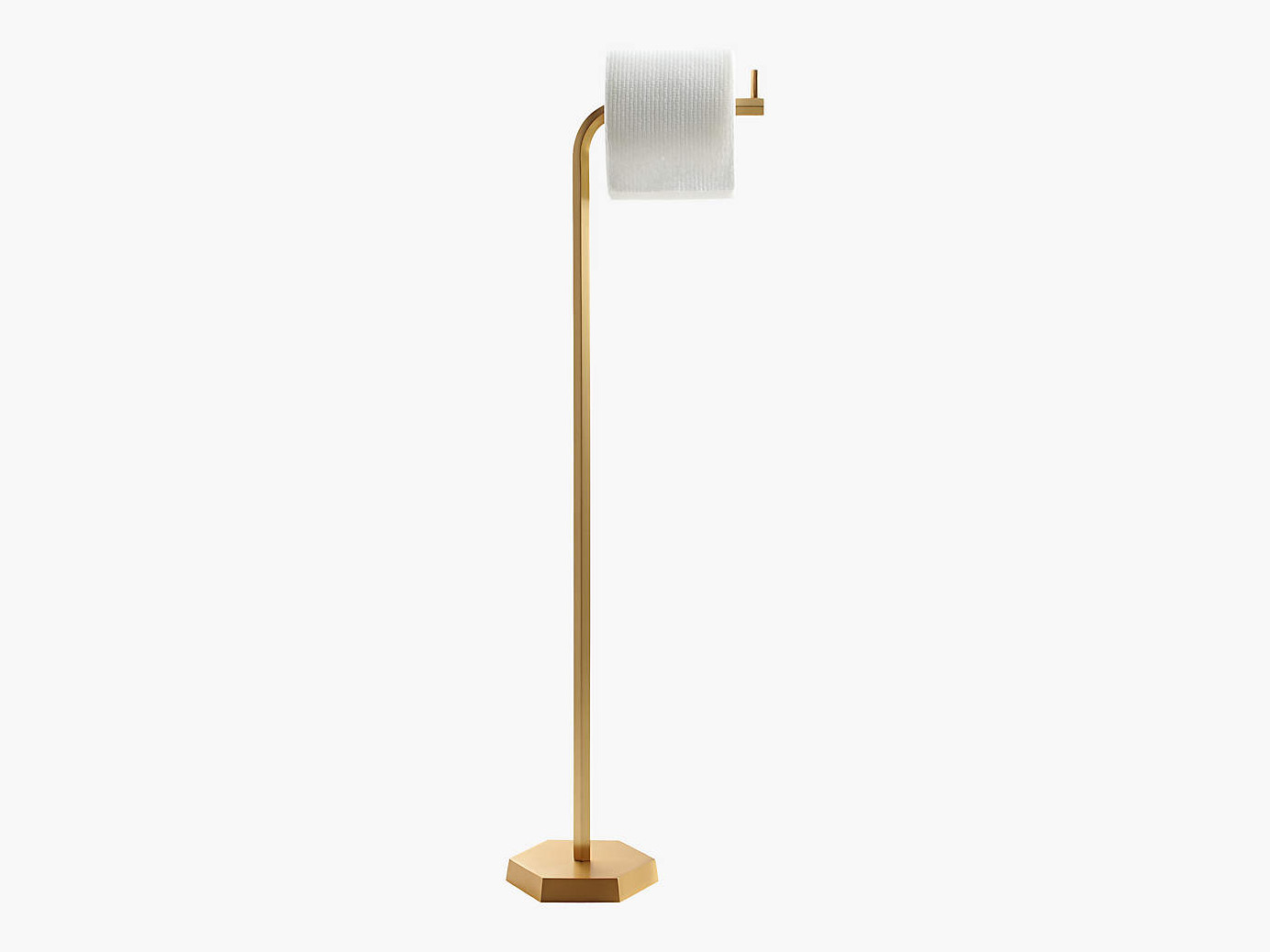
A toilet paper holder rarely receives top billing in a bathroom makeover. Usually, it is selected somewhere between choosing grout color and wondering why a decorative hand towel costs more than dinner. The Hex Brass Standing Toilet Paper Holder, however, makes a convincing argument that even the most practical bathroom accessory deserves thoughtful design.
Originally offered as a CB2 exclusive, this freestanding toilet paper holder combines solid brass construction with a geometric hexagonal base. Its warm metallic finish, slender profile, and sculptural shape turn an everyday object into a small but noticeable design feature. It does not install plumbing, increase water pressure, or organize an entire linen closet, but it does make a roll of toilet paper look surprisingly sophisticated.
What Is the Hex Brass Standing Toilet Paper Holder?
The Hex Brass Standing Toilet Paper Holder is a floor-standing bathroom accessory designed to hold one active roll of toilet paper. Unlike a traditional wall-mounted dispenser, it rests directly on the floor and can be repositioned whenever the bathroom layout changes.
The original product specifications describe a solid brass construction, a warm brass appearance, and a geometric hexagonal form. It measures approximately 6 inches wide, 6 inches deep, and 26 inches high. That narrow footprint helps it fit beside many toilets without occupying the amount of floor space required by a basket, cabinet, or combination storage stand.
Key product characteristics
- Solid brass construction
- Warm metallic finish
- Hexagonal geometric base
- Freestanding, drill-free design
- Approximately 6 by 6 by 26 inches
- Holds one active toilet paper roll
- Designed as part of CB2’s coordinated Hex bathroom collection
The archived CB2 listing currently identifies the original model as no longer available. Shoppers may therefore encounter it through resale websites, vintage home-furnishing sellers, estate sales, or secondhand marketplaces. Similar geometric brass toilet paper stands are also available from other manufacturers, although their materials and dimensions can differ.
Why the Geometric Design Stands Out
Many freestanding toilet paper holders use a circular base and a simple vertical post. That formula works, but it can look like a microphone stand waiting for a very quiet performer. The Hex holder replaces the ordinary round foundation with an angular six-sided shape, giving the piece a more architectural personality.
The hexagon provides visual structure without adding elaborate decoration. Its clean lines work especially well in modern, contemporary, transitional, and Art Deco-inspired bathrooms. Because the design is recognizable but not overly ornate, it can add interest without competing with patterned tile, dramatic wallpaper, or a statement vanity.
A small piece of bathroom jewelry
Designers often describe hardware as the jewelry of a room. The comparison is particularly appropriate here. Brass introduces warmth and contrast in spaces commonly dominated by white porcelain, cool stone, glass, and tile. A slim brass stand can make a plain bathroom look more considered without requiring a new vanity or a heroic encounter with demolition dust.
The holder can also create repetition when paired with brass cabinet pulls, a gold-framed mirror, warm metal sconces, or matching towel hardware. Repeating the finish in two or three locations usually produces a more intentional result than placing one isolated brass object in the room and hoping it makes friends.
Benefits of a Freestanding Toilet Paper Holder
No drilling or permanent installation
A standing toilet paper holder does not require screws, anchors, or holes in the wall. This makes it practical for renters, recently renovated bathrooms, tiled walls, glass partitions, and homeowners who would prefer not to test whether their drill bit is truly rated for porcelain tile.
It is also useful when the most convenient wall is unavailable. A vanity may be too far from the toilet, a pocket door may occupy the side wall, or a glass shower enclosure may eliminate the usual mounting surface. A freestanding holder solves these problems without altering the room.
Flexible placement
The holder can be placed on either side of the toilet and moved as needed. That flexibility is valuable in guest bathrooms, powder rooms, temporary living spaces, and households where different users have different reach preferences.
Good placement matters more than strict symmetry. The roll should be easy to reach from a seated position without requiring the user to twist sharply, lean dangerously, or perform an unexpected yoga pose. Before settling on a location, sit on the closed toilet seat and test the reach naturally.
Easy to clean around
A movable stand can be lifted when sweeping or mopping. Wall-mounted holders do not occupy the floor, but storage baskets and oversized combination units can create awkward corners that collect dust. The Hex holder’s compact base makes routine cleaning relatively simple.
A useful option for delicate surfaces
Installing accessories on marble, stone, specialty plaster, or decorative tile can be stressful and expensive. A freestanding bathroom tissue holder avoids penetrations that might crack a tile, damage a waterproof layer, or create a permanent hole in a carefully finished wall.
Possible Drawbacks to Consider
No bathroom accessory is perfect, not even one that looks as though it understands geometry. Before buying an original Hex holder or a similar brass toilet paper stand, consider how it will function in the specific room.
It uses floor space
The 6-inch footprint is compact, but it still occupies part of the floor. In an extremely narrow toilet alcove, every inch matters. Measure the intended location and confirm that the stand will not interfere with a bathroom door, cabinet drawer, cleaning tool, wastebasket, or user’s feet.
It stores only the active roll
The original design is a dispenser rather than a toilet paper storage tower. It does not appear intended to hold a stack of replacement rolls. Extra toilet paper will still need a basket, cabinet, shelf, or other storage location.
A standing holder can be bumped
Freestanding models may shift when struck by a foot, vacuum, mop, curious child, or enthusiastic pet. A solid metal construction can provide useful weight, but stability ultimately depends on the base design, floor surface, and condition of the item.
When buying secondhand, ask whether the stand sits level. A bent post, distorted base, missing floor pad, or loose connection can make an otherwise attractive holder wobble.
Accessibility requires individual evaluation
A movable holder is not automatically an accessible solution. It must remain within comfortable reach while staying out of transfer areas, walkways, and wheelchair maneuvering space. Commercial and formally accessible bathrooms may need to comply with specific dispenser-positioning requirements, so a portable stand should not be treated as a universal replacement for a correctly installed accessible dispenser.
How to Style a Brass Toilet Paper Stand
Modern bathrooms
In a modern bathroom, pair the holder with simple shapes and a restrained palette. White walls, gray tile, black accents, and a brass stand create crisp contrast. The hexagonal base can echo square sinks, grid-pattern tile, angular faucets, or geometric lighting.
Art Deco-inspired spaces
Brass and geometry are natural companions in an Art Deco-influenced powder room. Try the stand with dark green walls, black-and-white tile, fluted glass, a fan-shaped mirror, or rich marble veining. Keep the number of decorative motifs under control so the room feels glamorous rather than auditioning for three different hotel lobbies.
Warm minimalist interiors
Minimalism does not have to mean an all-white room with the emotional temperature of a refrigerator. Warm brass looks inviting beside cream tile, pale oak, limestone, woven baskets, and soft neutral towels. The holder adds character while maintaining a clean silhouette.
Traditional or transitional bathrooms
Although the base is contemporary, brass allows the stand to blend with more traditional materials. It can work beside paneled cabinetry, a framed mirror, classic subway tile, or a marble vanity. Transitional design benefits from this balance of familiar material and updated shape.
Mixed-metal bathrooms
The faucet, shower trim, light fixture, and toilet paper holder do not have to match perfectly. Thoughtful metal mixing can make a bathroom feel collected rather than purchased as one enormous matching set.
Choose one dominant finish and use another as an accent. For example, polished nickel faucets can remain the primary finish while the brass toilet paper stand, mirror frame, and cabinet pulls provide warmth. Repeating each finish at least once helps the combination look deliberate.
How to Choose the Right Placement
Because the Hex holder is movable, it offers more freedom than a wall-mounted model. That freedom should still be guided by reach, stability, hygiene, and circulation.
- Test the reach: Position the holder where the roll can be reached comfortably while seated.
- Protect the walkway: Keep the base away from the main path between the door, toilet, sink, and shower.
- Avoid splash zones: Do not place it where shower spray, sink splashes, or frequent floor puddles will soak the paper or leave water spots on the brass.
- Check door movement: Open the bathroom and vanity doors fully before choosing the final position.
- Allow cleaning access: Leave enough room to lift the stand and clean beneath it.
A common wall-mounted toilet paper holder height is around 26 inches from the floor, which happens to align closely with the overall height of this stand. However, the critical measurement for a freestanding model is the actual roll position and its distance from the seated user, not merely the height of the top of the post.
Brass Construction and Finish Care
Brass is an alloy primarily associated with copper and zinc. It is widely used for decorative hardware because it offers strength, workable manufacturing properties, corrosion resistance, and a naturally warm appearance.
However, “solid brass” describes the underlying material, not necessarily the exact surface treatment. Brass may be polished, brushed, antiqued, plated, lacquered, waxed, or left unlacquered. The archived product information identifies the Hex holder as solid brass with a warm brass appearance but does not clearly explain whether its surface has a protective lacquer.
For that reason, conservative cleaning is the safest approach, especially when dealing with a secondhand example whose finish history is unknown.
Routine cleaning
- Remove the toilet paper roll.
- Wipe dust away with a clean, dry microfiber cloth.
- For fingerprints or light residue, use a barely damp soft cloth with a small amount of mild dish soap.
- Wipe again with a clean damp cloth to remove soap.
- Dry the holder immediately and thoroughly.
What to avoid
- Abrasive pads or rough sponges
- Toilet bowl cleaner
- Bleach and strong disinfectants
- Harsh acidic or caustic bathroom sprays
- Long exposure to vinegar or homemade polishing mixtures
- Leaving the base wet after mopping
Do not polish the entire holder until you know what finish it has. Metal polish can remove tarnish from raw brass, but it may damage or unevenly alter a lacquered, plated, or intentionally aged surface. Test any product on a small, inconspicuous area first.
Patina versus damage
Unlacquered brass gradually changes color as it reacts with air, moisture, skin oils, and cleaning products. This natural patina may appear darker or less uniform over time. Some homeowners enjoy the evolving finish because it adds depth and character.
Patina should not be confused with serious corrosion, flaking coating, or structural damage. Pink or reddish areas, heavy green deposits, pitting, or weakening metal deserve closer inspection. When purchasing a used holder, request detailed photos of the base, joints, underside, and roll arm rather than relying on one dramatically lit glamour shot.
What to Check When Buying One Secondhand
Since the original CB2 model is no longer part of the active product assortment, resale listings may vary significantly in condition and price. A careful inspection can prevent a stylish bargain from becoming an expensive wobbling sculpture.
- Confirm that the listing shows the original Hex design rather than a loosely similar brass stand.
- Ask for measurements close to 6 inches wide, 6 inches deep, and 26 inches high.
- Verify that the material is solid brass if authenticity matters to you.
- Look for bends, cracks, loose joints, missing pads, and uneven feet.
- Request close-up photographs of tarnish, scratches, stains, and finish wear.
- Ask whether the holder stands level on a hard floor.
- Include shipping costs when comparing prices because a solid metal stand may be expensive to mail.
Minor patina can be attractive, but deep scratches or damaged coatings may be difficult to disguise. Buy the actual condition shown, not the gleaming future imagined after watching one enthusiastic restoration video.
Is the Hex Brass Standing Toilet Paper Holder Worth It?
The holder is most appealing to shoppers who value sculptural bathroom accessories, warm metallic finishes, and installation-free convenience. Its solid brass construction and distinctive base give it more presence than a basic utility holder, while the narrow footprint keeps the design from becoming bulky.
It is especially suitable for renters, tiled bathrooms, powder rooms, awkward layouts, and homeowners who enjoy collecting discontinued modern furnishings. It may be less practical for extremely tight spaces, households that need built-in spare-roll storage, or users who require a permanently fixed accessible dispenser.
As a design object, it succeeds because it does not try too hard. The shape is memorable, the material feels substantial, and the function remains immediately understandable. Nobody needs instructions to identify what it does, which is always encouraging in a bathroom.
What Using It Feels Like: A Practical 30-Day Experience
The following ownership-style evaluation reflects realistic day-to-day use considerations rather than a claim of laboratory testing. During the first few days, the most noticeable benefit is placement freedom. Instead of measuring, drilling, discovering a hidden pipe, and developing a sudden interest in moving to another house, the stand can simply be positioned beside the toilet.
Finding the ideal location may take several attempts. Placed too close, the base can crowd the user’s feet. Placed too far back, the roll requires an awkward reach. The best position is usually slightly forward of the seated user, close enough for a relaxed arm movement but far enough away to preserve comfortable legroom.
The 26-inch overall height feels familiar because it is comparable to common toilet paper accessory placement. The vertical profile also makes the stand easy to notice without making it visually heavy. In a white or neutral bathroom, the warm brass catches light and adds a controlled flash of color. It is decorative, but it does not shout, “Please admire the toilet paper infrastructure.”
Changing the roll is straightforward because there is no spring-loaded spindle to chase across the floor. The exact motion depends on the holder’s open arm configuration, but a simple design generally makes replacement faster than traditional two-bracket dispensers. This convenience becomes particularly noticeable in a guest bathroom, where uncomplicated hardware reduces confusion.
By the end of the first week, floor cleaning reveals another advantage. The stand can be lifted, the area beneath it wiped, and the holder returned to position. A small felt or protective pad under the base can reduce scratching, although any added material should be thin and evenly applied so it does not create instability.
Moisture management becomes important in a full bathroom. When the stand sits near a shower, droplets can create spotting on the finish and soften the exposed toilet paper. Moving it a few inches away from the splash zone often solves both problems. Drying the brass after noticeable splashes also reduces residue and uneven discoloration.
After several weeks, fingerprints and dust may become more visible, especially under bright vanity lighting. A quick pass with a dry microfiber cloth usually restores a cleaner appearance. Strong bathroom cleaner is unnecessary and potentially risky. The holder lives near the toilet, but that does not mean it wants to be sprayed with everything stored under the sink.
The most significant limitation remains the lack of spare-roll storage. When the active roll runs out, the stand offers no hidden emergency reserve. Keeping two or three replacements in a nearby cabinet or covered basket prevents an avoidable household crisis.
Overall, the Hex holder works best when treated as a movable design accessory rather than a storage station. Its daily value comes from convenience, compact dimensions, and visual warmth. Its long-term appeal comes from the unusual geometric base and substantial brass construction. For the right bathroom, it is a small upgrade that manages to be useful, handsome, and just eccentric enough to make ordinary hardware interesting.
Final Thoughts
The Hex Brass Standing Toilet Paper Holder demonstrates how a modest accessory can influence the look and function of a bathroom. Its solid brass body, hexagonal base, compact footprint, and freestanding design provide a combination of durability, flexibility, and decorative character.
It will not suit every layout, and buyers searching for the discontinued original should examine resale listings carefully. Nevertheless, it remains a compelling choice for design-minded homeowners who want to avoid wall installation and introduce a warm geometric accent. Sometimes a bathroom transformation begins with new tile. Sometimes it begins with a six-sided stand bravely holding one roll at a time.