If glute bridges and hip thrusts were siblings, they would absolutely argue over who does more around the house. They look similar. They train many of the same muscles. They both involve driving your hips upward like you are trying to impress your glutes into clocking in on time. But they are not the same exercise, and choosing the right one can make your workouts feel much smarter.
So, what is the real difference between glute bridges and hip thrusts? In one sentence: a glute bridge is usually performed with your upper back on the floor, while a hip thrust is usually performed with your shoulders elevated on a bench or platform, creating a larger range of motion and making the exercise easier to load heavily.
That simple setup change affects difficulty, stability, muscle emphasis, progression, and how each move fits into a training plan. If you are trying to build stronger glutes, improve hip extension, support better posture, or just stop feeling every lower-body exercise in your quads and lower back, understanding this difference matters.
In this guide, we will break down glute bridges vs hip thrusts in plain English, explain when to use each one, cover common mistakes, and help you decide which move deserves prime real estate in your workout routine.
What Is a Glute Bridge?
A glute bridge is a hip extension exercise performed from the floor. You lie on your back with your knees bent, feet planted, and arms by your sides. From there, you press through your feet, squeeze your glutes, and lift your hips until your body forms a straight line from your shoulders to your knees.
It looks simple because it is simple, and that is exactly why it is so useful. The glute bridge teaches the basic pattern of hip extension, helps people learn how to brace the core, and makes it easier to feel the glutes working without much setup or equipment.
Because your upper back stays on the floor, the movement is generally more stable and easier to learn than a hip thrust. That makes glute bridges popular for beginners, home workouts, warm-ups, activation work, and rehab-style progressions when cleared by a professional.
Muscles Worked in a Glute Bridge
The glute bridge mainly targets the gluteus maximus, while also recruiting the hamstrings and core. Depending on your foot placement and technique, your gluteus medius and adductors can also contribute to stabilizing the movement.
What Is a Hip Thrust?
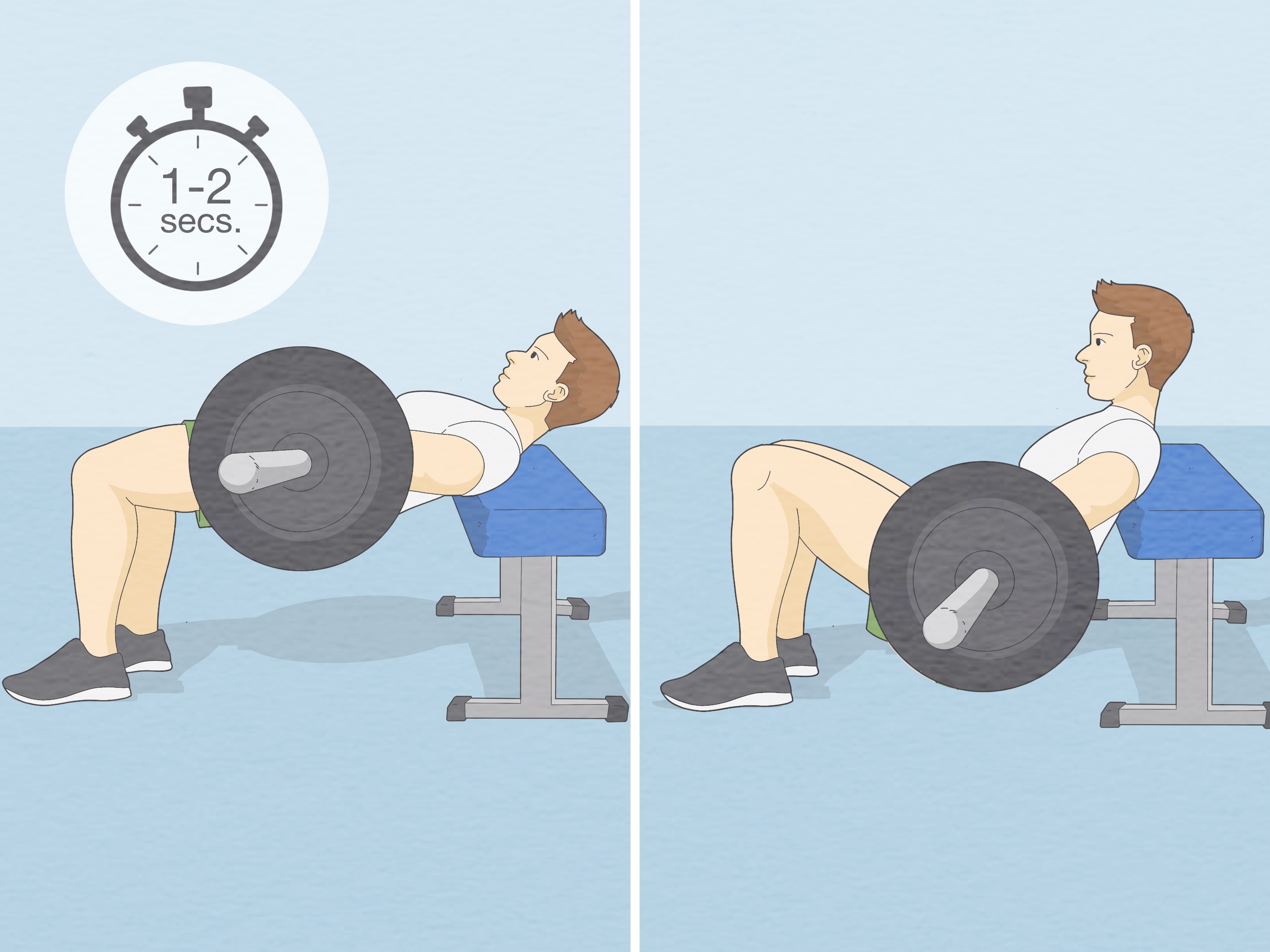
A hip thrust is another hip extension exercise, but the setup changes everything. Instead of keeping your upper body on the floor, you place your upper back or shoulder blades on a bench, box, or similar elevated surface. Your feet stay on the floor, your knees bend, and you drive your hips upward until your torso is roughly parallel to the floor at the top.
Because your shoulders are elevated, your hips move through a larger range of motion than they do in a standard glute bridge. That added travel usually increases the challenge and often makes the glutes work harder through the full movement. Hip thrusts are also easier to load with dumbbells, barbells, bands, or machines, which is one reason they are a favorite in strength and hypertrophy programs.
In other words, the hip thrust is not just a glute bridge with better marketing. It is a progression that gives you more range, more loading options, and usually more room to grow over time.
Muscles Worked in a Hip Thrust
Hip thrusts primarily train the gluteus maximus and also involve the hamstrings, core, and other muscles that help stabilize the hips and pelvis. When performed well, the exercise is especially useful for building strength in hip extension, which matters for walking, climbing, sprinting, and many athletic movements.
Glute Bridges vs Hip Thrusts: The Main Differences
1. Setup
The glute bridge is floor-based. The hip thrust uses an elevated surface for the upper back. That means glute bridges are faster to set up, easier to do at home, and more accessible for people who do not have a bench.
2. Range of Motion
This is the biggest mechanical difference. Hip thrusts usually allow more hip flexion at the bottom and more travel through the movement, which creates a larger range of motion. A glute bridge has a shorter range because the floor limits how far your torso and hips can move.
3. Load Potential
Both moves can be loaded, but hip thrusts are generally easier to progressively overload. If your goal is glute strength or muscle growth, the hip thrust often has the edge because it is more practical to add meaningful resistance over time.
4. Stability and Learning Curve
Glute bridges are more beginner-friendly. There is less balancing, less setup, and less opportunity to turn the movement into an interpretive dance with a barbell. Hip thrusts require more coordination, bench positioning, and body awareness.
5. Training Role
Glute bridges are great for teaching, warming up, activating, and building a foundation. Hip thrusts are often better as a main strength exercise or a dedicated glute-building move later in a program.
6. Comfort
Some people feel more comfortable on the floor doing glute bridges, especially if benches, barbells, or hip pads are not available. Others prefer hip thrusts because the exercise feels more substantial and easier to progress. Comfort is not a small detail. If an exercise feels awkward every time, compliance usually disappears faster than gym motivation in late December.
Is One Better Than the Other?
Not universally. The better exercise depends on your goal, experience level, equipment, and technique.
Choose glute bridges if: you are a beginner, want to learn hip extension mechanics, need a simple warm-up, want a lower-equipment option, or are trying to improve your ability to feel your glutes working without a complicated setup.
Choose hip thrusts if: you want to build glute strength more aggressively, have access to a bench or machine, plan to use progressive overload, or want a glute-focused exercise that can play a serious role in lower-body training.
For many people, the smartest answer is not choosing one forever. It is using both at different times. A glute bridge can teach the pattern and improve control. A hip thrust can build on that foundation with heavier loading and more range.
Which Exercise Builds Bigger, Stronger Glutes?
If your goal is muscle growth or strength development, hip thrusts usually have the advantage because they are easier to load, easier to progress, and offer a larger range of motion. That does not mean glute bridges are useless. Far from it. A loaded glute bridge can still be challenging, and bodyweight or banded bridges are extremely effective for learning proper glute engagement.
Think of it this way: glute bridges are excellent for building the signal, while hip thrusts are excellent for turning up the volume. One teaches your body what to do. The other often lets you do more of it.
That said, strength and muscle gains do not come from picking the “cooler” exercise. They come from using good form, training consistently, recovering well, and adding challenge over time. A perfectly executed glute bridge will beat a sloppy hip thrust every single day of the week.
How to Do a Glute Bridge Correctly
Step-by-Step
Lie on your back with your knees bent and feet flat on the floor about hip-width apart. Keep your heels fairly close to your glutes. Brace your core gently, press your lower ribs down, and avoid flaring your chest. Then drive through your heels, squeeze your glutes, and lift your hips until your body forms a straight line from shoulders to knees. Pause briefly at the top, then lower with control.
Good Form Cues
Keep your chin neutral. Do not overarch your lower back. Think about lifting with your hips, not your spine. At the top, your glutes should feel like they are doing the work. If your lower back is screaming for attention, your technique likely needs adjusting.
Common Glute Bridge Mistakes
One common mistake is pushing the hips too high and turning the movement into a lower-back extension contest. Another is placing the feet too far away, which can shift more work to the hamstrings. Some people also rush the reps and never actually squeeze at the top. Slow down. Your glutes are not late for a meeting.
How to Do a Hip Thrust Correctly
Step-by-Step
Sit on the floor with your upper back against a bench. Bend your knees and plant your feet flat on the floor. If using weight, position it securely across the hips. Brace your core, tuck the ribs slightly, and drive through your feet to lift your hips until your torso is close to parallel with the floor and your knees are bent around 90 degrees at the top. Pause, squeeze your glutes, and lower under control.
Good Form Cues
Keep your head and neck neutral. Avoid throwing your head backward. At the top, think about finishing the rep with your glutes, not by jamming your lower back into extension. Your shins are often close to vertical at the top when foot placement is right, though small differences are normal.
Common Hip Thrust Mistakes
The biggest mistakes are poor bench height, feet placed too far forward or too close, using too much weight too soon, and overextending the lower back instead of reaching full hip extension through the glutes. Bouncing reps also reduces control and turns a useful exercise into a noisy suggestion.
What If You Feel It More in Your Hamstrings or Lower Back?
This is common, and it usually points to setup or control issues rather than a bad exercise choice. If you feel too much hamstring tension, try moving your feet slightly closer to your body. If you feel it in your lower back, reduce the load, slow the movement, brace your core, and focus on a stronger glute squeeze at the top without over-arching.
It can also help to start with a glute bridge before progressing to a hip thrust. Many people find it easier to learn pelvic control and glute engagement on the floor before adding bench elevation and heavier loading.
How to Program Glute Bridges and Hip Thrusts
For Beginners
Start with bodyweight glute bridges for 2 to 3 sets of 10 to 15 controlled reps. You can also use bridge holds for 20 to 30 seconds. The goal is quality, not chaos.
For Strength and Muscle Growth
Use hip thrusts as a main lower-body accessory or primary glute exercise for 3 to 5 sets of 6 to 12 reps. Add load gradually, and make sure your form stays consistent as the weight increases.
For Warm-Ups or Activation
Banded glute bridges, mini bridge holds, and controlled bodyweight reps work well before squats, deadlifts, lunges, or running workouts. Keep the effort moderate so you wake the glutes up without exhausting them.
For Home Workouts
Glute bridges are usually the easiest choice. If you have a couch, sturdy step, or bench, hip thrusts can also work, but safety and setup matter. If the setup feels sketchy, the floor is your friend.
Best Variations to Try
Glute Bridge Variations
Try a banded glute bridge, single-leg glute bridge, weighted glute bridge, or glute bridge hold. These can increase challenge without making the movement overly complicated.
Hip Thrust Variations
Try dumbbell hip thrusts, barbell hip thrusts, single-leg hip thrusts, banded hip thrusts, or machine hip thrusts. If full hip thrusts feel too aggressive, a shorter-range variation like a Kas bridge can help you focus on control and top-end tension.
Glute Bridges vs Hip Thrusts for Specific Goals
For Learning Proper Form
Glute bridges win. They are simpler, more stable, and easier to coach.
For Progressive Overload
Hip thrusts win. They are usually easier to load heavily and repeat consistently.
For Small Spaces or No Equipment
Glute bridges win. No bench required, no complicated setup, no drama.
For Glute-Focused Strength Training
Hip thrusts usually win, especially once technique is solid and you are ready to challenge the movement.
For Activation Before a Workout
Glute bridges often make more sense because they are fast, simple, and less fatiguing.
Final Verdict
Glute bridges and hip thrusts are not rivals in a dramatic fitness soap opera. They are related tools with different strengths. The glute bridge is simpler, more stable, and better for learning, warming up, and building a base. The hip thrust is usually better for heavy loading, greater range of motion, and long-term glute strength and hypertrophy work.
If you are new to training, start with glute bridges and master control. If you already own the pattern and want more challenge, hip thrusts deserve a place in your program. And if you want the most complete answer, use both strategically. Your glutes do not care about gym tribalism. They care about tension, control, consistency, and smart progression.
So the next time someone asks, “Glute bridges vs hip thrusts: what’s the difference?” you can answer with confidence: same family, different job description.
Real-World Experiences: What People Often Notice When They Compare Both
One of the most common experiences beginners report is that glute bridges feel more approachable on day one. There is no bench to adjust, no awkward setup, and no question about where your shoulders should go. You lie down, plant your feet, and get to work. Because of that simplicity, many people finally learn what a proper glute squeeze is supposed to feel like during bridges. For someone who usually feels squats in their knees or lunges in their quads, that can be a small fitness miracle.
Another common experience is that hip thrusts feel strange at first but much more productive later. The first few sessions can be awkward. The bench feels too high, or too low, or suspiciously determined to slide away at the worst possible moment. People often spend the first workout wondering whether they are exercising or trying to escape a piece of furniture. But once the setup clicks, many lifters feel a stronger contraction, a better pump, and a clearer path for increasing resistance over time.
Some people notice that glute bridges help them clean up their technique in other lifts. After a few weeks of bridges, they become better at keeping the ribs down, bracing the core, and finishing hip extension without cranking through the lower back. That body awareness can carry over to deadlifts, split squats, step-ups, and even sprint mechanics. In that sense, the glute bridge often feels like a teaching tool that keeps paying rent.
Hip thrusts, on the other hand, are often where trainees begin to feel truly strong in a glute-focused movement. Once they can load the exercise confidently, track reps, and make small weekly increases, the movement starts to feel less like an accessory and more like a major lift. Many people say hip thrusts give them a very obvious signal that the glutes are working hard, especially at the top of the rep. Others like that the exercise challenges the glutes without placing a bar on the upper back the way some squat variations do.
There are also practical differences people mention. Glute bridges are easier to do in a living room, bedroom, hotel room, or crowded gym corner. Hip thrusts usually require more real estate, more setup time, and sometimes more emotional maturity than one should need before lifting weights. If you train at home with minimal equipment, bridges often become the dependable option you can always use. If you train in a well-equipped gym, hip thrusts become much easier to justify as a regular strength exercise.
Perhaps the most useful real-world takeaway is this: people rarely regret learning glute bridges first, and they rarely regret progressing to hip thrusts once they are ready. The two exercises often work best as stages of the same story rather than competing endings.