Note: This article is an original editorial synthesis based on real public information about Julie Lansom’s Sputnik Lamps, artisan lighting, handwoven pendant lights, and contemporary interior design practices.
Some lamps politely illuminate a room. Julie Lansom’s Sputnik Lamps do something slightly more theatrical: they arrive like tiny handmade spacecraft, hover above the table, and make the ceiling feel like it suddenly remembered it could have a personality. Part pendant light, part textile sculpture, part retro-futurist daydream, these handwoven lights prove that good design does not always need chrome, glass, and a dramatic showroom voice whispering, “limited edition.” Sometimes all it needs is wood, French cotton thread, a clever frame, and a designer with a lifelong weakness for color.
The title “Sputnik Sweetheart” fits beautifully. Lansom’s lights nod to the Space Age optimism of the 1950s and 1960s, especially the famous Sputnik-inspired lighting forms that turned satellites into décor. But instead of the usual metal arms and exposed bulbs, her version softens the galaxy. The result is a pendant lamp that feels handmade, warm, and slightly mischievouslike a UFO that stopped at a Paris flea market, bought yarn, and developed excellent taste.
Who Is Julie Lansom?
Julie Lansom is a French designer, photographer, and artist known for her confident use of color and her love of handcrafted objects. Her creative world includes lighting, mirrors, rugs, paintings, photography, and interior objects, but the Sputnik Lamps remain among her most recognizable designs. They combine geometry with craft, and they show how a functional fixture can become a piece of visual storytelling.
Lansom’s background helps explain the lamps’ personality. She grew up in southern France, near Montpellier, surrounded by antiques and objects of art. That early exposure to vintage forms, handmade details, and collectible design gave her work a natural sense of history. Yet she does not simply recreate the past. She edits it, brightens it, and gives it new rhythm. Her lamps feel nostalgic without becoming dusty. They reference old woven pendants, science-fiction silhouettes, and childhood drawing toys, but they land squarely in contemporary interiors.
What Makes the Sputnik Lamps Special?
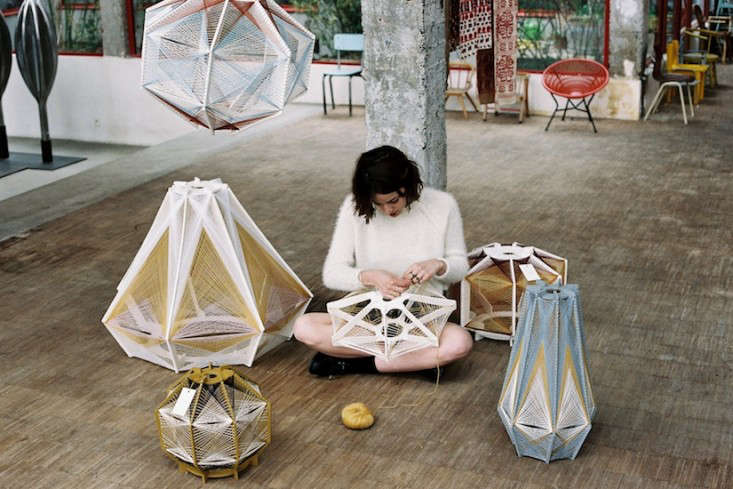
The Sputnik Lamps are made from wooden frames and woven cotton thread. Each piece is painted and handwoven, with the thread stretched across the notched frame to create bold, web-like patterns. The effect is both architectural and delicate. From one angle, the lamp looks like a clean geometric object. From another, it becomes a floating drawing in space.
That is the charm. These lights are not trying to disappear. They are conversation pieces, but they avoid the loudness of mass-produced statement lighting. Instead of shouting, they hum. They bring color, shadow, structure, and a handmade irregularity that makes a room feel more human.
A Spirograph in Three Dimensions
Lansom has described being fascinated by Spirograph as a child, and the connection is easy to see. Spirograph drawings create complex circular patterns from simple repeated movements. Her lamps do something similar: thread passes from notch to notch until a rhythmic pattern appears. What could be plain craft becomes optical energy.
This is why the Sputnik Lamps work so well in modern spaces. Their geometry satisfies the eye, while the woven texture prevents them from feeling cold. They have the precision of design and the warmth of something made by hand. That balance is rareand very useful if your living room currently looks like it was assembled by a responsible adult with no hobbies.
The Retro-Futuristic Influence
The word “Sputnik” carries design history. After the Soviet Union launched Sputnik 1 in 1957, the world became obsessed with satellites, rockets, atomic motifs, and starburst shapes. Interior design followed. Sputnik chandeliers became icons of mid-century modern style, often featuring radiating metal arms and globe bulbs. They suggested movement, technology, and optimismbasically, “the future,” but with better furniture legs.
Lansom’s lamps borrow from that energy but reinterpret it through textile craft. Rather than sharp metal points, her designs use thread. Rather than industrial shine, they offer color and tactility. The lamps still feel like satellites, flying saucers, or small orbiting objects, but they have a softer landing. This is Space Age design after a very good espresso and a visit to an artisan workshop.
Materials: Simple, Honest, and Full of Character
One of the best things about the Sputnik Lamps is their material honesty. They are not pretending to be marble, gold, or some mysterious luxury composite with a name that sounds like a password. They are made with wood and cotton thread. The beauty comes from the relationship between structure and color.
The frame gives the lamp its silhouette. The thread gives it movement. The color palette gives it mood. A lamp woven in soft neutrals may feel airy and Scandinavian. A version with coral, cobalt, yellow, or green can feel playful, almost Memphis-inspired. A darker palette can make the lamp more sculptural and graphic. Because the design is customizable, clients can choose the shape, wood color, and thread palette, making each fixture feel personal rather than pulled from a warehouse shelf.
Why Handwoven Lighting Feels So Current
Handwoven pendant lights are having a lasting moment because they answer a real problem in contemporary interiors: too many homes look polished but emotionally flat. Smooth surfaces, neutral sofas, and minimalist cabinetry can be beautiful, but they also need texture. Without texture, a room can start to feel like a very expensive waiting area.
Textile lighting changes that. Woven fixtures add softness, shadow, and craft. They make light visible as atmosphere, not just brightness. In Lansom’s case, the open thread structure lets light pass through while also creating graphic lines. The lamp is decorative when switched off and atmospheric when switched on. That is the dream: a fixture that works during dinner and during daylight, when it is simply hanging there looking clever.
How Sputnik Lamps Change a Room
A Sputnik Lamp can shift the identity of a room quickly. In a dining area, it becomes a sculptural centerpiece above the table. In a bedroom, it adds a dreamy, artistic quality without feeling heavy. In a child’s room, it can introduce color and imagination while still being sophisticated enough to avoid the dreaded “theme room” effect. In a studio or creative workspace, it adds personality without swallowing the entire visual field.
The lamp’s open structure also makes it feel lighter than a solid shade. This is important in small spaces. A heavy pendant can visually lower the ceiling and crowd the room. A woven geometric lamp creates presence without bulk. It occupies space, but it does not block it. That makes it especially appealing for apartments, breakfast nooks, creative studios, and rooms where every square foot has already filed a complaint.
Color: The Secret Ingredient
Lansom’s work is deeply tied to color. Her broader creative practice includes paintings, rugs, mirrors, and lighting, all connected by a strong sense of palette. The Sputnik Lamps are not just forms; they are color compositions. This is why they can feel so different from one project to another.
A palette of blush, cream, and pale wood can read soft and romantic. A combination of red, blue, and yellow feels graphic and playful. Earth tones bring the lamp closer to natural interiors, while high-contrast combinations make it feel almost like kinetic art. The thread turns color into structure. Instead of simply coating a surface, color becomes the line that builds the object.
Choosing the Right Palette
For a calm room, choose colors already present in textiles, art, or rugs. The lamp will feel integrated rather than random. For a bold room, let the lamp introduce one unexpected color that wakes everything up. If your space is mostly beige, a Sputnik Lamp with warm terracotta, deep blue, or citrus thread can do more than another beige pillow ever could. No offense to beige pillows; they know what they did.
Where to Use a Handwoven Sputnik Lamp
The best placement depends on the scale of the room and the size of the lamp. Above a dining table, the fixture should feel centered and proportionate. In a living room, it can hang where a sculptural pendant would normally anchor the seating area. In an entryway, it creates an immediate design moment, especially if the rest of the space is simple.
For kitchens, a handwoven pendant can work beautifully over a small breakfast table or in a cozy corner, though it may not be ideal directly above a greasy cooking zone. Cotton thread and cooking splatter are not exactly soulmates. In bedrooms and reading corners, the lamp’s softer personality shines. It adds visual interest without the harshness of exposed industrial lighting.
Lighting Quality: Beauty Meets Practicality
A sculptural pendant should still function as lighting. With a woven fixture, bulb choice matters. Warm LED bulbs are usually the best match for intimate spaces because they create a cozy glow and use far less energy than old incandescent bulbs. LEDs also produce less heat, which is helpful around textile and wooden fixtures.
For dining rooms and bedrooms, a warm color temperature around 2700K to 3000K typically feels welcoming. Dimmers are also a smart addition. A Sputnik Lamp on a dimmer can move from “bright enough to find the salad fork” to “romantic dinner where everyone looks like they slept eight hours.” That is not lighting; that is public service.
Styling Ideas for Modern Homes
1. Pair It with Clean Furniture
Because the lamp already has strong geometry, it looks excellent with simple furniture. A plain wood dining table, a linen sofa, or minimal cabinetry gives the woven form room to breathe. Let the lamp be the interesting guest at the party.
2. Repeat One Color Elsewhere
If the lamp includes blue thread, echo that blue in a cushion, vase, artwork, or rug. This creates visual rhythm and makes the fixture feel intentional. Good interiors are like good outfits: one matching detail can make the whole thing look planned, even if the morning began in chaos.
3. Mix It with Vintage Pieces
The Sputnik Lamp’s retro-futuristic roots make it a natural companion for vintage furniture. Try it with a mid-century sideboard, a curved chair, or a 1960s ceramic vase. The handmade thread prevents the look from feeling like a museum set.
4. Use It as Art
In a neutral room, treat the lamp like a hanging artwork. Give it space, keep surrounding décor simple, and let the shadows and pattern become part of the room’s composition.
Why It Appeals to Collectors and Design Lovers
Design lovers are often drawn to objects with a clear process. The Sputnik Lamps show their making. You can understand the frame, the thread, the repetition, and the patience. That transparency gives the piece emotional value. It feels connected to a person, not just a production line.
The lamps also sit at the intersection of several desirable design categories: French design, handmade lighting, textile art, mid-century influence, customizable interiors, and collectible craft. That makes them appealing to homeowners who want something distinctive but usable. Unlike a sculpture that needs a pedestal and a dusting schedule, a pendant lamp earns its keep every evening.
Care and Maintenance
Handwoven lighting should be treated gently. Dust the thread with a soft microfiber cloth or a clean feather duster. Avoid harsh cleaning sprays, especially near colored thread or painted wood. If the fixture is installed in a kitchen-adjacent area, keep it away from direct steam and grease. Use LED bulbs with appropriate wattage, and always follow the maker’s electrical recommendations or consult a qualified electrician for installation.
The goal is simple: let the lamp glow, not suffer. Handmade pieces age best when they are cared for like design objects, not treated like anonymous hardware.
The Bigger Design Lesson
Julie Lansom’s Sputnik Lamps remind us that lighting can be joyful. Many people choose fixtures at the end of a renovation, when decision fatigue has turned everyone into a beige-loving robot. But lighting deserves attention early. It affects mood, scale, color, and how people gather in a room.
A handwoven pendant also proves that craft and modernity are not opposites. The Sputnik Lamp is handmade, but it does not feel old-fashioned. It references the past, but it does not copy it lazily. It uses simple materials, but the final effect is sophisticated. That is the magic: a lamp that feels nostalgic, futuristic, playful, and elegant all at once.
Experience Notes: Living with a Handwoven Sputnik Light
Living with a handwoven Sputnik-style lamp is different from living with a standard pendant. A typical pendant behaves like an appliance: flip the switch, receive light, continue life. A woven Sputnik Lamp behaves more like a small domestic event. During the day, it hangs quietly, showing its geometry and color. At night, it changes character. The threads become lines of shadow, the wooden frame becomes a silhouette, and the room gains a gentle sense of movement.
The first experience is usually surprise. People notice the lamp before they understand it. They may ask whether it is vintage, handmade, French, or some kind of art project. That curiosity is part of its value. In a dining room, it becomes an easy conversation starter. Guests look up, squint slightly, and then say something deeply technical like, “Wait, that’s really cool.” This is the highest form of dinner-party lighting review.
The second experience is warmth. A woven lamp softens a room even when the design is geometric. The thread introduces a human touch. You can sense the repetition of the hand, the time spent wrapping and weaving, and the careful decisions behind the colors. This matters more than people think. Homes are filled with manufactured objects that arrive flawless and emotionally silent. A handmade lamp carries evidence of effort, and that effort makes the room feel more lived-in.
The third experience is flexibility. Because the Sputnik form is sculptural but open, it can work with many styles. In a minimalist apartment, it adds color without clutter. In a bohemian room, it adds structure. In a mid-century space, it connects naturally to starburst and satellite forms. In a family home, it brings playfulness without becoming childish. It is the rare statement piece that does not demand a personality transplant from the rest of the room.
The fourth experience is learning how important dimming can be. A bright bulb may make the lamp look graphic and crisp, but a dimmed warm bulb creates atmosphere. The woven pattern becomes more visible, shadows stretch across nearby surfaces, and the lamp feels less like a fixture and more like a mood. For evening meals, quiet reading, or slow weekend mornings, that softer glow is where the design becomes truly charming.
Finally, there is the experience of ownership. A customizable handmade lamp feels personal because choices are involved: shape, colors, finish, scale. That personal connection makes the object easier to love over time. Trends come and go, but pieces connected to memory, taste, and craft tend to stay. A Julie Lansom-inspired interior does not need to be perfect. It needs to feel curious, colorful, and alive. The Sputnik Lamp does exactly that. It gives the room a little orbit, a little humor, and a lot of handmade soul.
Conclusion
“Sputnik Sweetheart: A French Designer’s Handwoven Lights” is more than a catchy title. It captures the appeal of Julie Lansom’s Sputnik Lamps: Space Age inspiration, French craft, vivid color, and the unmistakable charm of something made by hand. These lamps show how lighting can be functional and poetic at the same time. They illuminate, decorate, and gently remind us that the best rooms usually include at least one object with a story.
For anyone looking to add warmth, artistry, and a bit of retro-futuristic sparkle to a home, handwoven Sputnik lighting is a beautiful place to start. It is not just a lamp. It is a tiny woven orbit, and frankly, most ceilings could use the adventure.