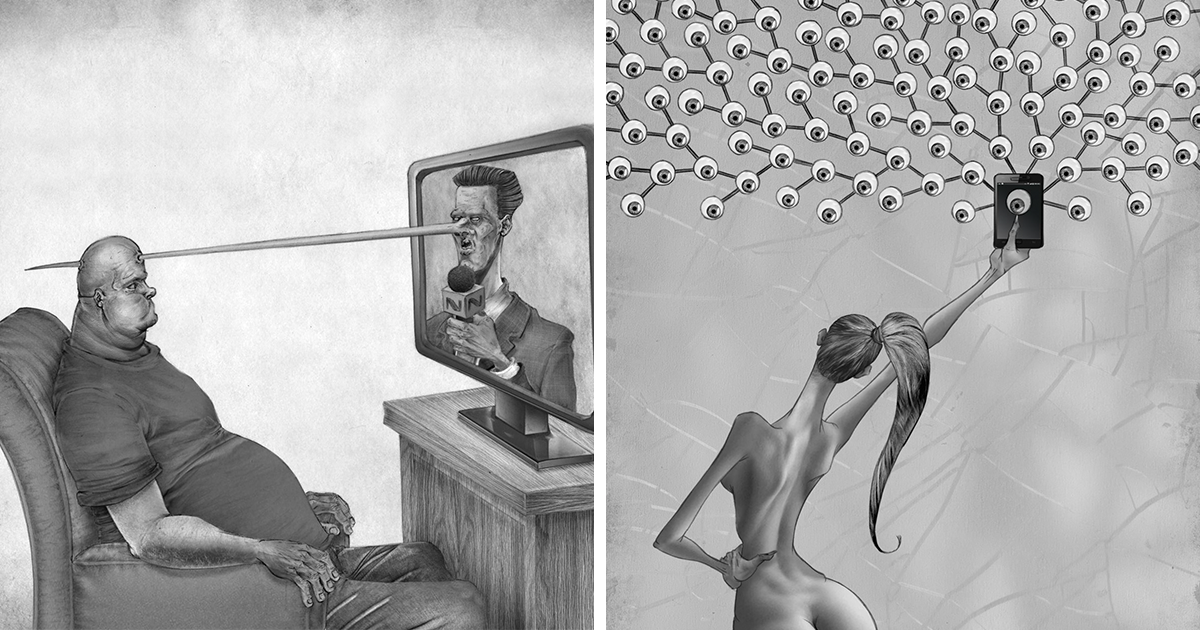
Some artists make pretty pictures for pretty walls. Al Margen walks into the room, flips on the fluorescent lights, and politely ruins everyone’s comfort. That is exactly why his work lands. In a gallery of 58 dark, symbolic illustrations, the Buenos Aires-based artist turns modern society into something that looks both surreal and painfully familiar. His drawings are not gentle little nudges. They are visual elbow jabs. And honestly, society has earned a few.
What makes these images so compelling is not just the gloom, the skeletal faces, or the unsettling symbolism. It is the recognition factor. One drawing can say what a thousand status updates cannot: people are overconnected and undernourished emotionally, glued to screens, trained to consume, desperate to be seen, and somehow still unsure who they are when the Wi-Fi drops. Al Margen’s illustrations work because they do not invent new problems. They expose the ones we have already normalized.
That is why this collection matters beyond art appreciation. These illustrations tap into anxieties that researchers, educators, psychologists, and public health experts have been warning about for years: loneliness disguised as connectivity, social comparison disguised as inspiration, misinformation disguised as confidence, and exhaustion disguised as ambition. In other words, the gallery is not just edgy. It is accurate. A little dramatic, perhaps, but modern life has been auditioning for a dystopian reboot for quite some time.
Why Al Margen’s Visual Satire Hits So Hard
Al Margen’s genius lies in compression. He can reduce an entire social problem into one image that the brain understands instantly. A person chained to a screen. A crowd swallowing headlines without thinking. A body turned into an impossible standard. A human being treated like a product on a shelf. These are not random nightmare doodles. They are social criticism with the volume turned all the way up.
Good satire has two jobs: make you smirk, then make you uncomfortable for smirking. That is the Al Margen formula. His illustrations are heavy on irony, but they are never empty. They ask what happens when technology becomes identity, when attention becomes currency, and when people start performing their lives more than living them. The answer, judging by his work, is not great. Stylish, maybe. Efficient, occasionally. Spiritually nourishing? Not even a little.
His art also succeeds because it avoids the trap of sounding preachy. There is no finger wagging paragraph under each drawing. The viewer has to do some of the moral labor. That matters. When people arrive at a conclusion themselves, it tends to stick. A strong illustration does not bark orders. It lets the viewer feel the absurdity first and name it second. That is far more powerful than another online lecture written in all caps by someone with a ring light and no inner peace.
The Biggest Problems These 58 Illustrations Expose
We Are Constantly Connected and Deeply Disconnected
One of the clearest messages in Al Margen’s work is that modern society has confused contact with connection. We can message instantly, react instantly, post instantly, and still feel profoundly alone. That contradiction sits at the center of much of his visual storytelling. The screen promises closeness, but often delivers performance. We are reachable by everybody and known by almost nobody. There is a difference, and the body knows it even when the feed does not.
That tension helps explain why these illustrations resonate so widely. They capture the strange emptiness of a world where people document dinner, heartbreak, and birthdays in real time but still struggle to feel supported. A culture of perpetual connection can create the illusion that no one should feel lonely anymore. Yet loneliness has not disappeared. It has simply become more embarrassing to admit. Al Margen understands that contradiction and draws it without mercy.
The Attention Economy Is Eating Our Minds Like a Bottomless Buffet
Another recurring theme is mental overstimulation. Modern society is noisy, fast, and relentlessly interruptive. Notifications compete for our eyes. Outrage competes for our emotions. Algorithms compete for our habits. Al Margen’s illustrations often show people being swallowed, steered, or manipulated by forces larger than themselves, which feels like a fair visual summary of life online. We call it scrolling, but half the time it looks more like surrender.
This is where his social critique becomes especially sharp. He is not merely saying people use phones too much. That would be a lazy take. He is pointing to something deeper: the industrialization of attention. Human focus has become a commodity, and society behaves accordingly. The loudest thing wins. The most emotional thing travels fastest. The most polarizing thing gets rewarded. Calm thought does not trend very well. It does not come with dramatic music or a sponsored link.
Consumerism Has Turned Identity Into a Shopping Cart
If Al Margen had a recurring villain, it would be modern consumer culture. His work suggests that society no longer sells products alone. It sells worth, relevance, beauty, belonging, and status in branded packaging. Buy this and become that. Wear this and signal that. Upgrade, optimize, glow up, monetize. Somewhere along the way, people stopped purchasing objects and started renting personalities.
That critique still bites because it feels so normal now. Consumption is not treated as a behavior anymore; it is treated as self-expression, therapy, aspiration, and entertainment all at once. The result is a culture in which wants dress up like needs and dissatisfaction becomes a business model. Al Margen’s illustrations expose that machine beautifully. He reminds us that consumerism thrives when people feel incomplete, because insecurity is one of the few renewable resources society never seems to run out of.
Beauty Standards Have Become More Democratic and More Cruel
In theory, the modern era expanded beauty representation. In practice, it also industrialized comparison. Now everyone has access to the beauty pageant, and everyone is judged in public. Al Margen’s distorted figures, gaunt faces, and exaggerated bodies often feel like a commentary on what happens when appearance becomes both currency and confession. The body stops being a home and starts acting like a résumé under hostile review.
That pressure is not limited to celebrities or influencers. Ordinary people now move through digital spaces where polished faces, edited bodies, and curated perfection show up before breakfast. It is hard to maintain a healthy sense of self when the culture keeps handing out impossible rubrics. Al Margen’s art gets this exactly right: the modern beauty standard is not just unrealistic. It is exhausting. It asks people to perform desirability with the stamina of an Olympic athlete and the emotional budget of a stressed intern.
Misinformation Travels Faster Than Wisdom
Several of Al Margen’s images feel like warnings about media manipulation and passive consumption. Society today often mistakes exposure for understanding. Seeing more headlines does not automatically produce more wisdom. Sharing information does not prove comprehension. Confidence is cheap online, and accuracy is somehow still treated like a premium subscription feature.
That makes his work especially relevant in an era when people increasingly encounter news through feeds, clips, personalities, and algorithmically selected fragments. The problem is not just that falsehood exists. Falsehood now arrives with better packaging, more emotional punch, and fewer brakes. In that environment, people can start consuming information the way they consume fast food: quickly, habitually, and without much nutritional value. Al Margen turns that cultural habit into haunting visual shorthand.
Productivity Culture Has Mistaken Burnout for Character
Modern society loves to say it cares about mental health right before scheduling another meeting that should have been an email and calling it “alignment.” Al Margen’s bleak symbolic style is well suited to the cult of productivity because the whole thing already feels halfway illustrated. Humans are told to optimize every corner of life, monetize hobbies, build personal brands, answer faster, sleep smarter, and somehow remain grateful for the opportunity to become efficient furniture.
What his art exposes is the dehumanizing logic underneath all that hustle. When a person is valued mainly for output, the self becomes secondary to performance. Rest starts feeling suspicious. Reflection looks unproductive. Even joy has to justify itself. No wonder so many of his figures look emotionally underfed. In a culture that treats people like machines, exhaustion stops feeling like a warning sign and starts looking like ambition in a nice blazer.
Visibility Has Replaced Value
One of the smartest themes running through these illustrations is society’s obsession with being seen. Visibility can be empowering, of course. But it can also become a trap. When public attention becomes the main measure of significance, people begin curating themselves for reaction rather than living for substance. The result is a culture where performance expands and interior life shrinks.
Al Margen understands how eerie that transformation can be. His art often suggests that people are being watched, measured, or reshaped by invisible systems of approval. That feels painfully contemporary. In a platform-driven culture, the difference between expression and exhibition can get blurry fast. The more public identity becomes, the more fragile it can feel. A self built for applause tends to panic in silence.
Why These Illustrations Feel More Relevant Than Ever
The reason this gallery still lands is simple: society has not exactly become less complicated, less image-driven, less anxious, or less online. If anything, the contradictions have sharpened. People know more about mental health and still feel overwhelmed. They know misinformation is rampant and still share without checking. They talk about authenticity while curating every angle. They want community while avoiding inconvenience. The modern condition, in short, is very efficient at being emotionally weird.
Al Margen’s work survives the fast churn of internet culture because it addresses root problems rather than temporary trends. He is not fixated on one app, one scandal, or one generation. He is interested in human habits under modern pressure. That is why the drawings feel timeless even when they reference deeply contemporary issues. They ask the big questions that keep resurfacing no matter how the platforms change: What are we becoming? What are we normalizing? And why does progress sometimes feel suspiciously like a prettier cage?
Why Satirical Art Can Say What Articles Sometimes Cannot
There is also a practical reason visual satire matters. People are tired. Long explanations bounce off distracted minds. But a single strong image can cut through noise because it does not require perfect concentration. It lands all at once. It bypasses defenses. It can make a viewer feel implicated before the viewer has time to rationalize. That is not manipulation. That is clarity with excellent timing.
Al Margen’s illustrations demonstrate the continuing power of art in a society drowning in commentary. Everyone has an opinion. Far fewer people have the skill to turn that opinion into a symbol so sharp it lingers. His drawings do that. They turn social critique into something memorable, portable, and emotionally immediate. In a world full of endless takes, that is no small achievement. Sometimes one eerie drawing says more than an entire thread written by somebody who uses “unpack” as a personality trait.
Experiences That Make This Topic Feel Uncomfortably Personal
To understand why Al Margen’s illustrations hit such a nerve, think about what ordinary life feels like now. A person wakes up and reaches for a phone before fully opening both eyes. Overnight notifications have already created a mood. There is news, group chat drama, a polished vacation photo from someone who appears to have perfect skin and zero electricity bills, an ad for something nobody needed ten seconds ago, and a headline designed to make the pulse do cartwheels. Before breakfast, the nervous system has completed a full obstacle course.
Then comes the daily performance layer. At work or school, people are expected to be productive, pleasant, quick, informed, and digitally responsive. They must absorb constant input while still sounding calm in emails and acting normal in meetings. If they slow down, they feel behind. If they disconnect, they feel invisible. If they stay connected too long, they feel fried. It is a remarkable system: society somehow makes people feel guilty both for participating and for stepping away.
Social life has become equally strange. Friends can talk all day through messages and still feel emotionally far apart. A person may know what someone ate, bought, posted, liked, and complained about, yet still have no idea how that person is actually doing. Al Margen’s art captures this perfectly. Modern closeness often looks like access without intimacy. People are visible to one another but not always available in a meaningful way. It is community with an echo.
There is also the pressure of self-presentation. Many people now experience life with an invisible audience in mind. Is this photo good enough? Is this opinion likable enough? Is this success impressive enough? Even private moments can start to feel like draft content. That changes how people move through the world. They stop asking whether something is meaningful and start asking whether it is presentable. That shift sounds small, but it changes everything. It turns life from an experience into a pitch deck.
Appearance pressure adds another layer. The internet did not invent insecurity, but it certainly gave it premium features. A teenager, a young adult, or frankly anyone with a pulse can scroll through a parade of edited perfection and begin negotiating with the mirror like it is a hostile manager. Al Margen’s distorted bodies and unnerving faces reflect that exact tension. They show what it feels like when the outside world keeps handing you an impossible version of who you should be.
Misinformation also makes the experience of modern life feel unstable. People do not just disagree anymore. They often operate from entirely different realities, shaped by wildly different streams of content. One person thinks they are informed because they watched a dozen clips. Another thinks speed equals truth. Another trusts the loudest voice in the room because certainty is comforting. In that environment, confusion is not a side effect. It is part of the atmosphere. Al Margen’s visual language of distortion and unease feels right at home in that fog.
And yet, perhaps the most relatable part of all this is the exhaustion. Not dramatic collapse. Just the daily, low-level fatigue of managing modern life while pretending it is all fine. Too much noise. Too many choices. Too much comparison. Too little stillness. People laugh at memes about burnout because humor is cheaper than a sabbatical. That is why Al Margen’s illustrations linger. They do not merely criticize society from afar. They mirror the lived experience of moving through it. Unsettling, yes. But also clarifying. Sometimes the darkest drawing in the room is the one that finally tells the truth.
Final Thoughts
So what is wrong with today’s society, according to Al Margen’s 58 unsettling illustrations? Quite a lot, apparently. But the deeper answer is this: society keeps building systems that amplify human weakness while advertising them as progress. We are more connected but lonelier, more informed but less discerning, more visible but less grounded, more optimized but more exhausted. His work does not offer easy fixes because easy fixes are usually sold by the same culture that caused the problem in the first place.
What these illustrations do offer is recognition. They remind viewers that the unease they feel is not random, personal failure, or simple nostalgia for a simpler time. It is often a rational response to an environment that is overstimulating, comparison-heavy, commercially aggressive, and emotionally thin. That is why the collection matters. It does not just criticize modern society. It helps people see it. And once people can see the absurdity clearly, they might be a little less willing to keep calling it normal.