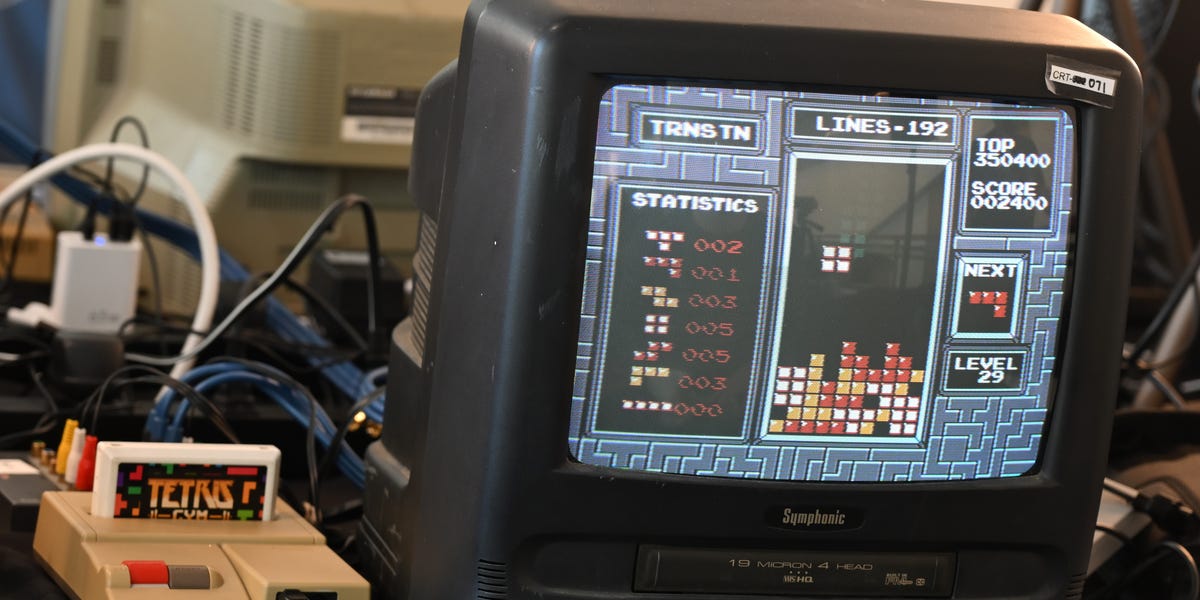
There is a special kind of disappointment that arrives the moment you plug an old console into a modern flat-panel TV and realize the game does not look “retro” so much as “slightly damaged.” The colors feel off, the motion feels a beat behind, and the whole thing can turn a beloved classic into a clinical museum exhibit. That is exactly why CRTs keep coming back into retro-gaming conversations: they display 240p-era games the way they were originally designed to be seen, with scanlines, phosphor glow, and an immediacy modern sets often fail to reproduce.
Why the pairing still makes sense
A vintage gaming console is not merely old hardware; it is hardware built around the assumptions of its era. The NES, SNES, Genesis, PlayStation, Saturn, Nintendo 64, and their peers were all created for displays that handled low-resolution progressive video in a very different way from today’s fixed-pixel screens. On a CRT, the image is drawn so quickly and naturally that motion feels immediate, while the beam-and-phosphor behavior creates the familiar soft edges and scanline rhythm that many games relied on visually. That is one reason retro enthusiasts keep saying the same thing in slightly different forms: the CRT does not just show the game, it completes it.
Popular Mechanics recently put the point bluntly: if you want your old console’s games to look the way you remember them, a CRT TV is the right display for the job. That statement is less about blind nostalgia than it is about the actual relationship between old video signals and old display technology. Modern TVs are optimized for sharp native resolution, while retro consoles were built around composite, component, RGB, or RF paths that CRTs handled gracefully with minimal fuss.
The picture is not just softer. It is more authentic.
One of the biggest reasons CRTs remain beloved is that they do not make old graphics look artificially “clean.” Instead, they preserve the blended look that game artists and hardware engineers expected. Wired describes CRTs as smoothing the experience and hiding flaws in a way that feels almost like rose-colored glasses for retro games, while also explaining how 240p and scanlines shape the visual personality of the medium. That softness is not a defect in this context; it is part of the art direction.
This matters especially for sprite-based games and early 3D titles. On a CRT, pixel clusters, dithering tricks, and blending effects can look surprisingly elegant because the display is literally helping the image fall into place. Modern displays often expose every raw edge, every rough transition, and every compromise in the original art assets. What once looked like a vibrant, pulsing world can suddenly resemble a spreadsheet of colored squares. That is not the console’s fault. That is the television being too honest.
Scanlines are not decoration; they are part of the language
Scanlines are often talked about like a filter, but on a CRT they are a natural byproduct of how the image is drawn. The darker gaps between lines, plus the glow of the phosphors, help create contrast and visual depth that many retro games were implicitly built around. RetroRGB and The Verge both note that CRT-style presentation is still prized because it feels like the original format rather than an approximation layered on top later. In practice, that means a good CRT can make a 16-bit platformer look crisp without making it sterile.
Input lag is the hidden villain modern TVs introduce
The most famous reason serious retro players keep a CRT around is latency. CRT televisions process images with astonishing speed because the display is analog and does not need to scale, buffer, or recompose the signal in the same way many modern televisions do. How-To Geek notes that CRTs have extremely fast image processing and can be well under a few milliseconds, while The Verge points out that games like Super Smash Bros. Melee feel noticeably different on a CRT because reaction timing changes even by a little.
That tiny delay may not matter much if you are wandering through an RPG town or pausing to admire a title screen, but it matters a lot in fighting games, rhythm games, shmups, and anything else that rewards frame-perfect timing. A console made for the living room of the 1990s expects a television that behaves like a living-room television of the 1990s. A modern TV can be excellent, but the best of them still have to work harder to interpret an old signal, and that extra work can show up as lag, scaling artifacts, or aspect-ratio weirdness.
This is why retro hardware enthusiasts often talk about “feel” rather than just image quality. A game can look acceptable on an LCD and still feel wrong under your thumbs. The controller input reaches the game, the game responds, and the screen should answer immediately. CRTs do that with a kind of effortless confidence. Modern TVs sometimes feel like they are checking their calendar first.
Some old tricks only make sense on old screens
Light guns are the most obvious example. RetroRGB explains that classic light-gun peripherals are tied to the timing behavior of the television itself, which is why they work naturally on CRTs and become a headache on modern LCDs. That means the NES Zapper, the Sega Menacer, and similar accessories were not merely “compatible” with CRTs; they were designed around the way CRTs scanned the image. Once that timing changes, the magic breaks.
There is also the matter of composite, S-Video, component, and RGB. CRTs were comfortable with the messy analog world that consoles lived in, while modern TVs usually want to convert that signal before they can show it. In that conversion, little pieces of the original presentation can disappear. Some players spend a fortune on scalers and upscalers trying to recover the look. Others eventually realize they already owned the right solution in the basement or garage twenty years ago.
Why repair culture matters now
CRTs are not being made anymore, which is why repair specialists and preservation enthusiasts have become such a big part of the retro scene. GameSpot has profiled the technicians keeping old CRTs alive, and that repair culture exists for a reason: the best display for an original console is increasingly a scarce object. The irony is beautiful and annoying in equal measure. The hardware outlived the industry’s expectations, but not the supply chain.
Why modern solutions are good, but not identical
It would be unfair to pretend every modern alternative is bad. There are excellent scalers, HDMI mods, FPGA consoles, and display modes that do a remarkably good job of recreating CRT-like presentation. Ars Technica and The Verge have both covered modern retro devices that chase authenticity with scanline modes, upscaling, and low-lag output, including Analogue hardware and MiSTer-style solutions. For many players, those are fantastic options. But even the best simulated CRT effect is still simulation. A real CRT has the exact glow, depth, decay, and motion behavior that software can imitate only approximately.
That distinction is why people keep arguing about “the best” way to play retro games. Some want convenience, some want accuracy, and some want the emotional memory of sitting in front of a bulky beige or black box with a controller cable stretching just far enough across the carpet. A modern display can offer brilliant convenience. A CRT offers historical honesty. For vintage consoles, that honesty is often the better fit.
Picking the right CRT without turning the hobby into a full-time job
You do not need a giant broadcast monitor to enjoy retro gaming. In fact, many enthusiasts prefer a modest 13-inch, 20-inch, or 27-inch consumer set because it feels closer to how these consoles were used in ordinary homes. RetroRGB notes that preferences differ depending on whether someone wants the sharper feel of a pro monitor or the softer, more nostalgic look of a living-room set. The important thing is not to fetishize specs so hard that you forget to play the game.
It also helps to remember that certain models and inputs matter more than others. Many retro gamers look for composite, S-Video, component, or RGB support, plus a set that is physically healthy and free from major geometry issues. How-To Geek has also warned that not every CRT is equally friendly to retro gaming, and some sets simply distort the image too much at the edges. In other words: a good CRT is a joy, but a bad CRT can still be a headache wearing a nostalgic costume.
Field notes from living with a CRT and an old console
The first thing people notice when they go back to a CRT is not always the picture. It is the ceremony. You lift the set carefully because your back starts negotiating before your brain does. You find the right cable, maybe wipe the dust off the top, and hear that familiar click as the power comes on. Then the screen blooms into life with a soft, organic glow that feels less like a device waking up and more like a small universe turning on in the corner of the room.
The second thing you notice is how the game seems less like a set of pixels and more like a living illustration. A platformer that felt harsh and angular on a 4K panel suddenly looks warm and complete. A survival horror game becomes moodier because the blacks behave differently. A racing game feels more present because the motion is not being translated, buffered, and reinterpreted by a television menu designed for streaming apps. Even the menu sounds seem to land differently when the screen itself has the right texture.
There is also a little emotional trick that happens once you settle in. You stop comparing the game against screenshots, YouTube clips, and “best settings” posts. You start comparing it against memory, which is the real battleground here. That is where the CRT wins most often. It does not present the past as a polished remix. It presents it as a familiar room you somehow walked back into after years away.
This is why so many retro players protect their CRT setups even when they own excellent modern gear. The modern gear is convenient, precise, and technically impressive. The CRT is comfortable in a different way. It gives old hardware the same kind of television it grew up with, and the result is not just nostalgia. It is coherence. Everything lines up: the console, the cable, the image, the latency, the sound, the memory of when games were played on furniture that weighed more than a refrigerator.
There is a practical side too. Light guns work. Motion feels honest. 240p content lands naturally. Scanlines appear without drama. Games that rely on timing, like fighters and shooters, feel less like they are being interpreted by a machine and more like they are being delivered straight through it. When retro enthusiasts say a CRT makes a vintage console “feel right,” they are usually talking about all of that at once.
And yes, there is still a little bit of magic in the absurdity of it all. A modern household can stream movies in 4K, play cloud games, and sync lights to music, yet a twenty-year-old or thirty-year-old TV can still be the best machine in the room for a cartridge that was designed before widescreen was normal. That is one of the most charming things about old game hardware: it never stopped being exactly what it was.
Spend an evening with a vintage console on a real CRT and you may notice how the room feels different too. The screen is not just an endpoint for a digital signal. It is a physical object making light in real time, with all the subtle softness and movement that modern displays try so hard to eliminate. For retro games, that softness is not a compromise. It is part of the tone. Part of the rhythm. Part of the reason a blue sky in a platformer can still feel big enough to get lost in.
Final verdict
If the goal is convenience, almost any modern display will do. If the goal is to understand why vintage console games looked and felt the way they did in the first place, a CRT is still the cleanest answer. It respects the signal, preserves the timing, restores the scanline-era look, and keeps legacy accessories alive in the bargain. For retro gaming, the display is not an accessory. It is part of the console’s identity. That is why a vintage gaming console still deserves a vintage CRT TV.
SEO Tags
Note: This article is an original synthesis of recent U.S. coverage on retro gaming and CRT display behavior.