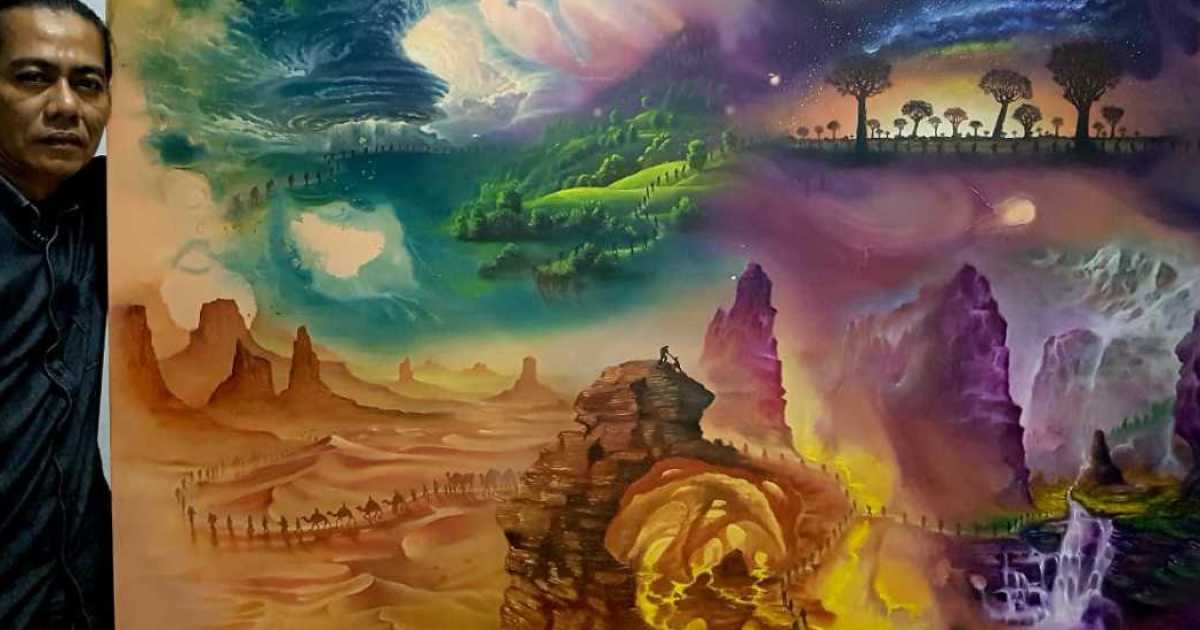
Some paintings politely ask for your attention. Veri Apriyatno’s work walks into the room, pulls up a chair, and says, “Look closer.” Then, just when you think you have seen everything, it reveals another layer: a reflection, a traveler, a symbolic road, a quiet question about where we are going and why we packed so much emotional luggage.
The Indonesian contemporary artist is widely known for hyperrealistic drawing, deeply detailed portraits, and images that feel almost photographic. Yet his oil and mixed-media works, especially pieces connected with the theme of Nomads, show another side of his vision. They are not only technical displays. They are visual journeys about movement, uncertainty, survival, memory, and the human search for a final destination.
In a digital world where people scroll past art faster than they scroll past cookie-policy pop-ups, Apriyatno’s paintings slow everything down. His work rewards patience. It asks viewers to pause, breathe, and notice the small details that turn an artwork from a “nice picture” into a full emotional weather system.
Who Is Veri Apriyatno?
Veri Apriyatno is an Indonesian contemporary artist associated with Jakarta and Bogor, and he has built an international reputation through realistic drawing, painting, exhibitions, books, and online art education. Born in 1973, he studied painting at the Bandung Institute of Technology, one of Indonesia’s most respected art institutions. His academic training gave him a strong foundation in composition, anatomy, observation, and visual storytelling.
What makes Apriyatno especially interesting is that he is not trapped inside one neat little label. He is a painter, draftsman, teacher, author, and content creator. He has published drawing tutorial books, developed realistic art courses, and built a large online audience by sharing process videos. In other words, he does not guard technique like a dragon sleeping on a pile of pencils. He teaches it.
His recognition includes awards such as the Windsor & Newton Millennium World Wide Award, the Jakarta Art Award, and the Bandung Contemporary Art Award. His exhibition history also includes solo and group shows in Indonesia, demonstrating that his career is not merely an internet phenomenon. The likes, shares, and comments are real, but so is the long studio discipline behind them.
The Power Behind “Nomads”
The word nomads immediately suggests movement. It brings to mind people crossing open land, carrying what they need, leaving behind what they cannot keep, and trusting the road because standing still is not an option. In Apriyatno’s Nomads theme, the subject becomes more than travel. It becomes a metaphor for the human condition.
We are all nomads in one form or another. Some people move across countries. Some move between careers. Some move through grief, ambition, doubt, love, and reinvention. Some simply move from Monday to Friday with the heroic endurance of a person whose coffee machine has betrayed them. Apriyatno’s work speaks to that universal motion.
Public references to “NOMADS” describe it as an oil-on-canvas work from 2019, while another related listing mentions “NOMADS #2” as a mixed-media work using acrylic and oil on canvas. These details matter because they show Apriyatno expanding beyond his famous graphite and charcoal practice into painterly surfaces where color, texture, and brushwork carry the emotional weight.
The Final Destination: A Spiritual and Visual Question
The phrase “final destination” adds gravity to the Nomads theme. It suggests that movement is not random. The traveler is not simply wandering for the sake of dramatic lighting and excellent composition. There is a deeper question: Where does the journey lead?
Apriyatno has also publicly connected the idea of life to a soul’s journey toward a final destination in his broader artistic messaging. That spiritual framing fits naturally with the Nomads imagery. The road becomes more than a road. The figure becomes more than a figure. The landscape becomes a stage for reflection, almost like the canvas is whispering, “Yes, you have errands, but also, what is the meaning of existence?” Very casual. No pressure.
In this reading, the nomad is not only a traveler. The nomad is a symbol of every person who keeps going without knowing the entire map. The destination may be physical, emotional, or spiritual. It may represent peace, death, belonging, enlightenment, or simply the moment when a restless person finally understands why the journey had to happen.
Why Apriyatno’s Oil Painting Style Feels So Alive
Apriyatno’s best-known works often demonstrate a hyperrealistic command of texture. His celebrated series “The Witnesses” features eyes rendered with extraordinary detail, including reflections that create tiny worlds inside the gaze. That same discipline helps explain why his oil paintings can feel so convincing.
Oil painting is a demanding medium. It can be luminous, stubborn, forgiving, and occasionally as moody as a cat near bathwater. It allows an artist to build layers slowly, deepen shadows, soften transitions, and create rich atmospheric effects. For a painter interested in realism and symbolism, oil offers both precision and mystery.
In the Nomads-related works, the medium supports the theme. Oil can make skin, cloth, dust, light, and distance feel tactile. It can make a road look hot, a sky look endless, and a face look heavy with thought. The viewer does not only see the traveler; the viewer senses the journey.
Hyperrealism With a Soul
Many technically gifted artists can make an image look real. That is impressive, of course. Most of us are still trying to draw matching eyes on a stick figure. But the deeper achievement is making realism feel meaningful. Apriyatno’s art often does exactly that.
His realism is not cold. It does not say, “Look how perfectly I painted this eyelash.” It says, “Look at this eyelash, and then look at the world reflected beyond it.” In his figurative and narrative works, detail becomes a doorway. The surface is beautiful, but the emotional pull comes from what the surface reveals.
This is why the Veri Apriyatno oil painting conversation is bigger than technique. The brushwork, anatomy, proportion, and light are all important, but they serve a story. The viewer is invited to think about identity, movement, time, and the strange human habit of looking for home while constantly changing.
The Nomad as a Contemporary Symbol
Nomad imagery feels especially relevant today. Modern life is full of movement: migration, remote work, changing cities, shifting identities, digital communities, and the constant search for stability. Even people who never leave their hometown may feel mentally nomadic, moving between versions of themselves.
Apriyatno’s Nomads theme can be read through this modern lens. The painting does not need to explain everything. It does not need a caption the length of a grocery receipt. A solitary figure, a path, a wide space, and the suggestion of a destination can say enough.
That restraint is part of the appeal. The painting leaves room for viewers to bring their own stories. One person may see migration. Another may see spiritual pilgrimage. Another may see artistic struggle. Another may see the emotional state of anyone who has ever opened a GPS app and still missed the exit.
Composition, Atmosphere, and the Road Ahead
In journey-themed painting, composition is everything. The placement of the figure, the direction of light, the scale of the landscape, and the balance between empty space and detail all shape the mood. A small figure against a vast background can make the journey feel lonely. A strong diagonal path can create urgency. A glowing horizon can suggest hope, even if the traveler looks exhausted enough to negotiate with a cactus.
Apriyatno’s broader artistic practice shows a strong understanding of visual drama. His hyperrealistic eye works use reflection as a compositional device. His portraits use expression and texture. In the Nomads works, the road or landscape can function in a similar way: not as decoration, but as psychological space.
This gives the painting cinematic energy. It feels like a still frame from a story already in motion. We do not know exactly what happened before the scene, and we do not know what happens after. That uncertainty is the hook.
Why Viewers Connect With Veri Apriyatno’s Work
Apriyatno’s audience connects with his art because it offers both immediate visual satisfaction and deeper interpretation. At first glance, viewers admire the technical skill. At second glance, they begin to notice emotional clues. At third glance, they may start wondering whether the painting is about the character, the artist, or themselves. That is when the artwork has officially moved into the viewer’s head rent-free.
His online presence also plays a role. By sharing tutorials and process videos, Apriyatno makes the act of creation visible. Viewers see not only the finished image but the labor behind it. This turns admiration into trust. The audience understands that the work is not produced by artistic magic alone. It comes from patience, study, correction, and many hours of looking carefully.
That transparency strengthens his reputation as both an artist and educator. He is not only showing what is possible; he is showing that possibility is built one mark at a time.
Oil Painting, Memory, and Human Movement
The beauty of an oil painting about nomads is that oil itself feels historical. It carries centuries of artistic tradition, from portraits and landscapes to religious scenes and modern realism. When Apriyatno uses oil to explore wandering and destination, the medium quietly deepens the theme.
Oil paint has a memory-like quality. Layers remain beneath layers. Earlier decisions influence later surfaces. A highlight depends on the shadow beneath it. A finished face contains invisible corrections. That process mirrors human experience. We are all layered beings, carrying earlier journeys under the visible surface.
In this sense, the Nomads theme becomes beautifully suited to the medium. The traveler on the canvas may be moving forward, but the painting itself is built from accumulated time. That is a poetic match: movement expressed through patience.
Specific Examples From Apriyatno’s Broader Art Practice
To understand why the Nomads works feel compelling, it helps to look at Apriyatno’s broader career. In “The Witnesses,” he uses the human eye as both subject and window. The eye is rendered with realistic detail, but the reflection inside it expands the meaning. The viewer is not only looking at an eye; the viewer is looking at what the eye has seen.
That same conceptual method can be applied to the Nomads theme. The traveler is not only a body in motion. The traveler becomes a container of unseen stories. What has this figure witnessed? What has been lost? What destination could justify such a journey?
Apriyatno’s realistic portraits and drawing tutorials also reveal his devotion to structure. His art education content often emphasizes observation, proportion, anatomy, and step-by-step development. These skills are essential in painting a convincing figure within a symbolic landscape. Without technical control, the message may become vague. With too much control and no feeling, the painting may become stiff. Apriyatno’s strength lies in balancing both.
The Emotional Message of “The Nomads And The Final Destination”
The strongest emotional message of the series is that the journey matters because the destination is unknown. If the final destination were obvious, the painting would become a travel brochure. Instead, it feels like a meditation.
There is also a quiet humility in the nomad figure. The traveler does not dominate the world. The traveler moves through it. That difference is important. The image suggests that human beings are temporary guests in a much larger landscape. We cross, search, rest, continue, and eventually disappear into whatever horizon waits for us.
That may sound heavy, but Apriyatno’s visual beauty keeps the experience from becoming bleak. The work offers dignity. It suggests that movement itself can be meaningful, even when the path is difficult. The final destination may be far away, but the act of continuing has its own grace.
Experience Section: Standing With the Nomads
Experiencing a painting like Veri Apriyatno’s Nomads is not like glancing at a decorative image above a couch and saying, “Nice, it matches the pillows.” It feels more like standing at the edge of a story. The first experience is visual: the texture of the paint, the mood of the light, the scale of the figure, and the silence of the surrounding space. Then the second experience begins, and that one is personal.
For many viewers, the nomad becomes a mirror. You may start by asking where the figure is going, then suddenly realize you are asking the same question about yourself. That is the sneaky brilliance of symbolic art. It starts with someone else’s journey and somehow ends up reading your emotional diary without permission.
The painting can also change depending on the viewer’s mood. On one day, the traveler may seem lonely. On another, brave. On another, peaceful. This flexibility is part of what makes the theme powerful. Great narrative art does not lock itself into a single meaning. It gives the viewer room to walk around inside it.
Artists and students can learn a great deal from the experience. The work demonstrates how realism can support metaphor without becoming stiff or overly literal. A painting does not need dramatic explosions, neon colors, or a title written in all caps to feel intense. Sometimes a quiet figure, a controlled palette, and a carefully built atmosphere can create more emotional pressure than a hundred visual fireworks.
Collectors and art lovers may appreciate the way Apriyatno connects technical discipline with universal themes. His art is accessible because viewers can recognize the subject, but it is not shallow. The recognizable surface becomes an entry point into bigger ideas: journey, identity, mortality, faith, memory, and hope.
There is also something refreshing about seeing an artist with a strong educational presence continue to produce work that feels personal and exploratory. Apriyatno is not simply demonstrating skill for applause. He is using skill as a language. The Nomads theme shows that technical mastery becomes most powerful when it carries emotional meaning.
In the end, the experience of viewing this painting series is similar to walking beside a traveler for a short distance. You may not know where the road ends. You may not even know where it began. But for a moment, you understand the movement. You understand the fatigue, the hope, and the strange beauty of continuing forward. And if a painting can make a viewer feel all that without saying a word, it has done more than decorate a wall. It has opened a door.
Conclusion
Veri Apriyatno – Amazing Oil Painting That Illustrates The Nomads And The Final Destination is more than a title with excellent search-engine stamina. It points to the heart of Apriyatno’s artistic appeal: his ability to combine realism, symbolism, and emotional storytelling. His background in painting, his reputation for hyperrealistic detail, his educational work, and his journey-themed oil and mixed-media pieces all contribute to a body of work that feels both technically impressive and deeply human.
The Nomads theme invites viewers to reflect on movement, uncertainty, and the final destination every life eventually approaches. Apriyatno’s art reminds us that the road matters, the details matter, and sometimes the most powerful images are the ones that do not explain themselves too quickly. They simply wait for us to arrive.
Note: This article is based on publicly available information about Veri Apriyatno, including artist profiles, art coverage, education pages, and public references to his Nomads-related works. It avoids unsupported claims about private collections, current pricing, or unverified exhibition schedules.