Note: This article examines a selection of 30 photographs from Richard Renaldi’s Typology of the American Teenager and places the series within the broader context of his portrait practice and the tradition of photographic typologies.
Ask someone to describe “the American teenager,” and the answer will probably collapse under the weight of its own stereotypes. Hoodies. High school hallways. Earbuds. Eye rolls powerful enough to alter local weather patterns. But the moment a camera actually faces individual teenagers, the tidy category begins to fall apart.
That tension is at the heart of Richard Renaldi’s Typology of the American Teenager, a black-and-white portrait series featuring young people photographed across the United States. A widely shared selection of 30 images introduced many viewers to a body of work that feels both systematic and deeply personal. There are solo portraits, pairs, and groups. Some subjects appear self-assured; others seem guarded, playful, serious, restless, or simply caught in that wonderfully confusing space between childhood and adulthood.
The photographs do not announce a grand theory of adolescence. They do something more interesting: they keep looking.
What Is “Typology of the American Teenager”?
Typology of the American Teenager is part of Richard Renaldi’s long engagement with portraiture and the American social landscape. The project gathers portraits of teenagers from different places and backgrounds, with images in the published series spanning much of the 2010s. A 2023 feature presented 30 of these photographs to a broad online audience, highlighting the variety of faces, friendships, styles, and social arrangements within the project.
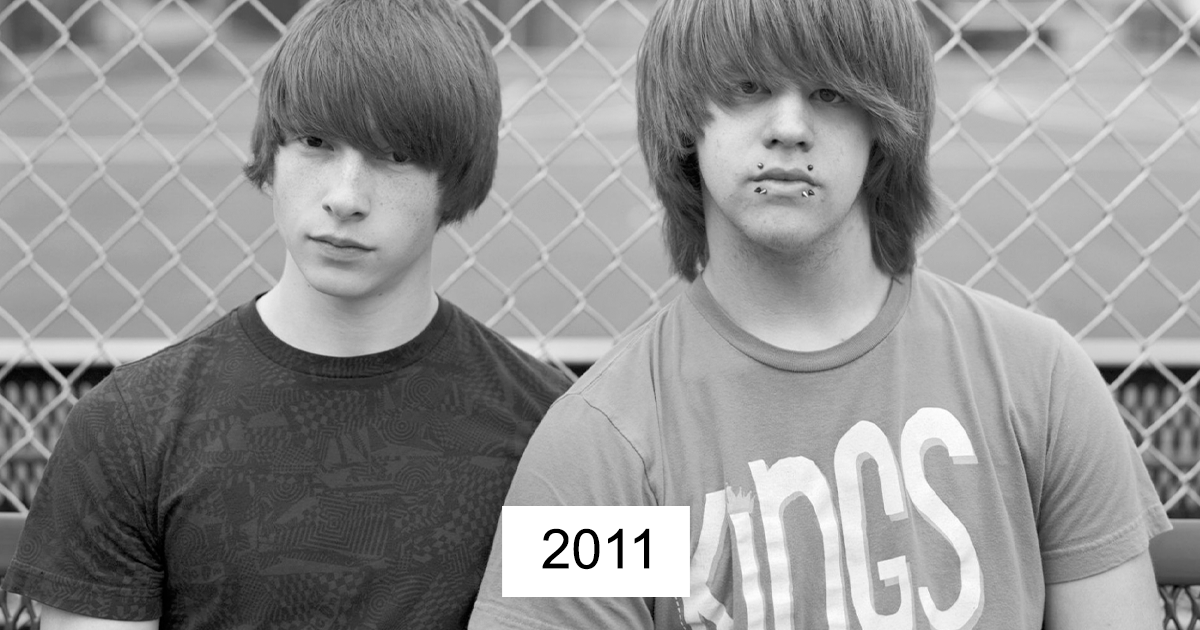
Titles such as Navajo Girls, 2010, Wes and Dedrick, 2011, Benny and Doris, 2010, Bianca, Shailah, Kayla, and Ashley, 2011, Katia, 2017, and Ben and Layden, 2019 give viewers just enough information to begin looking without supplying a complete biography. That restraint matters. We know names, groupings, and dates, but the pictures do not hand us a convenient explanation of who these people are.
Instead, we study posture. Clothing. Distance. Hands. Eye contact. The gap between two friends. The way one person leans while another stands rigidly upright. The teenager becomes not a sociological statistic but a physical presence.
The Clever Contradiction Inside the Word “Typology”
A typology usually organizes subjects according to shared characteristics. Photography has a long history of such projects, perhaps most famously in August Sander’s monumental effort to portray the social landscape of twentieth-century Germany through recognizable groups and occupations.
Renaldi’s title invites that history into the room, but Typology of the American Teenager also quietly resists the idea that one neat system can contain its subjects. The category is clear: these are teenagers in America. Everything after that gets messyin the best possible way.
There is no single teenage uniform. No universal pose. No required level of rebellion. Some subjects look as though they have mastered the camera before the photographer even arrived. Others seem to be deciding whether this whole portrait business is worth interrupting their afternoon for.
That is where the series becomes more than a catalog. The repeated structure encourages comparison, but comparison reveals difference. The more faces we see, the less useful the phrase “typical American teenager” becomes.
Richard Renaldi and the Art of Meeting People
Renaldi was born in Chicago in 1968 and received a BFA in photography from New York University in 1990. His career has been built around long-term photographic projects, particularly portraits of people encountered in public spaces. Early in his professional life, he worked as a researcher and editor at Magnum Photos and Impact Visuals, while developing his own street portrait projects.
His best-known bodies of work include Figure and Ground, Fall River Boys, Touching Strangers, and Manhattan Sunday. Across these projects, Renaldi repeatedly returns to a deceptively difficult question: what can happen when a photographer asks another person to stop, stand still, and be seen?
That question sounds simple until you try it. Photographing strangers requires social courage, patience, negotiation, and the ability to accept rejection without turning into a puddle beside your tripod.
Renaldi has spoken about portraiture as a complicated practice, especially when working with people encountered on the street. His broader photographic method is associated with slow, deliberate portrait-making and large-format photography. Unlike the nearly invisible act of snapping a phone picture, this kind of process makes the photographic encounter obvious. A portrait is being constructed. The subject knows it. The photographer knows it. The interesting part is what they create together.
Why These 30 Teenage Portraits Feel So Immediate
The photographs respect the power of the ordinary
Nothing needs to explode. Nobody has to perform a viral dance. There is no dramatic caption begging the viewer to feel something on schedule.
The photographs work because ordinary details become meaningful when we are allowed enough time to notice them. A graphic T-shirt, a pair of boots, a hand resting on a friend’s shoulder, or a backpack strap can help establish how someone wishes to occupy the world at that particular moment.
Teenage identity is often discussed through huge themesgeneration, technology, education, politics, fashion. Renaldi brings the scale back down to the individual body. How does this person stand? Where do they look? How comfortable are they beside someone else?
The answers are never complete, but incompleteness is part of the appeal.
Friendship becomes visible without being explained
Many of the strongest images feature pairs and groups. These photographs invite viewers to study social chemistry.
In a group portrait, tiny gestures become a language. One teenager takes up space while another hangs back. Someone touches a friend casually. Two people mirror each other without appearing to notice. Clothing may suggest shared taste or complete stylistic independence.
Yet the photographs do not provide enough information to turn those relationships into fixed stories. Are the subjects lifelong friends? Classmates? Siblings? A couple? People who simply happened to be together that day?
The temptation to invent an answer is powerful. That instinct says as much about the viewer as it does about the image.
Individual style works like a personal vocabulary
Teenagers have long used clothing, hair, accessories, and posture to experiment with identity. Renaldi’s photographs preserve those choices without turning the series into a fashion catalog.
Because the images span years within the 2010s, viewers can also notice the strange speed at which visual culture changes. A haircut that once felt completely contemporary can suddenly become a timestamp. A logo, silhouette, or pair of shoes may quietly reveal an era before the viewer consciously recognizes it.
That is one reason portraits gain value with time. The subject remains the center of the photograph, but everything around the subject slowly becomes historical evidence.
Black-and-White Photography Removes One Kind of Noise
The use of black and white gives the series a visual consistency that helps photographs made in different places and years speak to one another.
Color can be wonderfully descriptive, but it can also dominate attention. A bright sweatshirt, painted wall, or advertisement may become the loudest thing in a frame. In these monochrome portraits, texture and tone take greater responsibility. Skin, hair, fabric, pavement, trees, and architecture become part of a shared tonal world.
The result is not timelessness in the literal sense. The subjects still belong to specific moments. Their clothes and environments contain clues. But black and white creates enough distance from everyday visual clutter to encourage slower observation.
It also gives the full series cohesion. A teenager photographed alone on a path and a group sitting together in a public space can feel like pages from the same visual investigation rather than unrelated snapshots.
The Camera Catches Performanceand Something Beyond It
Every portrait contains performance. The instant someone realizes a camera is pointed at them, behavior changes. Adults do it. Children do it. Teenagers, who are often intensely aware of how they appear to other people, may be especially interesting subjects because self-presentation is already part of daily life.
Some of Renaldi’s subjects meet the camera directly. Their gaze seems confident, skeptical, or challenging. Others appear more inward. A few group portraits contain multiple emotional temperatures at once, which is approximately how most group chats work too.
The fascinating question is not whether a pose is “authentic.” A pose can be revealing precisely because it is chosen. The way someone wants to be seen is part of who they are at that moment.
Renaldi’s portraits leave room for both performance and uncertainty. That balance keeps the photographs from becoming simple illustrations of teenage types.
America Appears Through People Rather Than Symbols
A project about American teenagers could easily become a parade of familiar national imagery: flags, football fields, yellow school buses, diners, suburban lawns. Renaldi’s approach is less interested in forcing the country to announce itself.
America emerges through variation.
The series places different young people within one broad photographic framework while allowing difference to remain visible. Race, community, geography, fashion, friendship, and social setting all contribute to the larger picture, but no single portrait is asked to represent an entire population.
That distinction is crucial. A photograph can show a person, but viewers often rush to make that person symbolic. The title Typology of the American Teenager almost dares us to do so, then supplies enough variety to frustrate our shortcuts.
One portrait cannot explain American adolescence. Thirty cannot either. The series becomes compelling because it understands that limitation.
Looking at Teenagers Without Turning Them Into Stereotypes
Images of teenagers are frequently framed through adult anxiety. Young people are described as a problem to solve, a market to sell to, a generation to diagnose, or an audience whose attention must be captured before they scroll away.
Renaldi’s portraits offer a useful alternative: sustained attention without an obvious verdict.
The subjects are not presented as evidence that “kids today” are better, worse, stranger, lazier, more connected, or more doomed than previous generations. They are simply complicated individuals standing in front of a camera.
That does not make the photographs neutral. No portrait is completely neutral. The photographer chooses whom to approach, where to stand, when to release the shutter, and which images belong in a series. Editing creates meaning.
But the absence of heavy explanatory captions gives viewers less permission to confuse assumption with knowledge. We can observe expressions and relationships; we should be careful about pretending we know the full lives behind them.
What Photographers Can Learn From the Series
Typology of the American Teenager offers several lessons for anyone interested in portrait photography.
Consistency does not require sameness
A strong series needs a unifying idea, but every frame does not have to be mechanically identical. Renaldi’s subjects vary in number, setting, posture, and personality. The project remains coherent because its central inquiry is clear.
A portrait can be descriptive without becoming overexplained
Viewers often remember photographs that leave room for curiosity. Too much explanation can close an image before the viewer has had time to enter it.
Relationships are photographic subjects too
A group portrait is not simply several individual portraits squeezed into one frame. Distance, touch, hierarchy, discomfort, affection, and rhythm become part of the composition.
Long-term projects gain meaning through accumulation
One teenager is a portrait. Many portraits made over years can become an archive. Repetition allows subtle differences to become visible, and time adds layers the photographer cannot completely control.
Why the Series Feels Even More Valuable With Time
The teenagers photographed in the early 2010s are adults now. That simple fact changes how we look at the pictures.
A portrait always contains at least two time periods: the moment when it was made and the moment when it is viewed. As the distance between those moments grows, details that once seemed ordinary become culturally specific. Hairstyles become historical. Clothes become clues. Public spaces change. Entire technologies disappear into drawers beside mysterious charging cables.
Yet the emotional uncertainty of adolescence remains recognizable.
This combinationhistorical specificity and emotional continuityis one of portrait photography’s great strengths. The image preserves a person as they were, while the viewer arrives later carrying a completely different present.
Final Reflection: The Experience of Looking Slowly at “Typology of the American Teenager”
The most rewarding way to experience this series is to resist the habit of speed.
Online, 30 photographs can disappear in less than a minute. Scroll. Glance. Like. Next. The thumb is an efficient machine, but efficiency is not always the friend of seeing. Renaldi’s portraits become more interesting when each one is given enough time to become slightly uncomfortable.
At first, a viewer may notice the obvious: a face, an outfit, a hairstyle, the number of people in the frame. Stay longer, and smaller questions arrive. Who seems most comfortable? Who is performing confidence? Does the physical space between two people feel casual or significant? Is a serious expression actually serious, or simply the neutral face a person made while waiting for a large camera and photographer to finish doing complicated camera things?
Then another experience begins. The viewer starts comparing photographs.
A solitary teenager may seem more vulnerable after looking at several confident groups. A pair of friends may suddenly feel unusually close after another portrait in which two subjects occupy the same frame but appear emotionally miles apart. A direct gaze that initially seemed defiant may look calm when placed beside a more visibly guarded expression.
This is where the “typology” becomes active. The series trains the eye to notice difference through repetition.
There is also a peculiar experience for adult viewers: recognition mixed with distance. Most adults remember being teenagers, but memory is an unreliable photo editor. It crops out long afternoons, bad haircuts, awkward silences, intense friendships, and the astonishing importance of things that later became trivial. We tend to replace the actual teenager we were with a cleaner narrative.
These portraits interrupt that simplification.
They remind us that adolescence is not merely preparation for adulthood. A teenager is not an unfinished adult waiting for the software update to complete. The lives in these photographs were already happening. Friendships mattered immediately. Style mattered immediately. Belonging and loneliness mattered immediately. Whatever happened later does not reduce the importance of the person standing before the camera then.
For younger viewers, the experience may be different. The photographs can function as a near-history of youth culture from the 2010s, close enough to feel familiar but distant enough for certain details to look unmistakably dated. That transformation happens faster than anyone expects. Today’s completely ordinary outfit is tomorrow’s documentary evidence.
The series can also change how a person looks at strangers in everyday life. Spend enough time with portraits and public spaces begin to feel visually louder. A group waiting outside a store becomes a study in posture. Two friends on a bench become a composition. Someone standing alone at the edge of a crowd becomes impossible not to notice.
That may be the most valuable experience connected to Renaldi’s work: it restores curiosity to looking.
Photography can categorize people, but good portraiture complicates the categories it creates. Typology of the American Teenager begins with a broad label and ends with individuals. The project gives us American teenagers, pluralnot a single definitive teenager who somehow represents millions of people while also finishing algebra homework.
The 30 photographs are captivating because they do not solve adolescence. They preserve encounters with it.
Years pass. The subjects grow older. Fashion shifts, friendships evolve, and the country changes. The photographs remain, holding expressions that lasted perhaps a fraction of a second and identities that were always more complicated than a caption could contain.
That is the quiet achievement of Richard Renaldi’s series. It asks us to look at a familiar category until the category disappearsand people come into view.