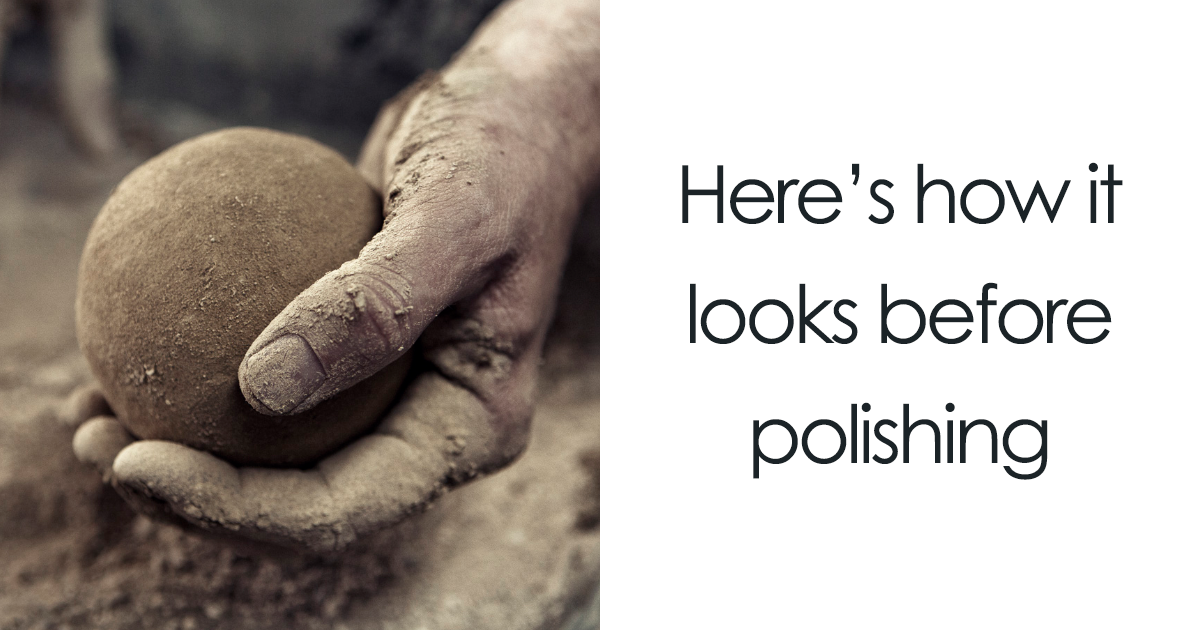
At first glance, the idea sounds like a prank from someone who has spent too much time in the garden: take a lump of dirt, roll it into a ball, dry it, polish it, and somehow end up with something that looks like a tiny planet, a ceramic jewel, or a museum object that forgot to be expensive. Yet in Japan, this humble craft is very real. It is called hikaru dorodango, often translated as “shiny mud dumpling,” and it turns ordinary soil into glossy, almost magical spheres.
Yes, we are talking about dirt. Not marble. Not glass. Not clay fired in a kiln by a person wearing dramatic linen. Dirt. The same stuff that clings to shoes, annoys parents, and makes white socks question their life choices. But when shaped with patience, dried with care, and polished with fine particles of soil, it can become an object so smooth and reflective that people often assume it must be painted, glazed, or secretly made by elves with excellent hand strength.
The beauty of Japanese polished dirt balls is not only in the finished result. It is in the process: slow, repetitive, focused, and oddly calming. In a world that wants everything delivered in two taps and half a second, dorodango quietly says, “Sit down. Breathe. Rub this mud ball for a while.” And somehow, that is exactly the kind of wisdom many of us need.
What Is Hikaru Dorodango?
Hikaru dorodango is a Japanese craft in which soil and water are mixed, molded into a sphere, dried gradually, coated with fine layers of sifted dirt, and polished until the surface shines. The word doro means mud, dango refers to a round dumpling, and hikaru means shining. Put them together and you get “shining mud dumpling,” which is probably one of the most charmingly accurate craft names ever invented.
The basic form of dorodango has long been associated with Japanese children’s play. Kids would make mud balls in playgrounds, trying to see whose sphere could become the smoothest and strongest. Over time, this simple activity evolved into something more refined. The modern art of hikaru dorodango became widely known after Japanese educator and psychologist Professor Fumio Kayo observed children making shiny mud balls and developed a more reliable method that others could follow.
Today, dorodango is practiced by children, artists, teachers, craft lovers, mindfulness enthusiasts, and people who enjoy hobbies that make guests say, “Wait, you made that from what?” The craft has spread far beyond Japan, inspiring workshops, books, videos, and DIY experiments around the world.
Why Are Japanese Polished Dirt Balls So Fascinating?
The main reason dorodango captures attention is the contrast. The material is ordinary, but the result looks extraordinary. A finished hikaru dorodango can resemble a polished stone, a lacquered ornament, or a miniature moon with a glossy finish. Some are deep brown, some are rusty red, some are golden, gray, black, or softly marbled depending on the minerals and soil used.
Unlike many crafts, dorodango does not rely on expensive tools or rare materials. You do not need a kiln, a studio, a power tool, or a mysterious jar labeled “professional glaze, do not touch.” You need dirt, water, your hands, patience, and a polishing tool such as a glass jar, cloth, or plastic bag. This simplicity makes the transformation feel almost unbelievable.
The Appeal of Perfection From Imperfection
Dorodango fits beautifully into Japanese aesthetic traditions that value patience, process, and the quiet dignity of humble materials. It also shares a spirit with ideas such as wabi-sabi, which appreciates natural imperfection, simplicity, and the passage of time. A dorodango may look perfectly round and smooth, but it remains fragile. It can crack, chip, or dull if handled carelessly. That fragility is part of its charm.
In other words, a shiny mud ball is not trying to become a diamond. It is still dirt. It simply becomes the most confident version of dirt imaginable.
How Dirt Becomes a Shiny Sphere
The process of making hikaru dorodango is simple in theory and surprisingly tricky in practice. Beginners often discover that mud has opinions. Too wet, and the ball collapses like a sad pancake. Too dry, and it cracks like a tiny desert. Too sandy, and it refuses to hold shape. Too clay-heavy, and it may shrink unevenly. The secret is balance.
Step 1: Choose the Right Soil
The best soil for dorodango usually contains enough clay to bind together, enough fine particles to polish well, and enough grit to give structure. Many makers sift their soil to remove rocks, roots, leaves, and other surprises from nature’s junk drawer. Different soils create different colors, so the ground itself becomes the palette.
Red clay soil may create warm terracotta tones. Gray soil can produce a stone-like finish. Dark earth may become rich and dramatic. Fine yellowish dirt can create golden results. This is one reason dorodango feels personal: every ball carries the character of the place it came from.
Step 2: Form the Mud Core
The maker mixes soil with water until it becomes workable mud. Then the mud is compressed by hand into a sphere. Compression matters. Air pockets can weaken the structure, and weak spots may lead to cracks later. The goal is not simply to roll a ball, but to squeeze, pack, and shape it into a dense core.
This stage is messy, which is part of the fun. If your hands look like you recently wrestled a flowerbed, you are probably doing it right.
Step 3: Shape, Rotate, and Dry Slowly
Once the rough sphere forms, it must be shaped gradually. The maker rotates it in the hands, gently smoothing high spots and keeping pressure even. Many techniques involve letting the ball rest in a plastic bag or humid environment so moisture leaves slowly. Drying too quickly can cause cracking.
This is where dorodango teaches its first important lesson: rushing makes mud angry. A careful maker works in cycles of shaping, resting, dusting, and drying. The ball becomes smoother not through force, but through repetition.
Step 4: Build the Outer Shell
After the core becomes firm enough to hold its shape, fine dry soil is added to the surface. This creates a thin shell, sometimes called a capsule. The maker sprinkles fine dirt over the damp surface, gently sweeps away the excess, and repeats the process. Each layer absorbs surface moisture and helps refine the texture.
The finest particles are especially important. They fill small gaps, cover roughness, and prepare the surface for polishing. Think of it as skincare for a mud ball, except the product is dust and the mud ball has no pores to complain about.
Step 5: Polish Until It Shines
When the surface is dry enough, the polishing begins. Makers may use the palm of the hand, a soft cloth, a plastic bag, or the inside curve of a smooth glass jar. The movement is gentle and consistent. The surface becomes compacted, and tiny particles align and flatten, reflecting light more evenly.
The shine does not appear all at once. It creeps in slowly. First the ball looks matte. Then it looks satin. Then, after enough patient polishing, it begins to glow. The final effect can be startling: a ball of dirt that looks polished, elegant, and weirdly precious.
The Science Behind the Shine
Dorodango may feel like magic, but there is real material science hiding under the charm. Soil contains particles of different sizes: sand, silt, clay, and organic material. Clay particles are extremely small and can bind together when moistened. As the ball dries and is burnished, those tiny particles compress into a denser surface.
Polishing works because the maker smooths the outer layer at a microscopic level. Rough surfaces scatter light in many directions, which makes them look dull. Smooth surfaces reflect light more evenly, which creates shine. The same general principle explains why polished stone, burnished clay, and even well-waxed cars gleam. Dorodango just proves that your backyard can join the glossy club.
The most successful dorodango has the right mix of strength, moisture, particle size, and patience. If the ball dries unevenly, cracks may form. If the shell is too thin, it may not polish well. If the maker presses too hard, the surface can break. The craft rewards attention to detail, which is why it appeals to both artists and science-minded experimenters.
Why Children in Japan Loved Making Dorodango
One of the most interesting things about hikaru dorodango is that it began as play. Japanese children made mud balls not because someone told them it would look good on Instagram, but because the challenge itself was absorbing. Could they make it rounder? Could they make it smoother? Could they make it shine more than their friend’s ball?
Professor Fumio Kayo’s interest in dorodango was connected to the psychology of children’s play. The activity encourages focus, experimentation, persistence, and emotional attachment to a handmade object. Children learn through touch, trial, failure, and adjustment. A cracked ball is not just a mistake; it is feedback from the mud department.
For educators, dorodango can be a surprisingly rich activity. It involves science, art, sensory learning, patience, and problem-solving. It also gives children a reason to look closely at natural materials. Dirt stops being “just dirt” and becomes color, texture, structure, and possibility.
Dorodango as Mindfulness: The Dirt Ball That Tells You to Calm Down
Many adults are drawn to dorodango because it feels meditative. The process requires slow attention. You cannot multitask your way to a polished sphere. You cannot aggressively speed-run it while answering emails, cooking pasta, and arguing with a printer. Dorodango demands presence.
The repeated motion of shaping and polishing can create a calm rhythm. Your hands stay busy while your mind settles. The object changes gradually, giving small rewards along the way. One minute it is rough. Ten minutes later it is smoother. An hour later it begins to shine. That visible progress is satisfying in a way that scrolling through a phone rarely is.
This is why hikaru dorodango fits so well into conversations about mindful crafts. It is inexpensive, tactile, slow, and forgiving enough for beginners, yet challenging enough to keep experts interested. It does not require perfection from the maker; it invites the maker to practice patience with imperfection.
Why the Results Blow People Away
The finished dorodango is surprising because it challenges expectations. Most people associate dirt with mess. A polished dirt ball looks clean, controlled, and refined. It creates a delightful mental glitch: your eyes say “precious object,” while your brain says “garden debris in formalwear.”
Some artists display dorodango in groups, allowing the natural colors of different soils to create a collection that resembles planets, stones, or abstract sculpture. Others make only one at a time, treating the process like a quiet ritual. In either case, the finished piece carries a story: where the soil came from, how long it was worked, how many times it nearly cracked, and how much patience went into its surface.
That story is part of the beauty. A dorodango is not valuable because it is rare or expensive. It is valuable because someone paid attention to it. In an age of mass production, that kind of attention feels almost rebellious.
Common Mistakes Beginners Make
Using Soil That Is Too Sandy
Sandy soil may not bind well enough to form a strong ball. If the sphere crumbles, the soil may need more clay-rich material. A little experimentation helps. The best soil is not always the prettiest at first; sometimes the ugly dirt has hidden talent.
Drying Too Quickly
Fast drying is one of the biggest enemies of dorodango. When the outside dries faster than the inside, cracks can appear. Many makers rest the ball in a plastic bag, opening it periodically to control moisture. This slow drying process helps the sphere stay stable.
Polishing Too Early
If the ball is still too wet, polishing can smear or dent the surface. If it is too dry, it may not develop a smooth shine. Timing is everything. Dorodango teaches you to read the material by touch, which sounds poetic until your first ball collapses and teaches you in a less poetic way.
Pressing Too Hard
A dorodango is not a bowling ball. It is delicate, especially before fully dry. Heavy pressure can damage the shell. Gentle, repeated polishing works better than brute force. This is craft, not arm wrestling.
Can You Make Hikaru Dorodango at Home?
Yes, you can make hikaru dorodango at home with basic materials. You need soil, water, a sieve, a cloth or plastic bag, and a smooth polishing tool such as a glass jar. Outdoor space helps, but a tray or workspace can also do the job if you are careful. Just remember: dirt has a way of expanding its territory. Protect your table unless you want your kitchen to enter its geological era.
Start with a small ball, about the size of a tennis ball or smaller. Smaller dorodango are easier to manage and less likely to crack. Sift the soil, mix it with water, compress it firmly, shape it gradually, let it rest, add fine dust layers, and polish gently. The first attempt may not become a mirror-bright masterpiece. That is normal. The second will be better. By the third, you may find yourself judging soil texture with the seriousness of a gem dealer.
What Dorodango Teaches Us About Craft and Attention
The deeper lesson of Japanese polished dirt balls is not simply that dirt can shine. It is that attention changes how we see ordinary things. A material we usually ignore becomes beautiful when we slow down enough to understand it. A task that looks childish becomes sophisticated when approached with care.
Dorodango also reminds us that transformation does not always require adding more. The maker does not decorate the ball with glitter, paint, jewels, or tiny motivational stickers. The transformation comes from removing roughness, compacting layers, and bringing out what the material can already do. It is a quiet kind of creativity.
That may be why dorodango continues to fascinate people around the world. It is simple, but not shallow. Humble, but not boring. Slow, but not pointless. It gives us a glossy little object and a useful reminder: sometimes the most impressive results come from working patiently with what is already in your hands.
Personal Experiences and Reflections: What It Feels Like to Make a Shiny Dirt Ball
Trying to make a dorodango for the first time feels a bit like entering a secret agreement with the ground. You begin with a pile of soil that looks completely unimpressed by your ambitions. You add water, mix it together, and immediately understand why children love mud. It is cool, soft, messy, and strangely satisfying. Then you start forming the ball, and the mood changes. Suddenly, you are not just playing; you are negotiating.
The first surprise is how much the mud resists becoming round. Human hands are excellent tools, but they are not perfect machines. You press one side and flatten another. You smooth one bump and create two more. The ball becomes round-ish, then lumpy, then better, then somehow worse. It is humbling. A simple sphere turns out to be a tiny engineering project wearing a mud costume.
After a while, though, the process becomes absorbing. You rotate the ball again and again. You learn to use lighter pressure. You notice moisture on the surface. You begin to feel when the mud is too soft, too dry, or just right. The activity pulls your attention away from noise and screens. There is no dramatic soundtrack, no instant result, no applause. Just your hands, a ball of earth, and the quiet hope that it will not crack.
The drying stage may be the hardest for impatient people. You want to keep working, but the ball needs to rest. This is where dorodango becomes a teacher with very dusty eyebrows. It tells you that progress sometimes happens while you are not actively pushing. The surface firms up. Moisture balances out. The structure becomes stronger. You return later, and the ball is ready for the next layer.
Adding fine dust is one of the most satisfying parts. The dry particles cling to the damp surface, and the ball begins to look more finished. The texture changes under your fingers. Rough spots soften. The sphere feels denser, quieter, more complete. It is still just dirt, but now it has presence. It starts acting like it deserves a small velvet cushion.
Then comes polishing. At first, nothing much happens. You rub and rotate, rub and rotate, and the ball looks back at you with the matte confidence of a potato. But slowly, almost secretly, the surface begins to catch light. A dull glow appears. Then a soft shine. Then a small highlight that moves as you turn the sphere. That moment is surprisingly thrilling. You have not added varnish or paint. You have simply convinced dirt to behave like treasure.
The experience also changes how you look at soil. A walk outside becomes a color hunt. You notice red dirt near a path, pale dust near a construction site, dark garden soil under leaves, or clay-heavy earth after rain. Places begin to have palettes. The ground is no longer background; it is material. Even if you never become a dorodango master, the craft gives you a new kind of attention.
There is also a funny emotional attachment that forms. A dorodango is fragile, and because you spend so much time shaping it, you become protective. You may find yourself warning people not to touch it too firmly. You may place it carefully on a cloth. You may admire it from different angles like a proud parent at a school play, except the child is a polished lump of mud. This is normal. Probably.
In the end, making hikaru dorodango is memorable because it is both ridiculous and profound. On one level, you are polishing dirt. On another, you are practicing patience, observation, and respect for simple materials. The finished sphere is beautiful, but the real experience is the transformation in attention. You begin by trying to improve the mud ball. By the end, the mud ball has quietly improved your ability to slow down.
Conclusion
Japanese polished dirt balls may sound like an internet curiosity, but hikaru dorodango is far more than a shiny trick. It is a craft rooted in play, patience, touch, and transformation. From Japanese schoolyards to international art studios and DIY tables, dorodango proves that beauty does not always require rare materials. Sometimes, it begins with soil under your fingernails and the willingness to keep going after the first crack.
The result truly can blow you awaynot because dirt has become something else, but because it has revealed what it could become with care. A finished dorodango is humble and elegant at the same time. It is a small sphere with a big message: ordinary things are only ordinary until someone pays close attention.