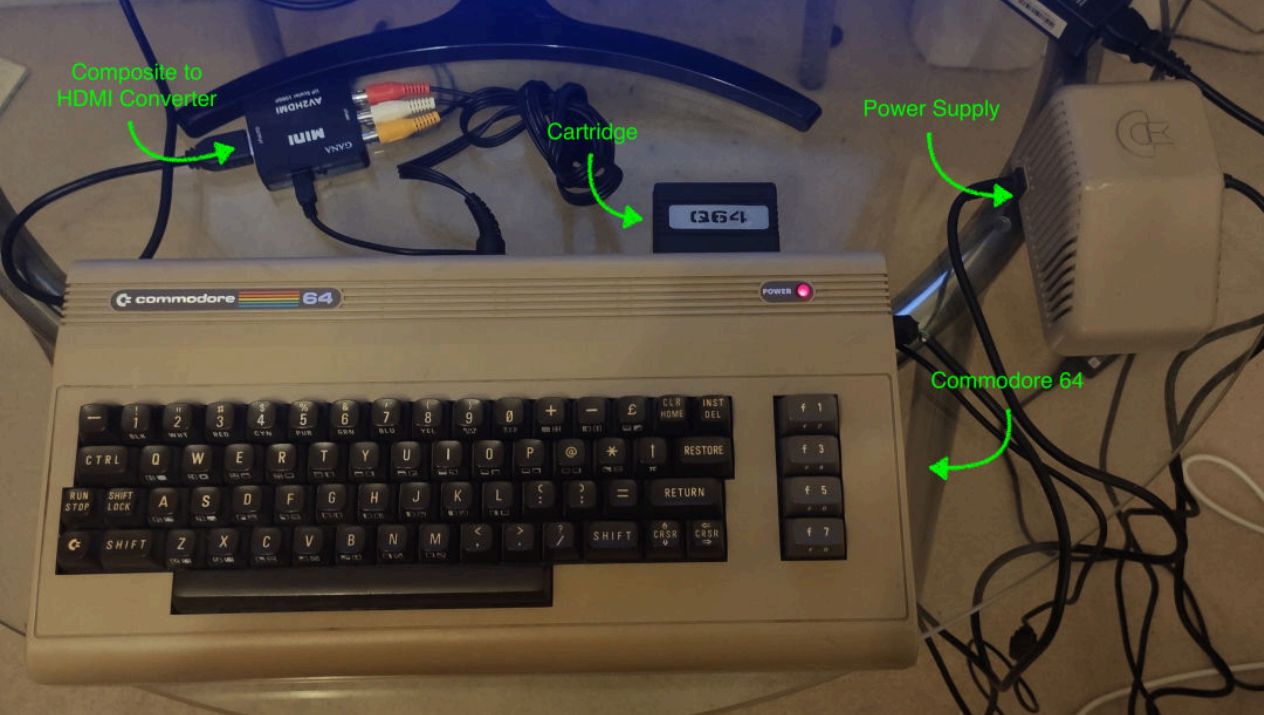
Every so often, the tech world produces a story so delightfully strange that it sounds like a late-night forum joke wearing a lab coat. “Trolling IBM’s Quantum Processor Advantage With A Commodore 64” is one of those stories. On one side, we have IBM’s 127-qubit Eagle quantum processor, chilled inside a futuristic cryostat and backed by some of the brightest researchers in computing. On the other side, we have a beige 1980s home computer with 64 kilobytes of RAM, a roughly 1 MHz MOS 6510 processor, and the spiritual energy of a garage band that refuses to stop playing.
The punchline is not that the Commodore 64 suddenly became a real quantum computer. It did not. Nobody should start cooling a breadbin C64 with liquid helium and calling it a startup. The point is subtler, funnier, and more important: a satirical SIGBOVIK paper showed that a carefully chosen classical method could reproduce parts of IBM’s famous “quantum utility” experiment on laughably limited hardware. That does not destroy quantum computing. It does, however, throw a banana peel under careless claims about “quantum advantage.”
To understand why this story went viral among hackers, physicists, and retro-computing fans, we need to unpack what IBM actually claimed, what classical researchers later demonstrated, and why the Commodore 64 stunt is more than just nerd comedy with a cartridge slot.
What IBM’s Quantum Processor Advantage Claim Was Really About
In 2023, IBM and collaborators published work describing evidence for the utility of quantum computing before full fault tolerance. The experiment used IBM’s 127-qubit Eagle processor to simulate the dynamics of a quantum Ising model, a simplified physics model often used to study interacting spins, magnetism, and many-body behavior. In plain English, IBM was not trying to run Microsoft Excel in another dimension. It was testing whether a noisy quantum processor could produce useful scientific results in a problem naturally suited to quantum hardware.
The key phrase here is quantum utility, not necessarily full, final, fireworks-in-the-sky quantum advantage. IBM’s argument was that Eagle could run large and deep circuits beyond brute-force exact simulation by ordinary classical methods. The team used error mitigation, especially zero-noise extrapolation, to extract more reliable expectation values from noisy hardware. That matters because today’s quantum computers are noisy intermediate-scale quantum devices, often called NISQ machines. They are promising, powerful in very specific ways, and still about as delicate as a soufflé in a marching band.
IBM’s experiment involved a 127-qubit device with heavy-hex connectivity and circuits with many layers of quantum gates. The system measured quantities such as magnetization after Trotterized time evolution. For researchers, that is a meaningful stress test. For everyone else, it means IBM asked its quantum machine to imitate the changing behavior of a complicated quantum system and then checked whether the answers made sense.
Why Classical Computers Came Back Swinging
The story became more interesting when classical-computing researchers began responding. Several groups showed that IBM’s specific benchmark could be simulated surprisingly well by classical algorithms. This did not mean a laptop could brute-force the entire 127-qubit wavefunction. Exact state-vector simulation at that scale is wildly memory-hungry. Representing 127 fully entangled qubits exactly would require tracking an astronomical number of amplitudes.
But “impossible by brute force” is not the same as “impossible by every clever method humans can invent after drinking coffee.” Classical algorithms such as tensor networks and sparse Pauli dynamics can exploit structure in certain quantum circuits. If the entanglement pattern is limited or the observable is friendly, the problem may have shortcuts. That is exactly where the classical response found room to operate.
Researchers showed that approximate classical techniques could reproduce expectation values from IBM’s kicked Ising experiment with high accuracy, and in some cases faster or more cleanly than the quantum run. That is not a humiliating failure for IBM so much as a reminder that benchmarks are moving targets. Quantum hardware gets better; classical algorithms get better; then everyone argues on the internet, which is how science stays hydrated.
Enter the Commodore 64: Beige Plastic, Big Attitude
Then came the part that turned a technical debate into a legend. A SIGBOVIK 2024 paper, styled with the conference’s usual “Association for Computational Heresy” flavor, took the idea to its comic extreme: if the classical method can be simplified enough, could it run on a Commodore 64?
The Commodore 64 was introduced in 1982 and became one of the most beloved home computers ever made. It had 64 KB of RAM, a MOS 6510 processor around 1 MHz, colorful graphics for its day, and a sound chip that still makes retro musicians grin like they discovered electricity. It was designed for BASIC programming, games, school projects, and the occasional family argument over whose turn it was to use the TV. It was not designed to roast a corporate quantum benchmark four decades later. Yet here we are.
The anonymous SIGBOVIK implementation reportedly used a sparse Pauli dynamics approach inspired by modern classical simulations of IBM’s experiment. Because the C64 has very little memory by today’s standards, the implementation had to be extremely compact. Hackaday reported that the program used about 15 KB of accessible RAM and ran from a ROM cartridge, with code written close to the metal in 6502-family assembly. That is the computing equivalent of building a ship in a bottle, then using it to heckle an aircraft carrier.
Did the Commodore 64 Actually Beat IBM’s Quantum Computer?
The honest answer is: not in the way a clickbait headline might suggest. The Commodore 64 did not become a better general-purpose quantum computer than IBM Eagle. It did not solve all quantum simulation. It did not open a portal to a universe where floppy disks are cloud infrastructure. What it did was demonstrate that, for this carefully selected benchmark and observable, a tiny classical machine could reproduce useful results using an algorithm tailored to the problem.
That distinction matters. Quantum advantage is not a single trophy that one company wins forever. It depends on the task, the metric, the hardware, the error rate, the classical baseline, and whether the problem has hidden structure that classical algorithms can exploit. IBM’s experiment was impressive because it pushed noisy quantum hardware into a regime beyond straightforward brute-force simulation. The classical responses were impressive because they showed that smarter simulation methods could still keep up.
The Commodore 64 version was funny because it compressed that whole debate into a meme-sized object: a 1980s computer, blinking patiently, saying, “Nice cryostat. I brought a cartridge.”
What This Teaches Us About Quantum Advantage
Benchmarks Must Be Chosen Carefully
A benchmark is only as strong as the assumptions behind it. If a quantum experiment is compared only against brute-force classical simulation, it may look unbeatable until someone applies a more specialized classical technique. That does not make the benchmark useless. It means the benchmark must evolve. Serious claims of quantum advantage need to compare against the best available classical methods, not the easiest classical method to defeat.
Error Mitigation Is Powerful, But Not Magic
IBM’s use of zero-noise extrapolation was a major part of the original result. Error mitigation helps noisy quantum devices produce more reliable estimates before full error correction exists. However, mitigation is not the same as having a fault-tolerant quantum computer. The output still depends on modeling, calibration, statistical confidence, and assumptions about how noise behaves. In other words, it is science, not wizardry. The wand still needs debugging.
Classical Algorithms Are Not Standing Still
One of the best parts of this story is that IBM’s claim encouraged classical researchers to improve their own methods. Tensor networks, sparse Pauli dynamics, belief propagation, and other quantum-inspired techniques are not boring leftovers from the pre-quantum era. They are active, sophisticated tools. In some cases, quantum hardware becomes a useful challenge that forces classical computing to get sharper. That competition benefits everyone.
Why the Commodore 64 Troll Worked So Well
The stunt landed because it combined three ingredients the internet loves: a giant technology company, a nostalgic underdog, and a technical joke with real teeth. The Commodore 64 is instantly understandable. People may not know what a Trotterized transverse-field Ising model is, but they understand “old computer challenges shiny quantum machine.” It is David versus Goliath, except David brought 64 KB of RAM and probably a slightly yellowed keyboard.
More importantly, the joke was not empty. It pointed to a genuine issue in quantum computing communication. The field uses phrases like “advantage,” “utility,” “supremacy,” and “beyond classical” in ways that can be technically precise inside papers but easily exaggerated in headlines. The Commodore 64 story acted like a friendly slap with a floppy disk: slow down, define your terms, and do not underestimate classical algorithms.
The Difference Between Quantum Utility and Quantum Hype
Quantum utility means a quantum computer can do something scientifically useful at a meaningful scale, even if it does not yet crush every classical competitor. Quantum hype is when that careful idea mutates into “quantum computers are here to replace everything, including your toaster, accountant, and emotional support spreadsheet.”
IBM’s work deserves respect because building, controlling, and extracting useful data from 127 superconducting qubits is extremely hard. The Eagle processor represented serious engineering progress. The follow-up work deserves respect because it showed that classical algorithms remained highly competitive. The Commodore 64 deserves respect because it made everyone laugh while quietly making a valid methodological point.
In healthy science, these things can all be true at once. IBM pushed the frontier. Classical researchers sharpened the comparison. A retro machine became the mascot for skepticism. Nobody has to throw the quantum computer into the ocean or declare the C64 the new national laboratory.
Specific Example: The Kicked Ising Model Problem
The central physics model in this debate is the kicked Ising model, implemented through Trotterized quantum circuits. Trotterization breaks continuous time evolution into discrete steps that can be represented with quantum gates. In IBM’s learning materials, the experiment is described through layers of X rotations and ZZ interactions across the Eagle processor’s heavy-hex connectivity graph. The observable of interest can be something like the expectation value of a Z measurement on a chosen qubit.
That kind of observable is important because it may be easier to estimate than the entire quantum state. You do not always need the whole encyclopedia; sometimes you need one paragraph. Classical approximation methods can take advantage of that. If the task is to compute certain expectation values, not reconstruct every detail of the wavefunction, a clever classical method may avoid the full exponential nightmare.
This is why the Commodore 64 story is scientifically funny instead of merely silly. It does not say “quantum computing is fake.” It says, “For this measurement, with this structure, using this specialized method, even ancient hardware can participate in the conversation.” That is a much more interesting punchline.
What IBM Can Take From the Trolling
For IBM, the lesson is not to stop building quantum processors. The lesson is to keep refining benchmarks, increase circuit depth and complexity, improve hardware fidelity, and compare results against the strongest classical methods available. IBM has continued to push larger and better systems, improve Qiskit tooling, and discuss quantum advantage as a process rather than a single finish line.
That is the right direction. Real quantum advantage will likely appear first in narrow, technical, domain-specific tasks: chemistry, materials science, optimization variants, or simulations where quantum structure becomes too expensive for classical shortcuts. It will not arrive as a magical press release that makes every classical computer suddenly look like a calculator from a cereal box.
What Developers and Tech Readers Should Learn
For developers, the big lesson is that hardware alone rarely wins. Algorithms matter. Data structure matters. Problem structure matters. A slow machine with a clever method can beat a fast machine with the wrong comparison. That has always been true in computing, from sorting algorithms to graphics rendering to database indexing. Quantum computing does not escape that rule; it makes the rule even more dramatic.
For tech readers, the lesson is to read past the headline. When someone claims a quantum processor has achieved advantage, ask: advantage over what? Brute force? Best known classical algorithm? Exact simulation? Approximate simulation? One observable? A commercially useful workload? The answers decide whether the claim is historic, promising, limited, or mostly confetti.
Experience Notes: Living With the Commodore 64 Mindset
The most useful way to think about the Commodore 64 troll is not as an insult to IBM, but as a mindset. Anyone who has spent time with old computers knows that limitations can become a strange form of creativity. On a modern machine, waste is easy. You can allocate memory casually, import a giant library, open thirty browser tabs, and still blame the computer for feeling slow. On a Commodore 64, every byte looks back at you like it paid rent.
That constraint forces discipline. If you have only kilobytes of memory, you stop thinking vaguely and start thinking mechanically. What do I really need to store? Can I represent this bitstring more efficiently? Can I precompute something? Can I avoid floating-point operations? Can I rewrite the loop so it does one fewer thing per iteration? These are not just retro-programming questions. They are excellent engineering questions in any era.
That is why the C64 quantum-utility parody feels so satisfying. It reminds us that performance is not only about having the biggest machine in the room. Performance is also about understanding the problem deeply enough to remove everything unnecessary. The C64 did not have cloud scaling, GPU acceleration, or a marketing deck with gradient backgrounds. It had a tiny address space and a demand for precision. In a weird way, that made the algorithm’s structure easier to see.
There is also an emotional lesson here. Old machines make computing feel physical. You can imagine the code fitting into memory. You can imagine the CPU stepping through instructions. You can imagine the programmer fighting for every cycle like a raccoon guarding a sandwich. Quantum computing, by contrast, often feels abstract and remote: cryostats, qubits, decoherence, calibration, probability distributions. The Commodore 64 brings the debate back to something tangible. It turns a high-level benchmark argument into a scene: a beige keyboard on a desk, quietly participating in frontier physics discourse.
For students, hobbyists, and working developers, that is encouraging. You do not need the newest hardware to learn something meaningful. You can study quantum computing concepts through simulators, classical approximations, small circuits, and old-fashioned algorithmic thinking. You can also learn skepticism without becoming cynical. The correct reaction to quantum claims is not “everything is hype.” It is “show me the benchmark, the baseline, the error model, and the practical workload.” That attitude is healthy, and it travels well beyond quantum computing.
The Commodore 64 troll also shows why humor belongs in technical culture. A joke can expose weak assumptions faster than a 40-slide presentation. It can invite non-specialists into a complex subject. It can make researchers sharpen their definitions. The best technical humor is not anti-science; it is pro-clarity. It says, with a wink, “This is impressive, but let us not clap so loudly that we stop measuring.”
Conclusion: A Funny Troll With a Serious Message
“Trolling IBM’s Quantum Processor Advantage With A Commodore 64” is not really a story about a vintage computer defeating the future. It is a story about how difficult it is to prove advantage in a field where both quantum hardware and classical algorithms are improving quickly. IBM’s Eagle experiment was a serious milestone in quantum utility. The classical follow-up work was a serious reminder that smart algorithms can change the scoreboard. The Commodore 64 parody was a brilliant little firecracker tossed into the middle of the debate.
The future of quantum computing is still exciting. But the path to real, practical quantum advantage will be measured against clever classical competition, not straw-man baselines. Until then, the Commodore 64 sits in the corner, humming at 1 MHz, reminding everyone that sometimes the oldest machine in the room has the sharpest joke.