The 1990s were a golden age for movie soundtracks. Hollywood could release a film that was confusing, overstuffed, overly sentimental, or held together with the cinematic equivalent of duct tape, and somehow the soundtrack would still produce a song people wanted to hear for the next three decades.
That was the strange magic of the era. A movie might spend two hours trying to make us care about angels, asteroids, masked vigilantes, troubled classrooms, or a giant mechanical spider. Then a four-minute song would arrive and accomplish more emotional work than the entire screenplay.
This list celebrates unforgettable 90s songs that became bigger, more enduring, or simply more enjoyable than the movies connected to them. That does not necessarily mean every film here is terrible. Some are cult favorites, some were major box-office successes, and some remain wonderfully rewatchable. The point is that the songs developed lives of their own. You can hear the opening notes today and instantly remember where you were, who you had a crush on, and possibly what kind of terrible haircut you were defending at the time.
So dust off the imaginary Discman, prepare for power ballads, alternative-rock longing, hip-hop drama, and enough emotional intensity to power a small shopping mall. Here are 10 of the best 90s movie soundtrack songs that outshone the films around them.
Why 90s Movie Soundtrack Songs Became So Unforgettable
Before streaming playlists took over, movie soundtracks were cultural events. A successful soundtrack could introduce audiences to new artists, revive older songs, dominate radio, and convince millions of people to buy an entire CD for the two tracks they actually wanted. We all did it. The other 11 songs were simply the financial consequences of loving one single.
The best 90s soundtrack songs also worked independently from their films. They had melodies, lyrics, and performances strong enough to survive after the VHS tapes disappeared into closets. In several cases, the song became the first thing people remembered about the movieand occasionally the only thing.
10. “Stay (I Missed You)” by Lisa Loeb – Reality Bites (1994)
Reality Bites remains a recognizable piece of Generation X culture, but Lisa Loeb’s “Stay (I Missed You)” escaped the movie and became something much larger. Its conversational lyrics, acoustic guitar, and slightly breathless delivery sounded unlike the polished blockbuster ballads surrounding it.
The song became a No. 1 hit while Loeb was still unsigned, an extraordinary achievement that helped turn her into one of the decade’s most recognizable singer-songwriters. The film captured a particular moment in young-adult anxiety, but “Stay” captured something more universal: the desperate mental replay that happens when a relationship falls apart and you are still arguing with someone who is no longer in the room.
The movie is a time capsule. The song is still an emotional emergency.
9. “Have You Ever Really Loved a Woman?” by Bryan Adams – Don Juan DeMarco (1995)
Ask someone to describe the complete plot of Don Juan DeMarco, and you may receive a thoughtful pause followed by, “Johnny Depp was very romantic, right?” Play the first few seconds of Bryan Adams’ “Have You Ever Really Loved a Woman?” and the recognition is much faster.
The song is peak 90s romantic drama: Spanish guitar, a huge chorus, and lyrics delivered with the seriousness of a man who has been personally appointed international chairman of love. Bryan Adams, Michael Kamen, and Robert John “Mutt” Lange created a soundtrack ballad that became far more portable than the movie itself.
You did not need to understand Don Juan’s complicated identity to appreciate the song. You only needed a slow dance, a dramatic stare, and perhaps a willingness to take romance slightly more seriously than was medically necessary.
8. “Because You Loved Me” by Celine Dion – Up Close & Personal (1996)
Celine Dion could sing a grocery list and make the produce section feel emotionally significant. With “Because You Loved Me,” she had much stronger material.
Written by Diane Warren for Up Close & Personal, the song became one of the defining power ballads of the 1990s. The film, starring Michelle Pfeiffer and Robert Redford, certainly had star power, but its theme song traveled much farther. It became a favorite for weddings, graduations, tributes, family slideshows, and any occasion where someone needed the emotional volume turned from six to approximately 47.
The brilliance of the song is its flexibility. It can sound romantic, grateful, nostalgic, or heartbreaking depending on the listener. The movie gave it a launchpad. Celine gave it wings, a jet engine, and probably a wind machine.
7. “Change the World” by Eric Clapton – Phenomenon (1996)
Phenomenon is a supernatural romantic drama about an ordinary man who suddenly develops extraordinary intelligence and abilities. “Change the World,” meanwhile, requires no plot summary, unexplained powers, or scientific mystery. It simply glides.
Performed by Eric Clapton and produced by Babyface, the song became a major hit and won Grammys for Record of the Year, Song of the Year, and Best Male Pop Vocal Performance. Its gentle rhythm and understated delivery offered a refreshing alternative to the decade’s tendency to treat every love song as though the singer were standing on a mountain during a thunderstorm.
The movie asks audiences to accept a complicated premise. The song asks you to relax for a few minutes. Decades later, that invitation remains hard to refuse.
6. “Wild Wild West” by Will Smith – Wild Wild West (1999)
There are movies that age gracefully. There are movies that become cult classics. And then there is Wild Wild West, a motion picture involving cowboys, steampunk technology, elaborate gadgets, and a giant mechanical spider that deserves its own management team.
Will Smith’s title song, however, knew exactly what it was doing. Built around a memorable sample and powered by Smith’s charismatic delivery, “Wild Wild West” was playful, instantly recognizable, and far more efficiently constructed than the movie.
The film threw nearly every expensive idea it could find onto the screen. The song had a beat, a hook, and confidence. Guess which formula proved easier to revisit?
Even people who have never watched the movie can recognize the track. That is the soundtrack equivalent of escaping a burning building while carrying the best furniture.
5. “(Everything I Do) I Do It for You” by Bryan Adams – Robin Hood: Prince of Thieves (1991)
Robin Hood: Prince of Thieves had arrows, castles, Kevin Costner, Alan Rickman stealing every scene within a 20-mile radius, and a geographical relationship with English accents that might politely be described as adventurous.
Then came “(Everything I Do) I Do It for You.” Bryan Adams’ enormous romantic ballad became a global phenomenon and won the Grammy for Best Song Written for Visual Media. Its connection to the film was clear, but the song quickly became bigger than Sherwood Forest.
The arrangement builds patiently, the vocal grows from intimate to enormous, and the chorus seems engineered to make couples stare at each other across school dances while pretending no parents are waiting in the parking lot.
The movie remains entertaining. The song became a monument. Somewhere, a lighter is still being held in the air.
4. “I Don’t Want to Miss a Thing” by Aerosmith – Armageddon (1998)
Armageddon is subtle in the same way a fireworks factory exploding inside another fireworks factory is subtle. Michael Bay gave audiences asteroids, explosions, heroism, slow motion, tears, and enough dramatic editing to make drinking a glass of water feel like a military operation.
Yet Aerosmith’s “I Don’t Want to Miss a Thing” somehow matched that scale and came out looking elegant.
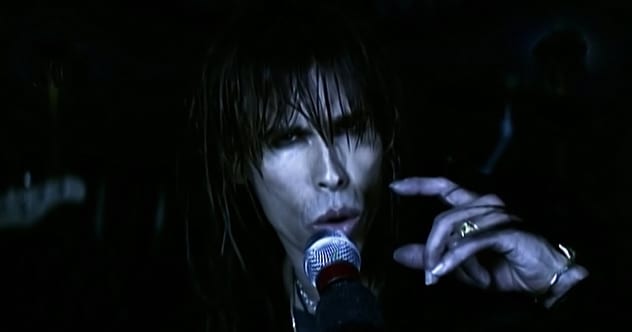
Written by Diane Warren and recorded specifically for the film, the ballad became Aerosmith’s first No. 1 single and earned an Academy Award nomination. Steven Tyler performs it as though missing even five seconds with the person he loves would violate international law.
The movie is gigantic entertainment. The song is gigantic emotion. Only one of them works equally well during a wedding, a breakup, a road trip, and an aggressively sentimental karaoke session.
3. “Iris” by Goo Goo Dolls – City of Angels (1998)
John Rzeznik wrote “Iris” specifically after seeing City of Angels and imagining the emotional perspective of its central character. The result was not merely a soundtrack contribution. It became one of the defining alternative-rock ballads of the late 1990s.
The unusual guitar tuning, swelling strings, and aching vocal gave the song an enormous emotional landscape. Its lyrics express the desire to be truly knownan idea far more durable than the specifics of a supernatural romance between an angel and a human.
City of Angels has its admirers, but “Iris” became a generational anthem. It earned three Grammy nominations and remains the kind of song that can make a perfectly stable person stare dramatically out of a car window.
The movie told one love story. “Iris” somehow became everybody’s.
2. “Gangsta’s Paradise” by Coolio featuring L.V. – Dangerous Minds (1995)
Dangerous Minds was built around a familiar inspirational-teacher structure, but “Gangsta’s Paradise” brought a gravity and cultural force that the movie could not fully contain.
Coolio’s verses, L.V.’s haunting vocals, and the song’s connection to Stevie Wonder’s “Pastime Paradise” created something dark, reflective, and immediately recognizable. It became one of the biggest hits of 1995 and won the Grammy for Best Rap Solo Performance.
The music video strengthened the connection with the film by featuring Michelle Pfeiffer, but the song rapidly developed an identity beyond Hollywood promotion. Its themes of danger, consequence, hopelessness, and self-examination gave it a depth that continues to resonate.
Many people remember the movie because of the song. Almost nobody needs the movie in order to remember the song. That settles the argument rather efficiently.
1. “Kiss from a Rose” by Seal – Batman Forever (1995)
Could any other song be No. 1?
Batman Forever gave audiences neon Gotham, Val Kilmer in the cape, Jim Carrey at maximum Jim Carrey levels, Tommy Lee Jones apparently competing with Jim Carrey at maximum Jim Carrey levels, and a visual style that believed every available color should be used immediately.
Then, floating above all that chaos, came Seal’s “Kiss from a Rose.”
The song had originally appeared before the movie, but its inclusion in Batman Forever helped transform it into a massive hit. It reached No. 1 and won three major Grammys: Record of the Year, Song of the Year, and Best Male Pop Vocal Performance.
Everything about it is unusual for a blockbuster soundtrack smash: the waltz-like rhythm, the layered vocals, the mysterious imagery, the strange emotional atmosphere. It sounds ancient and modern at the same time. More importantly, it still sounds like nothing else.
Batman Forever belongs unmistakably to 1995. “Kiss from a Rose” somehow escaped time.
The 90s Soundtrack Experience: When a Song Became Bigger Than Movie Night
To understand why these unforgettable 90s songs still have such power, it helps to remember how people actually experienced music during the decade. A movie song did not simply appear in a streaming playlist five minutes after the credits rolled. It followed you around.
You might first hear it in a theater, where the end credits began and half the audience immediately stood up to leave. Then the song would appear on the radio during a car ride. A few days later, its music video would show up on MTV or VH1. Soon someone at school had bought the soundtrack CD. A month later, the song was playing at the mall, at a restaurant, from a bedroom stereo, and through the questionable speakers of a friend’s first car.
That repetition created memories.
The Soundtrack CD Was Its Own Adventure
Buying a movie soundtrack in the 90s involved risk. You might love one song, recognize two others, and have absolutely no idea what was waiting on track eight. There was no instant preview of every song. There was no algorithm promising that the next track matched your “vibe.” You bought the CD, opened the booklet, and began an expedition.
Sometimes the soundtrack was better than expected. Sometimes you discovered a new favorite artist. Sometimes you learned that the one song you loved was surrounded by 48 minutes of music you would never voluntarily hear again.
Either way, the soundtrack became a physical object connected to the movie, the song, and a particular period of your life. Scratched jewel cases and handwritten mix CDs were part of the experience.
Radio Made the Biggest Movie Songs Feel Inescapable
When a 90s soundtrack song became a hit, there was nowhere to hideand that was often part of the fun.
“I Don’t Want to Miss a Thing” could appear during breakfast, in the car, and again before dinner. “Because You Loved Me” seemed capable of materializing whenever a radio station sensed someone nearby was feeling emotionally stable. “Gangsta’s Paradise” had such a distinctive opening atmosphere that recognition was immediate.
Heavy rotation could become ridiculous, but it also turned songs into shared cultural experiences. Millions of people heard the same tracks during the same months. Years later, one chorus can unlock a surprisingly detailed collection of memories: a school hallway, a summer job, a family road trip, or the exact wallpaper in a childhood bedroom.
The Music Video Could Be More Memorable Than the Film
Music videos gave soundtrack songs a second life. Movie footage was often mixed with new performance scenes, creating a miniature promotional universe where the artist and the film appeared to occupy the same reality.
Seal performing near the Bat-Signal is a perfect example. The image helped permanently connect “Kiss from a Rose” with Batman Forever, even though the song’s emotional tone was far removed from most of the movie’s colorful chaos.
Similarly, the “Gangsta’s Paradise” video reinforced the relationship between Coolio’s song and Dangerous Minds. For many viewers, the video became as important to the song’s identity as the film itself.
Some Songs Eventually Escaped Their Movies Completely
The most fascinating part of the 90s soundtrack experience is what happened after the promotional campaigns ended.
The movies went to home video. Posters came down. Premiere coverage disappeared. Actors moved on to new projects. Yet the best songs kept finding new listeners.
“Iris” became a standard for emotional rock ballads. “Change the World” became a radio staple. “Kiss from a Rose” continued inspiring covers, jokes, karaoke performances, and sincere admiration. These songs no longer needed their original films to provide context.
That may be the ultimate test of a great soundtrack song. Years later, someone who has never seen the movie can still feel something when the music begins.
Why These Unforgettable 90s Songs Still Win
The greatest 90s movie soundtrack songs were not successful merely because they appeared beside famous actors or during expensive closing credits. They lasted because they contained something audiences wanted to carry beyond the theater.
Some offered romance on an absurdly large scale. Others captured loneliness, gratitude, fear, regret, or hope. The movies gave them a moment, but the songs gave that moment portability. You could take it into a car, a bedroom, a school dance, a wedding, or a future decade.
And that is why songs such as “Kiss from a Rose,” “Gangsta’s Paradise,” “Iris,” and “I Don’t Want to Miss a Thing” still feel bigger than the films that helped introduce them. Cinema gave them the screen. Radio, CDs, music videos, and millions of personal memories gave them permanence.
Editorial note: This ranking is intentionally subjective. Several movies on the list remain popular, successful, or beloved. The real competition is not about whether the films were “good” or “bad,” but whether their songs achieved an even greater cultural afterlife. In the 1990s, that happened more often than anyone had a right to expectand our playlists are better for it.