Job hunting used to mean refreshing your inbox, polishing your résumé, and pretending “fast-paced environment” didn’t secretly mean “three people doing the work of twelve.” Now, there is a new annoyance in the search: job scams that look polished, personal, and frighteningly normal.
Across the United States, employment scams have moved far beyond the old “work from home and earn $5,000 a week stuffing envelopes” routine. Today’s fake job offers may impersonate real companies, copy legitimate listings, use convincing recruiter names, conduct interviews through messaging apps, send forged checks, or ask applicants to deposit money into a platform to unlock “earnings.” Some scams even begin with a small payout, which makes the trap feel more believable. That little payment is the worm on the hook.
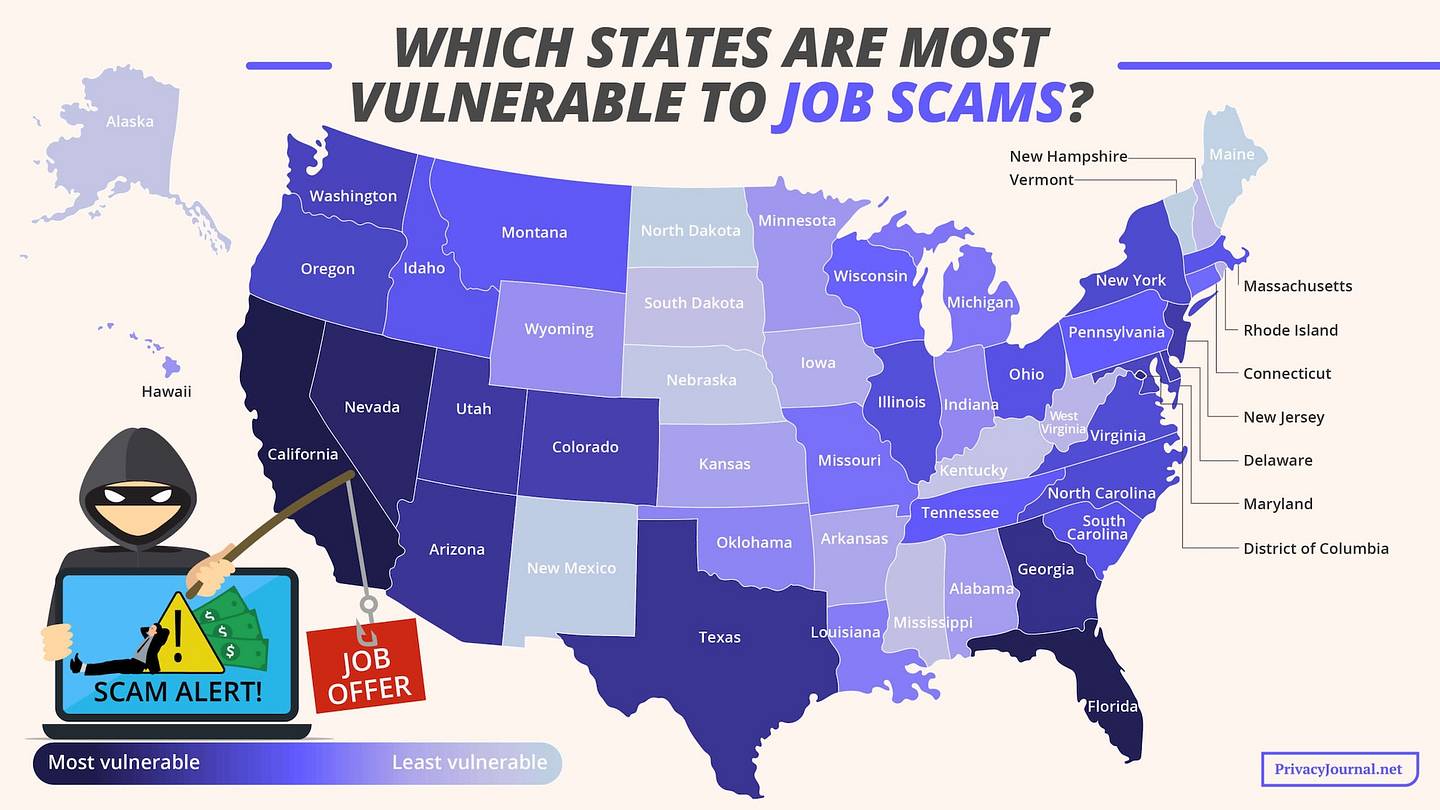
So, where are job scams hitting hardest? When the data is mapped by reported financial losses, several large and economically active states stand out: California, Florida, Washington, Texas, and Georgia. When mapped by the number of reported cases, California, Texas, Florida, Georgia, and New York rise to the top. These rankings do not necessarily mean every job seeker in these states is doomed to be chased by a fake recruiter named “Mr. Daniel HR Department.” But they do show where reported employment scam activity has been especially visible, costly, or concentrated.
This guide breaks down the worst states for job scams, explains why the map looks the way it does, and gives job seekers a practical way to spot suspicious offers before their bank account becomes an unpaid intern.
What Counts as a Job Scam?
A job scam is a fake employment opportunity designed to steal money, personal information, free labor, or access to financial accounts. The scammer may pretend to be a recruiter, hiring manager, staffing agency, job board contact, or representative of a well-known company.
The most common job scam formats include fake remote jobs, fake check schemes, reshipping jobs, mystery shopper scams, fake training programs, “pay to start” roles, identity theft applications, task scams, and cryptocurrency-based job schemes. In many cases, the job seeker is told they have been selected quickly, sometimes before a real interview happens. That should set off every alarm bell in the building, including the one nobody has tested since 2008.
Modern job scams usually fall into three broad categories:
- Money theft: The applicant is asked to pay for training, equipment, background checks, software, starter kits, cryptocurrency deposits, or “refundable” fees.
- Identity theft: The scammer asks for a Social Security number, driver’s license, banking information, ID.me credentials, or direct deposit details too early in the process.
- Fake work platforms: The victim performs simple online tasks, sees fake earnings grow, and is later told to deposit money to withdraw the supposed income.
The Worst States for Job Scams, Mapped by Reported Losses
Based on early 2025 employment scam reporting analyzed from BBB Scam Tracker data, the states with the highest total reported financial losses were California, Florida, Washington, Texas, and Georgia. These are the states that would appear darkest on a “reported loss” map.
| Rank | State | Reported Employment Scam Losses | Average Reported Loss | Map Tier |
|---|---|---|---|---|
| 1 | California | $531,065.81 | $7,586.65 | Highest loss zone |
| 2 | Florida | $341,548.35 | $9,231.04 | Highest loss zone |
| 3 | Washington | $138,527.75 | $9,235.18 | High loss zone |
| 4 | Texas | $94,416.57 | $1,967.01 | High activity zone |
| 5 | Georgia | $85,515.45 | $2,758.56 | High activity zone |
California leads by total reported losses, which is not surprising. It has a massive labor market, a huge tech sector, a large remote-work population, and a high volume of job seekers moving through online hiring platforms. More applicants, more listings, more recruiters, more remote roles, and more digital communication all create a larger target surface for scammers.
Florida ranking second is also notable. The state has a large population, many older adults, a growing remote-work economy, and plenty of job seekers looking for flexible income. Scammers love flexibility almost as much as they love vague job descriptions. “Flexible remote role with excellent pay” can be legitimate, but when it comes with a request for gift cards or a crypto deposit, it has officially left the job market and entered clown-town finance.
Washington’s high average loss stands out because it suggests fewer but more expensive hits. In states with strong tech and remote-work ecosystems, scammers may impersonate software companies, digital agencies, app-testing firms, or professional services employers. That makes the scam feel more normal to applicants who are already used to remote onboarding and online collaboration tools.
The States With the Most Job Scam Reports
Total losses are only one way to map job scam risk. If we map by the number of reported employment scam cases, the top five look slightly different:
| Rank | State | Reported Cases | What It Suggests |
|---|---|---|---|
| 1 | California | 70 | Large job market and high online hiring activity |
| 2 | Texas | 48 | High population and heavy job-board usage |
| 3 | Florida | 37 | Large flexible-work and remote-work audience |
| 4 | Georgia | 31 | Growing metro job markets and online hiring volume |
| 5 | New York | 27 | Dense labor market with many digital applications |
This second map matters because case count tells a different story than total losses. A state may not have the highest dollar losses, but it may still have frequent scam encounters. Texas, for example, ranked second by number of reported cases but fourth by total reported losses in the early 2025 analysis. That suggests a high volume of scams, even if the average reported loss was lower than in Florida or Washington.
New York appears in the top five by case count but not in the top five by total reported loss. That does not make the state “safe.” It means the reported cases, at least in the dataset analyzed, did not produce the same total dollar damage as the biggest loss states. A low-loss scam can still be devastating if it exposes a Social Security number, bank account, driver’s license, or login credentials.
Why Big States Often Look Worse on the Map
Large states tend to dominate fraud maps because they have more people, more job seekers, more businesses, and more online activity. California, Texas, Florida, and New York often appear near the top of many internet crime complaint lists for exactly that reason. A bigger pool means more opportunity for both legitimate hiring and fraudulent recruiting.
But that does not mean job seekers in smaller states can relax completely. In fact, South Dakota had the highest average reported employment scam loss in the early 2025 analysis because of a single $60,000 reported case. That is the statistical equivalent of one raccoon knocking over the whole trash can: low volume, huge mess.
This is why readers should interpret job scam maps carefully. The “worst” state depends on the metric:
- Worst by total losses: California, Florida, Washington, Texas, and Georgia.
- Worst by number of reports: California, Texas, Florida, Georgia, and New York.
- Worst by average loss: Smaller states can spike sharply when one or two victims lose large amounts.
Why Job Scams Are Growing So Fast
Job scams have surged because the hiring process has become almost entirely digital. That is convenient for honest employers and job seekers, but it also gives scammers a roomy playground. A criminal no longer needs an office, a phone bank, or a fake business card. They need a copied logo, a convincing domain name, a messaging app, and enough confidence to say “kindly complete the onboarding” with a straight face.
Remote Work Made Fake Jobs Easier to Sell
Remote work is legitimate, popular, and now deeply normal. That makes fake remote jobs easier to disguise. A job seeker may not question a virtual interview, online paperwork, or a recruiter who never appears in person. Scammers exploit that shift by advertising high-paying remote roles that require little experience, flexible hours, and fast onboarding.
Common fake remote positions include virtual assistant, data entry clerk, app tester, product reviewer, customer service representative, payroll assistant, package inspector, and social media evaluator. Some of these are real jobs in the real economy. The scam version usually has three ingredients: unusually high pay, very little screening, and a request for money or sensitive information.
Task Scams Turn Work Into a Fake Game
Task scams are one of the fastest-growing job scam formats. Victims are told they can earn money by completing simple online actions such as rating products, liking videos, boosting app visibility, reviewing hotel listings, or optimizing product data. The work appears inside a platform that displays fake commissions. At first, the victim may even be allowed to withdraw a small amount of money.
Then comes the twist. The platform says the worker must deposit money to unlock the next set of tasks, recover a balance, or access a bigger commission. The numbers on the screen look real, but the money is not. Once the victim deposits funds, the scammer keeps asking for more until the victim stops paying or runs out of money.
AI Makes Scams Look More Professional
Artificial intelligence has made scam messages cleaner, faster, and more personalized. Old scam emails used to announce themselves with broken grammar and the subtle elegance of a toaster falling down stairs. Newer scams can sound polished, industry-specific, and tailored to a real résumé. Scammers can generate fake recruiter messages, clone company language, write convincing interview scripts, and create realistic-looking documents.
This does not mean every polished message is suspicious. It means job seekers can no longer rely on grammar alone as a scam detector. A message can be well-written and still be fraudulent. The better test is whether the hiring process matches normal employer behavior.
Red Flags That Show Up Again and Again
Most job scams share patterns. One red flag may not prove fraud, but several together should make you slow down immediately.
- The recruiter contacts you unexpectedly through text, WhatsApp, Telegram, Signal, or a personal email account.
- The company offers the job quickly without a serious interview.
- The pay is unusually high for simple work.
- The job description is vague, generic, or copied from other listings.
- The recruiter asks for your Social Security number, bank details, driver’s license, or direct deposit information before you are fully hired.
- You are asked to pay for equipment, training, software, certification, background checks, or onboarding.
- You receive a check and are told to buy equipment, send money back, or purchase gift cards.
- The job appears on a job board but not on the company’s official careers page.
- The company domain is slightly wrong, such as an extra letter, hyphen, or unusual ending.
- The recruiter refuses a normal phone or video conversation.
How to Check Whether a Job Is Real
The best defense is not paranoia. It is verification. Before accepting a job, sharing sensitive data, or depositing any check, take these steps.
Go Directly to the Company Website
Do not rely only on a link sent by a recruiter. Search for the company yourself, go to its official careers page, and confirm that the job is listed there. If the job does not appear on the company’s website, that does not automatically prove fraud, but it is a reason to investigate further.
Check the Recruiter’s Email Domain
Legitimate recruiters usually use official company email addresses. Be careful with free email accounts, lookalike domains, or addresses that add words like “careers,” “team,” “hr,” or “jobs” to a company name in a way that does not match the real site.
Call the Company’s Main Number
Find the company’s official phone number independently and ask to verify the recruiter or job opening. Do not call a number provided only in the suspicious email. That number may lead directly to the scammer, who will be delighted to confirm that the scammer is definitely not a scammer.
Never Pay to Get Paid
Real employers pay workers. Workers do not pay employers for the privilege of maybe being paid later. If a job requires you to deposit money, buy gift cards, purchase equipment from a specific vendor, pay a recruiter fee, or “top up” an account, walk away.
Be Careful With Checks
A fake check can appear to clear at first, then bounce later. If a supposed employer sends a check and asks you to send part of the money elsewhere, buy equipment, or purchase gift cards, it is almost certainly a scam. Your bank may hold you responsible for the funds after the check fails.
What to Do If You Already Responded to a Job Scam
If you gave money, personal information, or account access to a suspected job scammer, act quickly. Save screenshots, emails, phone numbers, usernames, payment receipts, job descriptions, and any documents they sent. Contact your bank or payment provider immediately. If you shared sensitive identity information, consider placing a fraud alert or credit freeze with the major credit bureaus.
Report the scam to the job platform where you found the listing, the Federal Trade Commission, the FBI’s Internet Crime Complaint Center, and your state attorney general’s office. If the scam involved gift cards, cryptocurrency, wire transfers, payment apps, or fake checks, report it to the relevant company or financial institution as well.
Most importantly, do not pay a “recovery service” that promises to get your money back for a fee. Recovery scams often target people who have already been hurt. It is the fraud world’s version of stepping on a rake and then being sold a second rake.
What the Map Really Teaches Job Seekers
The map of the worst states for job scams tells us three big things. First, job scams follow people, jobs, and money. States with large labor markets and heavy digital hiring activity naturally produce more reports. Second, the costliest scams are not always the most common scams. A single victim can lose thousands, or even tens of thousands, if the scam involves fake checks, cryptocurrency deposits, or identity theft. Third, underreporting is a major issue. Many victims feel embarrassed, overwhelmed, or unsure where to report the crime, so the real scale is almost certainly larger than official numbers show.
Job seekers in California, Florida, Washington, Texas, Georgia, and New York should be especially alert, but the warning applies everywhere. Scammers do not need to live in your state to target you. They only need your phone number, email address, résumé, LinkedIn profile, or a job board account.
Experience-Based Advice: What Job Scam Encounters Usually Feel Like
People often imagine they will spot a job scam instantly. In reality, the early stage can feel flattering, exciting, and even professional. You might receive a message saying your experience is impressive. The recruiter may mention a real company, a real job title, or a real listing you recently applied for. The timing can feel perfect, especially if you have been searching for weeks and your inbox has mostly contained rejection emails with the emotional warmth of a vending machine.
One common experience is the “too smooth” hiring process. A job seeker applies online and receives a response almost immediately. The recruiter says the company is impressed and wants to move quickly. Instead of a normal interview, the applicant is asked to answer a few questions by text or chat. The questions may sound generic: Are you reliable? Can you work from home? Are you ready to start immediately? Then, suddenly, the applicant is “hired.” That speed feels good in the moment, but legitimate hiring usually involves more friction. Real employers ask detailed questions, verify qualifications, explain the role clearly, and allow time for the candidate to ask questions too.
Another common experience is confusion around equipment. The scammer may say the company will provide a laptop, printer, phone, or software. That sounds normal because many remote employers do provide equipment. The suspicious part appears when the applicant receives a check and is told to buy equipment from a specific vendor, send money to a third party, or return extra funds. The check may appear in the bank account at first, which tricks the victim into thinking it is safe. Later, the check bounces, and the applicant is left responsible for the money already sent.
Task scams feel different. They often begin like a side hustle. The “manager” explains that the job involves rating products, clicking buttons, testing apps, or boosting online content. The platform shows a balance growing with every completed task. Some victims receive a small payout early, which builds trust. Then the platform blocks withdrawals unless the worker deposits money. The victim thinks, “I already earned this balance, so I just need to unlock it.” That is the trap. The displayed earnings are fake, and each deposit only deepens the loss.
Many victims also describe emotional pressure. Scammers may say the position will be given to someone else, the onboarding deadline is urgent, or the account will be frozen unless payment is made. They may use group chats filled with fake workers celebrating fake payouts. They may even act offended if questioned. A real employer does not need to bully you into accepting a job, buying gift cards, or sending cryptocurrency. Pressure is not professionalism; it is a sales tactic wearing a cheap HR costume.
The safest habit is to pause before every major step. Pause before sending personal information. Pause before clicking a link. Pause before accepting a check. Pause before downloading an app. Pause before believing a stranger who says you can earn unusually high pay for unusually little work. A five-minute verification can save months of financial cleanup.
For job seekers, the best mindset is hopeful but skeptical. Great jobs exist. Remote jobs exist. Flexible roles exist. Recruiters really do reach out online. But legitimate opportunities can survive a little verification. A scam usually cannot. If an employer gets angry because you want to confirm the company, check the careers page, or speak with HR through official channels, congratulations: the trash has taken itself out.
Conclusion
The worst states for job scams, when mapped by reported losses and case counts, reveal a clear pattern: scammers go where job seekers are active, remote work is common, and digital hiring is busy. California, Florida, Washington, Texas, Georgia, and New York stand out in different ways, but no state is immune.
The rise of employment scams is not just a technology problem. It is a trust problem. Job seekers are trying to build a future, and scammers exploit that hope. The good news is that most scams leave clues: rushed hiring, vague duties, unusual communication channels, requests for money, fake checks, early demands for sensitive information, and pressure to act fast.
Before you accept any offer, verify the company, check the official careers page, contact HR through a trusted channel, and remember the golden rule of job hunting: never pay money to get paid. The right job will not require you to drain your savings, buy gift cards, or send crypto to a mysterious “task account.” That is not employment. That is a trap with a LinkedIn profile.