In Los Angeles, a city where palm trees, movie premieres, and luxury real estate all seem to compete for camera time, the sight of private firefighters guarding a Hollywood Hills home during a wildfire was guaranteed to ignite more than brush. The moment became a symbol of something bigger than one house, one neighborhood, or one viral video. It raised a deeply uncomfortable question: when disaster strikes, who gets protected first?
The controversy erupted during the January 2025 Los Angeles wildfires, when the Sunset Fire burned through the Hollywood Hills area and forced evacuations near some of the most recognizable addresses in the entertainment world. As public firefighters battled multiple blazes across the region, footage circulated of private firefighters protecting a hillside home. According to reporting at the time, crews had set up sprinklers so water could cascade from the second-story eaves and planned to guard the property through the night. Online reaction was instant, loud, and about as calm as a group chat during a power outage.
Critics called the scene “out of touch with reality,” arguing that private fire protection for wealthy homeowners looked obscene while thousands of residents were fleeing, public crews were stretched thin, and entire neighborhoods were facing catastrophic loss. Supporters pushed back, saying private crews can reduce damage, help insurers avoid larger losses, and sometimes supplement public efforts. The truth, as usual, is less tidy than a viral headlinebut far more revealing.
What Happened in the Hollywood Hills?
The Sunset Fire began on January 8, 2025, in the Hollywood Hills, with official updates placing the incident near the 2300 block of Solar Drive. The fire prompted mandatory evacuation orders in an area bounded by Hollywood Boulevard, Mulholland Drive, the 101 Freeway, and Laurel Canyon Boulevard. For anyone familiar with Los Angeles geography, that is not exactly the middle of nowhere. It is a dense, high-profile zone filled with homes, winding roads, cultural landmarks, and the kind of hillside terrain that makes firefighters age three years in one shift.
Public agencies later reported progress on the fire, with evacuation orders lifted as crews worked to prevent flare-ups. But the images and stories that lingered were not only about flame lines and containment numbers. They were about inequality. While ordinary residents waited for updates, packed cars, called relatives, or watched ash fall like apocalyptic confetti, reports of private fire crews protecting select properties made many people feel as if even emergency response had entered the VIP section.
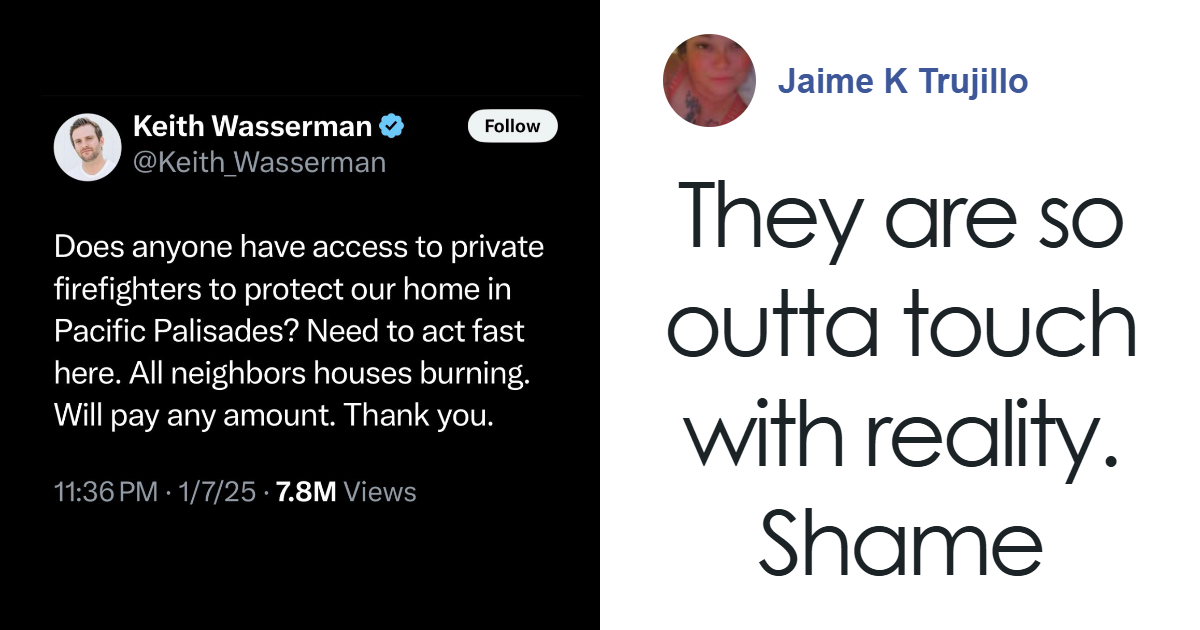
The Hollywood Hills house was not the only flashpoint. Around the same period, real estate executive Keith Wasserman faced widespread backlash after posting on social media asking whether anyone had access to private firefighters to protect his Pacific Palisades home, adding that he would “pay any amount.” The post was deleted, but the internet rarely forgetsespecially when it smells privilege, panic, and bad timing in the same sentence.
Why Private Firefighters Became a Public Lightning Rod
Private firefighting is not new, and it is not always the cartoonish “rich person hires a fire truck” scenario people imagine. Private crews have been contracted by government agencies for decades to support wildfire response. Insurance companies also hire private wildfire defense services to help protect insured homes, often by focusing on prevention: removing flammable materials near structures, closing vents or windows, applying fire-resistant gel, setting up temporary sprinkler systems, and monitoring properties when conditions become dangerous.
That said, there is a major difference between a vetted contractor operating under public command and a private crew hired directly by an individual homeowner in the middle of a fast-moving disaster. The first can be part of a coordinated emergency response. The second can raise serious questions about safety, communication, water access, liability, and fairness. In a wildfire, chaos is not a side dish; it is the main course. Unknown crews working outside the incident command structure can make an already dangerous scene more complicated.
Public fire officials and experts have repeatedly emphasized that coordination matters. Firefighters need to know who is in the hazard zone, what equipment is being used, whether crews are trained to compatible standards, and how to communicate if conditions change quickly. A private engine parked on a narrow hillside road might look heroic in a photo, but if it blocks access, uses incompatible radio systems, or fails to follow evacuation rules, it can become a problem with flashing lights.
The Anger Was Never Just About One House
The fury over the Hollywood Hills private firefighters was not simply jealousy dressed up as civic concern. It came from a raw emotional place. People were watching homes burn, families evacuate, small businesses close, pets go missing, and entire communities wonder whether they would have anything to return to. Against that backdrop, the image of a mansion receiving overnight private protection landed like a velvet-rope policy at the emergency shelter.
Los Angeles is no stranger to wealth gaps. The city contains billion-dollar entertainment empires, multimillion-dollar hillside homes, working-class neighborhoods, renters living paycheck to paycheck, and unhoused residents facing danger with almost no safety net. Wildfires do not care about income, but recovery often does. A wealthy homeowner may have insurance, lawyers, temporary housing, and the ability to hire specialists. A lower-income renter may lose everything and still have to argue with an insurance adjuster, a landlord, or a relief form that appears to have been designed by a haunted spreadsheet.
That is why the private-firefighter debate hit so hard. It seemed to expose a fear many people already carry: in a climate disaster, the wealthy can buy extra layers of protection while everyone else must hope public systems are strong enough to hold.
Supporters Say Private Crews Can Help
There is another side to the story. Supporters argue that private wildfire crews can reduce pressure on public responders by preparing homes before flames arrive. If an insurance-funded crew clears combustibles, applies protective gel, or prevents a structure from igniting, that may also reduce the chance of embers spreading to nearby homes. In that scenario, one protected house is not only one protected asset; it may be one fewer burning structure adding heat, smoke, and flying embers to the neighborhood.
Some private fire companies also bring their own water supplies or use pools on the property rather than relying on public hydrants. Others work only when authorized and coordinate with local agencies. The best version of private firefighting looks less like a billionaire’s emergency concierge service and more like a specialized prevention tool. It is not glamorous. It is not a movie scene. It is someone moving patio furniture, checking vents, and making sure dry leaves are not piled against a wall like kindling with a death wish.
Still, even when private crews are effective, the optics are difficult. A service can be useful and still feel unfair. A tool can prevent damage and still reveal that some people have access to tools others never will. That tension is at the heart of the controversy.
The Role of Insurance Companies
Insurance companies have become a major player in wildfire defense because the financial stakes are enormous. As wildfires grow more destructive, insurers face massive payouts and rising risk in fire-prone areas. Some companies include wildfire defense services in certain policies, especially for homes in high-risk regions. These services may be offered to policyholders not because the insurer has suddenly developed a warm, fuzzy personality, but because preventing a loss is cheaper than paying for one.
This is where the debate gets complicated. If wildfire defense services are tied to insurance coverage, access may depend on the type of policy a homeowner can afford. That can deepen inequality. At the same time, if insurers fund prevention work that reduces neighborhood-level damage, there may be public benefits. The question becomes: should wildfire defense be treated as a private perk, a public safety function, or some regulated hybrid of both?
California’s wildfire reality suggests the answer cannot be simple. Public agencies need resources. Communities need prevention. Homes need hardening. Insurance markets need stability. And residents need to believe that emergency response is not becoming another luxury subscription“Fire Protection Premium Plus,” now with bonus rooftop sprinklers and complimentary moral outrage.
Why Los Angeles Wildfires Are Getting Harder to Fight
The Hollywood Hills controversy unfolded during a period of extreme danger across Los Angeles County. Strong winds, dry vegetation, steep terrain, dense development, and strained water systems created brutal conditions for firefighters. In some areas, hydrants struggled under extraordinary demand. Public crews were fighting multiple fires at once, with reinforcements arriving from other regions.
Urban wildfires are especially challenging because they are not just forest fires moving through empty land. They burn through the wildland-urban interface, where homes, roads, power lines, trees, brush, and human evacuation routes are packed together. Once structures ignite, they can create new fire sources. Embers can travel ahead of the flames and start spot fires. Narrow roads can become clogged. Evacuation becomes urgent, and firefighting becomes a puzzle where every piece is hot, moving, and yelling.
Hollywood Hills, Pacific Palisades, Malibu, Altadena, and similar communities all face versions of this risk. Beautiful views often come with steep slopes, vegetation, limited access routes, and wind exposure. The same canyon roads that look dreamy in real estate photos can become nightmares during an evacuation.
Public Safety Should Not Feel Like a Luxury Product
The strongest criticism of private firefighters is not that homeowners want to save their homes. Of course they do. Anyone would. A house is not just walls and a roof; it is photographs, family records, childhood drawings, old coffee mugs, holiday decorations, and that one drawer full of cables nobody understands but everyone is afraid to throw away.
The criticism is that disaster response should not depend on personal wealth. Fire protection is a public good because fire does not respect property lines. If one home burns, neighboring homes are at risk. If one road is blocked, everyone’s evacuation is affected. If public water is depleted, the consequences ripple outward. In a wildfire, “my property” and “our community” are not separate categories.
That is why many people reacted so strongly to the Hollywood Hills scene. They were not only seeing private firefighters. They were seeing a system where public services appear underfunded, climate risks are rising, and the wealthy can purchase backup plans. The anger was not just about sprinklers on one expensive house. It was about whether society is building resilience for everyone or escape hatches for a few.
What a Fairer Wildfire Strategy Could Look Like
A better approach would not necessarily ban every private wildfire service. Instead, it would make safety, coordination, and equity non-negotiable. Private crews operating near active fires should be registered, trained to recognized standards, clearly identified, and required to coordinate with incident commanders. They should not interfere with evacuations, block access, or draw from public hydrants without authorization. If they are part of the response, they must be part of the plannot freelance heroes in yellow jackets.
At the same time, California and other fire-prone states need broader investment in public prevention. That includes vegetation management, home-hardening grants, defensible-space education, evacuation planning, resilient water infrastructure, and better support for renters, seniors, people with disabilities, and low-income households. A mansion with private sprinklers may survive, but a city survives through shared systems.
There is also a role for neighborhood-level preparedness. Community alert networks, evacuation drills, accessible emergency information, and local fuel-reduction programs can help people act before panic takes over. The goal should be to make basic wildfire protection less like a luxury add-on and more like seat belts: normal, expected, widely available, and not reserved for people with a hillside infinity pool.
Experience and Reflection: What This Controversy Teaches Us
Stories like the Hollywood Hills private firefighters controversy hit differently because they force people to imagine themselves in the same situation. If your home were in danger and you had the money, would you hire help? Many people answer honestly: yes. Protecting your family, pets, memories, and life’s work is not immoral. Panic makes philosophers of nobody. When the sky is orange and evacuation alerts are buzzing, most people are not calmly drafting an ethics paper.
But personal instinct and public policy are not the same thing. The fact that an individual would try to save a home does not mean society should accept a disaster system where protection is unevenly distributed. The lesson is not “wealthy homeowners are cartoon villains.” The lesson is that climate disasters expose every crack in public infrastructure, social trust, insurance access, housing inequality, and emergency planning. Wildfire does not create inequality from scratch; it simply lights it up bright enough for everyone to see.
For people living in fire-prone regions, the controversy is also a reminder to prepare early, not during the emergency. The safest wildfire defense happens long before flames arrive: clearing hazardous vegetation where appropriate, following local defensible-space rules, maintaining evacuation plans, signing up for official alerts, preparing go-bags, checking insurance coverage, and talking with neighbors. None of this is as dramatic as private crews guarding a mansion overnight, but boring preparation saves lives. Boring is underrated. Boring is the cardigan of survival: not flashy, but extremely useful when conditions turn ugly.
The experience of watching the Los Angeles fires unfold also shows how quickly public emotion can shift from sympathy to anger when people sense unfairness. During disasters, communities often become more generous. Strangers donate supplies, volunteers show up, restaurants feed evacuees, and firefighters work past exhaustion. But generosity has limits when people believe the rules are different for the rich. A private crew outside a luxury home may be legally allowed and technically useful, yet still become a symbol of abandonment to someone whose neighborhood had no such option.
That symbolism matters. Public trust is part of emergency response. Residents are more likely to evacuate, follow instructions, and support prevention policies when they believe the system is fair. If people think public agencies are overwhelmed while elites quietly buy separate protection, trust erodes. Once trust burns, it is harder to rebuild than a deck in the hills.
The Hollywood Hills house guarded by private firefighters sparked fury because it condensed a huge issue into one unforgettable image. It was wealth, climate risk, public strain, celebrity geography, and internet outrage all standing in the smoke together. The debate should not end with dunking on one homeowner or defending one industry. It should push cities to ask harder questions: Are public fire departments funded for the new reality? Are homeowners and renters getting equal access to prevention resources? Are private wildfire crews regulated clearly? Are insurance-based protections widening the gap between safe and vulnerable communities?
In the end, the most useful response is not outrage alone. Outrage is a flare; it gets attention, but it does not build the firebreak. The real work is creating a wildfire system where prevention starts early, public crews are supported, private resources are coordinated, and every residentnot just the ones with celebrity neighbors and emergency budgetshas a fighting chance.
Conclusion
The Hollywood Hills private firefighters controversy became a viral story because it touched a nerve America already knows too well: the fear that safety is becoming something money can buy faster than communities can build. Private wildfire crews can play a useful role when trained, regulated, and coordinated. But when they appear to protect luxury properties while public crews are stretched and ordinary residents are displaced, the optics are combustible.
The January 2025 Los Angeles wildfires were a warning about more than flames. They showed how climate risk, housing inequality, insurance pressure, and public infrastructure collide in real time. The question now is not whether people will try to protect what they own. They will. The question is whether cities and states can build systems strong enough that protection does not feel reserved for the highest bidder.