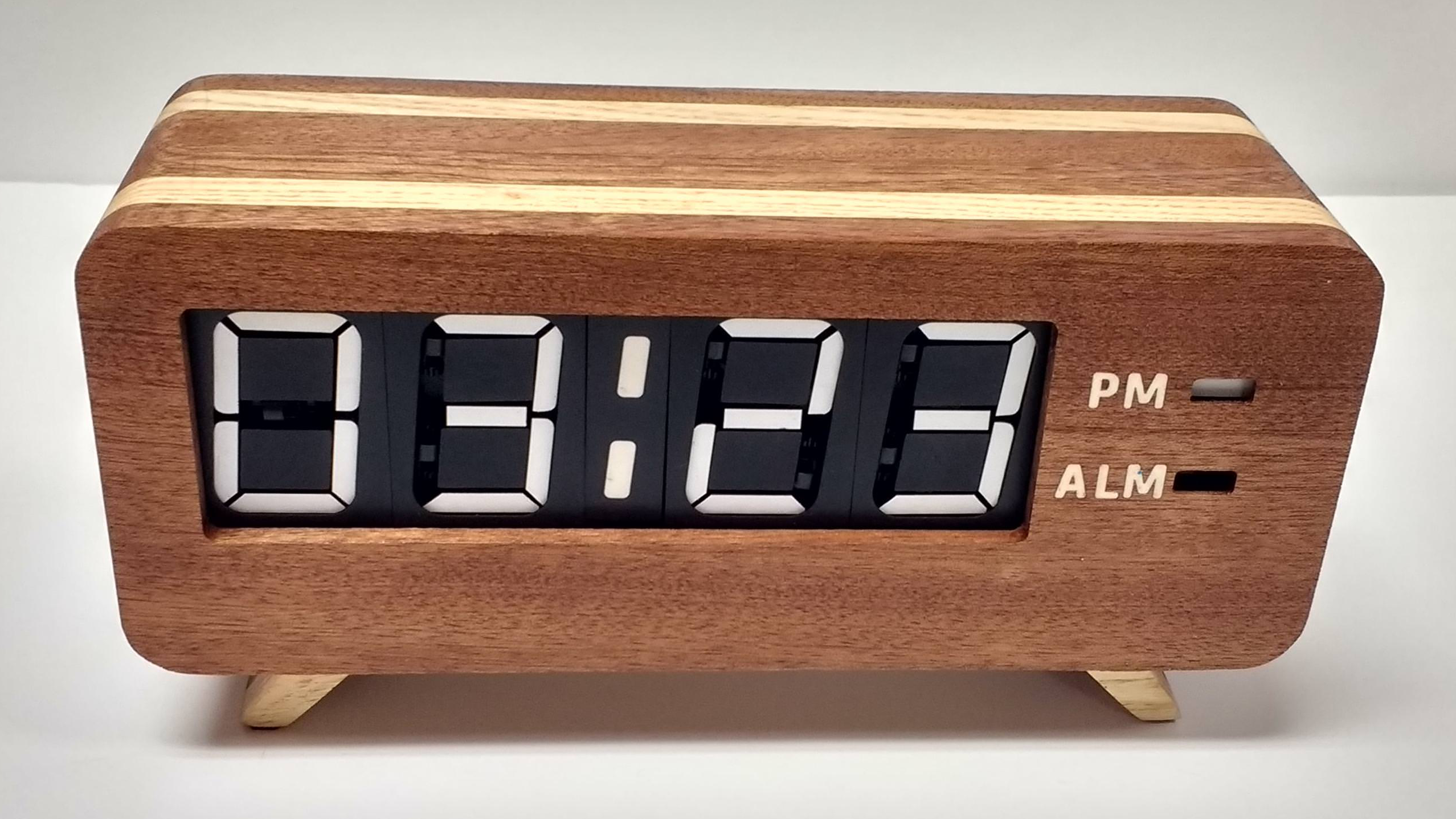
Some projects look cool because they blink. Others look cool because they move. A finished seven-segment flip clock display does both in spirit, while also making the kind of tiny mechanical drama that makes electronics people lean closer and whisper, “Okay, that is unnecessarily awesome.” This build is not just a clock. It is a love letter to electromechanical displays, vintage digital design, patient wiring, CNC-cut wood, and the noble hobby of spending several evenings solving a problem that a $4 LCD could solve before breakfast.
The phrase seven-segment flip clock display sounds simple at first. Seven segments make numbers. A clock shows time. Done, right? Not quite. In this kind of display, the digits are physical objects. Each segment flips between visible and hidden states using electromagnetic force. Instead of glowing like an LED, the segment changes position. The result feels more like a tiny train-station board, a flip-dot sign, and a designer desk clock all had coffee together and decided to become art.
What makes this finished project so satisfying is the balance between engineering and presentation. The electronics are clever, the mechanics are practical, and the enclosure looks polished enough to avoid the dreaded “prototype forever” look. Many DIY clock projects stop at “it works.” This one goes further: it works, it looks intentional, and it has personality. That is the maker trifecta.
What Is a Seven-Segment Flip Clock Display?
A seven-segment display is the classic numeric layout used to form digits from 0 to 9. You have seen it on calculators, gas pumps, ovens, old alarm clocks, measuring tools, and roughly half the gadgets that ever beeped at humanity. Each digit is made from seven bars arranged in a squared-off figure-eight pattern. Turn on the correct combination of bars and you get a number.
In most modern devices, those bars are LEDs. They are bright, inexpensive, reliable, and easy to drive. But a mechanical seven-segment display changes the idea. Each segment physically flips, rotates, or changes face. One side may be bright or reflective, while the other side may be dark. That gives the digit a tactile, old-school charm that no ordinary LED can fake without looking like it is trying too hard.
A flip clock display is usually associated with split-flap mechanisms, where small cards flip over to show minutes and hours. A seven-segment flip display takes a different route. Instead of flipping entire number cards, it flips the segments that build the numbers. That means the same display can create any digit by changing only the required bars.
Why This Finished Build Stands Out
The finished clock is memorable because it uses vintage seven-segment flip modules rather than ordinary LEDs. These modules behave somewhat like flip-dot displays. A current pulse through a coil creates a magnetic field that moves a segment one way; current in the opposite direction moves it the other way. The effect is wonderfully physical. The clock does not merely update the time. It performs it.
The builder’s design uses multiple digits for the time and a fifth offset digit for additional indicators such as AM/PM and alarm status. That small design choice matters. It keeps the main display clean while still giving the clock useful functions. It also avoids cluttering the front with random LEDs that would ruin the vintage mood. Nobody invites an elegant flip clock to the desk just to make it look like a router having a panic attack.
The project also shows thoughtful use of microcontroller pins. Instead of treating every coil connection as an isolated control problem, the wiring groups common connections in a way that reduces the number of required control lines. That is classic embedded design: make the hardware do less chaos so the software does not need therapy.
The Core Technology: Flip-Dot Thinking in Seven-Segment Form
Flip-dot and flip-segment displays are fascinating because they are bistable. Once a segment flips into position, it can remain there without constant power. That is different from an LED, which must be powered continuously to stay lit. In practical terms, a mechanical flip display may only need energy when changing state.
That feature gives the display a distinct personality. The digits are visible in ambient light, they do not glow in your face at 2:00 a.m., and the display has a natural contrast that feels closer to signage than screen technology. The downside is that driving the segments is more complex than lighting LEDs. Coils need current pulses. Polarity matters. Timing matters. Protection components matter. If the pulse is too long or the circuit path is not properly controlled, the magic smoke may begin exploring career opportunities outside the component.
The finished clock solves these problems with driver circuitry, a microcontroller, and careful wiring. Each segment must be told whether to enable or disable. The clock must know which digit is being updated. The system must avoid backfeeding through other coils. These are the kinds of issues that look invisible in a finished product but dominate the real build process.
Microcontroller Control: Small Chip, Big Responsibility
The project uses an AVR ATmega48-class microcontroller, a small 8-bit chip that fits the spirit of the build. It is not overpowered. It is not trying to run a web server, stream music, or ask whether your clock has accepted cookies. It simply handles time display, buttons, alarm features, segment updates, and control logic.
That restraint is refreshing. A clock like this does not need a supercomputer. It needs predictable timing, enough I/O strategy, and firmware that knows how to update physical segments without wasting space. In the project log, code size became a real constraint, which is a useful reminder for makers: small microcontrollers reward discipline. Every feature has a cost. Every shortcut eventually sends an invoice.
The firmware approach also highlights an important lesson in embedded systems. Mechanical displays are slow compared with LEDs. You cannot simply blast data at them and assume everything will behave. The software has to respect the hardware. Pulses must be timed. State changes should be deliberate. Buttons need debouncing. Alarm functions need logic. A real-time clock module or accurate timing source helps keep the clock honest when power cycles or drift become concerns.
Real-Time Clock Accuracy: Because “Close Enough” Is Not a Clock
Any clock project eventually faces the same question: how does it keep time accurately? A microcontroller can count, but without a stable reference it may drift. That is why many DIY clock builds use a dedicated real-time clock, often called an RTC. Popular RTC chips such as the DS3231 are known for temperature compensation and battery backup support, which helps the device maintain time even when main power is interrupted.
For a seven-segment flip clock display, accurate timekeeping matters because the display itself is the star. If the clock looks spectacular but loses several minutes a week, it becomes less of a clock and more of a decorative liar. The best builds combine mechanical beauty with electronic reliability. That is the sweet spot: old-school motion, modern accuracy.
The Display Driver Challenge
Driving a mechanical segment is not the same as driving an LED segment. With LEDs, you usually worry about current-limiting resistors, multiplexing, brightness, and common anode or common cathode layouts. With flip segments, you worry about magnetic actuation, current direction, coil protection, and avoiding unwanted current paths.
One of the most interesting parts of the build is the move from tedious hand wiring to cleaner adapter boards and ribbon cables. This is a familiar maker evolution. Stage one: “I can wire this by hand.” Stage two: “I regret having hands.” Stage three: “A PCB would solve this.” Stage four: “The PCB needs revision.” Stage five: “Now it looks professional and I have learned humility.”
The finished clock uses adapter circuitry to make the displays more reliable. Diodes help prevent backfeeding, and ribbon cables make assembly neater and more serviceable. That is not just cosmetic. Serviceability is part of good design. If a project cannot be opened, tested, repaired, or reassembled without summoning ancient curses, it is not finished. It is merely trapped.
The Case: CNC-Cut Wood With a Vintage Soul
The enclosure is one of the reasons this seven-segment flip clock display feels complete. The clock uses layered wood, including contrasting tones, to create a polished case with depth and warmth. CNC cutting allows the layers to align precisely, while sanding and finishing give the piece a refined look.
This matters because electromechanical displays already carry a retro mood. Pairing them with a thoughtful wooden enclosure reinforces that personality. A plastic box might have worked, but it would not have told the same story. The layered wood gives the clock a design language: part art deco, part mid-century desk gadget, part “I know what I am doing, please ignore the pile of failed prototypes behind me.”
The top surface also hides a capacitive sensor used for alarm control. That is a smart user-experience detail. Buttons on the back handle settings, but the daily action of silencing or snoozing the alarm can happen with a touch. It keeps the front clean and makes the interaction feel deliberate.
Daylight Alarm: A Practical Feature With a Soft Touch
The build includes LEDs for a daylight alarm concept, intended to brighten gradually before the alarm time. This feature is clever because it adds modern usefulness without stealing attention from the mechanical display. The flip digits remain the main visual event, while the light supports the morning routine.
A clock that wakes you gently is always preferable to one that screams like a smoke detector with unresolved childhood issues. A daylight alarm can make the device more than a desk sculpture. It becomes part of daily life. The best DIY projects often succeed because they are both beautiful and useful. They earn their place on the nightstand.
Why Makers Love Electromechanical Displays
Electromechanical displays have a strange power over technically minded people. They are not the fastest, cheapest, or simplest way to show information. That is exactly the point. They make information physical. They move air. They make sound. They introduce timing, texture, and anticipation.
When a flip display changes from 12:59 to 1:00, it feels like an event. Multiple segments snap into place. The display has rhythm. It reminds us that digital information does not have to live only behind glass. Numbers can have hinges. Time can click.
This is why split-flap boards at train stations and airports remain so beloved. They turned schedule updates into theater. The seven-segment flip clock display brings that same emotional quality to a smaller object. It makes checking the time oddly satisfying, which is more than most clocks can claim.
Lessons From the Build
1. Mechanical Projects Need Tolerance Thinking
Mechanical parts must fit in the real world, not just in CAD. A display module, support frame, PCB, wiring harness, enclosure, and buttons all need physical room. Even tiny dimensional errors can cause big assembly problems. This clock shows why test fitting, prototypes, and patience are essential.
2. Wiring Can Become the Project
Complex wiring is often underestimated. A seven-segment flip display with multiple digits creates a surprising number of solder joints and control paths. Clean wiring is not just prettier. It reduces faults, simplifies troubleshooting, and makes the final build more durable.
3. PCBs Are Worth It
Custom boards may feel like extra work, but they can turn a fragile project into a reliable one. Adapter boards, diode placement, headers, test points, and organized connectors all reduce future pain. A good PCB is like a good map: you appreciate it most when things go wrong.
4. Design Finish Matters
A working circuit on a bench is exciting. A finished object is different. The CNC-cut wooden enclosure, polished surfaces, hidden sensor, and thoughtful layout transform the clock from experiment to product-like artifact. For DIY electronics, the last 20 percent of finish often creates 80 percent of the “wow.”
Seven-Segment Flip Clock Display vs. LED Clock
An LED clock wins on simplicity. It is cheaper, easier to drive, thinner, brighter, and more widely available. If the goal is only to display time, LED technology is the obvious answer.
But a seven-segment flip clock display wins on character. It has mechanical presence. It is readable without harsh light. It adds movement. It invites questions. It is the kind of object people notice on a desk and immediately want to poke, photograph, or ask about. In other words, LEDs are practical. Flip displays are memorable.
That does not make one better in every situation. It makes them different tools for different emotional jobs. A microwave needs an LED display. A maker’s desk deserves something with a little drama.
Who Should Build a Clock Like This?
This type of project is best for intermediate to advanced makers, especially those who enjoy both electronics and fabrication. It involves embedded programming, display driving, power control, soldering, mechanical design, enclosure work, and debugging. Beginners can learn a lot from it, but it is not a “first Saturday afternoon” project unless that Saturday comes with a backup Saturday, several extra evenings, and snacks.
If you have experience with Arduino-style projects, AVR microcontrollers, PCB design, CNC routing, 3D printing, or old display modules, this build is deeply appealing. It also suits anyone who likes restoring vintage technology or combining old parts with modern control systems.
Common Problems in DIY Flip Display Projects
The biggest challenge is usually reliable actuation. Segments need enough current to flip, but not so much or so long that coils overheat. Another challenge is knowing the display’s state. Some flip mechanisms are bistable, so the system may assume a segment stayed where it was last commanded. Others may benefit from sensors, homing routines, or startup reset behavior.
Backfeeding is another classic issue. When multiple coils and shared lines are wired together, current can sneak through unwanted paths. Diodes, proper driver circuits, and careful matrix design help prevent accidental segment changes.
Mechanical alignment also matters. A segment that rubs, sticks, or slightly misses its intended position can ruin readability. The display must be both electrically correct and physically smooth. That is what makes the finished clock impressive: it solves enough small problems to make the final object feel effortless.
Why “Finally Finished” Feels So Good
Every maker understands the emotional weight of the phrase “finally finished.” It suggests revisions, surprises, delays, and at least one moment of staring at a non-working device while questioning your life choices. A project like this includes all the usual suspects: PCB adjustments, cable management, code optimization, mechanical fit, enclosure finishing, and final assembly.
The finished result matters because it proves that persistence can turn a pile of parts into something coherent. The clock is not just a machine for telling time. It is a record of decisions. Every screw, trace, diode, wood layer, sensor, and line of code represents a solved problem.
Experience Notes: What Building or Owning a Seven-Segment Flip Clock Feels Like
Living with a seven-segment flip clock display is different from living with a normal digital clock. The first thing you notice is the silence between changes. Unlike a bright LED display that constantly announces itself, a flip display can sit quietly, showing the time with calm confidence. Then the minute changes, and the clock briefly becomes alive. A segment flips. Sometimes several segments flip. The update feels like a tiny ceremony.
That physical update changes how you relate to the object. You may find yourself waiting for the next minute just to see which segments move. The number 1 changing to 2 is simple. The number 9 changing to 0 is more dramatic. The clock turns ordinary timekeeping into miniature choreography.
From a builder’s perspective, the experience is even richer. At first, the project looks logical. Seven segments per digit. A few digits. Some coils. A microcontroller. No problem. Then the real build begins and the hidden complexity appears. The wiring multiplies. The driver circuit needs protection. The enclosure needs space for connectors. The buttons must be reachable but not ugly. The display modules may not have convenient documentation. Suddenly, the clock is teaching you electronics, mechanical design, product design, and patience, all while sitting on your bench like a smug little professor.
The most satisfying moment is not always the first successful digit. Sometimes it is the first clean transition after everything is assembled. Seeing the clock tick inside its finished case feels different from seeing parts work separately. The enclosure frames the display. The wiring disappears. The object becomes whole. That is when the project stops looking like a collection of tasks and starts looking like something that was always meant to exist.
There is also a practical pleasure in using something you built. Setting the time with rear buttons, tapping the top sensor, watching the alarm indicator change, or seeing the daylight feature glow makes the clock feel personal. It has quirks because you made choices. It has charm because it was not mass-produced into blandness. Even small imperfections become part of the story.
For anyone considering a similar project, the best advice is to respect the final assembly from the beginning. Plan cable paths. Add test points. Leave room for fasteners. Think about how you will open the case later. Make the display serviceable. Future you will be very grateful, and future you deserves nice things.
A seven-segment flip clock display is not the easiest way to tell time. That is exactly why it is worth building. It turns a familiar function into a conversation piece, a learning tool, and a small mechanical performance that happens every minute. In a world full of invisible software and disposable screens, that feels refreshingly human.
Conclusion
The finished seven-segment flip clock display is a beautiful example of what happens when electronics, mechanical design, and craftsmanship meet in the same workshop. It combines vintage flip-dot charm with microcontroller control, careful driver circuitry, accurate timekeeping, CNC-cut wood, and thoughtful user interaction. The result is not merely a clock. It is a functional sculpture that makes time visible, audible, and oddly delightful.
For makers, this project is a reminder that finishing matters. A clever prototype is exciting, but a finished build tells the full story. The seven-segment flip clock display earns attention because it solves real technical problems and wraps them in a design worth looking at every day. It is proof that sometimes the long route is the best route, especially when the destination clicks, flips, and looks fantastic on a desk.
Note: This HTML body is written as original, publication-ready content based on real maker, electronics, and display-design information, with SEO tags placed at the end in JSON format as requested.