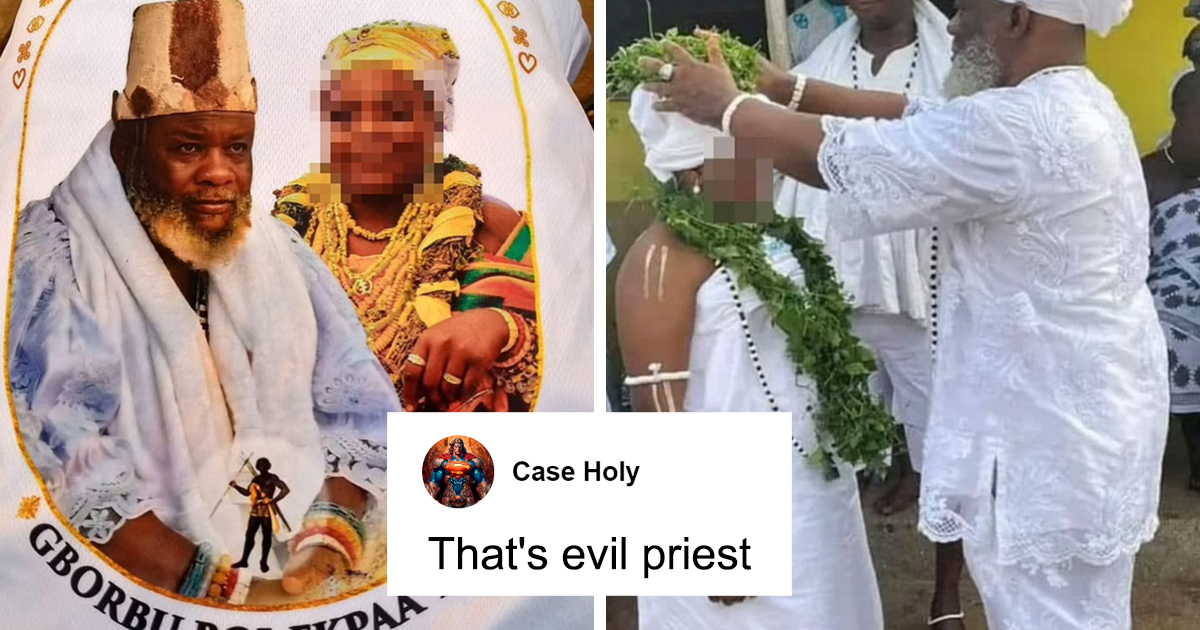
A disturbing child marriage case in Ghana drew global attention after reports said a 63-year-old traditional priest married a young girl in a customary ceremony. The story quickly moved beyond one community and became a worldwide conversation about child protection, tradition, law, power, and the dangerous silence that often surrounds harmful practices.
The priest was identified in public reports as Nuumo Borketey Laweh Tsuru XXXIII, also known as Gborbu Wulomo, a traditional high priest in the Nungua area near Accra. The girl’s age was reported by several outlets as 12, while some traditional authorities disputed the exact age. Either way, the controversy centered on one urgent question: how can any society protect children when cultural authority, family pressure, and public ceremony are allowed to blur the line between tradition and harm?
This article examines the incident, why it sparked outrage, what Ghanaian law says about child marriage, and why child-rights advocates insist that no custom should turn a child into a bride.
What Happened in the Ghana Child Marriage Case?
According to widely reported accounts, the ceremony took place in Nungua, a community in Ghana’s Greater Accra Region. Footage and images circulated online, showing a formal traditional event attended by community members. Public reaction was immediate and intense. Many Ghanaians, journalists, activists, and child-rights organizations argued that the ceremony appeared to violate both the spirit and the letter of child protection laws.
One detail that especially alarmed viewers was the reported advice given to the girl during the ceremony. Women speaking in the local Ga language were said to have instructed her about how to present herself as a wife, including remarks about perfume and dressing in a way meant to appeal to her husband. For critics, that moment cut through attempts to describe the marriage as purely symbolic. A child being instructed in “wifely” behavior is not harmless theater. It is a red flag waving so hard it practically needs its own weather forecast.
The priest’s representatives reportedly defended the arrangement as a customary or spiritual role rather than a conventional marriage. They suggested the child would not be expected to perform marital duties until she reached a legal age. But child advocates responded that the issue was not only physical harm. A public marriage ceremony can carry psychological, social, educational, and legal consequences long before adulthood.
Why the Public Outcry Was So Strong
The outrage was not simply because of the age gap, although a 63-year-old man and a child in a marriage ceremony is shocking enough. The deeper concern was the power imbalance. A traditional priest holds spiritual and cultural authority. A child, by definition, cannot meaningfully consent to the social weight of marriage, especially when families and community leaders frame it as destiny, duty, or sacred tradition.
Many people online summarized the issue with one blunt truth: she is a child, not a bride. That sentence became powerful because it strips away the decorative language often used to soften harmful practices. “Customary wife,” “spiritual role,” and “future responsibility” may sound formal, but they cannot erase a child’s right to education, safety, play, privacy, and self-determination.
Public reaction also reflected frustration with how often children’s rights are negotiated in rooms controlled by adults. Adults decide. Adults defend. Adults explain. Adults reinterpret the law. Meanwhile, the child at the center of the story is expected to carry the consequences. That is precisely why child protection laws exist: to prevent adults from voting away a child’s future with tradition as the campaign slogan.
Ghana’s Legal Position on Child Marriage
Ghana’s minimum legal age for marriage is 18. Child, early, and forced marriage is illegal, though enforcement challenges remain. Ghana has also committed to international child-rights and women’s-rights frameworks that recognize child marriage as a harmful practice.
In practical terms, this means that a community cannot simply declare a child marriage acceptable because it is traditional. A custom may be old, meaningful, and deeply rooted, but if it harms a child, the law must place the child first. Tradition can preserve language, music, food, ceremonies, clothing, family memory, and identity. It should not preserve inequality like an antique nobody asked to inherit.
Reports said Ghanaian authorities took interest in the case after the backlash, with the girl and her mother reportedly placed under protection and an investigation opened. That response mattered because child marriage cases can easily disappear when they are treated as private family matters. Public accountability makes it harder for influential figures to hide behind status.
Why Child Marriage Is Considered a Human Rights Violation
Child marriage is not just an early wedding. It is a chain reaction. It can interrupt schooling, increase dependence, limit future income, isolate girls from peers, expose them to violence, and place adult expectations on children before they are emotionally or physically ready.
Organizations such as UNICEF, UNFPA, Girls Not Brides, the World Bank, and Human Rights Watch consistently describe child marriage as a violation of human rights. The reason is simple: children cannot fully understand or consent to the lifelong obligations of marriage. Even when a ceremony is described as symbolic, the social message can be powerful. The girl may be treated differently at school, in her family, and in her community. She may be watched, judged, or pressured. Her childhood becomes conditional.
Education Often Becomes the First Casualty
One of the most common harms linked to child marriage is disrupted education. A girl may remain technically enrolled in school, but the social burden of being called a wife can change everything. Teachers may treat her differently. Classmates may gossip. Family members may prioritize ceremonial duties. Eventually, school can begin to feel like a side errand instead of a right.
Education is not only about grades. It gives children friendships, confidence, problem-solving skills, financial opportunity, and a wider view of the world. When marriage enters too early, it can shrink a girl’s horizon before she has even had a chance to draw her own map.
Power Imbalance Is the Core Problem
In child marriage, the imbalance is not subtle. Adults control the ceremony, the narrative, the finances, and the social pressure. A child may be praised for obedience, but obedience is not consent. A child may smile in photographs, but a smile at a public event is not proof of freedom. Many children learn early that resisting adults can bring punishment, shame, or rejection.
This is why child-rights advocates focus less on whether a ceremony looked joyful and more on whether the child had real choice. Real choice requires knowledge, maturity, safety, alternatives, and the ability to say no without fear. A child surrounded by powerful adults rarely has that kind of freedom.
Tradition Versus Harm: A Difficult but Necessary Conversation
Every culture has traditions worth protecting. Communities deserve respect for their histories, rituals, languages, and spiritual practices. But respect for culture cannot mean silence when a child is placed in harm’s way.
The strongest communities are not the ones that never change. They are the ones that know how to keep what is beautiful and retire what is harmful. Culture is not a museum display locked behind glass. It is alive. It breathes, adapts, learns, and grows. When a tradition threatens a child’s rights, the answer is not to destroy culture. The answer is to reform the practice so that culture and child protection can stand on the same side.
Community leaders have a special responsibility here. Their words can either protect children or normalize harm. When leaders defend child marriage as misunderstood custom, they may believe they are protecting heritage. But they risk sending a dangerous message: that a child’s rights are negotiable when tradition is involved.
The Role of Community Leaders, Families, and Authorities
Preventing child marriage requires more than laws on paper. It requires adults willing to act before a ceremony happens, not only after a video goes viral. Families need support. Schools need reporting systems. Religious and traditional leaders need child-protection training. Police and social welfare agencies need resources to respond quickly and safely.
Families sometimes agree to child marriage because of poverty, pressure, fear, or belief in tradition. That does not excuse the harm, but it explains why solutions must go beyond punishment. Communities need economic support, girls’ education programs, public awareness campaigns, and trusted local advocates who can challenge harmful norms without making families feel attacked.
At the same time, influential adults must be held accountable. If a leader uses status to legitimize a child marriage, the response should be firm. A child’s future should never depend on how powerful the adult is.
What This Case Reveals About Online Outrage
Social media played a major role in amplifying this case. Without videos and public discussion, the ceremony might have remained a local issue. Online outrage can be messy, loud, and occasionally about as organized as a drawer full of phone chargers. But in this situation, it pushed a child-protection issue into national and international view.
Still, online discussion must be handled carefully. The child’s name and identifying details should not be shared. Her image should not be circulated for clicks. Outrage should focus on adult systems, not on exposing a minor to permanent digital attention. Protecting a child means protecting her privacy too.
How Journalists and Publishers Should Cover Child Marriage
Stories like this attract search traffic, but they must not be treated as scandal entertainment. Ethical coverage should avoid sensational images, mocking language, or unnecessary details about the child’s appearance. The focus should remain on the law, the power imbalance, the community response, and the broader issue of child marriage.
Responsible reporting also means clarifying that a “priest” in this case refers to a traditional high priest, not necessarily a Christian priest. That distinction matters because inaccurate framing can fuel confusion and prejudice. Good journalism should inform readers, not hand them a fog machine and call it context.
Publishers should also include resources and prevention angles. Readers need more than shock; they need understanding. The goal is not simply to make people angry for five minutes. The goal is to make communities safer for children.
Experiences Related to Child Marriage: Lessons From Communities, Schools, and Advocates
In communities where child marriage has been challenged successfully, change often begins with one uncomfortable conversation. A teacher notices that a girl has suddenly stopped coming to class. A neighbor hears that a family is preparing a ceremony. A health worker realizes that a young teenager is being treated as an adult before she has had a chance to be a child. These moments may seem small, but they can become turning points when adults decide not to look away.
One common experience among educators is the quiet disappearance of girls from school. There may be no dramatic announcement. A student misses one week, then another. Her friends say she is “busy at home.” A parent says she will return soon. By the time teachers understand what is happening, the child may already be under pressure to accept a marriage arrangement. This is why schools need strong attendance monitoring and trusted reporting pathways. A missing student is not always just a missing student; sometimes, it is an alarm bell.
Child-protection advocates often describe another challenge: families may not see themselves as harming their daughters. Some parents believe they are preserving honor, fulfilling a spiritual obligation, reducing financial strain, or following what elders expect. Effective prevention work must therefore combine firmness with patience. Telling a family “you are wrong” may create resistance. Explaining the legal risks, educational consequences, health dangers, and emotional toll can open a door. The goal is not to win an argument like a debate trophy is waiting backstage. The goal is to keep a child safe.
Community reform also works better when respected local voices participate. When chiefs, elders, pastors, imams, women leaders, teachers, and youth advocates speak together, harmful practices become harder to defend. A family may ignore a government poster, but listen carefully when a trusted local leader says, “This is not protection. This is harm.” That kind of message can shift norms faster than outside criticism alone.
Survivors’ experiences are especially important, though they must be shared only with consent and care. Many women who were married as children describe losing school years, friendships, confidence, and control over their own lives. Some rebuild beautifully, becoming artists, activists, business owners, parents, mentors, and leaders. But their resilience should not be used to minimize the harm. Surviving something does not make it acceptable. A broken bridge can still be crossed by a brave person; that does not mean the bridge should stay broken.
Another lesson from child-marriage prevention is that laws must be visible. A legal minimum marriage age means little if families do not know it, police do not enforce it, or leaders believe custom can override it. Communities need clear public education: underage marriage is illegal, child consent is not adult consent, and anyone facilitating such a union may face consequences.
Finally, child protection depends on speed. When warning signs appear, delays can allow ceremonies to proceed and pressure to harden. Fast action by social welfare officers, police, teachers, and community advocates can prevent long-term harm. In the Ghana case, public concern reportedly helped trigger official attention. That should not require a viral video every time. A child should not need the internet to rescue her.
Conclusion: A Child’s Future Should Never Be a Ceremony
The case of a 63-year-old traditional priest reportedly marrying a young girl in Ghana is not just a shocking headline. It is a reminder that child marriage can survive wherever silence, power, poverty, and tradition combine. The most important issue is not whether adults can explain the ceremony. Adults can explain almost anything when reputation is on the line. The real issue is whether the child’s rights, safety, education, and future were protected.
Culture deserves respect, but children deserve protection. When the two appear to conflict, the answer should be reform, not denial. A society can honor its ancestors without handing a child an adult burden. It can preserve tradition without preserving harm. And it can listen to elders while still saying, clearly and firmly, that no child should be made a bride.