Note: HTML body only; the article below is synthesized from official NASA/JPL materials and reporting from major U.S. outlets such as AP, PBS NewsHour, Smithsonian Magazine, Scientific American, National Geographic, Science News, Popular Science, Ars Technica, and The Atlantic. Key facts used here include the February 18, 2021 landing in Jezero Crater, the first high-definition footage of a spacecraft landing on another world, Perseverance’s entry-descent-landing sequenc
NASA Science
+2
NASA Jet Propulsion Laboratory (JPL)
+2
The Atlantic
+12
NASA Science
+12
NASA Jet Propulsion Laboratory (JPL)
+12
>
Mars does not exactly roll out a red carpet. It barely rolls out an atmosphere. That is part of what makes the Perseverance landing video so jaw-dropping: it shows a one-ton rover surviving a blazing entry, a supersonic parachute deployment, a rocket-powered descent, and a sky-crane drop onto the Martian surface like it is merely parking outside a grocery store. Spoiler: it was not that casual.
When NASA released footage of Perseverance’s touchdown on Mars, viewers were not just watching another slick space animation. They were seeing the real thing. Real dust. Real cables. Real suspense. Real engineering doing backflips in public. For the first time, humanity got a front-row seat to a spacecraft landing on another world in high-definition color. That alone would have made history. But the video matters for more than its cinematic wow factor. It is a record of a mission built to answer one of the biggest questions in science: Did ancient Mars ever support life?
In this article, we will break down why the Perseverance rover landing footage became instantly iconic, what the video actually shows, why Jezero Crater was worth all that collective nail-biting, and how the mission changed the way people experience planetary exploration. Because yes, it is science. But it is also one of the greatest “you had to see it” moments in modern space history.
Why the Perseverance Landing Video Was Such a Big Deal
Space agencies have landed spacecraft before, but most of those moments arrived on Earth as telemetry, still images, and relieved shouting from mission control. The Perseverance landing video changed that. NASA equipped the spacecraft with a set of entry, descent, and landing cameras designed to capture the final approach in ways no Mars mission had done before. So instead of imagining the “seven minutes of terror,” the public could finally watch them play out.
That phrase, by the way, is not NASA being dramatic for fun. It refers to the roughly seven-minute period in which the spacecraft slammed into the top of the Martian atmosphere at incredible speed, slowed down using heat shielding, a parachute, and rocket engines, and then landed autonomously. No one on Earth could steer in real time because radio signals took too long to travel between the planets. By the time engineers heard what happened, Mars had already decided whether Perseverance got a heroic welcome or a very expensive faceplant.
The footage gave the public something rare: proof of just how physically intense a Mars landing really is. Instead of a tidy diagram, viewers saw the parachute snap open, the heat shield fall away, the landscape rush upward, and the rover dangle beneath the descent stage before touching down in a cloud of dust. Science had never looked more like a thriller.
What the Footage Actually Shows
The Parachute Deployment
One of the most unforgettable moments in the Perseverance touchdown video is the sudden bloom of the giant parachute. It opens at supersonic speed, which is about as gentle as opening an umbrella in a hurricane while skydiving over another planet. The camera angle makes the sequence feel both graceful and absurdly violent at the same time.
For many viewers, this was the first moment the landing stopped feeling abstract. This was not a hidden mechanism working somewhere behind a heat shield. It was visible, immediate, and strangely beautiful. Also, NASA engineers had tucked a coded message into the parachute pattern, because apparently even on Mars they cannot resist a good nerdy Easter egg.
Heat Shield Separation
Next comes the heat shield release, which is the engineering equivalent of taking off oven mitts while still falling through the sky. Once the shield dropped away, the rover’s systems could begin using radar and cameras to figure out exactly where it was relative to the ground. This part mattered because Jezero Crater is scientifically irresistible but not exactly forgiving. It has slopes, rocks, and terrain features that make landing tricky.
The footage of the heat shield falling away is not just visually cool. It marks the moment when Perseverance moved from surviving entry to actively hunting for a safe landing spot.
Terrain-Relative Navigation and the Sky Crane
If you have never heard of terrain-relative navigation, think of it as a spacecraft frantically checking a map while falling from the sky and somehow still being the smartest thing in the room. Perseverance compared live images of the surface with onboard maps so it could avoid hazards and aim for a safer patch of ground.
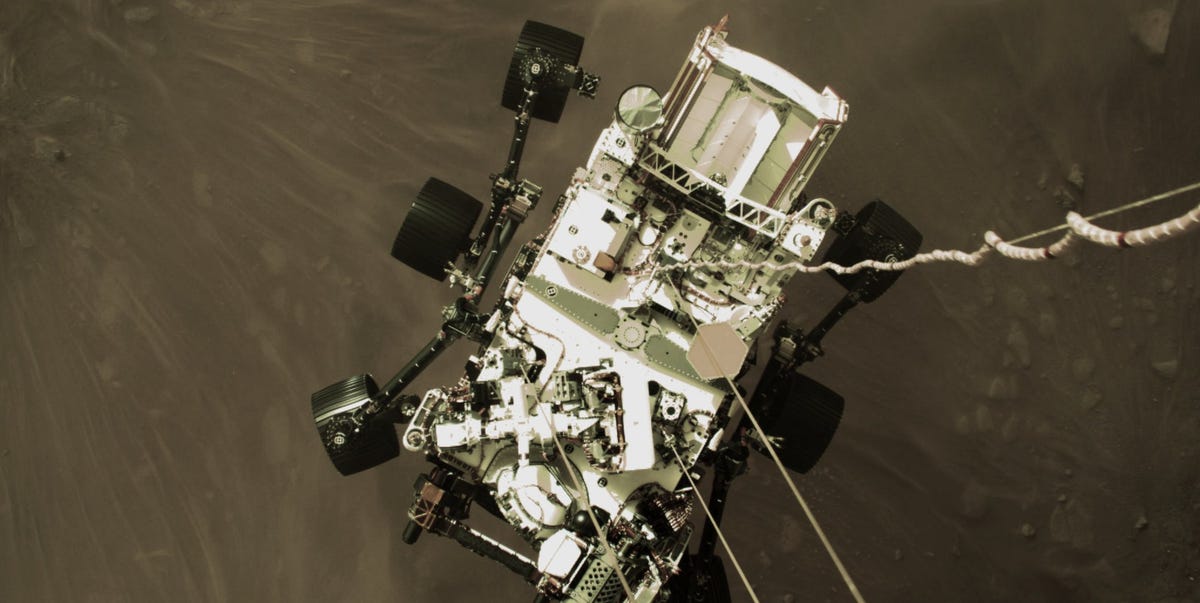
Then came the sky crane, the maneuver that sounds fake until you realize NASA keeps using it because it works. A rocket-powered descent stage hovered above the surface and lowered the rover on cables for the final few moments. In the video, the rover looks almost delicate as it hangs below the descent stage. In reality, it was a rolling science lab the size of a small car, carrying some of the most sophisticated instruments ever sent to Mars.
When the wheels touched the ground, the descent stage cut the cables and flew away to crash at a safe distance. It is one of the coolest exits in engineering history. Hollywood would absolutely keep that shot in the trailer.
Why Jezero Crater Was Worth the Stress
The landing site was not chosen because it looked nice in pictures. NASA targeted Jezero Crater because it appears to have once held a lake and a river delta billions of years ago. On Earth, deltas and lakebeds are excellent places to preserve evidence of past life. That made Jezero one of the most scientifically promising places on Mars.
In other words, Perseverance did not go to Mars just to survive a landing and take a victory selfie. It went to examine a landscape where water once flowed, sediments accumulated, and the chemistry may have been friendly to microbial life in the ancient past. That is the real reason the rover touchdown on Mars mattered so much. The landing was the opening act. The science was the reason for the ticket.
And Jezero came with a bonus complication: it was harder to land there than in some flatter, safer-looking regions. That is why the mission leaned on advanced landing technology. NASA was not just trying to get to Mars. It was trying to get to exactly the right neighborhood on Mars.
The Science Behind the Drama
The Perseverance Mars landing footage may have grabbed the headlines, but the rover’s mission is even more ambitious than the video suggests. Perseverance was designed to search for signs of ancient microbial life, study Martian geology and climate, collect and cache samples for possible return to Earth, and test technologies that could help future human exploration.
That sample-caching goal is especially important. The rover drills cores from carefully chosen rocks, seals them in tubes, and leaves them as a scientific treasure chest for future return efforts. If those samples eventually make it back to Earth, researchers will be able to study them with instruments far more advanced than anything that can currently be packed onto a rover.
Perseverance also carried Ingenuity, the small helicopter that later became the first aircraft to fly on another planet. So yes, the rover landed dramatically, searched an ancient crater for clues to life, gathered samples for future missions, and brought a helicopter along for the ride. Frankly, Perseverance had no business being this overachieving.
Did the Video Include Sound?
This is where the story gets slightly sneaky. Many people associate the landing release with the first sounds from Mars, but the situation was a bit more specific. The landing system included a microphone intended to capture audio during entry, descent, and landing, but it did not return usable descent audio. So no, we did not get a clean soundtrack of the parachute opening and the sky crane roaring over the surface.
What we did get soon after landing was still historic: Perseverance captured the first audio recordings from the Martian surface. Wind moved across the microphone with a soft, eerie hush, and the rover later recorded its own mechanical movements and laser zaps. That meant Mars stopped being only something we could see. It became something we could hear. Quietly, thinly, weirdly hear.
That distinction matters because it shows how the mission expanded human access to another world. The Perseverance landing video gave us sight. The rover’s later recordings gave us sound. Together, they made Mars feel less like a distant dot and more like a place.
Why the World Connected With This Video
The public response to the landing footage was huge for a reason. The video compressed an enormous amount of human effort into a few unforgettable minutes. Viewers were not just watching a machine descend. They were watching years of design, testing, risk analysis, and stubborn optimism survive the one phase everyone fears most.
There was also a powerful emotional contrast in the way the mission played out. Engineers at JPL were working during a pandemic. People around the world were watching from homes, classrooms, offices, and phones. Then suddenly the signal came through: touchdown confirmed. It felt like one of those rare modern moments when science was not abstract or distant. It was communal, immediate, and deeply human.
The official footage amplified that feeling. Seeing the rover sway beneath the sky crane and settle into Martian dust made the achievement tangible. This was not a line of code on a screen. This was a physical object on another planet, arriving with all the grace of a robot gymnast and all the suspense of a season finale.
What the Landing Video Still Means Today
Even years later, the Perseverance landing video remains one of the clearest examples of why robotic exploration still captures the imagination. It is an engineering triumph, a storytelling milestone, and a doorway into bigger scientific questions. It turned an invisible process into a shared human memory.
It also raised the bar for future missions. Now that people have seen a real Mars landing in such detail, expectations have changed. Space exploration is no longer just about charts, mission patches, and after-the-fact explanations. Audiences want to witness discovery as it happens. They want the dust, the motion, the stakes, and the strangely emotional sight of six rover wheels touching another world.
Most of all, the footage reminds us that exploration is not only about reaching new places. It is about making those places real enough for people on Earth to care about them. Perseverance did not just land on Mars. It brought Mars a little closer to home.
Experiences Related to the Perseverance Landing Video
Watching the Perseverance rover touchdown on Mars is one of those rare experiences that feels both intimate and cosmic. Even if you are sitting in a kitchen chair with cold coffee and too many browser tabs open, the moment can make the room feel bigger. The landing footage does that. It stretches the walls. It gives ordinary viewers the strange sensation of being present for something happening millions of miles away.
For students, the experience is often electric. A Mars landing can turn science from a textbook subject into a living event. Suddenly, physics is not just equations on a whiteboard. It is a parachute opening at supersonic speed. Engineering is not just vocabulary. It is a sky crane lowering a rover onto a planet with no human hands involved. Geology is not just rock layers in a diagram. It is Jezero Crater, a place that may once have held a river delta and a lake. The video gives young viewers a path from curiosity to career dream in about three breathtaking minutes.
For parents and teachers, the experience can be surprisingly emotional. The landing video offers something rare: a genuinely exciting piece of science that is also easy to share. You do not need a Ph.D. to understand the stakes. A machine is trying to land safely on Mars. Everyone understands that success will be amazing and failure will be heartbreaking. That clarity makes the footage powerful in living rooms and classrooms alike. People who do not normally watch space news suddenly lean in, ask questions, and stay for the answer.
For longtime space fans, the video feels like a reward decades in the making. Earlier Mars missions were thrilling, but they often arrived in the public imagination as still images, animations, and mission-control audio. Perseverance added motion, texture, and immediacy. It let viewers see the dust kick up, the terrain sharpen, and the rover descend with almost unreal precision. The effect is hard to overstate. It feels less like reading about exploration and more like participating in it.
There is also the experience of rewatching the footage, which is different from seeing it live. The first viewing is all nerves. The second is admiration. The third becomes a scavenger hunt for details: the parachute pattern, the falling heat shield, the change in perspective as the rover approaches the ground. Each replay reveals something new. That is part of why the video has staying power. It is not just historical footage. It is layered footage, the kind people return to because it keeps giving them reasons to stare.
And then there is the collective experience. People watched Perseverance land from schools, museums, offices, living rooms, and mission control. Many saw it alone and still felt connected to millions of others reacting at the same time. In an era when so much online attention is fragmented into tiny pieces, the landing created a shared focus. For a few minutes, a huge number of people around the world were all looking toward Mars together. That matters. Shared wonder is not a small thing.
Ultimately, the experience of watching the Perseverance landing video is not only about the rover itself. It is about perspective. The footage reminds us that human beings can build tools capable of surviving the impossible, traveling through deep space, and arriving precisely where science needs them most. That realization lands almost as hard as the rover did. It leaves viewers with a mix of awe, humility, and ambition. Mars still looks cold, dusty, and very uninterested in our feelings. But thanks to Perseverance, it also looks reachable. And that may be the most inspiring experience of all.
“` :