Editor’s note: This headline uses the wording that made the original viral story recognizable. The incident involved one family’s Christmas prank in 2018 and should not be treated as a broad claim about Latter-day Saints or any faith community.
Every family has a holiday gift story. Some involve socks. Some involve a blender that quietly communicates, “I have given up trying to surprise you.” And then there are the gifts that manage to become an accidental masterpiece of comedy.
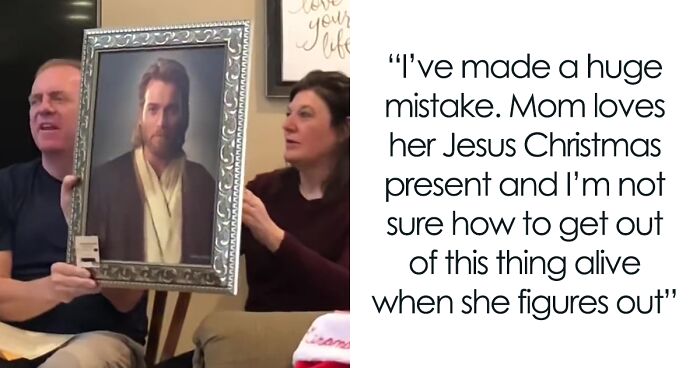
In this case, a Utah man gave his parents what appeared to be a reverent portrait of Jesus Christ. The frame was handsome, the painting had a soft spiritual glow, and the figure wore flowing robes with the calm, thoughtful expression expected from wall art intended for a religious home. There was only one tiny complication: the man in the portrait was not Jesus.
It was Ewan McGregor as Obi-Wan Kenobi.
The prank became a viral favorite because it combined several ingredients the internet cannot resist: a Christmas surprise, a loving family, a beautifully executed visual trick, and the realization that a Jedi Master can look surprisingly at home in a traditional religious portrait. The story was funny not because anyone’s faith was the punchline, but because the gift was so perfectly designed to pass a first-glance test.
For one glorious moment, the Force was strong with the living-room décor.
How an Obi-Wan Kenobi Portrait Became a Christmas Legend
The story began with a man named Ryan, who reportedly decided to play a holiday prank on his parents. His family belonged to The Church of Jesus Christ of Latter-day Saints, and religious artwork had long been part of the home environment he grew up in. That gave him a very specific idea: what if he gave his parents another portrait of Jesusexcept it was not Jesus at all?
Instead, Ryan selected an image of Obi-Wan Kenobi, the wise Jedi played by Ewan McGregor in the Star Wars prequel films. The character’s costume, beard, composed posture, and earnest expression helped the painting blend into the visual neighborhood of familiar devotional art. Put the image in a tasteful frame, add Christmas wrapping paper, and suddenly a galactic guardian of peace and justice can look like he belongs beside a family bookshelf.
His parents unwrapped the portrait and appeared delighted. According to the original account, the painting was even hung on the wall. That is when the prank moved from “clever gift” to “this may require an emergency family meeting.”
The joke worked because Obi-Wan did not look like a joke. He looked sincere. He looked contemplative. He looked like he had probably just delivered a lesson about kindness, patience, or why Luke Skywalker should stop leaving lightsabers lying around.
Why Obi-Wan Kenobi Can Pass as Religious Wall Art
At first glance, the resemblance may seem like a random internet gag. But there is a real visual reason it lands so well. Western images of Jesus have often emphasized a set of recognizable artistic cues: long or medium-length hair, a beard, gentle facial features, flowing robes, soft light, and a calm expression that suggests patience with humanity’s ongoing decision to make everything more complicated than necessary.
Obi-Wan Kenobi checks several of those boxes. Ewan McGregor’s version of the Jedi Master is often shown in earth-toned robes, with a beard and a solemn, compassionate look. His character is also a mentor, a guardian, and a figure associated with self-control and moral instruction. Remove the lightsaber, crop out the desert planet, and the image can become visually ambiguous enough to fool someone who is not already thinking, “Ah yes, the negotiator from the Clone Wars.”
That ambiguity matters. People do not identify images by inspecting every pixel like a museum conservator with a magnifying glass. Most of us rely on fast mental shortcuts. We notice a face, clothing, setting, emotional tone, and context. If the frame says “religious portrait,” the wrapping paper says “Christmas gift,” and the person presenting it is smiling far too hard, the brain may still decide, “This is probably a nice picture of Jesus.”
Human perception is efficient, but efficiency occasionally produces a Jedi-related loophole.
The Power of Familiar Visual Templates
Many people carry a mental picture of Jesus even though the Gospels do not provide a detailed physical description. Across centuries, artists have created countless versions of Christ shaped by their own cultures, communities, and artistic traditions. In the United States, certain popular paintings became especially familiar and helped establish a visual shorthand: gentle eyes, softly styled hair, a beard, and an expression of quiet compassion.
That means a painting does not need a halo, a cross, or a caption reading “Jesus, Definitely Not a Jedi” to feel spiritually familiar. A portrait can trigger recognition simply by matching enough emotional and visual cues.
This is also why the prank did not need to insult religion to work. It depended on the opposite: the family already had a meaningful visual tradition around portraits of Christ. The prankster understood that tradition well enough to create an image that appeared to belong within it.
The Difference Between a Prank and a Mean-Spirited Joke
The best family pranks are built on affection, not humiliation. They are funny because everyone eventually gets to laughincluding the person who was temporarily fooled. The Obi-Wan portrait story has survived online because it feels more like a warm holiday anecdote than a cruel gotcha moment.
There is an important difference between saying, “You were silly for believing this,” and saying, “We all got caught by an unexpectedly convincing painting.” The first approach makes someone the target. The second makes the situation the target.
In this story, the portrait itself is the comedian. The frame assists. Obi-Wan’s beard does a surprisingly large percentage of the work.
Family humor also works best when the reveal does not erase the affection behind the gift. A framed portrait can still be thoughtful, even when it accidentally comes from a galaxy far, far away. The joke succeeds because the family relationship is strong enough to hold both the sincerity of Christmas and the absurdity of mistaken Jedi décor.
Why the Internet Loved the Story
The internet has a permanent soft spot for harmless identity mix-ups. People love seeing a celebrity mistaken for someone else, a pet that looks like a baked potato, or a painting that appears to contain a hidden face. The Obi-Wan story added another layer: it involved a beloved fictional character who already carries an almost mythic presence in popular culture.
Obi-Wan is not just any Star Wars character. He is widely associated with wisdom, restraint, mentorship, sacrifice, and the famous ability to remain calm while everyone around him is making deeply questionable decisions. Those traits make him a natural fit for visual comparison with traditional moral or spiritual figures.
There is also a playful overlap between Star Wars language and religious language. Fans talk about “the Force” with mock seriousness. Jedi robes resemble monastic clothing just enough to inspire endless jokes. Characters offer guidance, appear after death, and occasionally speak in a tone that suggests they are about to deliver a life lesson before the soundtrack swells.
None of that makes Star Wars a religion. It simply explains why the visual and emotional parallels are so easy for audiences to recognize. The story became shareable because it brought two familiar cultural worlds together in one framed image.
What the Portrait Story Says About Religious Art
Religious art is often discussed as though every image has one fixed meaning. In reality, artwork gathers meaning from context. The same face can feel sacred, cinematic, historical, humorous, or deeply personal depending on where it appears and what the viewer expects to see.
A portrait of Jesus in a home may serve as a reminder of faith, comfort, family identity, or personal devotion. A portrait of Obi-Wan Kenobi may represent childhood movies, favorite characters, or the belief that a good beard can solve more problems than society is willing to admit. Place one image inside the frame and context of the other, and the brain has to do a little extra work.
That is the quiet genius of the prank. It did not rely on elaborate special effects. There was no deepfake, no fake news headline, no complicated setup involving a smoke machine and a fake bishop. It was one carefully chosen image, a frame, and an audience willing to make a reasonable assumption.
In a way, it became a miniature lesson in visual literacy. Context changes what we see. Familiarity changes what we accept. And sometimes the person watching your gift reaction video is trying very hard not to laugh for reasons you will discover later.
Lessons for Anyone Planning a Family Prank
A viral prank may look effortless after the fact, but the successful ones usually follow a few basic rules. First, know your audience. Ryan’s joke worked because he knew what kind of artwork his parents appreciated and what visual cues would feel familiar in their home.
Second, keep the stakes low. Nobody lost money, damaged property, or spent three weeks believing they had inherited a haunted Victorian painting. At worst, there was a brief case of mistaken Jedi identity.
Third, make the reveal part of the fun. A prank should have a satisfying ending, not a lingering feeling that someone has been tricked into embarrassment. When the truth comes out, the best response is ideally a laugh, a groan, and perhaps a debate about whether the portrait should stay on the wall anyway.
Finally, remember that not every joke belongs in every family. The best humor is personal and respectful. A harmless prank should make people feel included in the story, not excluded from it.
Related Experiences: Why We All Sometimes See What We Expect to See
The Obi-Wan portrait mix-up feels unusual, but the underlying experience is extremely common. People routinely see what they expect to see, especially when the setting offers strong clues. A parent opens a flat rectangular package at Christmas, notices a familiar-looking bearded figure in robes, and assumes it is religious artwork. A movie fan sees the same image and immediately hears a tiny voice in their head saying, “Hello there.” Both viewers are looking at the same painting, but their memories are doing different jobs.
Think about the classic household examples. Someone sees a face in the front grille of a car. Another person insists a cloud resembles a dragon. A sibling walks into a room, spots a framed old photograph from across the hallway, and confidently identifies the wrong relative. Nobody is being irrational. The brain is built to recognize patterns quickly because quick recognition is usually useful. It is just not always perfect.
Family spaces make this even more likely because they are filled with expectation. A person knows what typically hangs in the hallway, what kinds of decorations appear at Christmas, and what gifts certain relatives tend to give. Those expectations quietly guide interpretation before anyone has fully examined the details.
That is why visual pranks can be so powerful without being elaborate. They use the viewer’s own knowledge as part of the setup. The more natural an object seems in its environment, the less likely people are to question it. A fake plant can remain unnoticed for years. A novelty cookie jar can become “the family cookie jar” after one holiday season. And apparently, a Jedi Master can become religious wall art with the right robe, frame, and facial expression.
Similar experiences happen when people mix up famous faces. Someone may mistake an actor for a historical figure because of a beard, hairstyle, or costume. A person might see a painting of a saint and think it is a wizard from a fantasy movie. A child may look at an old black-and-white photo and assume every adult from 1947 was either a grandparent or a detective.
These mistakes are rarely about intelligence. They are about mental shortcuts. Our brains compare what we see with the visual library we already have. When a new image resembles a familiar category closely enough, the brain often makes a fast guess and moves on. Usually that is useful. Occasionally it results in a framed Obi-Wan Kenobi becoming the most unexpected Christmas decoration in the neighborhood.
There is also something comforting about these moments. They remind us that families are built from shared references. One person sees a devotional portrait. Another sees a movie character. A third sees the beginning of a story that will be retold at every holiday dinner for the next decade. The object itself becomes less important than the memory attached to it.
That may be the real reason this story remains funny. It is not just about a mistaken identity. It is about the affectionate chaos of family life, where a carefully wrapped picture can become a legend, a living room can become a tiny stage, and one unsuspecting Jedi can earn a permanent place in Christmas history.
Conclusion
The story of the Obi-Wan Kenobi portrait mistaken for Jesus remains one of the internet’s most charming holiday pranks because it combines family affection, cultural familiarity, and a genuinely convincing piece of artwork. It is less a joke about belief than a reminder that context shapes perception. Add a robe, a beard, a framed portrait, and a Christmas morning audience, and even a legendary Jedi Master can become the unexpected star of a family tradition.
Whether the portrait stayed on the wall or eventually returned to the Jedi Archives, one thing is certain: no one will ever look at a softly lit Obi-Wan Kenobi painting quite the same way again.