Note: This article is written from synthesized public information from Wilson Sporting Goods, NBA.com, NBA Official rules, U.S. sports reporting, product specifications, and basketball manufacturing coverage. No source links are included per request.
At first glance, an NBA basketball looks simple enough: orange, round, bouncy, and occasionally responsible for making a grown adult yell at the television. But the official Wilson NBA basketball is not just a ball. It is a carefully engineered piece of sports equipment built from leather, rubber, nylon, air, heat, pressure, and a truly ridiculous amount of feel.
Every dribble, crossover, outlet pass, step-back jumper, and buzzer-beater begins with the same object: the official NBA game ball. Since Wilson returned as the NBA’s official game ball maker for the 2021–22 season, the company has had the delicate job of producing a basketball that feels familiar to the world’s best players while meeting strict performance standards. That means the ball cannot be too slick, too springy, too dead, too heavy, too light, or too “something feels weird but I can’t explain it.” NBA players can detect tiny differences the way a chef can tell whether soup needs one more grain of salt.
So how does Wilson make NBA basketballs? The answer is a layered process involving a rubber bladder, nylon-and-polyester winding, a rubber carcass, and a genuine leather cover sourced from Horween Leather Company in Chicago. In plain English: the inside controls air, the middle controls shape and bounce, and the outside controls grip and feel. In basketball English: the ball has to behave perfectly when a seven-foot center palms it, a guard pounds it into the hardwood, and a shooter releases it with a season on the line.
Why Wilson’s NBA Basketball Matters
Wilson has deep history with professional basketball. The company was the NBA’s original official game ball supplier during the league’s first decades, then returned to the role during the NBA’s 75th anniversary season. That return was not as simple as stamping a different logo on an orange sphere and calling it a day. The NBA, the National Basketball Players Association, equipment managers, and Wilson’s research and development team all had to make sure the new official NBA game ball matched the feel and performance players expected.
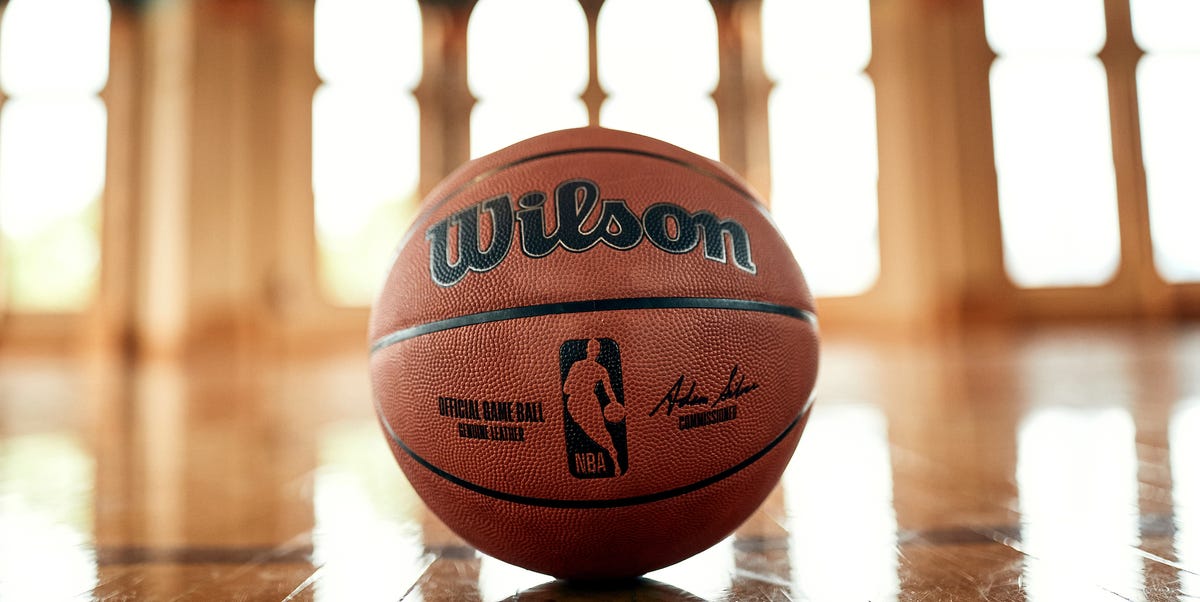
The modern Wilson NBA basketball uses the same basic eight-panel configuration that players had been accustomed to. It is official size 7, measuring 29.5 inches in circumference, and it is designed for indoor professional play. NBA rules require approved game balls to be inflated within a range of 7.5 to 8.5 pounds of pressure. That pressure range matters because air is not just empty space inside the ball. Air is the engine of the bounce.
Make the ball too soft, and it feels lazy, like it stayed up too late watching overtime. Make it too firm, and it becomes a caffeinated brick. The sweet spot is where the ball rebounds predictably, sits naturally in the hand, and responds consistently on every NBA court.
The Four Main Layers of a Wilson NBA Basketball
A Wilson official NBA basketball is not one material pretending to be many things. It is a layered system. Each layer has a job, and each job affects how the ball feels in real game conditions.
1. The Rubber Bladder: The Air-Controlling Core
The first major component is the internal bladder. This is the innermost rubber chamber that holds air. Wilson uses a rubber blend that emphasizes air retention, with butyl rubber playing a major role because it helps keep air from escaping too quickly. Natural rubber may also be part of the performance mix because it contributes liveliness and rebound.
The bladder is formed through heat and pressure in a molding process. This is where basketball manufacturing starts to look less like a craft project and more like a science lab wearing sneakers. The rubber is shaped, heated, and cured so it can hold air while maintaining a reliable round form.
The bladder determines much of the ball’s bounce behavior. While players talk about “feel,” engineers also think about rebound height, pressure consistency, and shape retention. If the bladder fails, the ball becomes useless. Nobody wants to dribble a sad orange pancake during warmups.
2. The Nylon Winding Layer: The Shape Keeper
Next comes the winding layer. This is where nylon earns its spot in the title. The bladder is wrapped with thread, typically a nylon-and-polyester blend, with nylon contributing tensile strength. The purpose is simple but critical: keep the ball round.
Without winding, an inflated rubber bladder could stretch unevenly. It might start round and slowly drift toward an egg shape, which is excellent for breakfast and terrible for basketball. The winding layer acts like a structural net around the bladder. It controls expansion, reinforces the ball, and helps preserve consistent rebound.
Machines rotate the bladder while thread is applied evenly around it. Adhesive helps bind the winding in place. This layer is not glamorous. It does not get the logo. Nobody buys a basketball and says, “Wow, look at that winding layer.” But without it, the official NBA game ball would not hold the shape that players rely on.
3. The Rubber Carcass: The Bounce and Structure Layer
After the winding comes another rubber layer called the carcass. This is different from the internal bladder. The carcass provides structure, rebound support, and a surface for the leather cover to attach to. It also helps create the raised channels that separate the eight leather panels.
The rubber carcass is molded over the wound bladder. Heat helps the rubber flow into and around the winding, locking the structure together. Think of it like reinforced concrete, except instead of building a bridge, Wilson is building something that must survive thousands of violent dribbles from athletes with forearms like hydraulic equipment.
This layer also affects how the ball comes off the floor. Internal pressure does most of the bounce work, but the rubber materials contribute to response and consistency. In a professional game, tiny differences matter. A ball that rebounds slightly differently can affect timing on a dribble move, the rhythm of a catch-and-shoot jumper, or the confidence of a player who has touched basketballs for most of his life.
4. The Genuine Leather Cover: The Player’s First Impression
The outside of the official Wilson NBA basketball is genuine leather. More specifically, Wilson uses leather from Horween Leather Company, a historic Chicago tannery known for sports leathers. The NBA game ball is unusual because it remains a genuine leather basketball in a world where many other basketballs use composite leather or rubber.
Leather changes over time. A brand-new Wilson NBA game ball can feel slick and a bit stiff. That is not a defect; it is part of the nature of real leather. As the ball is used, the leather loosens, absorbs moisture and oils from players’ hands, darkens in color, and develops better grip. In other words, the ball has a break-in period. Like a good pair of boots, it needs time before it becomes your best friend.
The leather is treated, dyed, textured, and cut into panels. Pebbling is added to create grip, while the thickness and finish are carefully controlled. If the leather is too smooth, players lose control. If it is too tacky, it can feel unnatural. If it is too thick or too thin, it can affect weight and response. Wilson and Horween are not just making something attractive; they are building a surface that must perform under sweat, speed, pressure, and bright arena lights.
Why the Eight-Panel Design Still Works
The Wilson NBA basketball uses an eight-panel construction. Those black channels are not only for looks. They give players finger placement, help with grip, and contribute to the familiar feel of the ball. When a shooter catches the ball, the hands often find the channels instinctively. That split-second touch can influence shot comfort and rhythm.
The NBA has learned that players value consistency. A basketball may look like a small detail to fans, but to players it is the main tool of the job. A chef has a knife. A violinist has a bow. An NBA guard has a basketball that better not feel like it came from a discount bin at a beach store.
Wilson’s challenge was to preserve the familiar eight-panel experience while applying its own manufacturing expertise. The company also uses NBA Pro Seams, a channel construction designed around player preference. The goal is a ball that feels controlled in the hand, predictable off the floor, and reliable from game to game.
How Horween Leather Becomes NBA-Ready
The leather journey begins long before a basketball reaches an arena. Horween works with steer hides, selecting sections that can meet the demands of elite basketball. Not every piece of leather is good enough. The hide must have the right grain, thickness, flexibility, and durability.
The leather is tanned, retanned, dried, finished, dyed, and embossed. The pebble texture is not random decoration. It is a performance feature. Those tiny raised bumps help players grip the ball, especially when hands are sweaty. The finish must also allow the ball to age properly. A good NBA ball does not stay looking showroom-new forever; it becomes darker and more playable as it breaks in.
This is one reason NBA basketballs are not typically used in games straight out of the box. Teams break them in over time. Equipment staffs know when a ball has reached the right feel. The perfect game ball is not too new, not too worn, and not suspiciously shiny like it just escaped a museum display.
The Science of Bounce, Grip, and Feel
When fans ask how Wilson makes NBA basketballs, the answer often starts with materials. But the deeper answer is performance balance. The ball must pass the eye test, the hand test, the bounce test, and the player trust test.
Bounce depends heavily on air pressure. The official pressure range keeps the ball responsive without making it uncontrollable. Grip depends mostly on the leather cover and pebbling, but also on how the ball wears in. Feel is the trickiest part because it is both measurable and personal. Engineers can measure rebound, weight, circumference, pressure, and material thickness. Players can tell you within one dribble whether something feels off.
That human feedback is essential. Wilson worked with NBA players and basketball professionals during the transition back to the league. The mission was not to reinvent the NBA ball. It was to make a Wilson basketball that respected what players already trusted.
Wilson NBA Basketball vs. Composite and Rubber Basketballs
Not every basketball is made like an NBA game ball. Outdoor basketballs often use rubber because rubber survives asphalt, concrete, dust, and the occasional encounter with a chain-link fence. Composite leather basketballs are popular for indoor and indoor-outdoor play because they provide good grip without requiring the same long break-in period as genuine leather.
The official Wilson NBA basketball is different. It is designed for indoor hardwood, professional handling, and elite performance. Its genuine leather cover gives it a feel that many serious players consider special, but it also means the ball needs care. Take a genuine leather NBA game ball outside and the pavement will treat it like a cheese grater with hobbies.
For casual players, a composite Wilson NBA replica or indoor/outdoor model may be more practical. For collectors, coaches, serious hoopers, and anyone who wants the true professional feel, the official leather game ball is the premium option. It costs more because the materials, processing, and quality standards are on another level.
Quality Control: Making One Ball Feel Like the Next
The hardest part of making NBA basketballs is not producing one great ball. It is producing thousands of balls that feel consistently great. Every panel must align. Every seam must be clean. Every ball must be round. Every bounce must fall within expectations. Every leather cover must behave like an NBA basketball, not like a fashionable handbag that learned to dribble.
Wilson’s manufacturing process includes checks for shape, pressure, rebound, weight, surface quality, and overall finish. The NBA’s standards and player expectations leave little room for casual “close enough” thinking. A small change in leather texture, rubber response, or inflation retention can affect performance.
That is why the official NBA game ball is such an interesting product. It blends old-school material craft with modern engineering. Leather tanning has heritage. Rubber vulcanization has chemistry. Nylon winding has structural logic. Player feedback has intuition. Put them all together, and the result is a ball that seems simple until you realize how much work it takes to make “simple” feel perfect.
Why Breaking In the Ball Is Part of the Magic
Many basketball fans are surprised to learn that a genuine leather NBA ball improves with use. A new ball may feel slick at first, but repeated dribbling, passing, shooting, and handling soften the leather. The pebbling settles. The color darkens. The ball begins to feel more connected to the hand.
This break-in period is why experienced players often prefer a ball that has already seen some action. A perfectly broken-in NBA ball has personality. It grips without sticking, bounces without jumping wildly, and feels familiar the moment it lands in your palm. It is the basketball version of a favorite hoodie: not brand-new, not worn out, just right.
Wilson even advises that dribbling drills can help speed the break-in process. That means the best way to improve the ball is also the best way to improve your handle. Convenient, unless your downstairs neighbor strongly disagrees.
Experience Section: What It Feels Like to Use a Wilson NBA Basketball
Spending time with a genuine leather Wilson NBA basketball is different from grabbing a basic gym ball from a rack. The first surprise is the texture. A new official-style leather ball does not always feel immediately soft or sticky. It can feel firm, dry, and slightly slick, almost like it is politely refusing to trust you yet. That first impression can confuse players who are used to composite basketballs, which often come ready with a softer, grippier feel right away.
After a few sessions, the Wilson NBA basketball starts to change. The leather begins to relax. The surface becomes more responsive. The channels feel more natural under the fingers. The bounce also feels controlled, especially on clean indoor hardwood. This is where the ball’s construction becomes noticeable. The rubber bladder and carcass give it a consistent rebound, while the winding layer keeps the shape steady. You do not feel the nylon directly, of course, but you experience its work every time the ball returns cleanly to your hand instead of wobbling like it has stage fright.
Shooting with a leather NBA ball can also feel more honest. Because the ball is not overly cushioned, your release feels direct. Good backspin feels satisfying. Bad form receives no mercy. If your guide hand gets too involved, the ball will happily report you to the rim. On catch-and-shoot attempts, the eight-panel design and NBA Pro Seams help your hands find familiar placement quickly. That matters when practicing game-speed shots, where comfort has to happen fast.
Dribbling is where the ball’s personality really shows up. On hardwood, the bounce feels crisp but not jumpy. Crossovers, between-the-legs moves, and hesitation dribbles feel more precise as the leather breaks in. The ball rewards repetition. The more you use it, the better it seems to understand your hand. That sounds dramatic, but anyone who has ever had a favorite basketball knows the feeling. Some balls are just strangers. Others become teammates.
Care also becomes part of the experience. You learn not to take the ball outdoors. You learn not to leave it in a hot car. You learn to check air pressure instead of guessing by squeezing it like a melon at the grocery store. A real leather basketball asks for respect. Treat it well, and it develops a feel that cheaper balls rarely match.
For young players, using a Wilson NBA basketball can be motivating because it connects practice to the professional game. For coaches, it can be a teaching tool about touch, ball control, and consistency. For collectors, it is a beautiful object with real sports heritage. For everyday hoopers, it may be overkillbut it is the fun kind of overkill, like wearing a tailored suit to a pickup game and then hitting six threes.
Conclusion: A Basketball Built for the Best Hands in the Game
The official Wilson NBA basketball is a perfect example of how sports equipment can look simple while hiding serious engineering. Leather, rubber, and nylon each play a specific role. The rubber bladder holds air and controls the foundation of bounce. The nylon-heavy winding layer keeps the ball round and stable. The rubber carcass adds structure, rebound, and panel support. The genuine Horween leather cover gives NBA players the grip, feel, and break-in character they expect.
Wilson’s job is not merely to make basketballs. It is to make a basketball that disappears into the flow of the game. When the ball is right, players do not think about it. They just dribble, pass, shoot, dunk, and occasionally blame the rim. That quiet reliability is the real achievement.
So the next time you watch an NBA game, take a moment to appreciate the orange blur moving across the court. It is not just leather wrapped around air. It is a layered performance product shaped by chemistry, craftsmanship, player feedback, and decades of basketball tradition. And yes, it still has to survive being slapped, spun, launched, dunked, chased, and argued over for 48 minutes. Not bad for something that started as rubber, thread, leather, and a dream of becoming the most important object in the arena.