Describing yourself in French sounds simple until your brain suddenly turns into a croissant: flaky, buttery, and unable to remember the word for “friendly.” The good news is that introducing yourself in French does not require a dramatic Parisian monologue, a scarf, or the ability to debate philosophy near a tiny espresso. You only need a clear structure, a handful of useful phrases, and a basic understanding of how French descriptions work.
This guide walks you through how to describe yourself in French in 9 practical steps. You will learn how to say your name, age, nationality, job or school status, personality traits, physical appearance, hobbies, family details, and a short polished self-introduction. Along the way, you will also pick up essential grammar, including when to use être, when to use avoir, and why French adjectives sometimes behave like they are auditioning for a mystery film.
By the end, you will be able to create a natural, confident self-description in French for class, travel, language exams, online profiles, or awkward moments when someone says, “Tell us about yourself,” and everyone suddenly forgets how human conversation works.
Why Learning to Describe Yourself in French Matters
Self-description is one of the first real-life skills in any language. It helps you move beyond textbook greetings and into actual communication. When you can say who you are, where you are from, what you do, and what you like, you can start conversations instead of simply nodding politely and hoping the waiter brings bread.
In French, describing yourself also teaches several core grammar patterns. You practice French adjectives, subject pronouns, gender agreement, basic verbs, and everyday vocabulary. These same patterns appear in job interviews, school presentations, travel conversations, dating profiles, and casual chats with French speakers.
Step 1: Start With a Natural Greeting
Before you describe yourself, open with a greeting. French has several options depending on the level of formality. Use Bonjour during the day and in polite situations. Use Bonsoir in the evening. Use Salut with friends, classmates, or people your age.
Useful French greetings
- Bonjour. Hello / Good morning / Good afternoon.
- Bonsoir. Good evening.
- Salut. Hi.
- Enchanté. Nice to meet you. Usually said by a man.
- Enchantée. Nice to meet you. Usually said by a woman.
A simple opening might be:
Bonjour, je m’appelle Claire. Enchantée.
Hello, my name is Claire. Nice to meet you.
Notice that French introductions often begin with je m’appelle, which literally means “I call myself.” It sounds strange in English, but in French it is the normal, friendly, everyday way to say your name. Language is full of surprises. At least this one does not involve irregular verbs yet.
Step 2: Say Your Name Correctly
The most common way to introduce your name in French is:
Je m’appelle… My name is…
Examples:
- Je m’appelle Daniel. My name is Daniel.
- Je m’appelle Olivia. My name is Olivia.
- Je m’appelle Minh. My name is Minh.
You may also hear:
Moi, c’est Alex. I’m Alex.
This version is casual and conversational. It is great among friends, classmates, and informal groups. For school assignments, interviews, or polite introductions, je m’appelle is safer.
Mini self-introduction
Bonjour, je m’appelle Sophie.
Hello, my name is Sophie.
That is already a complete beginning. Congratulations. You have officially entered the French-speaking world and nobody has asked you to conjugate the subjunctive yet.
Step 3: Give Your Age With “Avoir”
In English, you say “I am 25 years old.” In French, you say “I have 25 years.” The correct verb is avoir, meaning “to have,” not être, meaning “to be.”
The structure is:
J’ai + number + ans.
Examples:
- J’ai quinze ans. I am 15 years old.
- J’ai vingt ans. I am 20 years old.
- J’ai trente-deux ans. I am 32 years old.
Do not say Je suis vingt ans. French speakers will understand you, but it sounds like you are saying you personally are the concept of 20 years. Poetic? Maybe. Correct? Sadly, no.
Step 4: Share Where You Are From and Where You Live
Next, tell people where you are from. The phrase Je viens de… means “I come from…” or “I am from…”
- Je viens des États-Unis. I am from the United States.
- Je viens du Vietnam. I am from Vietnam.
- Je viens du Canada. I am from Canada.
- Je viens de France. I am from France.
To say where you live, use J’habite à… for cities.
- J’habite à New York. I live in New York.
- J’habite à Paris. I live in Paris.
- J’habite à Hanoi. I live in Hanoi.
For countries, the preposition changes depending on the country’s gender and number. Beginners do not need to master every pattern immediately, but here are common examples:
- J’habite en France. I live in France.
- J’habite au Canada. I live in Canada.
- J’habite aux États-Unis. I live in the United States.
Step 5: State Your Nationality
To describe your nationality in French, use Je suis, meaning “I am,” followed by a nationality adjective. Here is where French adds a little twist: many nationality words change depending on gender.
- Je suis américain. I am American. Masculine form.
- Je suis américaine. I am American. Feminine form.
- Je suis français. I am French. Masculine form.
- Je suis française. I am French. Feminine form.
- Je suis canadien. I am Canadian. Masculine form.
- Je suis canadienne. I am Canadian. Feminine form.
- Je suis vietnamien. I am Vietnamese. Masculine form.
- Je suis vietnamienne. I am Vietnamese. Feminine form.
Many feminine forms add an -e. Some change spelling more noticeably, such as canadien becoming canadienne. If that feels unfair, welcome to French. It is beautiful, elegant, and occasionally likes to hide extra letters in your backpack.
Step 6: Describe Your Job, Studies, or Role
To explain what you do, use Je suis plus a profession, role, or status. In French, professions often do not use the article “a” after être.
- Je suis étudiant. I am a student. Masculine form.
- Je suis étudiante. I am a student. Feminine form.
- Je suis professeur. I am a teacher.
- Je suis ingénieur. I am an engineer. Often masculine form.
- Je suis ingénieure. I am an engineer. Feminine form.
- Je suis écrivain. I am a writer.
- Je travaille dans le marketing. I work in marketing.
- Je travaille dans l’informatique. I work in IT.
If you are still in school, you can say:
Je suis au lycée. I am in high school.
Je suis à l’université. I am at university / in college.
J’étudie le français. I study French.
For a fuller sentence, combine your status and your field:
Je suis étudiant en biologie.
I am a biology student.
Je suis étudiante en commerce.
I am a business student.
Step 7: Describe Your Personality With French Adjectives
Personality is where your self-description becomes more interesting. You are not just a name, age, and location. You are a person with energy, dreams, opinions, and probably a favorite snack. To describe personality in French, use Je suis plus an adjective.
Common personality adjectives in French
- sympa nice
- gentil / gentille kind
- drôle funny
- sérieux / sérieuse serious
- travailleur / travailleuse hardworking
- créatif / créative creative
- calme calm
- curieux / curieuse curious
- patient / patiente patient
- optimiste optimistic
Examples:
- Je suis sympa et drôle. I am nice and funny.
- Je suis créatif et curieux. I am creative and curious. Masculine form.
- Je suis créative et curieuse. I am creative and curious. Feminine form.
- Je suis travailleur, mais un peu timide. I am hardworking, but a little shy. Masculine form.
- Je suis travailleuse, mais un peu timide. I am hardworking, but a little shy. Feminine form.
French adjectives usually agree with the person or noun they describe. If you describe yourself and you use a feminine form, many adjectives will add -e or change spelling. Some adjectives, such as sympa, drôle, calme, and optimiste, look the same in masculine and feminine forms.
Step 8: Describe Your Physical Appearance
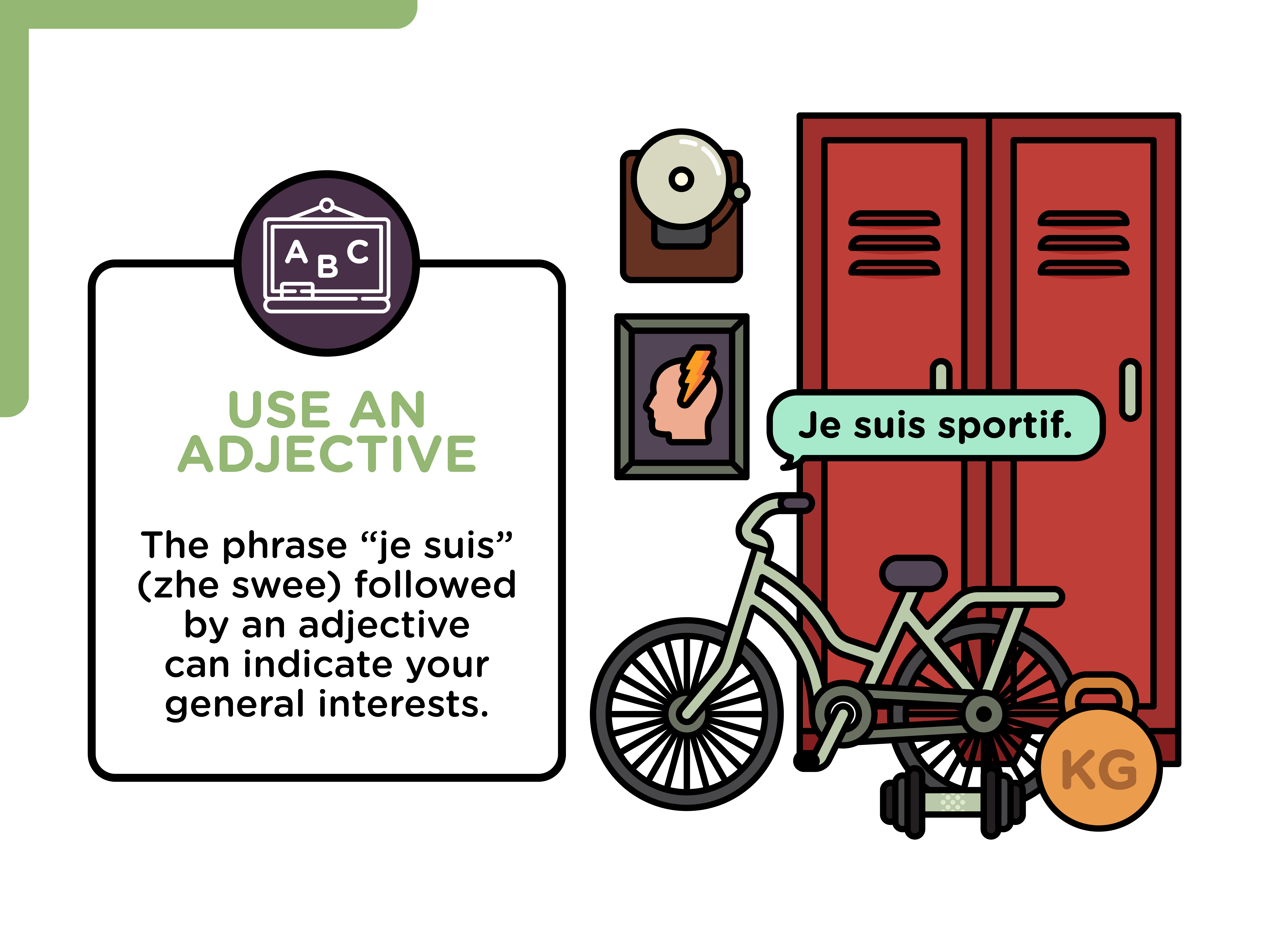
Physical description in French often uses either être or avoir. Use être for general traits such as height, build, and overall appearance. Use avoir for specific features like eyes, hair, or age.
Use “être” for general appearance
- Je suis grand. I am tall. Masculine form.
- Je suis grande. I am tall. Feminine form.
- Je suis petit. I am short. Masculine form.
- Je suis petite. I am short. Feminine form.
- Je suis mince. I am slim.
- Je suis sportif. I am athletic. Masculine form.
- Je suis sportive. I am athletic. Feminine form.
Use “avoir” for hair and eyes
- J’ai les cheveux bruns. I have brown hair.
- J’ai les cheveux blonds. I have blond hair.
- J’ai les cheveux noirs. I have black hair.
- J’ai les cheveux courts. I have short hair.
- J’ai les cheveux longs. I have long hair.
- J’ai les yeux bleus. I have blue eyes.
- J’ai les yeux verts. I have green eyes.
- J’ai les yeux marron. I have brown eyes.
A balanced physical description might sound like this:
Je suis grande et sportive. J’ai les cheveux noirs et les yeux marron.
I am tall and athletic. I have black hair and brown eyes.
Keep physical descriptions respectful and simple. You do not need to provide a police sketch of your own face. Two or three details are enough.
Step 9: Add Hobbies, Likes, and a Complete Self-Description
Your hobbies make your French self-description feel natural. To say what you like, use J’aime, which means “I like” or “I love.”
Useful hobby phrases
- J’aime lire. I like reading.
- J’aime écouter de la musique. I like listening to music.
- J’aime faire du sport. I like playing sports / exercising.
- J’aime voyager. I like traveling.
- J’aime cuisiner. I like cooking.
- J’aime regarder des films. I like watching movies.
- J’aime apprendre les langues. I like learning languages.
You can also say what you do not like:
Je n’aime pas me lever tôt.
I do not like getting up early.
This sentence is extremely useful because it is honest, relatable, and possibly the most universal human statement after “Where is the coffee?”
Complete example: beginner level
Bonjour, je m’appelle Emma. J’ai dix-huit ans. Je viens des États-Unis et j’habite à Chicago. Je suis étudiante. Je suis gentille, curieuse et un peu timide. J’ai les cheveux bruns et les yeux verts. J’aime lire, voyager et écouter de la musique.
Hello, my name is Emma. I am 18 years old. I am from the United States and I live in Chicago. I am a student. I am kind, curious, and a little shy. I have brown hair and green eyes. I like reading, traveling, and listening to music.
Complete example: more advanced level
Bonjour, je m’appelle Marc. J’ai vingt-six ans et je viens du Canada. Maintenant, j’habite à Boston. Je travaille dans l’informatique. Je suis sérieux, créatif et assez patient. J’ai les cheveux courts et les yeux bleus. Pendant mon temps libre, j’aime faire du vélo, cuisiner et apprendre le français.
Hello, my name is Marc. I am 26 years old and I am from Canada. Now I live in Boston. I work in IT. I am serious, creative, and fairly patient. I have short hair and blue eyes. In my free time, I like biking, cooking, and learning French.
Common Mistakes to Avoid When Describing Yourself in French
Using “être” for age
Say J’ai vingt ans, not Je suis vingt ans. French uses “to have” for age.
Forgetting adjective agreement
If you use a feminine form, many adjectives change. For example, Je suis créatif becomes Je suis créative. If you use a plural subject, many adjectives add -s.
Overloading your introduction
A good self-description is not a résumé, autobiography, and therapy session all at once. Keep it short, clear, and relevant. A few strong sentences are better than a paragraph that sounds like it is applying for a passport, a scholarship, and a cooking show.
Translating directly from English
French has its own patterns. “I am 20” becomes J’ai vingt ans. “My name is” becomes Je m’appelle. “I am a student” becomes Je suis étudiant or Je suis étudiante, usually without the word for “a.” Learn phrases as complete chunks instead of translating word by word.
Quick Vocabulary Table for Describing Yourself in French
| English | French |
|---|---|
| My name is… | Je m’appelle… |
| I am… | Je suis… |
| I am … years old | J’ai … ans |
| I am from… | Je viens de… |
| I live in… | J’habite à… |
| I like… | J’aime… |
| I study… | J’étudie… |
| I work in… | Je travaille dans… |
A Simple Formula for Your French Self-Description
Use this formula when you need to describe yourself quickly:
Greeting + name + age + origin + residence + job/studies + personality + appearance + hobbies.
Here is the template:
Bonjour, je m’appelle [name]. J’ai [age] ans. Je viens de [place] et j’habite à [city]. Je suis [job/student status]. Je suis [personality adjective] et [personality adjective]. J’ai [hair/eyes]. J’aime [hobby], [hobby] et [hobby].
Example:
Bonjour, je m’appelle Lucas. J’ai vingt et un ans. Je viens des États-Unis et j’habite à Seattle. Je suis étudiant. Je suis calme, curieux et créatif. J’ai les cheveux bruns et les yeux bleus. J’aime la musique, le sport et les films.
Real-Life Experiences: Describing Yourself in French Without Freezing Like a Baguette
The first time many learners try to describe themselves in French, they discover an interesting scientific fact: the sentence “My name is Sarah” can vanish from memory at the exact moment a French speaker smiles and says, Et toi ? Suddenly, even your own name feels optional. This is normal. Speaking a new language is not just about vocabulary; it is about confidence, rhythm, and giving yourself permission to sound imperfect.
One helpful experience is practicing your self-description in small layers. Start with three sentences: Je m’appelle…, J’ai…, and J’habite…. Say them out loud until they feel automatic. Then add personality: Je suis sympa et curieux or Je suis calme et créative. After that, add hobbies. This layered method works because it keeps your brain from trying to juggle twelve grammar rules while also remembering how to breathe.
Another common experience is realizing that French adjectives are not random enemies. At first, créatif, créative, travailleur, and travailleuse may feel like a spelling obstacle course. But after using them in personal sentences, they become easier. When the vocabulary is connected to your real identity, your memory holds onto it better. “I am creative” is more meaningful than “the pencil is yellow,” unless, of course, you are deeply emotionally attached to stationery.
Many learners also improve faster when they prepare two versions of their introduction: a short version and a longer version. The short version is useful for class, travel, or meeting someone quickly. The longer version helps in presentations or language exams. For example, your short version might be: Bonjour, je m’appelle Anna. J’ai vingt ans. Je suis étudiante et j’aime voyager. Your longer version can include where you are from, what you study, your personality, appearance, and hobbies.
Practicing with real people adds another layer. A tutor, classmate, or language partner may ask follow-up questions such as Tu viens d’où ? or Qu’est-ce que tu aimes faire ? These questions can be scary at first, but they are also useful. They teach you to move from memorized speech to real conversation. Think of your self-description as a launchpad, not a museum exhibit. It should be alive, flexible, and ready for small changes.
One final experience: pronunciation matters, but it does not need to be perfect. French has nasal vowels, silent letters, liaisons, and sounds that may feel like they were designed by a committee of elegant cats. Still, communication comes first. If you say Je m’appelle clearly, use J’ai for age, and choose a few accurate adjectives, you are already doing well. Confidence grows through repetition. The more often you describe yourself in French, the less it feels like a performance and the more it becomes a normal human introduction, just with better vowels.
Conclusion
Learning how to describe yourself in French is one of the most useful beginner skills because it combines vocabulary, grammar, and real conversation. Start with a greeting, introduce your name with je m’appelle, give your age with j’ai, and use je suis for nationality, personality, and general traits. Add where you live, what you do, what you look like, and what you enjoy.
The secret is not memorizing a giant speech. The secret is building a flexible self-description that sounds natural and fits the situation. Learn a few accurate sentence patterns, practice them out loud, and update them as your French improves. Soon, describing yourself in French will feel less like a grammar test and more like opening a door.
Note: This article is written for web publication and is based on real French grammar and language-learning principles. Source links and unnecessary reference markers have been intentionally excluded from the article body for clean publishing.