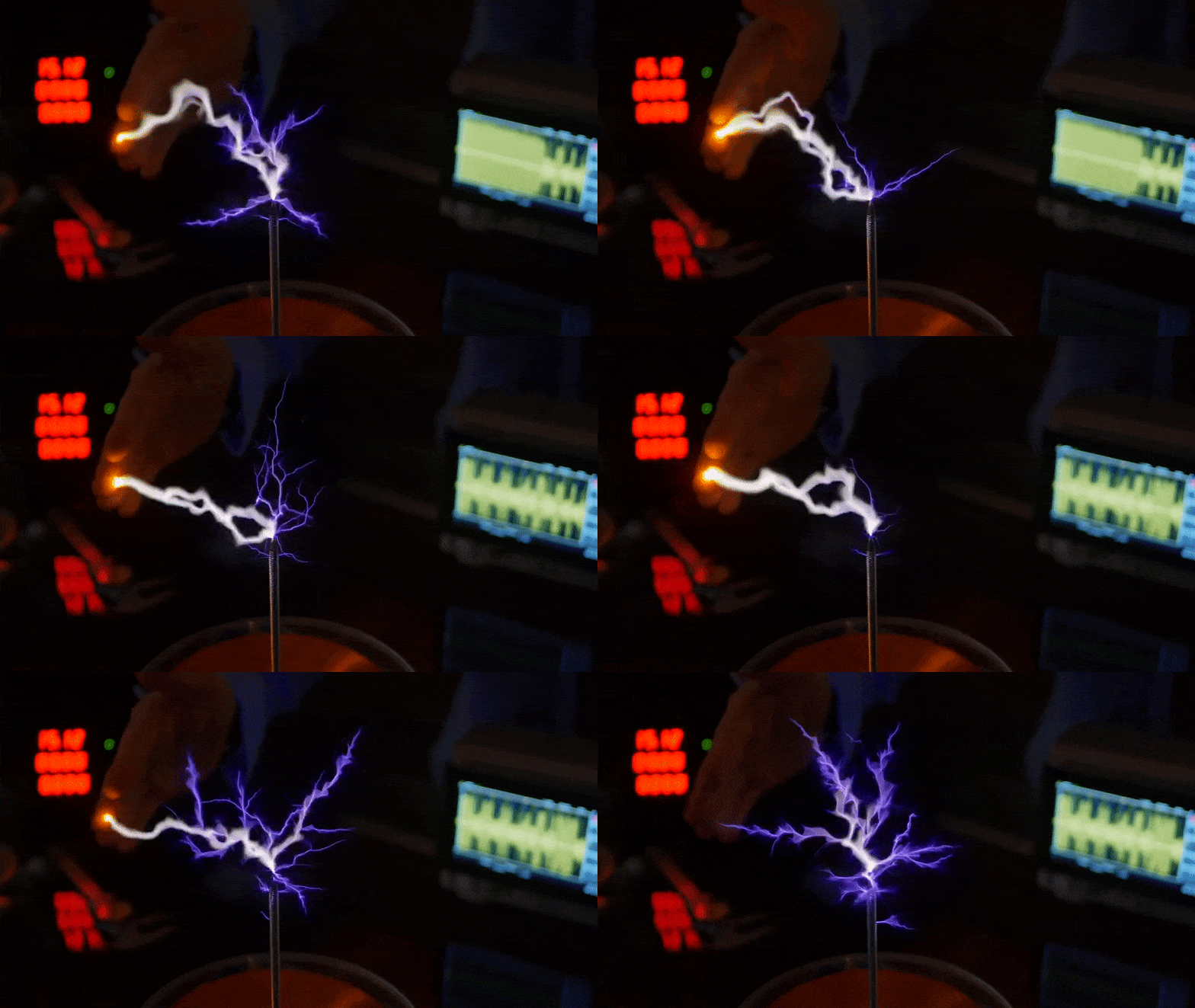
Some inventions solve a practical problem. Others solve a theatrical one. The pancake Tesla coil manages to do both. It is compact, dramatic, weirdly elegant, and fully capable of making your brain say, “Science!” while your eyebrows whisper, “Let’s stand a little farther back.” In an age when a lot of electronics hide inside black boxes, the high-tech pancake Tesla coil does the opposite. It performs its physics in public, with visible arcs, buzzing plasma, and enough sci-fi energy to make a room feel like Nikola Tesla just walked in wearing better tailoring.
The phrase “High Tech Pancake Tesla Coil Brings The Lightning” sounds like a headline written after too much coffee and not enough fear, but it captures something real. Modern pancake-style coils take a classic idea from the 1890s and remix it with contemporary components, better switching control, tighter layouts, and cleaner design. The result is a machine that is part resonant transformer, part engineering demo, part stage performer, and part reminder that electricity is beautiful right up until it becomes a very expensive life lesson.
This article explains what a pancake Tesla coil is, why the flat spiral design matters, how solid-state Tesla coils changed the game, and why these machines still fascinate makers, performers, and anyone who enjoys seeing raw physics throw a tantrum in the air.
What Is a Pancake Tesla Coil, Exactly?
At its core, a Tesla coil is a resonant, air-core, high-frequency step-up transformer. That sounds formal, but the idea is simple enough: feed energy into one part of the system, tune the circuit so the primary and secondary resonate together, and the voltage climbs high enough for electricity to stop behaving politely and start leaping through the air. Lightning, in other words, becomes less of a weather event and more of a design choice.
A pancake coil changes the geometry. Instead of the familiar tall cylindrical secondary winding, the coil is arranged as a flat spiral. That gives the device a lower profile and a very different visual personality. It also changes how the electric field is distributed, how the coil couples to nearby structures, and how the whole build can be packaged. In some modern versions, the spiral is etched directly into a PCB, making the coil look less like a mad-scientist relic and more like a piece of futuristic hardware that escaped from a movie prop department.
The pancake layout is not some trendy internet invention cooked up between 3D printer runs. Nikola Tesla himself explored flat-spiral transformer geometries in his patents. That historical detail matters because it reminds us that the “high-tech” part of the modern pancake Tesla coil is not the shape alone. The shape is old. The modern magic lies in what contemporary electronics can do with it.
From Nikola Tesla’s Lab to the Modern Maker Bench
Nikola Tesla invented the Tesla coil in 1891 while pursuing high-frequency, high-voltage electrical experiments and broader ideas about wireless transmission. He later pushed those ambitions further through work connected to Colorado Springs and Wardenclyffe, where the dream was not merely to make sparks look cool, though he absolutely understood the value of a good spectacle. The larger goal was to explore how energy and signals might travel without wires.
That dream remains one of the great “what if” stories in engineering history. Tesla was chasing wireless power and communication at a scale the technology of his time could not fully support. But along the way, he produced tools and concepts that influenced radio technology, resonant systems, and generations of experimenters who saw in the Tesla coil something rare: a device that is both educational and unforgettable.
The pancake version fits neatly into that legacy. Tesla’s flat-spiral concepts were not aesthetic quirks. They were serious attempts to shape fields, improve behavior at high potential, and manage the relationship between turns, insulation, and resonance. In modern language, you could say he was already thinking hard about electrical geometry. He just had the misfortune of doing it before simulation software, affordable oscilloscopes, and online forums filled with people arguing about parasitic capacitance at 2 a.m.
Why the Flat Spiral Design Still Matters
The flat spiral coil offers a few obvious advantages before you even get into the technical weeds. First, it is compact. A pancake Tesla coil can occupy a smaller and more visually striking footprint than a conventional tower-style build. Second, it can be easier to inspect, show off, and in some designs repair. Third, it changes the visual behavior of the discharge, which is one reason these builds are so popular in videos and demonstrations. The coil does not just work differently in subtle ways; it often looks different, and that matters when part of the appeal is spectacle.
Historically, Tesla noted benefits related to insulation and potential difference between adjacent turns. Modern builders care about those fundamentals, but they also care about packaging, cooling, switching, repeatability, and whether the thing can survive more than one dramatic afternoon. That is where the modern era enters the scene with steel-toed boots.
How a High-Tech Pancake Tesla Coil Brings the Lightning
The phrase “brings the lightning” is a little cheeky, but not wrong. A Tesla coil creates visible discharges because the voltage becomes high enough to ionize air. Once that happens, the air stops acting like a reliable insulator and starts acting like it has been talked into making poor decisions. The result is a bright, branching arc that looks like bottled weather.
In a classic coil, resonance is the star of the show. The primary and secondary circuits are tuned so energy transfers efficiently. When the timing is right, the voltage in the secondary climbs dramatically. The top load, field concentration, surrounding air, and nearby objects all influence how that energy escapes into space. This is why Tesla coils are not just “big spark makers.” They are finely tuned resonant systems, and when the tuning is off, the magic disappears faster than confidence at a live demo.
Modern high-tech pancake coils often use solid-state switching instead of a traditional spark gap. That means semiconductors such as MOSFETs or IGBTs handle the rapid switching needed to drive the resonant system. In more advanced topologies like SSTC and DRSSTC, builders gain far more control over pulse timing, duty cycle, frequency behavior, and output characteristics. Translation: less crude chaos, more engineered chaos.
That control is a big deal. Solid-state designs can be quieter in operation, more compact in form, and more flexible in how they are driven. They also open the door to features that would have seemed delightfully absurd in Tesla’s day, including musical Tesla coils that modulate discharges to produce notes, melodies, and the occasional robotic cover song no one requested but everyone remembers.
Why Solid-State Tesla Coils Feel So Modern
What makes a solid-state pancake Tesla coil feel modern is not just the parts list. It is the personality of the machine. Older spark-gap systems have a glorious brute-force charm, like a steam engine that learned to spit lightning. Solid-state coils, by contrast, feel programmable. They are shaped by control electronics, feedback, pulse strategy, and careful power-stage design. They can be tuned for display, audio modulation, experimentation, or compact presentation.
That is why recent maker projects get so much attention. A build highlighted by Hackaday through Plasma Channel showed exactly how compelling this form can be: a flat, solid-state “pancake” Tesla coil that was compact enough to look approachable, but advanced enough that even the coverage suggested it was better left to professionals. That tension is part of the appeal. It looks like a desk toy from the future, yet behaves like a concentrated argument with the laws of insulation.
Smaller commercial and hobby examples push the idea even further. Some compact musical Tesla coils use PCB spirals, onboard modulation circuits, and tightly integrated layouts that shrink the form factor dramatically while keeping the wow factor intact. The result is a device that looks almost too neat to be dangerous, which is exactly the kind of misunderstanding electricity loves to punish.
Why Makers and Audiences Love Pancake Tesla Coils
Part of the fascination is visual. Traditional tower-style Tesla coils are iconic, but the pancake form has a different kind of charisma. It looks deliberate, symmetrical, and strangely modern. Put one in a clear acrylic case with a polished heatsink and a few glowing indicators, and it stops reading like “old laboratory apparatus” and starts reading like “artifact recovered from a near-future moon base.”
Part of the appeal is educational. A pancake Tesla coil turns abstract topics like resonance, inductive coupling, field distribution, switching losses, and parasitics into something you can actually see. Students may forget a formula. They do not forget the moment a fluorescent tube glows nearby, an arc snaps into the air, and everyone in the room suddenly becomes interested in electromagnetic theory.
Part of it is performance culture. Tesla coils have been used in stage acts, museum demos, and music-adjacent spectacles because they are one of the rare machines that are both technically legitimate and inherently dramatic. Smithsonian coverage of performance groups like ArcAttack captured this perfectly: Tesla coils are not just historical curiosities; they are still active participants in modern science theater.
And then there is the maker mentality. The internet loves projects that merge old-school physics with modern electronics. A pancake Tesla coil checks every box. It has history. It has danger. It has visible output. It has tuning challenges. It has enough engineering nuance to keep experts engaged and enough lightning to keep everyone else from wandering away.
The Reality Check: Gorgeous, Educational, and Not a Toy
Now for the necessary anti-fairy-tale paragraph. Tesla coils are fascinating, but they are not harmless. High voltage, stored energy, radio-frequency effects, hot arcs, electromagnetic interference, and the possibility of damaging nearby electronics are all real concerns. Even relatively small systems can create conditions that deserve serious respect, especially around medical devices, sensitive electronics, and poorly planned demonstrations.
This is one reason responsible coverage matters. The best articles and technical references do not pretend the machine is magic dust and vibes. They stress resonance, tuning, electrical stress, insulation, switching behavior, and safety. That is also why the smartest way to enjoy a pancake Tesla coil, unless you are trained and equipped, is as a viewer, student, or reader rather than as someone improvising with high voltage and optimism. Optimism is not an insulator.
What Tesla Coils Still Teach Us in 2026
It would be easy to dismiss Tesla coils as flashy historical leftovers, but that would miss the point. Modern research into air-core resonant transformers and related high-frequency power systems still touches ideas that Tesla would recognize immediately: geometry, resonance, coupling, efficiency, parasitics, and power density. MIT work on lightweight high-voltage conversion has noted that Tesla-coil-style air-core resonant transformers can be very light for their output, though they are sensitive, narrow-band, and not always the efficiency champions of the universe.
That is the deeper reason the pancake Tesla coil still matters. It sits at the intersection of history, education, performance, and real electrical engineering. It reminds us that resonance is not just a chapter in a textbook. It is something you can hear, see, and almost feel in the room. A good coil makes physics visible. A great one makes it unforgettable.
And the pancake form adds one more lesson: design geometry is never just cosmetic. Shape changes behavior. Layout changes fields. Packaging changes performance. In electronics, form and function are not roommates. They are married, and they argue in public.
The Experience of Seeing a Pancake Tesla Coil Come Alive
Even if someone knows the theory, the experience of a high-tech pancake Tesla coil is something else entirely. The first surprise is usually how compact it looks before power enters the story. Sitting idle, the device can seem almost polite, like a well-organized project that deserves praise for clean cable management. Then it energizes, and the room instantly understands that “compact” is not the same as “mild.”
There is a sensory sequence to it. First comes anticipation. People lean in, then remember what they are looking at, and lean back. Then comes the sound: a sharp buzz, crackle, or rhythmic chatter depending on the design and drive mode. It is not the background hum of ordinary electronics. It sounds active, deliberate, and slightly offended that air has been allowed to remain nonconductive for so long.
Next comes the visual impact. The arc appears less like a line and more like a living decision. It branches, snaps, curls, and reaches toward nearby conductors with startling confidence. On a pancake coil, the effect can feel especially theatrical because the flat geometry makes the whole device look like it is projecting energy from a deliberate platform rather than from a classic tower. The discharge feels staged, almost choreographed, even though part of the thrill is that it never looks exactly the same twice.
Then there is the atmosphere around the demonstration. Conversations get shorter. Eyes get wider. Someone always tries to explain resonance to a friend in real time and suddenly discovers that explaining resonance during visible lightning is harder than expected. Someone else inevitably says, “That can’t possibly be legal,” which is less a legal opinion than a compliment. If the coil is musical, the experience becomes even stranger in the best possible way. Watching arcs create recognizable tones feels like seeing electricity discover a side hustle.
For students, the experience can be a turning point. Concepts that seemed dry on paper suddenly become physical. Inductance is no longer a vocabulary word. Coupling is no longer a diagram. High frequency stops being abstract when it is expressed through sound, light, and the behavior of nearby objects. A Tesla coil demo can compress a week of classroom attention into a few unforgettable seconds because the lesson arrives wearing thunder as a costume.
There is also a quieter emotional layer. A good pancake Tesla coil demo tends to produce a mix of awe and respect. Awe comes from the beauty of the arcs and the elegance of the engineering. Respect comes from realizing that the machine is not performing because it is cute or clever. It is performing because the underlying physics is real, intense, and unforgiving. That combination is rare. Plenty of gadgets are fun. Fewer make people laugh, stare, learn, and reconsider the invisible world around them all at once.
That, ultimately, is why the experience lingers. Long after the sound fades and the room smells faintly like hot electronics and ozone, what remains is the feeling that electricity briefly stepped out from behind the walls and introduced itself. It did not send a text. It kicked open the door and arrived with lighting effects.
Conclusion
The high-tech pancake Tesla coil is more than a flashy curiosity. It is a modern remix of Tesla’s resonant-transformer ideas, a lesson in how geometry shapes electrical behavior, and a perfect example of why old science never really gets old when new tools make it visible again. From flat-spiral patent concepts to solid-state switching, from wireless-power dreams to musical plasma displays, the pancake Tesla coil occupies a rare place in technology culture: it is historically grounded, technically rich, visually unforgettable, and just funny-looking enough to be lovable.
In other words, it earns the headline. It is high tech. It is a pancake. And yes, it absolutely brings the lightning.