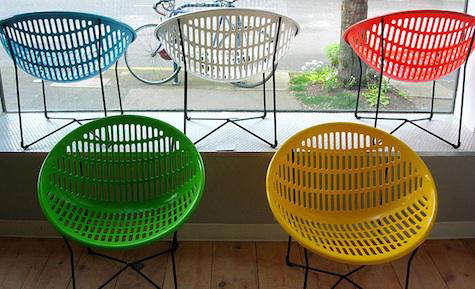
Some chairs politely disappear into a room. The Solair chair does not. With its rounded plastic shell, loks as though a 1970s motel pool deck and a modern design gallery decided to split the rent. That unusual combination is precisely why the chair has remained memorable for decades.
The connection between Solair chairs and Canoe, the Portland, Oregon, design retailer, offers a particularly good snapshot of how an everyday piece of outdoor furniture can become a collectible design object. In June 2011, Remodelista highlighted the chairs after Canoe stocked them in multiple colors, describing the model as a garden-friendly dose of color and noting a then-current price of $145. That historical appearance was more than a retail footnote. It showed how the Solair chair had traveled from 1970s Canadian modernism into the carefully curated world of contemporary design shops.
More than half a century after its creation, the Solair still has the rare ability to look nostalgic without looking trapped in the past. It is cheerful, practical, sculptural, and just strange enough to keep people asking, “Where did you get that chair?” For furniture, that is practically a standing ovation.
Historical grounding: he Story Behind the Solair Chair
The Solair chair was designed in Montreal in 1972 by Fabio Fabiano and Michelange Panzini. The period matters. Furniture designers in the 1960s and 1970s were enthusiastically exploring plastics, industrial manufacturing, bright colors, and forms that would have been difficult or expensive to produce using traditional woodworking techniques.
Plastic was no longer merely a substitute material. Designers were discovering that molding technology could create curves, hollows, shells, and continuous shapes with their own visual language. Institutions documenting design history have noted how molded plastics opened new possibilities for large furniture forms during this era. The Solair belongs comfortably in that broader story, but it has a personality all its own.
Its basic recipe is wonderfully straightforward: a molded plastic seating shell supported by a metal frame. Instead of disguising the construction, the design celebrates the contrast. The shell is round and visually soft; the base is thin and linear. One part says “space-age lounge pod.” The other says “I promise not to take up the entire patio.”
The chair also became widely associated with motels, pool areas, vacation properties, and casual outdoor spaces, which helped inspire its familiar nickname, the “Motel Chair.” That history gives it an appealing democratic quality. This was not furniture designed only to sit behind velvet ropes. It was meant to be used.
Design-history grounding: hy the Solair Chair Looked Right at Home at Canoe
Canoe was founded in Portland in 2005 around a philosophy of offering simple, beautiful, functional objects intended for everyday use and long-term enjoyment. The retailer has described modern design not merely as a visual style but as an approach centered on thoughtful function and enduring quality.
Seen through that lens, the Solair chair was an obvious match.
It is visually distinctive without relying on elaborate ornament. Its form largely grows out of what the chair needs to do: hold a person comfortably, remain relatively lightweight in appearance, and work in relaxed environments. A bright orange or yellow version can become the focal point of an outdoor space, while white, gray, or black can play a quieter architectural role.
The 2011 Canoe appearance also arrived during a period when mid-century and 1970s design were being enthusiastically rediscovered by a broader audience. Yet the Solair was not simply another famous museum chair being treated as a trophy. Its appeal came from something more casual. You could admire the shape and then actually sit in it with an iced drink while wearing flip-flops. Design history does not always require white gloves.
Canoe grounding: hat Makes the Solair Chair So Visually Memorable?
The Rounded Shell
The Solair’s most recognizable feature is its bowl-like seating shell. Rather than separating the chair into a conventional back, seat, and arms, the shell visually blends those functions into one sculptural form. The result feels more relaxed than an upright dining chair and more compact than a traditional lounge chair.
The opening in the center is equally important. Without it, the chair could appear heavy and blob-like. The cutout adds negative space, reduces visual bulk, and gives the design its unmistakable profile.
The Low-Slung Proportions
Vintage and later examples can vary somewhat in listed measurements, but the Solair generally sits low to the ground, with an overall width and height of roughly the upper-20-inch range and a low lounge-style seat. Those proportions encourage informal use. This is a chair for lingering, not conducting a quarterly performance review.
The low profile also makes the chair useful in spaces where tall furniture could interrupt sightlines. On a terrace, beside a garden, or in a compact room, it can provide substantial visual character without building a wall of furniture.
The Contrast Between Plastic and Steel
The combination of a molded shell and a slender metal base gives the Solair a useful tension. The seat feels playful; the frame feels disciplined. The shell has volume; the base almost disappears.
This mixture is one reason the chair works with more decorating styles than its dramatic silhouette initially suggests. Place it beside concrete and steel, and it reads as modern. Put it near weathered wood and vintage accessories, and it develops a retro vacation-house mood. Set one in a minimalist interior, and suddenly the chair becomes the room’s exclamation point.
Dimensions/material grounding: olor Is Part of the Furniture, Not an Afterthought
One of the pleasures of the Solair chair design is how dramatically its personality changes with color.
An orange Solair feels energetic and unmistakably retro. Yellow brings a sunny, almost playful quality. White emphasizes the sculptural form and can feel surprisingly contemporary. Black turns the same rounded shell into something more graphic and sophisticated. Blue or green can connect the chair visually to pools, gardens, and landscaped outdoor settings.
This makes the Solair particularly effective when used as an accent chair. A room does not necessarily need a complete matching set. One strong color can wake up a neutral space. Two matching chairs can create symmetry. A mixed group can make a patio feel collected over time rather than ordered from a single showroom display.
The trick is to let the color do some work. If you choose a vivid Solair, the surrounding furniture can afford to be quieter. The chair already walked into the party wearing the interesting jacket.
How to Style Solair Chairs Indoors and Outdoors
On a Patio or Terrace
The most historically natural setting is an outdoor lounging area. Pair two chairs with a compact side table rather than a bulky coffee table. Their curved shapes look especially good against strong architectural lines such as concrete pavers, horizontal siding, brick walls, or simple decking.
For a small balcony, one Solair can create a destination without filling the entire floor plan. Add a small table and a plant, and the space immediately reads as intentional rather than as the place where the recycling bin happens to live.
Beside a Pool
The chair’s association with motels and leisure spaces makes poolside placement feel almost instinctive. The molded shell has a visual connection to the optimistic recreational design of the 1970s, especially in bright colors.
Keep the surrounding arrangement simple. Repetition works well here: two, four, or more chairs can create a strong rhythm, particularly when the colors match.
In a Living Room
Indoors, the Solair works best when treated as a sculptural lounge chair rather than ordinary filler seating. Give it enough open space to see the silhouette. Pairing it with a simple sofa, low table, and restrained lighting lets the chair become a deliberate visual surprise.
It can also soften interiors dominated by rectangles. Bookshelves, windows, rugs, tables, and sofas often create a room full of straight edges. The Solair introduces a curve without requiring a decorative object whose only job is to collect dust.
In an Eclectic or Vintage Interior
The chair is especially convincing when mixed with furniture from different decades. A Solair beside a vintage wooden cabinet, contemporary lamp, and simple wool rug can prevent a room from turning into a time capsule.
Good vintage-inspired interiors rarely reproduce a single year perfectly. They create conversations between eras. The Solair happens to be a very talkative participant.
Buying a Vintage Solair Chair: What to Look For
Because Solair chairs have existed in different periods of production and appear on the secondary market, condition deserves careful attention. Online marketplaces show both individual examples and larger vintage sets, sometimes with significant differences in age, restoration, and replacement components.
Before buying, inspect or request detailed photographs of the following areas:
- The plastic shell: Look for cracks, deep scratches, fading, stress marks, or damage around attachment points.
- The metal base: Check for corrosion, flaking finish, bends, repairs, and stability.
- Feet and glides: Missing or damaged glides can affect both stability and flooring.
- Connection points: Confirm that the shell sits securely on the frame.
- Restoration history: Ask whether the shell, frame, hardware, or glides have been replaced or refinished.
Collectors may care deeply about originality, while someone furnishing a patio may prioritize structural condition and color. Neither approach is wrong. The important part is knowing what you are paying for.
Also measure the intended space. The Solair is visually airy, but its rounded footprint is wider than a conventional upright chair. Furniture has a mischievous habit of looking smaller online.
Secondary-market grounding: aring for a Solair Chair
The safest routine for plastic and metal outdoor furniture usually begins with the least dramatic solution: remove loose dirt and wash the surfaces gently with mild soap and water using a soft cloth or nonabrasive sponge. Rinse appropriately and dry the chair rather than reaching immediately for the strongest cleaner in the garage.
Harsh chemicals, aggressive abrasives, and overly forceful cleaning can damage finishes or scratch surfaces. When dealing with a vintage chair, caution matters even more because decades of exposure and previous cleaning may have changed the condition of the materials.
For chairs kept outdoors, inspect the metal frame periodically for developing rust or finish damage. Severe weather also deserves common sense. Outdoor furniture may be designed for exterior use, but that does not mean every material enjoys endless exposure to extreme cold, storms, falling branches, or six months under a snowbank.
When possible, clean furniture before long-term storage and make sure it is dry. A little routine maintenance is considerably easier than holding an emotional support meeting for a badly neglected patio chair.
Care grounding: he Solair Chair and the Bigger Story of Molded Plastic Furniture
The Solair is sometimes described simply as a plastic chair, but that phrase can hide what made designs of its era so significant. During the mid-20th century, advances in plastic manufacturing encouraged designers to rethink the physical possibilities of furniture. Molded materials could produce shapes that were difficult to achieve economically through traditional joinery and upholstery.
The result was an explosion of experimentation. Chairs became shells, curves, pods, continuous surfaces, and brightly colored objects that sat somewhere between industrial product and sculpture.
The Solair’s importance is not that it was the only chair participating in this movement. It is that it developed such a recognizable identity while remaining practical and approachable. Many design classics become famous because they are rare or intimidatingly expensive. The Solair built much of its reputation through everyday visibilityin homes, vacation settings, outdoor spaces, and hospitality environments.
That history explains why the chair can inspire two completely different reactions at once. One person sees a serious example of Canadian modern design. Another says, “My aunt had those by the pool.” Both may be correct, and the chair is richer for it.
Molded-plastic context: hy the Solair Still Feels Fresh
Furniture trends change constantly, but genuinely distinctive forms tend to return because they offer something trends cannot manufacture on demand: identity.
The Solair chair is recognizable from across a room. Its construction is understandable. Its materials are honest about what they are. The shape is playful without becoming a novelty. Most importantly, it does not require a complicated design lecture before someone can enjoy it.
That combination helps explain its continuing presence in design-oriented interiors and vintage marketplaces. Dwell, for example, has shown the chair used as a strong orange accent in a contemporary Quebec residential project, illustrating how naturally the decades-old design can sit within newer architecture.
It also demonstrates an important lesson in decorating: a room often benefits more from one memorable object than from ten vaguely fashionable ones.
Contemporary-use grounding: iving With a Solair Chair: A Realistic Ownership Experience
The experience of adding a Solair chair to a home begins before anyone sits down. The first thing you notice is the shape. In photographs, the chair can appear almost like a graphic symbola circle balanced on thin lines. In a real space, however, it has more physical presence. The shell is broad, the stance is relaxed, and the low profile immediately changes the mood of the area around it.
Imagine bringing a bright orange Solair onto a quiet patio furnished mostly with wood, concrete, and neutral textiles. Nothing else has changed, yet the patio suddenly feels intentional. The chair creates a focal point without requiring a new rug, a collection of decorative pillows, and an emergency visit to the garden center. One object has done the visual heavy lifting.
The next surprise is how informal the chair feels. You do not approach it the way you approach a delicate antique. Its rounded shape invites a relaxed posture. Because the seat is low, sitting down feels more like settling into a lounge area than taking a formal chair at a table. That makes the Solair especially suited to reading, casual conversation, coffee, or the highly advanced recreational activity known as doing absolutely nothing.
After a few days, another quality becomes noticeable: the chair changes character throughout the day. Morning light emphasizes the color and smooth shell. Strong afternoon sun creates dramatic shadows through the opening and beneath the steel base. At night, under a wall light or outdoor lamp, the silhouette becomes more sculptural. It is furniture, but it also behaves a little like an architectural object.
Using more than one creates a different experience. A pair naturally forms a conversation area. Four chairs can establish a complete social zone without the visual heaviness of four large upholstered lounge chairs. In mixed colors, the arrangement feels playful and spontaneous; in one color, it becomes more graphic and deliberate.
Indoors, the experience changes again. A single Solair in a bedroom corner or living room can feel almost like functional artwork. Because the chair is so distinctive, surrounding it with too many equally loud objects can become exhausting. The most successful experience often comes from contrast: a simple rug, restrained walls, natural wood, and then one unapologetically curvy chair.
There are practical lessons, too. A low chair is not automatically ideal for every person or every purpose. Someone who prefers a higher, more upright seat may find the lounge-style proportions less convenient. Likewise, the rounded footprint should be measured rather than guessed. The Solair may look visually light, but physics remains stubbornly committed to taking up actual floor space.
Outdoor ownership also encourages a useful maintenance rhythm. Dust, pollen, and rain residue are more obvious on some colors than others, especially white and black. A gentle cleaning keeps the chair looking intentional rather than abandoned. The metal frame deserves an occasional inspection, particularly in damp climates. These are not glamorous tasks, but neither is discovering rust five minutes before guests arrive.
Perhaps the most satisfying part of the experience is how easily the Solair starts conversations. Visitors who know the design may recognize it immediately. Others may remember seeing similar chairs at motels, cottages, or family homes decades ago. Younger guests may simply think it looks futuristic.
That mixture of recognition and surprise is difficult to manufacture. The chair connects design history with personal memory, and serious modernism with something as ordinary as sitting outside on a summer afternoon. It can be collectible without becoming precious and nostalgic without turning sentimental.
In practical terms, living with a Solair chair means accepting that one piece of furniture may get considerably more attention than the respectable beige sofa that cost five times as much. The sofa will eventually forgive you.
Conclusion: A Design Classic With Its Feet Firmly on the Patio
Furniture: Solair Chairs at Canoe is more than the story of a colorful chair appearing in a Portland design shop. It is a small chapter in the much larger journey of a 1972 Canadian design that moved from molded-plastic experimentation and motel culture into contemporary interiors, collector markets, and design-conscious retail.
The Solair succeeds because its appeal operates on several levels at once. It is functional seating. It is a recognizable piece of modern design. It is a splash of color. It is a nostalgic object for some people and a fresh discovery for others. Most furniture would be delighted to accomplish two of those things before lunch.
For homeowners and design enthusiasts, the lesson is simple: memorable furniture does not always need to be complicated. A strong silhouette, useful construction, a well-chosen color, and enough personality to survive changing fashions can carry a design surprisingly far. The Solair chair has been proving that point since the 1970s.
Note: The $145 price and Canoe availability discussed above refer specifically to the historical June 2011 Remodelista feature and should not be interpreted as current inventory or pricing. Present-day availability, condition, production details, and prices should always be verified with the relevant retailer or seller.