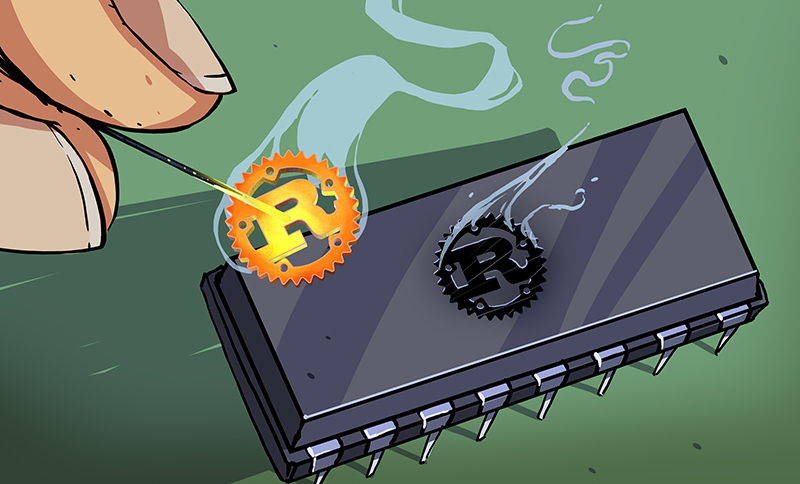
Rust on microcontrollers used to feel like bringing a laser-guided toolbox to a shed with no electricity: powerful, precise, and occasionally a little dramatic. Then the ESP32 family grew into one of the most popular playgrounds for makers, IoT engineers, and embedded developers, while Rust kept building its reputation for memory safety, fearless refactoring, and compile-time guardrails. The natural question became obvious: can we get the practical, inexpensive, Wi-Fi-friendly world of ESP32 development together with the reliability and structure of Rust?
That is exactly where esp-hal steps in. The name is simple: “ESP” for Espressif chips, and “HAL” for Hardware Abstraction Layer. But the impact is bigger than the label on the jar. esp-hal gives Rust developers a stable API for controlling ESP32 hardware, especially in bare-metal no_std projects where there is no operating system politely holding your coffee while your firmware does real-time work.
For anyone writing Rust firmware for ESP32 boards, esp-hal is not just another crate to add to Cargo.toml. It is a signal that the Rust-on-ESP ecosystem has matured from “cool experiment” to “serious embedded development option.” And yes, it still lets you blink an LED. Embedded tradition demands it.
What Is esp-hal?
esp-hal is a hardware abstraction layer for Espressif ESP32 microcontrollers written for Rust embedded development. It provides safe, idiomatic Rust APIs for working with peripherals such as GPIO, UART, SPI, and I2C. In plain English, it lets your firmware talk to the chip without forcing you to manually poke registers like a cave explorer tapping every wall for secret doors.
A HAL sits between your application code and the raw hardware. Instead of memorizing every register bit and timing detail for each ESP32 variant, you write against a cleaner Rust interface. The HAL then handles the lower-level details in a way that is more structured, reusable, and less likely to end in mysterious smoke, silence, or a serial monitor full of regret.
Why “Stable API” Matters
Stability is the gift here. In embedded development, code often lives longer than expected. A “weekend sensor project” becomes a lab tool. A prototype becomes a production gateway. A clever desk gadget somehow becomes mission-critical because everyone in the office now depends on it. If the underlying API changes constantly, maintenance turns into digital archaeology.
With esp-hal reaching a stable API milestone, Rust developers gain a firmer foundation for ESP32 firmware. The core pieces are designed to remain dependable over time, so projects can be upgraded with more confidence. That does not mean every possible peripheral is magically finished forever. It means the foundationinitialization, core drivers, timing tools, and common hardware access patternshas crossed an important line from experimental motion to practical stability.
Why Rust Developers Care About ESP32
The ESP32 family is everywhere for good reason. These chips are affordable, capable, and available in many flavors, from classic dual-core ESP32 boards to RISC-V-based ESP32-C series chips and more advanced variants such as the ESP32-S3 and ESP32-P4. They show up in home automation, environmental monitoring, industrial prototypes, wearables, robotics, low-power sensors, art installations, and the occasional “I made my toaster tweet” project that probably did not need to exist but absolutely did.
Rust brings a different strength: reliability. Embedded C and C++ are still dominant, but Rust has become attractive because it helps prevent whole categories of bugs before the firmware ever reaches the board. Ownership, borrowing, strong typing, and pattern matching are not just language features; in embedded work, they are a safety net.
On a microcontroller, a memory bug is not just a software inconvenience. It can freeze a device, drain a battery, corrupt sensor readings, or make a deployed system impossible to trust. Rust’s compile-time checks are therefore more than academic neatness. They are a practical advantage.
The no_std Advantage: Rust Without the Operating-System Sofa
Many ESP32 projects use a bare-metal approach. That means your program runs without a full operating system, and Rust code is usually written with #![no_std]. Instead of the standard library, you rely on core and embedded-focused crates.
This model is lean and direct. It is ideal for firmware that needs tight control over timing, memory, interrupts, and power. The tradeoff is that you do not get all the conveniences of desktop Rust. There is no big runtime waiting behind the curtain. Your firmware is the curtain, the stage, the lighting technician, and sometimes the emergency exit.
esp-hal fits this world by offering a bare-metal HAL that feels Rusty without pretending the chip is a laptop. It gives you abstractions, but not bloated ones. It helps you write clearer code while keeping you close enough to the hardware to understand what is happening.
Core esp-hal Features That Matter Most
The most important thing about esp-hal is not that it supports every shiny peripheral at once. The important thing is that it focuses on stabilizing the hardware features developers use constantly.
GPIO for the Physical World
GPIO is where many embedded projects begin. Buttons, LEDs, relays, sensors, chip-select lines, wake-up pins, and random wires on a breadboard all come through general-purpose input and output. esp-hal gives Rust code a structured way to configure pins, set outputs, read inputs, and build predictable hardware behavior.
For example, a temperature logger might use one GPIO pin to read a button, another to drive a status LED, and another to control power to a sensor. Without a HAL, every step involves chip-specific registers. With esp-hal, your code expresses intent more clearly: configure this pin, set that output, read this input. Your future self will thank you, especially at 2:00 a.m. when the LED refuses to blink because you swapped pin numbers.
UART for Logs, Modules, and Sanity
UART remains a faithful friend in embedded development. It is used for serial logging, debugging, GPS modules, cellular modems, external microcontrollers, and many other devices. When something goes wrong, UART is often the little text window that tells you whether your firmware is alive, confused, or quietly judging you.
esp-hal’s UART support helps developers build serial communication into Rust firmware with clearer APIs and better integration into the broader embedded Rust ecosystem.
SPI for Fast Peripheral Communication
SPI is common in displays, flash memory, radio modules, ADCs, DACs, and high-speed sensors. It is simple in concept but easy to mishandle in real projects, especially when multiple devices share a bus. esp-hal provides SPI abstractions that make configuration and communication easier to reason about.
A Rust ESP32 project driving a small TFT display, for example, can use SPI for screen updates while using GPIO for chip select and data-control pins. The HAL makes the relationship between those parts clearer, which helps when the screen displays nothing and you are trying to decide whether the bug is in wiring, timing, power, or cosmic punishment.
I2C for Sensors and Small Devices
I2C is the polite shared bus of the embedded world. It is popular for environmental sensors, EEPROMs, real-time clocks, power monitors, touch controllers, and other low-to-medium-speed devices. esp-hal’s I2C support gives Rust developers a cleaner way to talk to these chips and use generic embedded drivers.
This is where Rust’s ecosystem becomes especially useful. If a sensor driver is written against common embedded-hal traits, it can often be reused across multiple microcontroller platforms. That portability is a major reason embedded Rust feels increasingly practical rather than merely interesting.
Blocking and Async: Pick the Right Style for the Job
Modern embedded Rust is not limited to one programming model. esp-hal supports both blocking and async modes where applicable, giving developers flexibility.
Blocking code is straightforward. You ask the hardware to do something, and your code waits until it finishes. This is easy to understand and excellent for many simple applications. A sensor node that wakes, reads data, sends a packet, and sleeps may not need anything fancier.
Async code becomes useful when several things need to happen without wasting time. A device might read a sensor, update a display, listen for serial input, and manage network activity. In Rust embedded projects, async frameworks such as Embassy have helped make concurrency more approachable without requiring a traditional operating system.
esp-hal’s compatibility with async patterns matters because ESP32 projects often grow beyond “blink and read.” They become connected devices. They wait on buses, interrupts, timers, and external modules. Async support lets firmware stay responsive without turning the codebase into a maze of callbacks and flags.
How esp-hal Fits the Embedded Rust Ecosystem
esp-hal is not an island. It connects to a broader ecosystem that includes embedded-hal, embedded-hal-async, Espressif tooling, project generators, documentation, examples, and debugger support.
The embedded-hal traits are particularly important. They provide common interfaces for embedded peripherals. When a HAL implements these traits, driver authors can write reusable code that is not locked to one chip family. That means a sensor driver can work on an ESP32, an STM32, an nRF chip, or another supported platform if the right HAL implementation exists.
For developers, this reduces friction. You are not starting from zero every time you change boards. You can bring familiar driver patterns with you. That is especially valuable in prototyping, where hardware choices change faster than anyone wants to admit.
esp-hal vs esp-idf-hal: Which One Should You Use?
The ESP32 Rust world has more than one path. Two names often come up: esp-hal and esp-idf-hal.
esp-hal is the bare-metal no_std route. It is a strong fit when you want direct control, a smaller runtime model, and firmware that does not depend on the ESP-IDF operating-system environment. This is attractive for low-level drivers, simple devices, real-time work, and projects where you want to understand every layer between your Rust code and the silicon.
esp-idf-hal is tied to Espressif’s ESP-IDF framework. It can be a better fit when you want access to mature ESP-IDF services, including networking stacks and system-level features that are already deeply supported there.
A practical rule: if you want bare-metal Rust and stable core peripheral APIs, look at esp-hal. If your project needs the full ESP-IDF environment right away, especially mature Wi-Fi and system services, esp-idf-hal may be more appropriate. The good news is that both paths make Rust on ESP32 more realistic.
What Is Stable, and What Is Still Evolving?
One of the most useful things about esp-hal’s stable API approach is honesty. Instead of pretending every feature is equally mature, the project separates stable foundations from APIs that are still evolving.
The stable core includes HAL initialization, key configuration mechanisms, GPIO, UART, SPI, I2C, blocking and async support for those core drivers, time utilities, system reset functionality, and the main macro used to structure firmware entry points. Other drivers and advanced features may still be available, but they can be gated as unstable while their APIs continue to develop.
That is a healthy model. Embedded development needs experimentation, but production-minded developers also need to know where the ground is firm. esp-hal gives both groups a place to stand.
A Simple Example: Why the HAL Makes Code Cleaner
Imagine you are building a compact ESP32 environmental monitor. It reads temperature and humidity over I2C, writes status data to a small SPI display, uses UART for debug logs, and blinks an LED when readings update.
Without a HAL, your application code can quickly become tangled with register addresses, pin matrix configuration, timing details, and peripheral setup. Every feature works, but the codebase starts to look like a junk drawer with semicolons.
With esp-hal, the architecture becomes easier to separate. GPIO handles pins. I2C talks to the sensor. SPI updates the display. UART prints logs. Timers manage intervals. Your application logic can focus on the behavior of the device instead of drowning in setup details. You still need embedded knowledge, of course. The HAL is a tool, not a wizard. But it lets your Rust code express the design more clearly.
Why This Matters for Production Firmware
A stable HAL is not just convenient for hobbyists. It matters for teams building real products. Firmware often has long maintenance cycles. Devices may ship to customers, sit in factories, run in homes, or live inside equipment that nobody wants to open again unless absolutely necessary.
A stable API reduces churn. It makes code reviews easier. It helps teams write reusable internal libraries. It improves onboarding because new developers can learn one consistent model instead of chasing shifting examples across versions. It also encourages better testing because abstractions make it easier to isolate hardware-facing logic from application behavior.
Rust’s compile-time checks add another layer of confidence. When combined with a stable HAL, the result is a development experience that feels less like wrestling wires in a thunderstorm and more like building firmware with a plan.
The Developer Experience: Tooling Is Half the Battle
Embedded development is not only about writing code. It is also about creating projects, selecting chip targets, flashing firmware, reading logs, debugging, and repeating the loop until the device behaves. esp-hal benefits from the growing Espressif Rust ecosystem, including documentation, project templates, examples, and flashing/debugging tools.
Project generation tools can help bootstrap a new ESP32 Rust project with the right dependencies and target configuration. Flashing tools such as espflash and debugging support through probe-rs make the workflow more approachable. This matters because embedded setup friction can scare away even experienced software developers. Nobody wants to spend two evenings proving that USB drivers have a sense of humor.
Where esp-hal Shines
esp-hal is especially attractive for projects that need dependable low-level control without a heavy software stack. Examples include:
- Sensor nodes that read data over I2C or SPI
- Industrial monitors that use UART-connected modules
- Battery-powered devices where lean firmware matters
- Custom drivers for displays, actuators, and hardware interfaces
- Educational projects teaching embedded Rust on real hardware
- Prototypes that may later become production firmware
It is also a good fit for developers who want to understand the hardware closely. esp-hal does not hide the embedded nature of the job. It gives you tools, structure, and safety, while still reminding you that pins, clocks, buses, and interrupts are real things with real consequences.
Where You Should Be Careful
Stable does not mean every ESP32 use case is equally simple. Wireless features such as Wi-Fi and Bluetooth are central to many ESP32 projects, and the broader Rust support around those areas continues to evolve. If your application depends heavily on mature wireless stacks today, evaluate the current state of the related crates and decide whether a bare-metal esp-hal approach or an ESP-IDF-based route fits better.
You should also pay attention to your exact chip variant. The ESP32 family includes Xtensa and RISC-V devices, and not every peripheral exists on every chip. Documentation may be chip-specific. A project targeting ESP32-C6 may not map perfectly to a classic ESP32 or ESP32-S3. In embedded development, “same family” does not always mean “same kitchen.”
Related Experience: Building With esp-hal in the Real World
Working with esp-hal feels a bit like moving from a cluttered workbench to a well-labeled electronics drawer. The resistors are still tiny, the breadboard still has opinions, and your jumper wires can still betray you, but the software side becomes easier to reason about.
The first experience many developers have is the classic blinky project. It sounds trivial, but it teaches the shape of the ecosystem: selecting a target chip, generating a project, configuring dependencies, initializing peripherals, choosing a GPIO pin, compiling for the correct architecture, flashing the board, and watching the LED blink with the quiet satisfaction of someone who has successfully negotiated with silicon.
The next useful exercise is usually serial logging over UART. This is where esp-hal starts to feel practical. Once you can print status messages, you can confirm boot progress, inspect sensor readings, and debug setup problems. A stable UART API is not glamorous, but neither is a screwdriver until you need one.
After that, I2C sensors make an excellent test case. A simple temperature, humidity, pressure, or light sensor demonstrates why embedded-hal traits matter. You can use a driver written for a common interface, connect it to the esp-hal I2C implementation, and keep your application logic relatively clean. Instead of stuffing register transactions directly into your main loop, you can create a small sensor module that reads values and returns structured data.
SPI displays are another rewarding experiment. They reveal the importance of bus speed, pin configuration, and timing, but they also show how a HAL can make hardware composition less chaotic. You may have one module responsible for drawing UI elements, another for reading sensor data, and another for managing timing. Rust’s type system helps keep those pieces honest.
One of the best habits when using esp-hal is to keep hardware setup near the edge of your program and keep business logic separate. For example, do not bury your entire device behavior inside one giant main function. Create modules for sensors, display updates, command parsing, and state management. Let esp-hal handle the hardware access, then pass higher-level values through your application. This makes testing easier and saves you from turning firmware into a bowl of spaghetti with GPIO seasoning.
Another practical lesson is to respect chip differences early. Choose the exact ESP32 variant before copying examples. Check which pins are safe to use, which peripherals are available, and how flashing/debugging works on your board. Many frustrating bugs are not Rust bugs or HAL bugs at all. They are board-layout facts wearing a fake mustache.
Async development is worth exploring once the basics are solid. A small project that blinks an LED, reads a sensor on a timer, and listens for UART commands can demonstrate why async embedded Rust is appealing. Instead of writing one large loop full of manual state machines, you can structure tasks around events and timers. It is still embedded programming, so memory and timing matter, but the mental model can be cleaner.
The biggest experience-based takeaway is this: esp-hal rewards disciplined firmware design. It does not remove the need to understand hardware. It does not magically fix wiring. It does not prevent you from choosing the wrong pull-up resistor. But it does give Rust developers a stable, expressive, and increasingly mature way to build ESP32 firmware without surrendering to register soup.
Conclusion: A Real Gift for Rust Firmware Developers
esp-hal is important because it brings stability to a place where Rust embedded developers genuinely need it: the hardware boundary. For ESP32 projects, that boundary includes pins, buses, timers, serial ports, chip initialization, and all the tiny details that decide whether firmware behaves beautifully or spends the afternoon doing absolutely nothing.
By stabilizing core APIs for ESP32 Rust development, esp-hal makes bare-metal firmware more approachable, maintainable, and future-friendly. It supports the parts developers reach for firstGPIO, UART, SPI, I2C, time, initialization, blocking workflows, and async patternswhile allowing the ecosystem to continue evolving responsibly.
If you are writing Rust code for ESP32, esp-hal is more than a crate. It is a signpost. It says the ecosystem is growing up, the tools are getting sharper, and your next embedded project might be both safer and more pleasant to maintain. That is not just a gift for your Rust code. That is a gift for your future debugging sessions, your production firmware, and possibly your blood pressure.