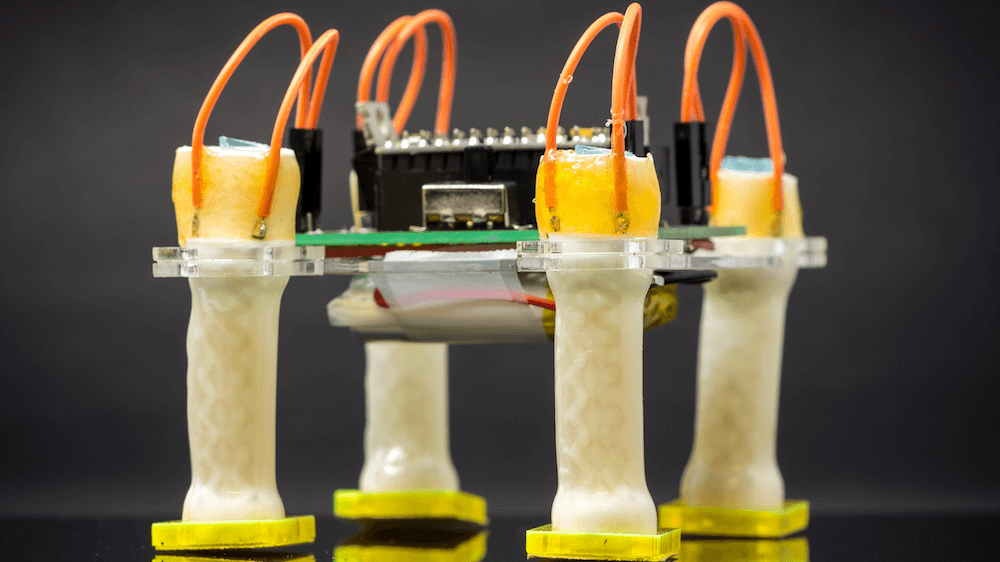
Soft robots are no longer just floppy science fair noodles with ambition. Thanks to electricity, smart materials, artificial muscles, and some very clever engineering, they are starting to move less like clanky machines and more like us: squishy, adaptive, slightly unpredictable meatbags with excellent grip strength when snacks are involved.
Traditional robots are amazing at welding cars, stacking boxes, and looking vaguely threatening in promotional videos. But they are mostly built around hard motors, rigid joints, gears, and metal frames. Humans, octopuses, caterpillars, and other biological show-offs work differently. We use soft tissue, tendons, fluids, nerves, and distributed sensing to move through a messy world without snapping every egg, tomato, or finger we touch.
That is where soft robotics comes in. Instead of forcing robots to be stiff skeletons wearing plastic armor, researchers are building machines from elastomers, gels, fluids, textiles, and stretchable electronics. The big challenge has always been actuation: how do you make a soft thing move powerfully, quickly, safely, and precisely? Pneumatics and hydraulics can do the job, but they often require pumps, tubes, compressors, tanks, and the kind of plumbing situation that makes a robot look like it escaped from a hospital basement.
Electricity changes the story. With electrically driven soft actuators, dielectric elastomers, HASEL artificial muscles, liquid crystal elastomers, and electrofluidic fibers, engineers are creating soft robots that can bend, contract, grip, lift, crawl, and even self-sense their own motion. In other words, electricity is helping soft robots become more muscle-like, more compact, and more useful in the human world.
What Is Soft Robotics?
Soft robotics is the field of designing robots with flexible, compliant materials rather than rigid mechanical structures. A soft robot might have silicone limbs, inflatable chambers, stretchable sensors, textile muscles, or fluid-filled pouches that deform when activated. The goal is not to make robots weaker. The goal is to make them safer, more adaptable, and better at dealing with unpredictable environments.
A rigid robotic arm is great when every object is exactly where the program expects it to be. Unfortunately, the real world enjoys chaos. Fruit bruises. Human hands move. Surfaces are uneven. A soft robot can conform to an object instead of smashing into it with all the emotional sensitivity of a shopping cart. This makes soft robotics especially promising for prosthetics, wearable devices, surgical tools, food handling, exploration, assistive technology, and robots that work near people.
Why Electricity Matters in Soft Robots
For years, many soft robots depended on air or fluid pressure. Pneumatic actuators inflate like balloons. Hydraulic actuators use fluid movement to create force. Both approaches are useful, but they can be bulky. If a soft gripper needs a compressor, valves, tubes, and a large power supply, it stops looking like a nimble artificial hand and starts looking like a science project dragging its luggage behind it.
Electric actuation offers a cleaner path. Electrical signals are easy to control with microcontrollers, batteries, sensors, and software. That means a soft robot can be programmed more like a normal electronic device. Send current here, apply voltage there, heat this zone, polarize that material, and suddenly the robot bends, contracts, twists, grips, or releases.
The dream is simple: soft robots with muscle-like motion, onboard power, compact control electronics, and no giant external life-support system. We are not fully there yet, but the research is moving fast enough to make old-school robot joints look a little jealous.
Artificial Muscles: The Robot Gym Membership Finally Paid Off
An artificial muscle is an actuator designed to mimic at least some qualities of biological muscle. Real muscles are impressive because they are soft, lightweight, efficient, powerful, responsive, and self-sensing. They do not need a gearbox in your elbow. They also do not usually require a firmware update before you pick up a mug.
Engineers are trying to capture those advantages using materials that deform under electrical, thermal, magnetic, chemical, or pressure-based stimulation. Electrically driven artificial muscles are especially attractive because they can be controlled directly by signals. That opens the door to robotic hands, wearable exosuits, prosthetic limbs, soft grippers, robotic fish, and medical devices that respond smoothly rather than mechanically jerking around like a haunted office chair.
HASEL Actuators: Electricity, Oil, and a Tiny Soft-Robot Flex
One of the most exciting families of electrically powered soft actuators is known as HASEL, short for hydraulically amplified self-healing electrostatic actuators. Yes, the acronym sounds like a space agency for very polite robots, but the concept is elegant.
A HASEL actuator typically uses a soft pouch filled with an electrically insulating liquid. When voltage is applied across electrodes, electrostatic forces squeeze part of the pouch, moving the liquid and changing the actuator’s shape. Depending on the design, the actuator can contract, expand, bend, or produce more complex motion.
The magic is in the combination. HASEL actuators borrow the controllability of electrostatic systems and the force transmission of fluidic systems. Because the liquid dielectric can recover after some electrical breakdown events, these actuators can show self-healing behavior. That is a big deal because high-voltage soft actuators often face durability problems. A material that can recover from electrical damage is much closer to the practical, long-lasting artificial muscle engineers actually need.
Why HASEL Feels So Biological
Biological muscles are not just motors. They are soft, responsive, adaptable systems. HASEL actuators are interesting because they can create muscle-like linear contraction, deliver strong force, respond quickly, and be built into different shapes. Researchers have explored versions that mimic straight muscle fibers, donut-like actuators, soft grippers, and antagonistic muscle pairs that act more like the push-pull systems in animal bodies.
In a human arm, your biceps and triceps work against each other. One contracts while the other relaxes, giving your elbow controlled motion. Soft robotic researchers are increasingly designing similar antagonistic systems using artificial muscles. That is where robots stop being “a motor with a claw” and start looking more like a simplified musculoskeletal system.
Dielectric Elastomer Actuators: Stretchy Electricity Tricks
Dielectric elastomer actuators, often shortened to DEAs, are another major branch of electrically driven soft robotics. A dielectric elastomer is a soft insulating material that deforms when an electric field is applied. Imagine a flexible sandwich: soft elastomer in the middle, stretchable electrodes on both sides. Apply voltage, and electrostatic attraction squeezes the material thinner while it expands in area.
That movement can be fast, lightweight, and muscle-like. DEAs are appealing for soft robots because they can produce large deformation without heavy motors. They also pair naturally with sensing because changes in electrical properties can reveal deformation. In simple terms, the same squishy material that moves may also help the robot know how much it moved. That is very meatbag behavior. Our muscles and tendons are full of feedback loops; we do not need a separate measuring tape in every finger.
The hard parts are durability, control, material fatigue, and safe high-voltage operation. A robot muscle is not useful if it performs beautifully for three minutes and then retires dramatically. Researchers continue to improve electrodes, elastomers, manufacturing methods, and control models so electric artificial muscles can survive real-world use.
Liquid Crystal Elastomers: Soft Robots That Bend When Heated
Liquid crystal elastomers, or LCEs, bring another flavor to the soft robotics buffet. These materials can contract, expand, or bend when triggered by heat, light, or electricity-driven heating. UC San Diego researchers demonstrated soft tubular actuators made from liquid crystal elastomers that could be controlled electrically. By embedding heating wires and activating different regions of the tube, the actuator could bend in multiple directions or contract along its length.
The advantage is compactness. Instead of needing a compressor or pump, a soft robot can use a small battery, microcontroller, and electric current to control movement. The drawback is speed. Thermal systems often need time to heat up and cool down. That means some LCE soft robots move more like a sleepy inchworm than a caffeinated gecko. Still, the research matters because it shows how electricity can simplify soft robot hardware and make untethered designs more realistic.
Electrofluidic Fibers: Soft Muscle Goes Wearable
Recent work on electrofluidic fiber muscles points toward a particularly exciting future: artificial muscles that look and behave more like textile fibers. Researchers at MIT and collaborators developed electrically driven fiber-format muscles that use flexible tubes and electric fields to move fluid, generating pressure and flow without traditional moving pump parts.
That is important because many fluidic soft actuators are strong but inconvenient. They need external pumps. Electrofluidic fibers aim to put the pump and actuator closer together in a compact, quiet system. Multiple fibers can be bundled or woven, much like biological muscle fibers bundle together. Demonstrations have included fast lever motion, lifting several kilograms, and biceps-triceps-style arrangements that bend a robotic arm while remaining compliant enough for human interaction.
This is where soft robotics starts to look less like a lab bench and more like future wearable technology. Imagine assistive sleeves, robotic gloves, prosthetic liners, or fabric-based exosuits with muscle-like fibers woven into them. The robot is not a metal frame strapped to your body. It is closer to clothing that lends a hand, literally.
The Octobot Lesson: Soft Robots Need Soft Everything
Harvard’s famous Octobot showed the world that soft robotics is not only about soft limbs. A truly soft robot needs soft actuation, soft control, and soft power systems. Octobot used microfluidic logic and hydrogen peroxide fuel to move without rigid electronics or a hard external tether. It was not an electric soft robot in the usual sense, but it proved a crucial point: if every part of the robot is soft, the design philosophy changes completely.
Octobot’s movement was simple, but its impact was huge. It demonstrated that autonomous soft machines could be built with embedded fluidic systems, chemical power, and additive manufacturing. Today’s electrically driven soft robots build on that broader idea. The future is not one single actuation method. It is a toolbox: electrostatic muscles, fluidic fibers, liquid crystal elastomers, dielectric elastomers, pneumatic networks, soft sensors, and smart materials working together.
Soft Robots Are Safer Around Humans
One of the biggest reasons soft robotics matters is safety. Robots are leaving cages. They are entering hospitals, homes, farms, warehouses, and rehabilitation clinics. A rigid robot can be dangerous if it misjudges contact. A soft robot can absorb impact, conform to the human body, and reduce injury risk.
That does not mean every soft robot is automatically safe. High voltage, heat, chemical fuels, sharp embedded components, and control failures still require careful engineering. But softness gives designers a better starting point. A soft gripper can pick up a tomato, a fragile test tube, or a human hand without needing perfect geometry. It can distribute pressure rather than concentrate force at one hard contact point.
Applications: Where Electric Soft Robotics Could Shine
Prosthetics and Robotic Hands
Electric artificial muscles could make prosthetic hands lighter, quieter, and more natural. Instead of using only motors and gears, future prosthetics may combine soft actuators with sensors to produce smoother grip, better compliance, and more comfortable interaction with everyday objects.
Wearable Assistive Devices
Soft robotic sleeves, gloves, trousers, and exosuits could help people stand, walk, lift, or recover movement after injury. Electrically driven soft actuators are promising because they can be controlled by small electronics and integrated into fabric-like systems.
Medical and Surgical Robots
In medicine, soft robots could move through delicate environments where rigid tools are risky. Soft grippers, steerable catheters, and compliant surgical devices may reduce tissue damage while improving control.
Food Handling and Agriculture
Soft robots are ideal for handling irregular, fragile objects. Picking berries, sorting produce, packaging baked goods, or handling seafood requires a gentle touch. A rigid gripper sees a strawberry as a task. A soft gripper treats it more like the delicate fruit balloon it is.
Exploration Robots
Soft robots can squeeze, crawl, swim, and adapt to uncertain terrain. Underwater robots inspired by fish or octopuses could move more quietly and efficiently. Disaster-response robots could crawl through rubble without needing perfectly flat floors.
The Big Engineering Challenges
Electric soft robotics is exciting, but it is not magic. Several problems still need serious work.
Power and Voltage
Some electric artificial muscles require high voltages. Even when current is low, voltage creates safety and insulation challenges. Researchers are working on lower-voltage designs, better dielectric materials, safer electrodes, and compact drive electronics.
Durability
Soft materials stretch, fatigue, tear, dry out, and age. A practical robot muscle must survive thousands or millions of cycles. It also needs to handle dust, moisture, temperature changes, and the occasional user who thinks “gentle prototype” means “please poke it.”
Control
Soft robots are harder to model than rigid robots. Their bodies deform continuously, and their motion depends on material properties, fluid behavior, temperature, voltage, geometry, and time. That creates nonlinear effects such as hysteresis and creep. In plain English: the robot does not always return exactly the way you expect, because it is squishy and has a memory like a foam mattress.
Manufacturing
Making one beautiful soft actuator in a lab is different from manufacturing thousands reliably. Soft robotics needs scalable fabrication methods, repeatable materials, embedded sensing, quality control, and designs that can be repaired or recycled.
Why Soft Robots Feel More “Alive”
Soft robots feel more lifelike because their motion comes from deformation rather than rotation. A motor turns. A gear transfers torque. A soft actuator changes shape. It swells, contracts, bends, wrinkles, stretches, or twists. That kind of motion resembles muscle, tendon, skin, and fluid-filled tissue.
Electricity makes this lifelike behavior easier to control. A microcontroller can activate different regions of a soft actuator, coordinate artificial muscle bundles, and respond to sensor feedback. The robot’s “brain” sends signals, and the soft body translates those signals into motion. That is not exactly how your nervous system works, but the analogy is close enough to make the phrase “robot meatbag” feel scientifically rude yet oddly accurate.
Experience Notes: What Working With Soft Robotics Feels Like
Anyone who has handled soft robotic prototypes quickly learns that they do not behave like normal machines. A rigid mechanism has a satisfying predictability: tighten the screw, align the shaft, apply power, get motion. Soft robotics is more like working with a stubborn combination of balloon animal, electrical circuit, and undercooked pasta. It is fascinating, but it has opinions.
The first experience is usually surprise. A soft gripper does not need to know the exact shape of an object to hold it. When it wraps around a cup, fruit, or tool, the material itself handles part of the intelligence. This is called embodied intelligence, and it feels almost unfair. Instead of writing hundreds of lines of code to calculate contact points, the soft body simply conforms. The robot is not smarter in the traditional sense; its body is doing some of the thinking.
The second experience is humility. Soft actuators are sensitive to tiny details. A slightly different wall thickness, a small air bubble, a wrinkle in an electrode, a temperature change, or a misaligned layer can alter performance. Two actuators that look identical may bend differently. That can be annoying when you want precision, but it also mirrors biology. Human muscles are not identical industrial parts either. We compensate with feedback, adaptation, and practice.
The third experience is delight. Watching an electrically activated soft actuator move for the first time is weirdly charming. It does not snap into place like a servo. It comes alive gradually, curling or contracting as if it has remembered its purpose. When a soft robotic finger closes around an object without crushing it, the movement feels less mechanical and more creature-like. It is easy to understand why researchers keep borrowing inspiration from octopuses, elephant trunks, worms, fish, and human hands. Nature has been prototyping soft machines for a few billion years, which is a pretty solid research timeline.
The fourth experience is respect for power electronics. Electricity may make soft robots more compact, but it also introduces trade-offs. High voltage needs insulation. Heating-based actuators need thermal management. Electrostatic systems need careful material selection. Batteries add weight. Controllers must deal with nonlinear movement. A soft robot may look cute, but behind that squishy exterior is a tough engineering problem wearing a silicone hoodie.
The most useful lesson is that soft robotics is not about replacing rigid robots everywhere. It is about choosing the right body for the task. If a robot needs to machine metal parts with micron precision, stiffness is your friend. If it needs to hold a peach, assist a patient’s hand, swim like a fish, or crawl through a cluttered environment, softness becomes a superpower. Electricity gives that superpower a nervous system.
Conclusion
Electricity makes soft robotics more like us meatbags because it gives squishy machines a practical way to turn signals into motion. Instead of relying only on compressors, external pumps, and rigid motors, engineers can now design soft actuators that contract, bend, grip, lift, self-sense, and sometimes recover from damage. HASEL actuators, dielectric elastomers, liquid crystal elastomers, and electrofluidic fibers all point toward robots that are lighter, safer, quieter, more adaptable, and more comfortable working around humans.
The future of robotics will not be only metal humanoids marching through factories. It will also be soft grippers sorting fruit, wearable muscles helping people move, prosthetic hands with gentler control, underwater robots swimming with fish-like bodies, and medical tools that treat tissue like tissue instead of a construction site. We meatbags may still have the original soft-body design, but electricity is helping robots close the gapone squishy artificial muscle at a time.
Note: This article is fully rewritten in original language and synthesized from real soft robotics research, university reports, and peer-reviewed developments. It is designed for web publication without copied source text.