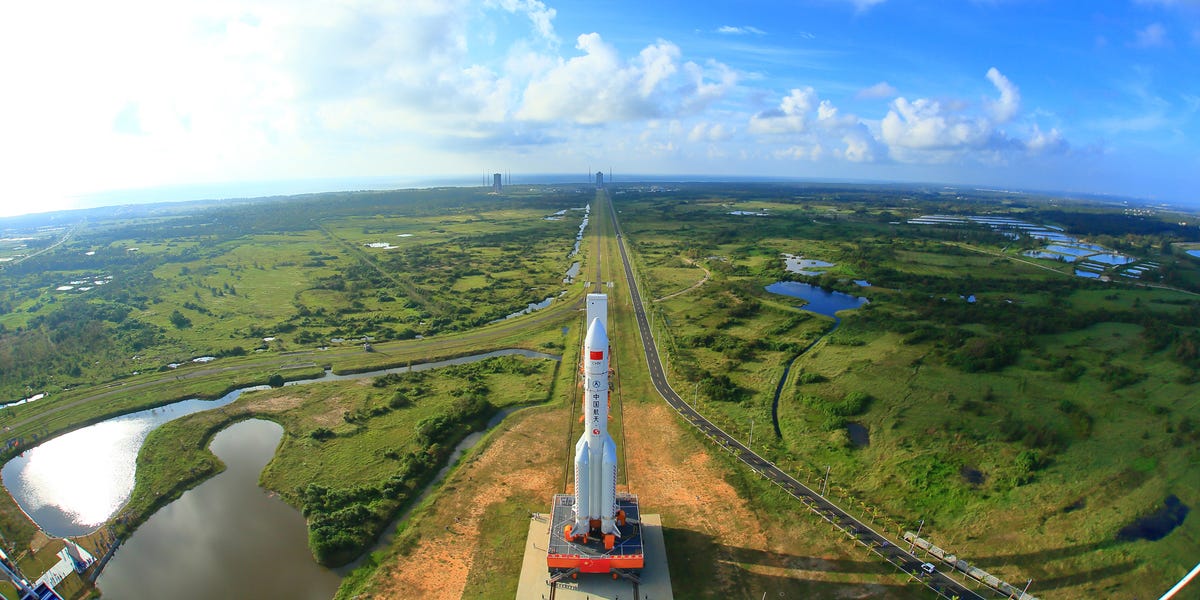
China is not merely trying to join the Moon club; it is trying to bring a bigger backpack. Its planned Long March 9 super-heavy-lift rocket is often described as a Saturn V-class vehicle, which means we are talking about the rare kind of rocket that makes skyscrapers look like office furniture and makes engineers reach for both calculators and coffee.
The comparison matters because Saturn V was not just “a big rocket.” It was the machine that sent Apollo astronauts to the Moon, launched Skylab, and became the gold standard for national space ambition. For decades, if a rocket was compared to Saturn V, that meant it was entering the heavyweight division. China’s Long March 9 is designed for that same category: lunar infrastructure, Mars missions, giant space telescopes, large deep-space probes, and possibly the construction of a long-term Moon base.
But here is the important twist: China’s current crewed Moon landing plan before 2030 relies mainly on the Long March 10, the Mengzhou crew spacecraft, and the Lanyue lunar lander. Long March 9 is the bigger, later, more strategic rocketthe kind of vehicle that could turn a one-time lunar landing into an industrial supply chain beyond Earth. In other words, Long March 10 may help China get boots on the Moon, while Long March 9 could help China bring the toolbox, the spare parts, and maybe the coffee machine.
What Is Long March 9?
Long March 9, also known as Chang Zheng 9 or CZ-9, is China’s planned super-heavy-lift launch vehicle. It belongs to the Long March rocket family, the backbone of China’s space program. While earlier Long March rockets have launched satellites, robotic lunar missions, Mars probes, and crewed Shenzhou spacecraft, Long March 9 is meant for a much larger job: moving enormous payloads beyond low Earth orbit.
Earlier public concepts described Long March 9 as a roughly Saturn V-class rocket capable of placing around 140 metric tons or more into low Earth orbit, with tens of metric tons sent toward the Moon or Mars. More recent concepts have shifted toward methane-fueled engines and reusability, a sign that China is watching the global rocket market very carefully. SpaceX’s Starship has clearly changed the mood in the room. No country wants to spend the 2030s flying yesterday’s rocket while competitors are learning to reuse giant boosters like airline equipment.
Why the Saturn V Comparison Still Grabs Attention
Saturn V remains the cultural measuring stick for giant rockets because it did something no other launch vehicle had done before: it sent humans to the Moon. Standing 363 feet tall and powered by five F-1 engines in its first stage, Saturn V produced about 7.5 million pounds of thrust at liftoff. It could launch about 130 tons into Earth orbit and roughly 50 tons toward the Moon. Those are not polite numbers. Those are “please notify the neighborhood before ignition” numbers.
Calling Long March 9 “as powerful as Saturn V” is not just a flashy headline. It tells readers that China is aiming beyond routine satellite launches. A Saturn V-class rocket can support missions that smaller rockets cannot handle efficiently: large lunar landers, heavy cargo modules, giant station parts, nuclear-power systems, Mars transfer stages, and big scientific observatories. If China succeeds, it would gain a tool that can reshape deep-space logistics.
Long March 9 vs. Long March 10: The Key Difference
One common mistake is to treat Long March 9 and Long March 10 as the same rocket. They are not. Long March 10 is the nearer-term crewed lunar rocket, built around China’s plan to land astronauts on the Moon before 2030. It is expected to launch the Mengzhou crew spacecraft and Lanyue lander in a dual-launch mission architecture, where separate launches assemble the pieces needed for a lunar landing.
Long March 9 is the heavier, more ambitious vehicle aimed at the 2030s and beyond. Think of Long March 10 as the expedition vehicle and Long March 9 as the cargo railroad to deep space. Long March 10 helps China reach the Moon. Long March 9 could help China stay there, build there, and eventually use the Moon as a staging ground for larger missions.
Why China Wants a Super-Heavy Rocket
1. A Permanent Lunar Presence
China has openly discussed long-term lunar ambitions, including participation in the International Lunar Research Station, a proposed Moon base project developed with international partners. Robotic missions such as Chang’e-5 and Chang’e-6 have already shown China’s ability to return lunar samples, including from the Moon’s far side. The next challenge is scale. A base requires cargo, power systems, habitats, rovers, communications equipment, and repeated landings. Small rockets can participate, but super-heavy rockets make the job less like moving apartments one backpack at a time.
2. Mars Missions and Sample Return
Mars is unforgiving. It is far away, mission windows are limited, and the spacecraft need serious mass: propulsion, heat shields, communications systems, landers, ascent vehicles, and return capsules. China already succeeded with Tianwen-1, which placed an orbiter around Mars and deployed the Zhurong rover. A super-heavy rocket could support more complex Mars missions, including sample return or cargo delivery for future crewed exploration.
3. Large Space Infrastructure
Super-heavy rockets are also useful closer to home. They can launch huge space telescopes, massive Earth-observation platforms, space-based solar power demonstrators, and large modules for orbital stations. China’s Tiangong station is smaller than the International Space Station, but it has proven China can operate a long-term crewed platform. Long March 9 could support future stations or industrial platforms that are too large for current launchers.
Reusable Rocket Design: China Learns From the New Space Race
China’s Long March 9 concept has evolved. Earlier designs looked more like traditional expendable super-heavy rockets. Newer concepts appear to move toward reusability, methane-liquid oxygen propulsion, and architectures that invite comparison with SpaceX’s Starship. This is not surprising. Reusability has become the defining technology of modern launch economics. If a rocket can fly again, the cost model changes dramatically.
That does not mean reusability is easy. Landing a booster is like throwing a pencil over a mountain and catching it upright on a dinner plate during a thunderstorm. SpaceX took years to make Falcon 9 landings routine. China’s state-backed and commercial space companies are testing reusable stages, vertical landing systems, and methane engines, but the road from impressive demo to reliable launch cadence is long. Still, China has shown patience in spaceflight. It tends to build step by step, test repeatedly, and then move with surprising confidence.
How Long March 9 Fits Into China’s Broader Space Strategy
China’s space program has a pattern: first demonstrate capability, then build infrastructure, then scale. It launched astronauts, then built Tiangong. It landed on the Moon, then returned samples. It reached Mars, then began planning more ambitious missions. Long March 9 fits the next stage of that strategy: scaling from exploration to presence.
The timing also matters. The United States is pursuing Artemis, built around NASA’s Space Launch System, Orion spacecraft, commercial lunar landers, and the planned Gateway station. China is developing its own crewed lunar system while continuing robotic exploration. This is not a simple replay of the Cold War space race, but it does have familiar ingredients: prestige, technology, national strategy, and the universal human desire to plant flags in places where nobody has yet built a decent sandwich shop.
Could Long March 9 Really Match Saturn V?
In raw payload class, yes, that is the goal. Publicly discussed Long March 9 concepts place it in the same super-heavy category as Saturn V, NASA’s larger SLS configurations, and SpaceX’s Starship. But matching Saturn V is not only about lifting mass. Saturn V became legendary because it worked. It flew 13 times, carried Apollo crews, and helped achieve one of the most difficult engineering goals in history.
For Long March 9 to earn the same kind of respect, it must do more than look impressive at air shows or in renderings. It needs reliable engines, strong stage separation, precise guidance, safe ground systems, high launch cadence, and a mission architecture that actually uses its capacity. The rocket is only the loudest member of the orchestra. Without spacecraft, landers, cargo systems, launch pads, tracking networks, and trained crews, even the biggest rocket is just an expensive monument to combustion.
The Engineering Challenges Ahead
Building a Saturn V-class rocket is brutally difficult. The first challenge is propulsion. Large engines must produce enormous thrust while avoiding combustion instability, vibration, overheating, and structural stress. The second challenge is manufacturing. Huge tanks, domes, and engines require precision at a scale where tiny mistakes can become very dramatic, very quickly.
The third challenge is integration. A super-heavy rocket is not one machine; it is a stack of machines arguing with gravity at high speed. Engines, avionics, pressurization systems, propellant feed lines, guidance computers, flight software, and ground equipment must all cooperate. If one part has a bad day, the whole mission may become a very expensive fireworks show.
The fourth challenge is operations. A rocket that flies once every few years is a national symbol. A rocket that flies regularly becomes infrastructure. China’s real goal is likely not just to launch Long March 9 once, but to make it useful enough to support repeated lunar and deep-space missions.
What It Means for the United States and the Global Space Industry
China’s super-heavy rocket ambitions will put pressure on the United States, Europe, Japan, India, and commercial space companies. The next decade may decide who can move the most mass, most often, at the lowest cost, beyond Earth orbit. That matters for science, communications, navigation, national security, and future industries such as lunar resource processing or space-based energy.
For NASA, China’s progress strengthens the argument for consistent lunar funding and faster execution. For SpaceX and Blue Origin, it validates the commercial focus on reusable heavy-lift systems. For the rest of the world, it shows that deep-space capability is becoming less like a one-time stunt and more like strategic infrastructure.
Experience-Based Reflections: Watching the Heavy-Lift Race Grow Up
Following China’s heavy-lift rocket development feels a little like watching a chess match where every piece weighs several hundred tons and occasionally explodes during testing. The exciting part is not just the size of the rocket; it is the way the entire space industry has changed around the idea of heavy lift. Twenty years ago, a Saturn V-class rocket sounded like nostalgia. Today, multiple programs are trying to build vehicles in that range because the Moon is back on the schedule and Mars no longer feels like science fiction wearing a lab coat.
One lesson from watching modern spaceflight is that rockets are never just rockets. They are political statements, engineering schools, industrial supply chains, and national confidence machines. When a country builds a super-heavy launcher, it trains welders, software engineers, materials scientists, engine designers, mission planners, and launch crews. The rocket may fly for minutes, but the ecosystem behind it takes decades to mature.
Another experience is that early rocket concepts should be treated with cautious enthusiasm. Renderings are beautiful. Payload charts are persuasive. Conference slides are elegant. But hardware is the truth serum. Until engines fire repeatedly, tanks survive pressure tests, stages separate cleanly, and missions reach orbit, every super-heavy rocket remains partly a promise. That is not a criticism of China; it is simply how rocketry works. Even the most advanced programs learn by testing, failing, adjusting, and testing again.
The Long March 9 story is also a reminder that the Moon has changed. In the Apollo era, the goal was to land, explore, collect samples, and return. In the 2030s, the goal is presence. Countries want power stations, landing zones, communications relays, polar research sites, ice prospecting, and reusable landers. That changes the rocket equation in a practical way. A single heroic launch is impressive, but a steady cargo pipeline is transformative.
For readers who love space but do not speak fluent engineer, the best way to understand Long March 9 is this: China is trying to build the kind of rocket that turns big dreams into shippable objects. A Moon base is not built with slogans. It is built with pressure vessels, solar arrays, batteries, rovers, tools, food, water systems, spare parts, and enough redundancy to make accountants sigh. Heavy-lift rockets make those deliveries possible.
The most fascinating part is that the race is no longer only about who lands first. It is about who can keep going. If China lands astronauts by 2030 and later brings Long March 9 online, it could move from symbolic achievement to sustained lunar logistics. If the United States accelerates Artemis and commercial heavy lift matures, the result could be a genuinely productive competition. That would be good news for science, technology, and everyone who has ever looked at the Moon and thought, “Nice place. Needs better Wi-Fi.”
Conclusion: A Saturn V-Class Signal From China
China’s work on Long March 9 signals that it is planning for more than a brief visit to the Moon. The rocket represents a long-term bet on deep-space capability, lunar infrastructure, Mars exploration, and large-scale orbital construction. While Long March 10 is the immediate vehicle for China’s crewed lunar landing goal, Long March 9 is the larger strategic piece that could support a permanent presence beyond Earth.
The Saturn V comparison is powerful because it frames the scale of the ambition. Saturn V helped define the first Moon age. Long March 9 could help define the next one, especially if China succeeds in combining super-heavy lift with reusability and steady launch operations. The rocket has not yet proven itself, and its design may continue to evolve. But the direction is clear: the future of space exploration belongs to those who can move big things reliably, affordably, and often.
If Long March 9 works as intended, the 2030s may bring a new era where Moon bases, Mars missions, and giant space infrastructure are no longer occasional dreams but scheduled cargo manifests. That is the real meaning of a rocket as powerful as Saturn V. It is not just about reaching space. It is about bringing enough with you to stay.