A bathroom faucet may be one of the smallest fixtures in the room, but it performs an impressive amount of visual heavy lifting. Choose ordinary chrome and it politely blends into the background. Choose a colored VOLA faucet, and suddenly the sink has a personality, the tile looks more intentional, and brushing your teeth feels vaguely like participating in a Danish design exhibition.
Known for minimalist forms, precise proportions, and a remarkably broad finish palette, VOLA offers a different approach to bathroom color. Instead of relying only on painted walls, patterned tile, or decorative towels, homeowners can place color directly on the object they touch every day. The result can be playful, architectural, quietly sophisticated, or all three at once.
Why Colored VOLA Faucets Still Feel Fresh
VOLA’s modern faucet story began in 1968, when manufacturer Verner Overgaard collaborated with Danish architect and designer Arne Jacobsen on fittings for the National Bank of Denmark. Their idea was radical for the period: hide the mechanical components inside the wall and leave only the essential controls and water outlet visible.
The finished design reduced the faucet to simple geometric forms. Cylinders, circles, straight lines, and carefully balanced proportions replaced decorative flourishes. It was minimalism before minimalism became a word people used to justify owning only one chair.
Early prototypes explored gray and orange, and color soon became part of the brand’s identity. The original shades eventually developed into a palette of 15 colors, accompanied by metallic finishes and additional exclusive options. Because the underlying forms remain restrained, even energetic shades such as orange, yellow, blue, or red can look architectural rather than cartoonish.
Color Without Visual Clutter
Bright bathroom fixtures sometimes become dated because their shapes are strongly tied to a particular era. A heavily ornamented turquoise faucet may announce its decade before the water is turned on. VOLA avoids much of that problem by pairing color with uncomplicated geometry.
The silhouette remains clean, so the finish can do the expressive work. A red faucet against white tile resembles a graphic punctuation mark. A pale blue mixer against limestone feels calm and airy. Dark green against warm oak introduces color while maintaining an organic, spa-like mood.
Understanding the VOLA Color and Finish Palette
Colored VOLA faucets are available in shades ranging from quiet neutrals to strong primary and secondary colors. Depending on the product, market, and dealer, selections may include gray, light blue, orange, light green, yellow, dark gray, blue, red, dark blue, white, black, carmine red, pink, matte black, and matte white. Metallic choices may include chrome, brushed chrome, stainless steel, brass, copper, and related brushed or polished treatments.
This range gives designers two useful strategies: make the faucet disappear into the room or make it the room’s most memorable detail.
Soft and Subtle Colors
Light blue, pale green, gray, white, and muted neutral finishes work well when the goal is serenity. They complement limestone, terrazzo, warm white plaster, pale oak, and gently veined marble. These combinations support the spa-inspired atmosphere many homeowners want without making the bathroom feel like a luxury hotel lobby copied from an airport magazine.
A light-colored faucet can also soften the hard surfaces typically found in a bath. Porcelain, glass, stone, and metal naturally create a crisp environment. A powder-coated pastel introduces warmth and makes the space feel more residential.
Bold Statement Colors
Orange, yellow, red, and saturated blue produce a stronger visual effect. These colors are especially successful in powder rooms, children’s bathrooms, creative studios, and modern homes where the faucet can function as a small piece of usable art.
Bold color does not require a bold room. In fact, a simple background often gives the faucet more impact. White tile, a plain mirror, and an uncomplicated basin allow one vivid fixture to command attention without starting an argument with the grout.
Metallic Finishes
Metallic VOLA finishes provide color through material rather than pigment. Brushed brass can warm a cool stone bathroom, while copper develops character through its distinctive appearance. Brushed stainless steel and brushed chrome offer an understated, durable look that suits contemporary and industrial interiors.
Natural brass may change and develop a patina over time. Some homeowners consider this aging process part of the material’s charm; others prefer a finish that remains visually consistent. That distinction should be discussed before ordering, preferably before someone discovers that “living finish” does not mean the faucet has learned to water the plants.
How to Choose the Right Faucet Color
The best colored bathroom faucet is not necessarily the one that looks most exciting on a sample card. It is the finish that creates a clear relationship with the room’s permanent materials, lighting, and overall design direction.
Start With the Fixed Surfaces
Begin with materials that will be expensive or inconvenient to replace: tile, stone, flooring, countertops, and cabinetry. A faucet can coordinate with one of these elements, contrast with them, or repeat a smaller accent color already present.
For example, a dark blue VOLA faucet can echo blue veining in stone. A red fitting can pick up a small red detail in patterned floor tile. Matte white can blend into a white backsplash, allowing the fixture’s shape and shadow to become the main attraction.
Test Samples in the Actual Room
Bathroom lighting changes color dramatically. Warm bulbs can make a cool gray appear taupe, while bright daylight can expose blue undertones that were nearly invisible in a showroom. View samples beside the basin, tile, and mirror at several times of day.
Photographs are useful for inspiration, but screens cannot reliably reproduce powder-coated or metallic finishes. A physical sample prevents the unpleasant surprise of ordering “calm forest green” and receiving what appears, under your lighting, to be “competitive pickle.”
Decide Whether to Match or Contrast
A matching approach produces a calm, integrated composition. Pairing a white faucet with a white basin, for instance, creates a nearly seamless appearance. Using the same finish for the shower controls, towel warmer, and accessories can further unify the room.
A contrasting approach treats the faucet as a focal point. Orange against blue tile, black against warm plaster, or yellow against gray stone creates an intentional visual break. Contrast works best when the fixture is allowed to stand alone rather than competing with five other unrelated accent colors.
Wall-Mounted or Deck-Mounted?
VOLA’s catalog includes wall-mounted, deck-mounted, and freestanding configurations. Choosing among them involves more than appearance; plumbing access, basin dimensions, counter depth, and installation timing all matter.
Wall-Mounted VOLA Faucets
The wall-mounted format closely reflects the original VOLA concept. Most of the working components remain concealed, leaving the spout and control visible. This creates a clean countertop and makes it easier to wipe water from around the basin.
However, wall-mounted faucets require careful planning. The plumber must establish the correct rough-in depth, spout height, projection, and relationship to the basin before the wall is closed. Tile thickness and finished wall materials also affect the final positioning. Moving the spout two inches after the stone has been installed is not a charming weekend project.
Deck-Mounted VOLA Faucets
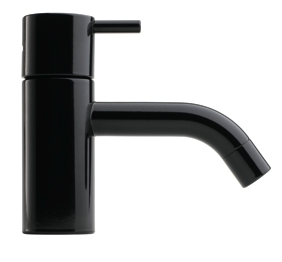
Deck-mounted models install on the basin or countertop and are often easier to incorporate into an existing bathroom. The classic HV1, for example, is a compact one-handle mixer with a fixed spout, ceramic-disc operation, and a water-saving aerator.
Deck-mounted models still require dimensional coordination. The spout must reach far enough into the basin to reduce splashing, while the handle needs sufficient clearance from the backsplash and mirror. Vessel sinks may require taller fittings or a different spout configuration.
Freestanding Bath Fillers
For a dramatic bathtub installation, VOLA offers freestanding mixers such as the FS1, which combines a tall floor-mounted body with a hand shower and swivel spout. In a color finish, this fixture becomes a vertical sculpture beside the tub.
Freestanding fillers require plumbing below the floor and should be specified early. Floor construction, waterproofing, finish thickness, and access for future service all need to be considered before the tub reaches the “it looked smaller in the showroom” stage.
Pairing Colored Faucets With Bathroom Materials
White Tile and Porcelain
White creates the easiest background for a colorful faucet. Carmine red, orange, yellow, blue, or black can provide a crisp graphic accent. This combination is particularly effective with square tile grids because the rounded faucet forms contrast with the straight grout lines.
Marble and Natural Stone
Stone already contains variation, so a faucet color should relate to its undertones. Warm brass, orange, muted green, or deep red can complement creamy or brown-veined stone. Blue, gray, stainless steel, and matte black often suit cooler white or gray marble.
Terrazzo
Terrazzo offers a convenient roadmap because the faucet color can repeat one of the chips in the surface. A restrained terrazzo may benefit from a bright fitting, while a highly colorful pattern usually pairs better with a quieter faucet drawn from one of its secondary tones.
Wood Vanities
Oak and walnut introduce natural warmth. Green, blue, black, matte white, and brushed metallic finishes all work well with wood, depending on the desired mood. A green fixture feels botanical, while black creates sharper contemporary contrast. Brushed brass emphasizes warmth but should be balanced carefully so the room does not become excessively golden.
Color-Drenched Bathrooms
A faucet can also match walls, cabinetry, or tile in a tonal design. A blue faucet in a blue-tiled bathroom creates depth through differences in texture rather than sharp color contrast. This technique feels immersive and sophisticated when the shades share compatible undertones.
Water Efficiency and Everyday Performance
Appearance matters, but a bathroom faucet still needs to deliver comfortable, controlled water flow. In the United States, EPA WaterSense-labeled bathroom faucets and accessories have traditionally been designed to use no more than 1.5 gallons per minute while maintaining acceptable performance, reducing flow compared with the federal standard of 2.2 gallons per minute.
Flow specifications, certifications, and local plumbing requirements should be confirmed for the exact VOLA model and installation location. Some states and municipalities apply stricter limits. A qualified dealer or plumber can verify whether the selected configuration includes the appropriate aerator or flow regulator.
Spout placement also affects perceived performance. Even a well-engineered faucet may splash if installed too high above a shallow basin or aimed near the drain stopper. Proper specification considers water pressure, spout projection, basin slope, and the position where the stream lands.
Cleaning and Maintaining Colored VOLA Faucets
Colored finishes are not difficult to maintain, but they should be treated as finished design surfaces rather than as targets in a chemistry experiment. VOLA recommends regular gentle cleaning, including wiping with a damp cloth and rinsing away soap, shampoo, and lotion residue.
Avoid abrasive pads, harsh powders, aggressive acids, and unsuitable chemical cleaners. These products can dull or damage coatings and metallic surfaces. In hard-water areas, frequent light cleaning is preferable to waiting for mineral deposits to build a small geological monument around the aerator.
Use a soft cloth, follow the manufacturer’s instructions for the specific finish, and dry the faucet when practical to reduce spotting. Natural brass and other living materials may change over time, so confirm whether the desired surface is intended to remain stable or develop patina.
Longevity, Modularity, and Repair
One reason VOLA fittings remain relevant is the company’s modular approach. Families of compatible handles, spouts, levers, and plates allow designers to create coordinated installations and, in some situations, adapt components as needs change.
VOLA also emphasizes repairability and continued access to replacement parts. That matters for concealed fittings, where replacing an entire system can require opening finished walls. A faucet designed to be serviced is particularly valuable when surrounded by expensive tile or custom stonework.
Before purchasing, ask the dealer about cartridge replacement, aerator access, spare-part availability, warranty coverage, and local service support. A design icon is most enjoyable when it continues dispensing water instead of becoming an extremely elegant paperweight attached to the wall.
Common Design Mistakes to Avoid
- Selecting color from a screen: Obtain a physical sample whenever possible.
- Ignoring undertones: A blue-based gray may clash with creamy stone or warm white paint.
- Ordering too late: Specialty colors and built-to-order configurations may require additional lead time.
- Forgetting rough-in components: Concealed and freestanding models often require installation parts before finish work begins.
- Mixing too many finishes: Two coordinated finishes can feel layered; six unrelated ones can feel like a plumbing showroom lost a bet.
- Overlooking basin geometry: Confirm spout height, reach, stream position, and handle clearance.
- Skipping local code checks: Verify flow-rate and plumbing requirements for the project location.
Experience-Based Perspective: Living With a Colored VOLA Faucet
The most noticeable experience of using a colored VOLA faucet is not the color alone. It is the way color makes an ordinary routine feel intentionally designed. In a neutral bathroom, a bright mixer becomes the object the eye finds first each morning. That small moment of recognition can make the room feel less generic and more connected to the people who use it.
Consider a compact powder room with white square tile, a wall-hung basin, and a carmine red wall-mounted faucet. The room does not need elaborate wallpaper, decorative molding, or a chandelier that threatens taller guests. The faucet supplies enough visual energy by itself. Visitors remember it because the choice feels confident, yet the overall room remains clean and functional.
In a primary bathroom, the experience may be quieter. Imagine a light green faucet paired with limestone, oak cabinetry, and softly textured plaster. The color is visible without demanding attention. During bright daylight, it feels fresh and botanical. Under warm evening lighting, it appears softer and more muted. This type of finish rewards careful sample testing because its personality changes throughout the day.
Families may find that color also helps organize shared spaces. Two basins can use matching faucets for consistency, or carefully selected colors can give each sink a subtle identity. A child may be more enthusiastic about using the “blue sink,” although no faucet finish has yet demonstrated the power to make toothpaste land consistently inside the basin.
The maintenance experience is generally straightforward when the fixture is cleaned gently and frequently. A quick wipe prevents soap and mineral residue from becoming noticeable, particularly on dark matte colors. Black and deep blue may show water spotting more readily than pale shades, while white can disguise some mineral marks but reveal colored cosmetics. The most practical finish depends partly on local water quality and household habits.
Another important experience occurs before installation: decision-making. Colored fixtures require more coordination than standard chrome because replacement accessories from unrelated brands may not match. Homeowners often get better results when they plan the faucet, shower controls, towel hooks, drain, and other visible hardware as a complete family. Exact matching is not always necessary, but differences should look deliberate.
Wall-mounted models create an especially satisfying finished appearance because the countertop remains uncluttered. Cleaning around the basin is easier, and the exposed components look almost diagrammatic in their simplicity. The trade-off is that planning must be precise. Successful projects typically involve early communication among the homeowner, designer, dealer, plumber, cabinetmaker, and tile installer. Everyone needs the same dimensions before the wall is sealed.
Long-term satisfaction tends to come from choosing a color with personal meaning rather than chasing the loudest trend. Orange may connect with a collection of midcentury furniture. Dark blue may recall the coast. Green may relate to garden views outside the window. When the finish belongs to the story of the home, it is less likely to feel dated simply because another color appears in next year’s trend report.
Ultimately, living with a colored VOLA faucet demonstrates how a small, frequently touched object can shape the emotional character of a room. It combines practical operation with visual pleasure, turning running water into a tiny daily design event. That may sound dramatic for a faucet, but bathrooms have survived decades of beige tile. They deserve a little excitement.
Conclusion
Colored VOLA faucets offer a distinctive balance of expressive color and disciplined Scandinavian form. Their simple geometry allows bright shades, soft neutrals, and metallic finishes to fit into bathrooms ranging from restrained modern retreats to playful, personality-filled powder rooms.
A successful installation depends on more than selecting a favorite color. Homeowners should compare physical samples, coordinate the finish with permanent materials, verify plumbing and flow requirements, choose an appropriate mounting configuration, and plan concealed components early. With thoughtful specification and gentle maintenance, a colored faucet can remain both a functional fixture and a memorable design feature for years.
Note: Available colors, product specifications, lead times, water-flow options, certifications, and installation components may vary by model, dealer, and location. Confirm current details with an authorized VOLA supplier and a licensed plumbing professional before ordering.