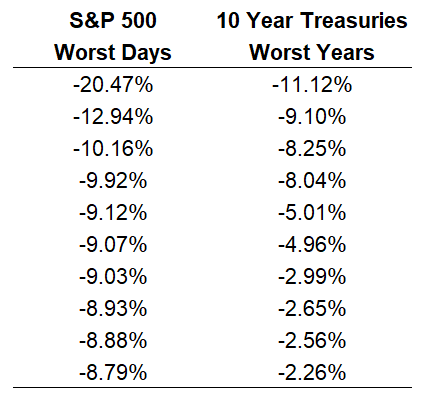
There is an old market joke hiding inside the title of this article: a bad year in the bond market is a bad day in the stock market. Like most good financial jokes, it is funny because it is only mostly true, and the “mostly” part is where investors usually trip over the garden hose.
Stocks get the drama. They wear the sunglasses, crash the car, show up on television, and make headlines with phrases like “bloodbath,” “meltdown,” and “investors flee.” Bonds are supposed to be the quiet roommate who pays rent on time, labels leftovers, and says things like, “Have you considered duration risk?” But every now and then, the quiet roommate throws a chair through the window. That was 2022.
For decades, many investors treated bonds as the sleepy side of the portfolio. Stocks were for growth. Bonds were for income, stability, and emotional support during equity tantrums. Then inflation surged, the Federal Reserve raised interest rates aggressively, and both stocks and bonds fell together. The S&P 500 dropped sharply in 2022, while broad U.S. bond indexes suffered one of their worst years on record. Suddenly, the “safe” part of the portfolio looked like it had forgotten its job description.
Still, the title remains a useful mental model. A painful bond-market year often resembles the kind of loss the stock market can deliver in a much shorter window. That difference in speed, volatility, and investor expectations explains why bond losses feel so strange. A 10% decline in stocks is unpleasant but familiar. A 10% decline in core bonds feels like ordering oatmeal and receiving a roller coaster.
Why Bonds Usually Move More Slowly Than Stocks
Stocks represent ownership in businesses. Their prices are pushed around by earnings, interest rates, investor sentiment, competition, innovation, recessions, headlines, and occasionally a CEO saying something weird on a conference call. Because future corporate profits are uncertain, stock prices can move violently when expectations change.
Bonds are different. A bond is essentially a loan. Investors lend money to a government, municipality, or corporation, and in return they expect interest payments and principal repayment. That structure gives bonds a more predictable cash-flow profile than stocks. Predictable does not mean risk-free, but it usually means less daily drama.
That is why high-quality bonds historically have had lower volatility than stocks. Treasury securities and investment-grade bonds are not designed to make investors rich overnight. They are designed to provide income, diversify risk, and help portfolios survive periods when stocks decide to audition for a disaster movie.
But bond prices still move. They move because interest rates move. They move because inflation expectations change. They move because investors demand different compensation for lending money. And they move because the market is a giant voting machine operated by caffeinated humans and algorithms that never sleep.
The Simple Rule: When Yields Rise, Bond Prices Fall
The most important bond-market concept is also the one that causes the most forehead-slapping: bond prices and yields generally move in opposite directions. When new bonds are issued with higher yields, older bonds with lower coupons become less attractive. Their prices fall until their total return becomes competitive with the new market rate.
Imagine you bought a bond paying 2% interest. The next day, similar new bonds pay 5%. Your 2% bond is now the financial equivalent of a flip phone at an iPhone launch. It still works, but nobody wants to pay full price for it. To sell it, you likely need to accept a lower price.
This is where duration enters the room wearing a lab coat. Duration measures how sensitive a bond or bond fund is to changes in interest rates. A bond fund with longer duration usually falls more when rates rise and rises more when rates fall. FINRA’s investor education materials explain the basic rule of thumb: for every one-percentage-point move in rates, a bond’s price may move in the opposite direction by roughly its duration. A duration of six years means a one-point rise in rates could create about a 6% price decline, before considering income and other factors.
That is why long-term bonds can be surprisingly spicy. Investors may buy them expecting calm income, only to discover that long maturity plus rising rates can behave like hot sauce in a retirement account.
What Made 2022 So Painful for Bonds?
The 2022 bond-market decline was not a random lightning strike. It was the result of several forces arriving at the same party and refusing to leave.
1. Inflation Came Back Loudly
After years of low inflation, prices rose rapidly across the U.S. economy. Food, energy, housing, wages, and services all became part of the inflation conversation. Bond investors dislike inflation because fixed interest payments lose purchasing power when prices rise. If a bond pays 3% while inflation runs much higher, the investor may be earning income but losing real-world buying power.
2. The Federal Reserve Raised Rates Aggressively
To fight inflation, the Federal Reserve raised short-term interest rates at one of the fastest paces in decades. Higher policy rates filtered through Treasury yields, mortgage rates, corporate borrowing costs, and bond valuations. Existing bonds had to reprice lower to compete with newer, higher-yielding securities.
3. Starting Yields Were Very Low
Low starting yields left bonds with less income cushion. When a bond fund yields 6%, its income can absorb some price decline. When it yields 1% or 2%, there is not much padding. In 2022, many investors learned that low-yield bonds can still carry meaningful interest-rate risk. The seat belt was there, but it was made of dental floss.
4. Stocks and Bonds Fell Together
The traditional 60/40 portfolio depends partly on stocks and bonds behaving differently. In many recessions or growth scares, Treasury bonds can rise as investors seek safety and rates fall. But inflation shocks are different. When inflation forces rates higher, both stock valuations and bond prices can come under pressure. That is exactly what happened in 2022.
Why a Bad Bond Year Feels So Much Worse Than the Numbers Suggest
Investors do not experience losses only mathematically. They experience them emotionally. A stock investor expects volatility. A bond investor expects calm. So when bonds fall, the surprise multiplies the pain.
A 12% decline in a stock fund is annoying, but most stock investors understand that equities can drop quickly. A similar decline in a core bond fund feels like betrayal. Bonds were supposed to be the sensible shoes of the portfolio. They were not supposed to sprint into traffic.
This is why the phrase “a bad year in the bond market is a bad day in the stock market” remains useful. It reminds investors that bonds usually move in smaller increments. Stocks can lose several percentage points in a single day when panic hits. Bonds often take months to deliver losses that equities can deliver before lunch. The stock market is a thunderstorm. The bond market is usually a slow change in barometric pressure. Both matter, but they feel different.
The Bond Market Is Bigger and More Important Than Many People Realize
Because stocks dominate financial media, many people assume the stock market is the main event. In reality, the bond market is enormous. SIFMA data shows that global fixed-income markets are larger than global equity markets by outstanding value. The U.S. fixed-income market alone represents tens of trillions of dollars across Treasuries, mortgage-backed securities, corporate bonds, municipal bonds, and other debt instruments.
This matters because bond yields influence nearly everything: mortgage rates, auto loans, corporate borrowing, government financing costs, bank lending, private equity valuations, and even the price investors are willing to pay for fast-growing technology stocks. The bond market is not the boring basement of finance. It is the plumbing. And when the plumbing breaks, everyone suddenly becomes very interested in pipes.
How Rising Bond Yields Affect Stocks
Higher bond yields can pressure stocks in several ways. First, they raise the discount rate used to value future earnings. Growth stocks, especially companies expected to earn much of their profit far in the future, can be sensitive to this. When rates rise, those distant profits are worth less in today’s dollars.
Second, higher yields create competition for stocks. If Treasury bills or high-quality bonds offer attractive yields, some investors may ask, “Why take equity risk if I can earn decent income with less volatility?” That does not mean stocks become useless. It means the hurdle rate rises.
Third, higher borrowing costs can squeeze companies. Businesses that rely on debt may face higher interest expense. Consumers may spend less when mortgages, credit cards, and car loans become more expensive. Lower spending can reduce corporate revenue, which can pressure earnings.
In other words, the bond market whispers into the stock market’s ear every day. Sometimes it whispers, “Relax.” Sometimes it whispers, “Your valuation makes no sense.”
The 60/40 Portfolio Is Not Dead, But It Is Not Magic
Every time stocks and bonds fall together, someone declares the 60/40 portfolio dead. This is a long-running Wall Street tradition, like complaining about the Fed or pretending to enjoy networking breakfasts.
The better conclusion is more nuanced. A 60/40 portfolio is not magic. It is a framework. It combines growth assets with income-producing assets in an attempt to balance risk and reward. Over long periods, this structure has helped many investors stay invested. But it can struggle during inflation-driven shocks when rates rise and stock valuations fall at the same time.
That does not mean investors should abandon bonds. It means they should understand what kind of bonds they own. Short-term Treasuries, intermediate bond funds, long-duration government bonds, high-yield corporate debt, municipal bonds, and inflation-protected securities all behave differently. Calling all of them “bonds” is like calling every vehicle with wheels a bicycle.
What Investors Can Learn From a Bad Bond Year
Know Your Duration
Duration is not a tiny footnote. It is one of the main drivers of bond risk. Investors who want stability should pay close attention to the average duration of their bond funds. Long-duration funds can be useful when rates fall, but they can hurt when rates rise.
Income Matters More When Yields Are Higher
After the rate reset of recent years, bond investors have something they lacked for much of the 2010s: meaningful income. Higher starting yields can improve future return potential and provide a cushion against modest price declines. That does not eliminate risk, but it changes the math.
Diversification Should Be Real, Not Decorative
Owning five funds that all react the same way to inflation is not diversification. It is financial cosplay. A resilient portfolio may include different types of bonds, stocks, cash, real assets, and other diversifiers depending on the investor’s goals and risk tolerance.
Do Not Confuse Safety With No Movement
Even high-quality bonds fluctuate. Treasury bonds have very low credit risk, but they still have interest-rate risk. Corporate bonds add credit risk. Long-term bonds add duration risk. Bond funds do not mature the same way individual bonds do, so their prices can keep moving as the portfolio rolls into new securities.
Why Bonds Still Belong in the Conversation
After a brutal bond year, some investors are tempted to say, “Why own bonds at all?” The answer depends on goals. Investors seeking long-term growth may rely heavily on stocks. Investors seeking income, stability, liquidity, or lower volatility may still need bonds. Retirees, near-retirees, institutions, and conservative investors often cannot treat stocks as the only tool in the box.
Bonds can still provide income. They can still reduce portfolio volatility over time. They can still rally during recessions or periods when rates fall. They can still serve as dry powder for rebalancing. The key is to stop thinking of bonds as “safe” in a cartoonish way and start thinking of them as instruments with specific risks and roles.
The bond market is not a pillow. It is a machine. Used correctly, it can support a portfolio. Used blindly, it can pinch fingers.
Specific Example: The Investor Who Thought Bonds Could Not Fall
Consider an investor who entered 2022 with a simple portfolio: 60% in an S&P 500 index fund and 40% in a broad U.S. aggregate bond fund. This investor expected the stock side to be volatile. That was part of the deal. But the bond side was supposed to smooth the ride.
Instead, inflation rose, the Fed hiked rates, stocks fell, and bonds fell too. The portfolio declined on both sides. The investor opened the account statement and saw something emotionally confusing: the “safe” allocation was red. Not catastrophic red, but still red enough to ruin coffee.
The lesson is not that the investor was foolish. A diversified portfolio can still have bad years. The lesson is that portfolio construction requires understanding the economic environment. Bonds protect best against some risks, especially recession and deflationary shocks. They protect less well against sudden inflation and rapid rate increases.
Experience Section: What a Bad Bond Year Teaches Real Investors
The most useful experience from a bad bond market year is humility. Before 2022, many investors had spent years in a world where interest rates were low, inflation was quiet, and bonds often behaved like polite guests. Then the environment changed, and portfolios built for yesterday’s weather discovered they were wearing sandals in a snowstorm.
One practical experience is learning to read a fund page beyond the name. A fund called “total bond market” may sound simple, but the details matter. What is the duration? What is the yield? How much is in Treasuries, mortgage-backed securities, corporates, or lower-quality credit? Is the fund short-term, intermediate-term, or long-term? These questions are not academic trivia. They explain why one bond fund might barely wobble while another falls hard when rates rise.
Another experience is discovering that cash has a role. During years of near-zero interest rates, cash felt useless. Investors joked that savings accounts paid in emotional support. But when short-term rates rose, Treasury bills, money market funds, and certificates of deposit became more attractive. Cash is not a long-term growth engine, but it can provide flexibility, reduce forced selling, and help investors sleep. Sleep is not listed on a brokerage statement, but it is a valuable asset.
A bad bond year also teaches investors to rebalance with discipline. When both stocks and bonds fall, rebalancing feels uncomfortable. Nobody enjoys buying assets that recently disappointed them. But disciplined rebalancing is often how long-term investors avoid making emotional decisions at the worst time. The goal is not to predict next Tuesday. The goal is to keep the portfolio aligned with its purpose.
There is also a communication lesson for financial advisors and DIY investors alike: explain risk before it appears. Telling someone “bonds can lose money” after bonds already lost money is like explaining sunscreen after the sunburn. Investors are more patient when they understand in advance that bond funds can decline, especially when rates rise quickly.
Finally, a rough bond year teaches that markets do not owe investors a smooth path. Bonds are calmer than stocks most of the time, but “most of the time” is not “always.” Stocks can deliver a bad bond year in a single trading session. Bonds can deliver a stock-like surprise when inflation and rates move violently. The best response is not panic. It is preparation: know what you own, know why you own it, and make sure each part of the portfolio has a job.
Conclusion
A bad year in the bond market may indeed look like a bad day in the stock market, but that comparison should not make investors dismiss bond risk. It should help them understand scale. Stocks are usually faster, louder, and more dramatic. Bonds are usually slower, quieter, and more mathematical. But when inflation rises and interest rates reset, bonds can remind everyone that “conservative” does not mean “motionless.”
The smartest takeaway is not that bonds are broken. It is that bonds are tools. A hammer is useful, unless you try to use it as an umbrella. Investors should understand duration, yield, credit quality, inflation risk, and the role each bond allocation plays in a broader plan.
Markets will always have surprises. The stock market will keep throwing dramatic one-day tantrums. The bond market will keep quietly repricing the cost of money. And investors who understand both will be better prepared than those who assume the quiet side of the portfolio can never make noise.