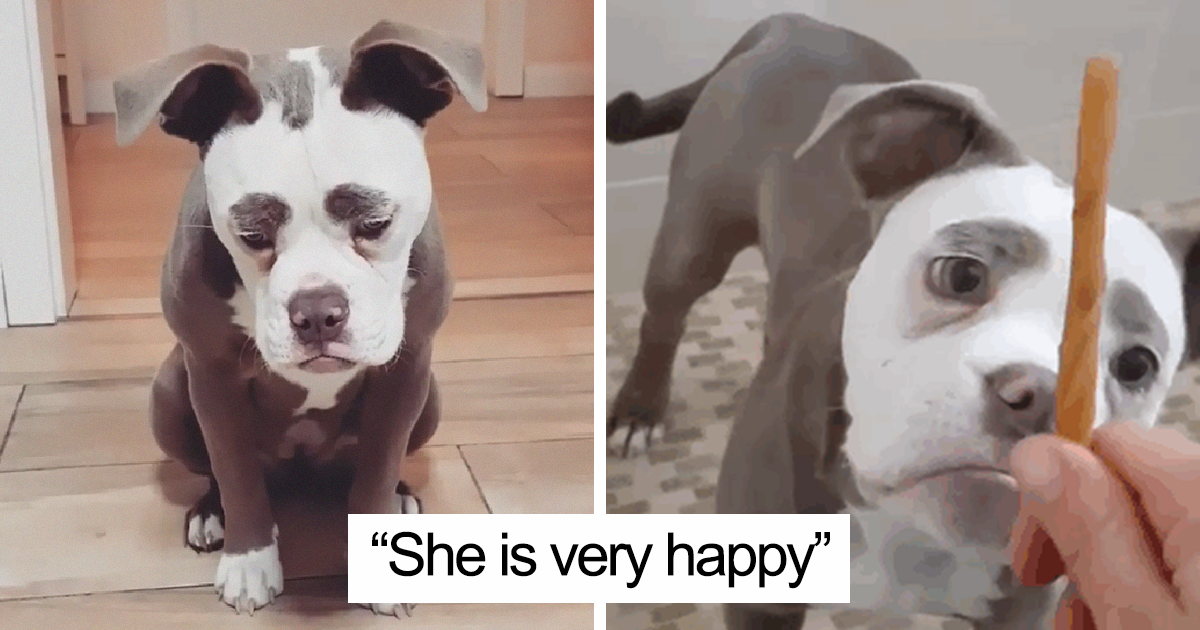
Some dogs go viral because they can skateboard, open refrigerators, or stare into the middle distance like tiny philosophers. Then there is the internet’s favorite emotional support eyebrow: a bulldog so naturally mournful-looking that she seems to carry the spiritual weight of every rainy Monday morning ever recorded. Meet Madame Eyebrows, the dog many people lovingly dubbed the saddest dog on the internet.
Now, before anyone starts playing violin music and filing emotional paperwork, here is the twist that makes this story even better: Madame Eyebrows is not actually living a tragic little dog life. In reality, the face that launched a thousand “Who hurt her?” comments is mostly the result of anatomy, markings, and the deeply unfair way some dogs are born looking like they just got bad news from their accountant.
That contrast is exactly why this story works so well online. It is cute, funny, oddly relatable, and surprisingly revealing. A sad-looking dog can teach us quite a bit about canine facial expressions, internet culture, bulldog features, and the very human habit of projecting our own feelings onto animals with dramatic faces. So yes, this article begins with a droopy-faced internet celebrity, but it ends somewhere more interesting: with a better understanding of how dogs communicate and why we are so quick to fall in love with a face that looks one snack away from tears.
Who Is the “Saddest Dog on the Internet”?
The dog most closely associated with that title is Madame Eyebrows, an English bulldog from Germany who became internet-famous thanks to the markings above her eyes. Those darker patches look uncannily like expressive eyebrows, and paired with her naturally droopy bulldog face, they create the kind of look that says, “I have seen things,” even when she is merely sitting near a flowerpot.
Photos of Madame Eyebrows spread widely because her face felt instantly readable. You did not need a caption. You did not need context. You just took one look and thought, “This dog has the emotional energy of a person who opened an email marked ‘quick question’ at 4:58 p.m.” That level of visual comedy is internet gold.
But according to her owner, the gloomy expression is misleading. Off-camera, she is affectionate, playful, and full of normal dog joy. She wags, gives kisses, and acts like a happy bulldog puppy. The sadness is basically a permanent facial illusion. In other words, Madame Eyebrows is less “tragic heroine” and more “goofy little comedian with built-in stage makeup.”
Why Does She Look So Sad?
Bulldogs Are Built for Big Expressions
A huge part of Madame Eyebrows’ look comes from being an English bulldog. Bulldogs are famous for their stocky build, broad heads, short muzzles, loose skin, facial folds, and naturally serious expressions. The breed has long been described as looking stern or sour even when perfectly content. Put simply, bulldogs often come with a face that appears more dramatic than their actual mood.
That means Madame Eyebrows was already working with a high-drama canvas. Add jowls, wrinkles, a low-set mouth, and a compact face, and you already have a dog that can look concerned while doing absolutely nothing. Then nature sprinkled those eyebrow-like markings above her eyes, and suddenly the result was less “cute bulldog” and more “Victorian orphan in a dog bed.”
The funny part is that bulldogs are often far sweeter and sillier than their expressions suggest. Many owners describe them as affectionate, laid-back, clownish companions who enjoy attention, naps, snacks, and short bursts of play. So the famous sad look is often just that: a look. Behind it is usually a dog who is, at most, mildly annoyed that breakfast is not also lunch.
The Science of “Puppy Dog Eyes”
There is also real science behind why humans react so strongly to a face like Madame Eyebrows’. Research on canine facial expression suggests that dogs are especially good at producing looks humans interpret as emotional. One influential line of research found that domestic dogs have eyebrow-related facial anatomy that makes their eyes appear larger, softer, and more infant-like than wolves. That raised inner-brow movement is one reason “puppy dog eyes” feel so powerful to us.
In plain English, dogs are excellent at making us melt. A slight eyebrow lift can make the eyes look bigger and more vulnerable. Humans are wired to respond to those kinds of features because they resemble infant cues: large eyes, soft expressions, and faces that seem to invite care. That does not mean dogs are tiny furry con artists sitting around plotting emotional manipulation. It means domestication favored faces and expressions humans read easily and respond to quickly.
Madame Eyebrows takes that effect and cranks it up to eleven. Her markings exaggerate the illusion of inner-brow lift even in still photos. She looks permanently soulful, even when she is almost certainly thinking about snacks, sunbeams, or whether someone might drop cheese.
Is a Sad-Looking Dog Actually Sad?
This is where the story gets useful. A dog that looks sad is not always sad, and a dog that looks cheerful is not always comfortable. One of the biggest mistakes humans make with pets is assuming a single facial expression tells the whole story. Dogs communicate with their entire bodies, not just their eyebrows.
If you want to understand how a dog is feeling, look at the full picture. Are the eyes soft or wide and tense? Are the ears relaxed or pinned back? Is the tail loose, waggy, and easy, or tucked tightly under the body? Is the mouth gently open and relaxed, or closed and stiff? Is the dog bouncing around, seeking attention, and acting playful, or pacing, whining, licking, avoiding contact, and seeming shut down?
That matters even more with breeds that have unusual facial structures. Bulldogs, pugs, and other flat-faced breeds can look grumpy or worried because of their natural features. Wrinkles, short noses, and heavy facial folds can muddy the message. In other words, a bulldog face is not always a mood ring.
Happy dogs often show relaxed facial muscles, soft eyes, a loose body, easy breathing, and a general air of “I am content and possibly available for treats.” Stressed dogs tend to show a cluster of signals instead of a single one: pacing, anxious whining, lip licking, stiff posture, avoidance, or unusual clinginess. Context matters, body language matters, and one dramatic photograph definitely does not tell the full emotional story.
Why the Internet Fell Head Over Heels
She Is Relatable in the Funniest Possible Way
Madame Eyebrows did not just go viral because she is cute. Plenty of dogs are cute. She went viral because she is emotionally legible in a way that feels instantly human. Her face looks like Monday. It looks like traffic. It looks like seeing your phone battery at 2% without a charger in sight. She is a meme without trying to be one.
That kind of relatability is rocket fuel online. The internet loves an animal that appears to reflect the human condition. People do not just want adorable pets; they want pets that seem to embody a whole personality in one frame. A dog who looks mildly concerned is charming. A dog who looks as if life itself has become a heavy administrative burden? Legendary.
She Is Not Alone in the Sad-Dog Hall of Fame
Madame Eyebrows is perhaps the cleanest example of the “sad dog” phenomenon, but she is far from the only one. Another bulldog, Big Poppa, also captured hearts with a viral photo showing him sitting on a balcony during lockdown, looking deeply forlorn because he could not go play with the kids he usually saw. The reaction was immediate: people projected loneliness, longing, and emotional depth onto one very expressive dog face.
That is the pattern. When a dog’s expression appears readable, people respond fast. They write captions. They invent backstories. They offer sympathy. They laugh. They share. And in that strange little internet exchange, the dog becomes both pet and pop-culture symbol.
To be fair, there are worse things the internet could obsess over than an expressive bulldog. A sad-looking dog is at least a wholesome national treasure compared with, say, whatever the internet was arguing about five minutes ago.
What Madame Eyebrows Really Teaches Us About Dogs
We Love Faces We Think We Understand
Humans are face-reading machines. We do it with each other constantly, and we do it with animals too. When we see a familiar emotional pattern, even an accidental one, we latch onto it. That helps explain why dogs occupy such a special place in our lives. They are incredibly good at fitting into our social world. They watch our faces. They respond to our tone. We respond to theirs. It is a feedback loop built on attention, empathy, and occasionally ridiculous amounts of baby talk.
Madame Eyebrows is a perfect example of that bond. Her face invites care, curiosity, humor, and affection. Even when people know she is not actually sad, they still feel something when they look at her. That response says as much about us as it does about dogs.
Good Dog Care Starts With Reading the Whole Dog
The fun part of this story is the face. The serious part is the reminder not to mistake appearance for welfare. A dog can look grumpy and be thriving. A dog can look cute and need help. Responsible owners and dog lovers learn to read behavior, routine, appetite, playfulness, energy, sleep, and comfort level, not just photogenic expressions.
That is especially important with bulldogs. Their wrinkles are adorable, but they need care. Facial folds should be kept clean and dry so moisture and debris do not cause irritation. Owners also need to be mindful of heat, breathing, and healthy weight. A bulldog may look like a plush loaf with opinions, but it is still a dog that needs thoughtful daily care.
So yes, enjoy the memes. Laugh at the eyebrows. Fall in love with the dramatic face. Just also remember that a good life for a dog is built on health, comfort, enrichment, and attention to real signals, not just viral photos and emotional captions.
Life With a Dog Who Looks Permanently Heartbroken
There is a very specific comedy that comes with owning a dog whose face always looks tragic. Strangers stop you on walks and ask if your dog is okay. Visitors speak in soft, concerned voices as if approaching a tiny, four-legged poet in mourning. Meanwhile, the dog in question is usually trying to lick someone’s shoelaces, sit on a sandwich, or sprint toward a squirrel with zero emotional complexity.
That gap between expression and reality is part of the charm. A sad-faced dog can be an absolute chaos goblin. She can steal socks, bulldoze through toys, snore like a chainsaw, and demand dinner with the confidence of royalty, all while looking as though life has personally betrayed her. It is basically physical comedy with fur.
And honestly, there is something weirdly comforting about a dog like that. Humans spend a lot of time trying to hide what they feel. Madame Eyebrows does the opposite by accident. She broadcasts a giant, dramatic emotional signal while actually being just fine. She is the canine version of someone saying, “I’m exhausted,” while booking brunch, dancing at a wedding, and somehow organizing everybody’s calendar.
The Saddest Dog on the Internet Is Secretly a Happy Story
That may be the best part of all. “Meet the saddest dog on the internet” sounds like the beginning of a tearjerker. Instead, it turns out to be a cheerful little lesson about perception. Madame Eyebrows looks like she carries the emotional weather of a Dickens novel on her forehead, but by all accounts she is living the good life: love, play, affection, comfort, and the kind of attention most influencers would sell a ring light for.
So if you came here expecting a sob story, the truth is much better. The internet’s saddest-looking dog is not a symbol of misery. She is a reminder that dogs can be expressive, hilarious, and delightfully misleading. She is proof that a face can tell a story, even when it is not the literal one. And she is a strong argument for the idea that the world could use more bulldogs with accidental eyebrow theater.
In the end, Madame Eyebrows is not famous because she is sad. She is famous because she makes people feel something instantly, and because the reality behind the face is even sweeter than the photo itself. That is the kind of internet fame we can all get behind.
Related Experiences: What It Feels Like to Know a Dog Like This
Anyone who has spent real time around an expressive, sad-looking dog knows the experience is half comedy and half public relations. The first thing you learn is that people do not trust the dog’s face. They trust their own interpretation of the dog’s face. So the moment your bulldog, pug, or droopy-eyed mixed breed appears in public, people start narrating a story that does not exist. “Aww, what happened?” they ask. “Why does she look so upset?” someone else says. Your dog, at that exact moment, is usually thriving. She is sniffing grass, planning to sit down in the least convenient place possible, and wondering whether every passing human might be persuaded to offer a snack.
Then there is the camera problem. In everyday life, the dog seems playful, silly, noisy, and full of personality. In photos, however, she transforms into a tiny Victorian widow. You can take fifty pictures in a row during the happiest five minutes of her day, and somehow every single image will suggest she has just received difficult family news. The tail may be wagging in real life. The zoomies may be mid-zoom. But in the still image? Pure existential drama. It becomes impossible not to laugh, because the dog is not posing. She is simply built like an emotional plot twist.
Living with a dog like that also teaches you to become a better observer. You stop relying on the face alone and start noticing the rest. A loose body. A happy little bounce. A soft gaze. The famous wiggle-butt greeting. The eager trot to the food bowl. The dramatic sigh before a nap that sounds sorrowful but really means, “Excellent, this couch is acceptable.” Over time, you get good at translating the difference between a dog who looks sad and a dog who feels stressed. That is a valuable lesson, because it makes you more attentive and more responsible. You learn the dog in front of you, not just the expression in a snapshot.
There is also a daily tenderness in caring for a dog with a memorable face. Bulldogs, especially, turn ordinary routines into rituals. Cleaning wrinkles. Checking skin folds. Wiping drool. Keeping them cool when the weather gets warm. Watching their breathing after play. None of it is glamorous, but all of it is part of loving the dog you have, not just admiring the face the internet loves. And oddly enough, that practical care deepens the humor. It is hard not to laugh when you are carefully maintaining the face of a creature who looks permanently disappointed in modern society.
What stands out most, though, is how these dogs draw people in. A child may laugh at the eyebrows. A stranger may smile from across the sidewalk. A tired adult may soften for a second because the dog’s face says exactly what they have been feeling all day. That is the quiet magic of a dog like Madame Eyebrows. She creates connection before she even moves. People look, interpret, react, and then, if they are lucky, realize the truth: the sad face is not a warning sign. It is an invitation to pay attention, to laugh, and to love a little faster.