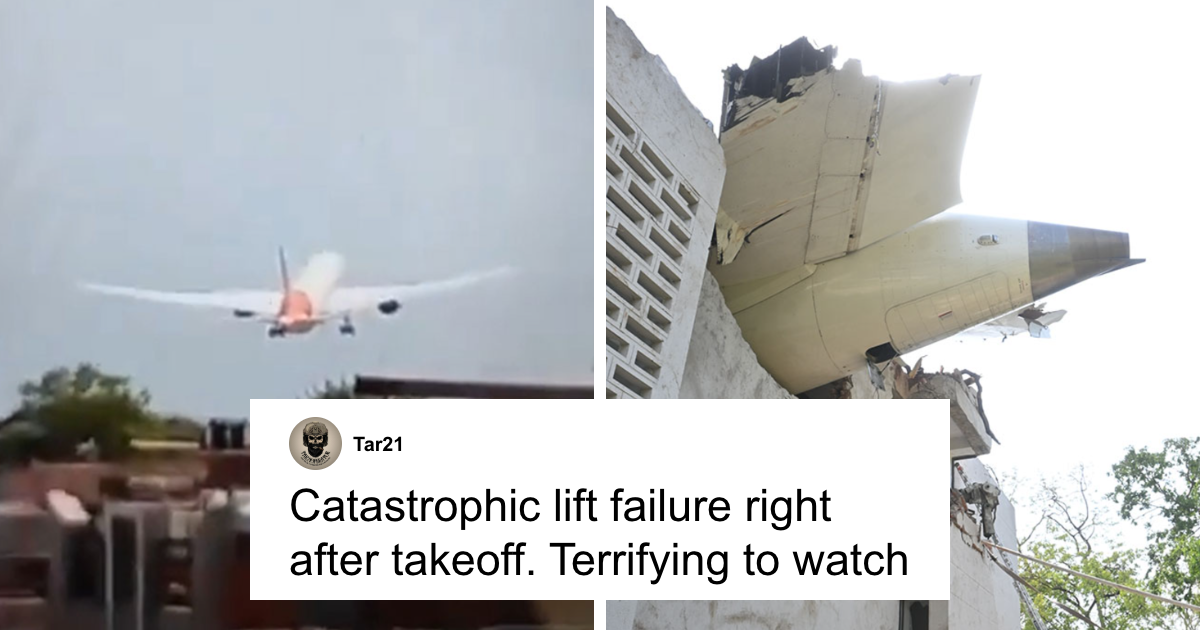
The phrase "evil intent" is the kind of headline fuel that makes the internet sit up, spill its coffee, and start zooming into blurry takeoff videos like everyone suddenly earned a flight-safety certificate overnight. But behind the viral reactions, shocked comments, and frame-by-frame social media debates is a real tragedy: Air India Flight AI171, a Boeing 787-8 Dreamliner bound from Ahmedabad to London Gatwick, crashed shortly after takeoff on June 12, 2025.
The crash killed 260 people, including passengers, crew members, and people on the ground. One passenger survived. Because the aircraft appeared to climb unusually, lose height, and descend with little time for recovery, the disaster quickly became the subject of intense public speculation. Some observers pointed to an unusual takeoff profile. Others questioned the landing gear, engine sound, flaps, emergency systems, and cockpit decisions. Then came the most dramatic theory: was there "evil intent"?
The responsible answer is not as flashy as the headline, but it matters: investigators have not issued a final conclusion proving sabotage, deliberate action, or malicious intent. What the preliminary evidence does show is troubling enough on its own: the aircraft lost thrust after both engine fuel control switches moved from RUN to CUTOFF shortly after liftoff. That fact has reshaped the conversation from vague online theories into a serious aviation-safety mystery.
What Happened to Air India Flight AI171?
Air India Flight AI171 departed Sardar Vallabhbhai Patel International Airport in Ahmedabad, India, with 230 passengers and 12 crew members on board. The Boeing 787-8 Dreamliner was headed to London Gatwick. According to the preliminary investigation, the aircraft began its takeoff roll normally, reached takeoff speeds, lifted off, and then entered the briefest and most terrifying phase of flight: a climb that lasted only seconds before the aircraft began losing altitude.
The aircraft crashed into buildings near B.J. Medical College, less than a nautical mile from the runway area. The wreckage path, fire damage, and impact zone showed how little time the crew had to respond. In modern air travel, crashes during initial climb are especially alarming because the aircraft is heavy, close to the ground, and operating in a phase where seconds matter. At 500 or 600 feet, there is no comfortable margin. There is no dramatic movie-style recovery arc. There is only physics, training, systems, and timeand time was brutally short.
Why the Takeoff Looked So Unusual
The viral reaction began with video. Footage appeared to show the aircraft lifting off, failing to climb normally, and sinking toward the ground. Many viewers noticed that the landing gear appeared to remain down. Others claimed the wing flaps looked wrong. Some believed the aircraft seemed to "hang" in the air, as if it had lost energy almost immediately after becoming airborne.
The landing gear remaining extended was not, by itself, proof of pilot error. During a sudden emergency right after liftoff, pilots follow priorities: maintain control, manage power, identify the emergency, and communicate if possible. Gear retraction is important, but if both engines are losing thrust, the aircraft’s immediate survival depends on energy and control. In other words, the gear being down may have been a symptom of the emergency timeline, not the cause.
The flap theory also became popular online because people love a good screenshot detective session. However, the preliminary report indicated that the aircraft’s takeoff configuration was not the simple social-media story many assumed. Early visual guesses from grainy videos are risky. Aviation accident investigations do not rely on "it looks flat to me" analysis; they rely on recorder data, maintenance records, cockpit voice recordings, wreckage examination, simulator work, and system testing.
Where the "Evil Intent" Theory Came From
The "evil intent" theory gained attention after aviation and security commentators said investigators should not rule out the possibility of deliberate interference or sabotage. The phrase is emotionally explosive, but the underlying point was more technical: if a modern Boeing 787 lost thrust so soon after takeoff, investigators would naturally examine every possible cause, including technical failure, human error, security breach, or intentional action.
That does not mean the theory is proven. In aviation, "not ruled out" is not the same as "confirmed." The gap between those two phrases is wide enough to park a Dreamliner. The official preliminary report did not declare sabotage. It did not blame a specific crew member. It did not say a terrorist act occurred. It did, however, identify a sequence that would understandably make investigators sharpen their pencils: both engine fuel control switches moved to CUTOFF shortly after takeoff, one after the other.
That finding is why the public conversation shifted. Instead of asking only whether birds, weather, maintenance, or Boeing design issues caused the crash, attention turned to the cockpit center console and the fuel control switches.
The Fuel Control Switches: Small Levers, Huge Consequences
On a Boeing 787, fuel control switches regulate whether fuel flows to each engine. In normal operations, these switches are used during engine start and shutdown. They are not switches pilots casually touch during takeoff, in the same way you do not casually pull the fire alarm in a hotel because you wanted to find the ice machine.
The preliminary report said that after liftoff, the aircraft reached a maximum recorded airspeed of about 180 knots. Immediately afterward, the fuel cutoff switches for Engine 1 and Engine 2 transitioned from RUN to CUTOFF within about one second of each other. When fuel is cut off, engines lose thrust. In this case, both engines began losing power almost immediately.
The cockpit voice recording added another haunting detail: one pilot was heard asking the other why he had cut off the fuel; the other responded that he had not. That exchange has become central to the mystery because it suggests confusion in the cockpit rather than a clearly understood procedure. Investigators will need to determine who was speaking, what actions were taken, whether any switch mechanism behaved abnormally, and whether any other system interaction could explain the recorded sequence.
What the Ram Air Turbine Revealed
One detail that helped aviation experts understand the emergency was the deployment of the ram air turbine, often called the RAT. It is a small emergency turbine that drops into the airflow to provide backup power when normal systems are compromised. In simple terms, it is the aircraft’s emergency windmill. It is not there for decoration, and it does not deploy because the plane is having a mild inconvenience.
Airport CCTV showed the RAT deployed during the initial climb. That was consistent with a major loss of engine-generated power. Once both engines lost thrust, the aircraft had very little altitude and very little time. The fuel switches were later moved back to RUN, and the engines began relight attempts, but the crash occurred before full thrust recovery could save the aircraft.
This is one reason the "unusual takeoff" looked so alarming. Viewers were not simply seeing a low climb; they were likely seeing an aircraft that had lost the energy needed to continue climbing, while emergency systems activated in a desperate but time-limited response.
Could It Have Been Birds, Bad Weather, or Mechanical Failure?
Early speculation included bird strikes, engine failure, incorrect flap settings, and maintenance problems. Those theories were understandable in the chaotic hours after the crash. Initial climb accidents often involve engine power, configuration, or environmental hazards. However, the preliminary report noted no significant bird activity near the flight path. Weather conditions were not presented as the leading explanation. Fuel samples tested from refueling sources were found satisfactory.
Maintenance records also matter. The aircraft had active maintenance items, as many airliners do, but the preliminary findings did not identify them as direct causes of the crash. The report also mentioned a previous FAA advisory about fuel control switch locking mechanisms on several Boeing models, including the 787 family. The advisory was not mandatory, but it has become part of the broader discussion because it involved the possibility of fuel switches moving more easily if a locking feature was disengaged.
At the same time, investigators did not recommend immediate actions for Boeing 787-8 or GE GEnx-1B engine operators at the preliminary stage. That does not close the case. It simply means the early evidence did not demand an urgent fleet-wide directive at that moment.
Why Jumping to Blame Is Dangerous
Aviation disasters create an information vacuum. The public sees smoke, wreckage, grieving families, and one shocking video. Social media then tries to fill the empty space with certainty. Unfortunately, certainty is exactly what serious investigators avoid until the evidence is complete.
Calling the crash an act of "evil intent" before the final report risks doing real harm. It can unfairly target pilots who are not alive to defend themselves. It can distract from mechanical or procedural issues that still need examination. It can also fuel conspiracy theories that turn a tragedy into entertainment. Aviation safety depends on uncomfortable honesty, not dramatic shortcuts.
The better framing is this: the fuel-switch movement is unusual, serious, and central to the investigation. Whether it resulted from deliberate action, error, mechanical malfunction, or another factor remains for investigators to establish.
What Investigators Still Need to Answer
Several questions remain open. First, how exactly did both fuel control switches move to CUTOFF so close together? Second, who physically or mechanically initiated the movement, if anyone did? Third, were the switch locking mechanisms functioning properly? Fourth, did cockpit workload, confusion, training, or startle effect contribute? Fifth, could any system fault have produced misleading indications or unexpected switch behavior?
Investigators will also review pilot histories, crew rest, cockpit audio, maintenance logs, component examinations, simulator reconstruction, and manufacturer data. The final report may confirm some current assumptions, reject others, or reveal an unexpected chain of events. In aviation, crashes rarely come from one simple cause. They usually come from a chainand safety improves when every link is understood.
Experience-Based Reflections: What This Crash Teaches Travelers and Readers
Most travelers never think about takeoff beyond the familiar push into the seat, the rattle of overhead bins, and that one person who decides the climb is the perfect time to open a crinkly snack bag. But a crash like this changes how people watch aircraft. Suddenly, a takeoff is not just a routine roar down the runway. It becomes a sequence: rotation, climb rate, gear retraction, engine sound, flap position, and the invisible work happening inside the cockpit.
Anyone who has sat near a runway observation area knows that takeoffs can look different depending on aircraft weight, weather, runway length, temperature, and camera angle. A heavy long-haul aircraft may appear slower and more deliberate than a short domestic jet. A video shot from the ground can flatten perspective and make altitude harder to judge. That is why online viewers should be careful before declaring, "I saw the problem." Sometimes the camera tells part of the truth. Sometimes it lies with confidence.
Still, the public reaction to the AI171 footage is understandable. People noticed something felt wrong because the aircraft did not continue climbing normally. That instinct matters. Many aviation investigations have benefited from videos, witness accounts, and passenger observations. The key is to treat those observations as clues, not verdicts. A witness can say, "The plane seemed low." A recorder can say exactly how fast, how high, and what systems changed.
For frequent flyers, the most useful lesson is not to fear flying, but to respect how carefully aviation learns from failure. Modern air travel is extraordinarily safe because accidents are investigated with almost obsessive detail. A switch position, a maintenance note, a cockpit phrase, a warning light, or a half-second timeline can become the difference between mystery and prevention.
The emotional lesson is harder. Families affected by a crash do not need internet guessing games. They need answers, accountability, and dignity. When a theory like "evil intent" spreads, it may satisfy public curiosity, but it can also deepen pain. The more humane response is patience: let the evidence speak, let investigators finish, and let safety improvements come from facts rather than viral noise.
For writers, journalists, and readers, the best practice is simple: keep the question mark until the final report removes it. Write about the unusual takeoff. Explain the fuel-switch finding. Discuss why deliberate action is being examined. But do not turn suspicion into certainty just because certainty gets more clicks. Aviation deserves better. So do the victims.
Conclusion: A Disturbing Theory, but Not a Final Answer
The Air India Flight AI171 crash remains one of the most disturbing aviation disasters in recent memory, not only because of the terrible loss of life, but because the early evidence raises such difficult questions. The unusual takeoff, the loss of thrust, the RAT deployment, the cockpit confusion, and the fuel control switches moving to CUTOFF all point to a complex event that cannot be solved by a single viral theory.
The phrase "evil intent" may capture attention, but attention is not evidence. Until the final investigation report explains how and why the fuel was cut off, the most accurate conclusion is also the most responsible one: something highly unusual happened in the cockpit or aircraft systems shortly after takeoff, and investigators are still determining the cause.
In the meantime, this tragedy should be discussed with care. The goal is not to win an argument online. The goal is to understand what happened well enough to prevent it from happening again.
SEO Tags
Note: This article is written for web publication and treats all claims about intent as unproven until the official final investigation report is released.