Some paintings do not sit still. They shimmer, split, echo, and quietly refuse to behave like a neat little window into reality. That is exactly why the idea behind I Paint Pictures Out Of Sync feels so compelling. It sounds like a confession, a method, and a manifesto all at once. It is the kind of phrase that suggests an artist is not trying to copy a face as a camera would, but to paint the way a mind actually experiences a person: in fragments, in feelings, in memory, and in time.
At its core, painting “out of sync” is about refusing the lie that identity is fixed. Nobody is just one expression, one angle, one mood, or one uninterrupted moment. We are part memory, part motion, part contradiction. On Monday we feel bold. On Tuesday we feel like a human email draft that was saved but never sent. A painting that layers versions of a figure together can capture that messier truth far better than a perfectly polished likeness ever could.
That is why this phrase resonates beyond one artist or one body of work. It taps into a larger history in modern and contemporary art: the urge to show movement, inner life, psychological tension, and changing selfhood on a flat surface. When a portrait looks doubled, displaced, or stitched together, it can feel more human, not less. Strange? Yes. Effective? Also yes.
What Does “Out Of Sync” Mean in Painting?
To paint out of sync is to create an image that feels slightly misaligned on purpose. A face may appear layered with another face. A shoulder may seem to belong to a different pose. An eye may suggest one emotion while the mouth quietly argues with it. Instead of locking the subject into one decisive instant, the artist lets several moments coexist.
This approach can make a figure seem suspended between memory and presence. The subject looks like a person, but also like a recollection of a person. The image becomes less about “Here is exactly what someone looked like at 2:14 p.m.” and more about “Here is what it feels like to remember, know, miss, fear, or love someone over time.” That difference matters.
In practical terms, the effect often comes from overlapping forms, repeated contours, shifted features, altered angles, and a balance between clarity and blur. Parts of the figure may feel solid while others dissolve. That tension is the whole point. The painting is not broken. It is behaving like consciousness.
Why This Idea Feels So Human
Human perception is not as clean as we like to pretend. We do not move through life as flawless recording devices. We gather impressions. We compare one expression to another. We fill gaps. We revise memories. We project meaning onto faces. We also carry multiple versions of ourselves at once: the public self, the private self, the self we remember, the self we are becoming, and the self we hope nobody saw during that awkward phase we insist never happened.
That is why layered portraiture feels psychologically rich. It mirrors the way identity actually works. A portrait made of superimposed parts can suggest aging, uncertainty, emotional conflict, grief, desire, nostalgia, or transformation without spelling everything out. It invites the viewer to do some of the work, which is exactly where the emotional charge lives.
In this way, an out-of-sync painting becomes less like a passport photo and more like a visual diary. It records not just a face, but the instability of being a person. And honestly, that is a very large subject for one canvas, which may explain why paintings like this often feel dense, mysterious, and a little haunted in the best possible way.
The Art History Behind the Look
Painting out of sync may sound contemporary, but the instincts behind it have deep roots in modern art. Cubism shattered the idea that a single viewpoint was enough. Instead of presenting one stable angle, Cubist painters fractured forms and reassembled them so different viewpoints could exist at once. The result was not mere distortion for distortion’s sake. It was a new way of describing experience on a flat surface.
Futurism pushed that experimentation toward motion. Artists became obsessed with speed, dynamism, and the sensation of modern life. Rather than depicting a frozen instant, they tried to evoke continuous movement. Figures and objects seemed to multiply, repeat, and blur forward. A body was no longer a still object but an event unfolding in time.
Modern portraiture took these lessons and ran with them. A portrait no longer had to be a flattering record of social status. It could become a site of experimentation, doubt, interiority, and self-invention. Instead of asking, “Does this look exactly like the sitter?” artists increasingly asked, “Does this express something true about the sitter’s presence, tension, or consciousness?” Those are very different questions, and the second one is much more interesting.
That broader shift helps explain why contemporary artists continue to build portraits out of fragments, repeated silhouettes, mismatched angles, and layered memories. The fractured portrait is not a gimmick. It is part of a long conversation about how identity is seen, felt, and constructed.
A Contemporary Example of the “Out Of Sync” Approach
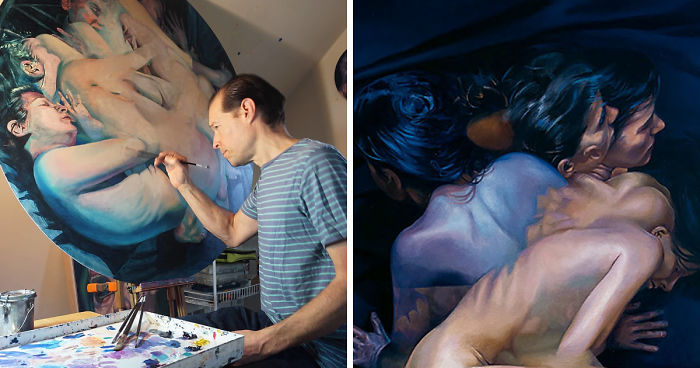
One of the clearest examples of this idea comes from painter Scott Hutchison, whose work describes overlapping figures stitched together within a single composition. His portraits suggest that identity is always in flux and that consciousness itself can feel both fragile and multifaceted. In this kind of work, the figure does not simply pose; it seems to exist in several emotional and temporal states at once.
That matters because it gives the phrase I Paint Pictures Out Of Sync a concrete artistic meaning. It is not just poetic branding. It points to a method: layered bodies, displaced features, and composite identities that feel like ghosts, memories, or inner states made visible. The paintings often look as though they were assembled from several lives pressing into one face.
What makes this approach powerful is that it avoids over-explaining itself. The figures are mysterious without being empty. They feel intimate, but not simplistic. You look at them and sense time passing through the body. You sense memory interrupting the present. You sense that a person can be singular and plural at the same time. Which, frankly, sounds like a headache until you realize that is just ordinary human existence.
How Artists Build the Effect
1. Multiple Reference Points
Artists working this way often do not rely on a single photograph or pose. They combine angles, gestures, and expressions. One painting may borrow the posture from one image, the eyes from another, and the emotional temperature from something half-remembered rather than directly observed.
2. Layered Drawing
Before the painting even becomes fully painted, the drawing stage may already contain the “out of sync” effect. Contours overlap. A head appears twice. A shoulder shifts. Instead of erasing every earlier decision, the artist leaves a visual history on the surface. The painting remembers its own making.
3. Controlled Disruption
Good out-of-sync painting is not random chaos. It is carefully managed instability. The artist decides where the image should snap into focus and where it should drift. Too much disorder and the viewer disconnects. Too much order and the painting loses its tension. The magic lives in the push and pull.
4. Color as Emotion
Color often does heavy psychological lifting in these works. Saturated passages can intensify emotion, while muted or broken color can create distance, melancholy, or memory. Sometimes color itself becomes a second layer of syncopation, with warm and cool notes disagreeing just enough to make the figure vibrate.
5. Edges, Transparency, and Paint Handling
Soft edges can suggest recollection. Hard edges can insist on presence. Thin paint can feel ghostly; thicker passages can anchor the body. Transparent layers let earlier marks survive beneath later ones, which is perfect for an image built on the idea that identity is cumulative rather than fixed.
Why Viewers Connect With It
People respond to out-of-sync portraits because they feel truer than they first appear. Viewers may not use art-historical language for it, but they recognize the emotional logic. Life rarely feels synchronized. Memory interrupts the present. Anxiety jumps ahead. Nostalgia drags us backward. We can be physically in one room while mentally in three different decades. A painting that captures that split state can feel uncannily accurate.
These works also make room for ambiguity, and ambiguity is often where serious art earns its keep. If a portrait tells you exactly what to think in the first five seconds, it may be visually efficient, but it rarely stays with you. An out-of-sync image lingers because it keeps changing as you look. One moment it seems tender; the next it feels uneasy. One angle suggests intimacy; another suggests estrangement. The viewer becomes part of the painting’s rhythm.
There is also something deeply modern about this language. We live among overlapping identities, edited versions of ourselves, and constant image-making. A stable, singular portrait can still be beautiful, but layered portraiture speaks directly to an era in which selfhood often feels constructed, revised, and publicly performed.
Where This Style Matters Most
Painting pictures out of sync is especially effective when the subject involves memory, migration, family history, grief, aging, relationships, and self-portraiture. These are all areas where a single clean image can feel emotionally insufficient. When a painter wants to show that a person is shaped by past and present at once, fragmentation becomes expressive rather than decorative.
It also works beautifully in portraiture that explores inherited identity. Family resemblance, cultural memory, and generational experience can all be suggested through doubled faces and superimposed bodies. The same goes for portraits about emotional conflict: love mixed with resentment, confidence mixed with fear, or exhaustion mixed with hope. Human beings are complicated; the composition should be allowed to know that.
Even when the image becomes abstracted, the body remains central. That is part of the power. The figure is still there, but it is being translated into something more elastic and psychologically charged. The viewer gets a person, but also a process.
Why “I Paint Pictures Out Of Sync” Works as a Title
It is a terrific title because it is simple, memorable, and slightly off-balance. It makes you pause. Out of sync with what, exactly? Time? Emotion? Reality? Memory? A relationship? The self? The phrase opens a door without forcing a single answer.
That open-endedness is a gift for both art and SEO. As a headline, it is intriguing and emotionally specific. As a concept, it touches several search-friendly themes naturally: portrait painting, identity in art, layered painting, abstract portraiture, memory in art, figurative painting, and contemporary painting techniques. Better still, it sounds human. It does not read like a spreadsheet wearing a beret.
For web readers, that combination matters. A strong title pulls attention, but the idea beneath it has to sustain interest. This one does. It promises more than technique. It promises a way of seeing people that is richer, stranger, and closer to real life than a perfectly synchronized image could ever be.
Final Thoughts
I Paint Pictures Out Of Sync is more than a quirky phrase. It is a smart description of a visual language built around memory, movement, contradiction, and the instability of identity. It belongs to a long tradition of artists who understood that one viewpoint is never enough and that the self is always more layered than it appears.
The beauty of this approach is that it does not try to tidy up human experience. It lets the painting hold several truths at once. A figure can be present and distant. A face can be familiar and strange. A portrait can feel like a body and a memory at the same time. That is not confusion. That is recognition.
And maybe that is why paintings like these stay with us. They do not merely show what a person looks like. They show what it feels like to exist a little out of step with certainty, which is, for most of us, not a temporary condition. It is the whole dance.
Extended Reflections: The Experience of Painting Out Of Sync
The experience of painting out of sync is often described less like copying and more like negotiating. An artist may begin with one face and end with three versions of the same person sharing the canvas. One version holds the calm expression the subject wore in the room. Another carries the tension the artist sensed but could not photograph. A third arrives from memory later, while cleaning brushes or walking home, because the mind keeps painting after the hands stop.
That is part of what makes this method so compelling in the studio. It allows room for discovery. Instead of chasing perfect resemblance, the painter follows emotional accuracy. A cheekbone shifts slightly. A jaw opens into a second contour. The forehead turns one way while the eyes insist on another. At first, this can feel wrong. Then, suddenly, it feels more right than realism ever did.
Artists who work this way often describe a strange moment when the painting starts to behave like a remembered conversation. It is no longer just an image of a person sitting still. It contains hesitation, mood changes, half-finished thoughts, and the residue of previous moments. The painting becomes a record of looking over time rather than a snapshot of one instant. That difference can be emotional, even physical. The canvas begins to hum.
There is also vulnerability in the process. Painting a person out of sync means admitting that you do not experience them as fixed. You experience them through attention, memory, intuition, and projection. You miss things. You revise things. You notice one expression and then realize, ten minutes later, that a completely different emotion had been hiding underneath it. The layered image makes room for that delayed understanding.
For viewers, the experience can be surprisingly intimate. They may not know why a portrait feels charged, only that it does. Their eyes travel between repeated outlines and unresolved edges, trying to decide what belongs where. That act of searching becomes part of the meaning. The viewer is not just looking at the painting; the viewer is reenacting perception itself, piecing a person together from incomplete evidence. Which, when you think about it, is basically what we do every day.
That is why these works often linger in memory long after cleaner images disappear. A fully synchronized portrait may impress the eye, but an out-of-sync painting tends to stick in the mind. It feels unfinished in the most productive way, as though the painting is still unfolding inside the viewer. It keeps asking quiet questions about identity, time, and emotional truth. And for an artwork, that is a pretty excellent afterlife.