Note: In this article, “great” means unforgettable, culturally influential, and historically fascinatingnot always morally spotless. A few of these British eccentrics were charming; a few were difficult; one or two were the sort of people you would not want borrowing your horse, your house, or your parliamentary seat.
Why Britain Has Such a Magnificent Reputation for Eccentricity
Britain did not invent eccentricity, but it did give it a waistcoat, a damp country estate, and a strong opinion about tea. From aristocrats who built pyramids in churchyards to poets who dressed like Elizabethan thunderclouds, the British eccentric has long occupied a special place in cultural imagination. These are people who treated convention not as a rulebook, but as a polite suggestion left behind by someone less interesting.
The phrase “British eccentrics” usually brings to mind odd habits, theatrical clothing, stubborn independence, and a talent for turning private quirks into public legend. Yet the best examples are more than funny anecdotes. Their unusual lives often reveal something deeper about art, class, science, politics, personal freedom, and the national fondness for letting unusual characters flourishprovided they do not block the queue.
This list of 10 great British eccentrics blends the comic with the consequential. Some changed science, poetry, politics, or social attitudes. Others simply built follies, rode animals they should not have ridden, or turned personal style into a lifelong manifesto. Together, they prove that eccentricity can be foolish, brave, excessive, creative, and occasionally usefulall before lunch.
1. Lord Rokeby: The Aristocrat Who Preferred Water to Society
The nobleman of baths, beards, and bracing weather
Matthew Robinson, 2nd Baron Rokeby, was an 18th-century English nobleman whose devotion to cold bathing became the stuff of legend. In an age when most people sensibly avoided unnecessary discomfort, Lord Rokeby embraced the sea with the enthusiasm of a seal who had inherited land.
After becoming interested in the health benefits of bathing, he reportedly made daily journeys to the coast near Hythe, Kent, to swim in salt water regardless of the weather. Rain, wind, and general common sense did not appear to trouble him. He had a bathing hut built on the sands and later installed a glass-covered swimming pool at his home, where he could spend long hours in watery solitude.
Rokeby’s eccentricity extended beyond swimming. He allowed his beard to grow dramatically at a time when clean-shaven respectability was fashionable. He disliked fires, avoided doctors, and preferred a private, austere routine to the social glitter expected of a man of rank. His sister, the celebrated writer and salon hostess Elizabeth Montagu, moved in very different circles, which only made Rokeby’s reclusive habits seem stranger.
What makes Lord Rokeby memorable is not simply that he liked bathing. It is that he transformed a health habit into an entire philosophy. To him, nature seemed holier than drawing rooms, and seawater more persuasive than polite society. He was an early example of the British eccentric as lifestyle absolutist: choose one unusual principle, then pursue it until everyone else gives up arguing.
2. “Mad Jack” Fuller: The Squire Who Built His Personality in Stone
Follies, politics, philanthropy, and a pyramid-shaped reputation
John “Mad Jack” Fuller of Brightling, Sussex, was a landowner, Member of Parliament, patron of science, builder of follies, and human warning label for excess. Born in 1757, Fuller inherited wealth and used it to leave a surprisingly durable mark on the landscape. If most people have hobbies, Fuller had monuments.
His architectural projects around Brightling included towers, temples, an observatory, and the famous pyramid in the churchyard where he was buried. Local legend claimed he was interred seated at a table with wine and food, though the truth was less theatrical. Still, when your tomb is a pyramid in rural Sussex, reality hardly needs help.
Fuller’s life was not all comic oddity. He supported the arts, bought paintings, encouraged scientific work, and helped fund projects with public value, including a lifeboat at Eastbourne. He was also connected to the profits of slavery through inherited Jamaican plantations and opposed abolition, a fact that must sit beside the jokes about eccentric architecture.
That contradiction makes Fuller a complicated figure. His eccentricity produced beauty, curiosity, and local folklore, but his wealth came from a deeply unjust system. In any honest account of famous British eccentrics, Fuller belongs on the listbut not as a harmless cartoon. He is a reminder that colorful historical characters often cast long shadows.
3. John “Mad Jack” Mytton: The Regency Daredevil Who Treated Life Like a Bad Bet
Horses, hounds, debts, and decisions no insurance company would approve
If British eccentricity had a hazard category, John “Mad Jack” Mytton would require his own form. Born in Shropshire in 1796, Mytton was a wealthy squire, sportsman, gambler, and short-lived Member of Parliament whose biography reads like a list of things a sensible adult should not do.
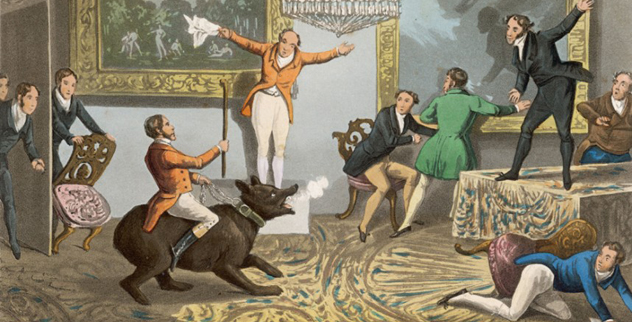
Stories about Mytton include extravagant hunting habits, dangerous carriage rides, reckless drinking, and a wardrobe packed with astonishing quantities of boots, hats, and shirts. He kept numerous animals, including many dogs, and was said to have allowed favored horses into the house. One of the most famous tales claims he rode a bear into his dining room, which ended about as well as one might expect when a man attempts to make formal dining more ursine.
Some Mytton anecdotes may have been polished by repetition, but the broad picture is consistent: he burned through money, health, and opportunity with remarkable speed. He eventually fell into debt and died in King’s Bench Prison in London in 1834, still in his thirties.
Mytton’s appeal lies in the wild absurdity of his choices, but his life is also a tragedy of privilege without restraint. He represents the dark side of the British eccentric tradition: when personality becomes performance, performance becomes compulsion, and compulsion empties the stable, the cellar, and the bank account.
4. William Buckland: The Scientist Who Ate His Way Through Curiosity
Geology, dinosaurs, coprolites, and a dinner menu with no boundaries
William Buckland was not merely eccentric; he was brilliantly, academically, fork-in-hand eccentric. Born in 1784, he became one of Britain’s most important early geologists and paleontologists. He was Oxford’s first Reader in Geology and gave the first full scientific description of Megalosaurus, one of the earliest dinosaurs formally studied.
Buckland helped interpret fossil evidence in bold new ways. His work on Kirkdale Cave argued that ancient bones found there belonged to animals dragged in by prehistoric hyenas, showing how geology could reconstruct vanished worlds. He also helped popularize the study of coprolitesfossilized dungwhich is exactly the kind of topic that separates casual curiosity from professional commitment.
Then there was his diet. Buckland reportedly practiced zoophagy, the attempt to taste animals from across the natural world. Accounts describe guests being offered unusual dishes such as hedgehog, crocodile, mouse, or other creatures best left out of polite menus. The most famous story claims he once tasted what was said to be the preserved heart of King Louis XIV, though that anecdote belongs in the “legendary but widely repeated” drawer.
Buckland’s eccentricity was inseparable from his scientific appetite. He wanted to know the world through bones, rocks, lectures, fieldwork, and occasionally dinner. Strange? Absolutely. But also energetic, original, and foundational to the public excitement surrounding geology in Victorian Britain.
5. Lord Berners: The Composer Who Dyed Pigeons and Entertained Horses
Art, music, wit, and a country house with better jokes than many sitcoms
Gerald Hugh Tyrwhitt-Wilson, 14th Baron Berners, was a composer, writer, painter, and one of the most stylish British eccentrics of the 20th century. Born in 1883, he moved easily among artists, writers, aristocrats, and bohemians. His home, Faringdon House in Oxfordshire, became a magnet for creative people who enjoyed wit served with a side of absurdity.
Berners composed music, wrote novels and memoirs, painted, and inspired fictional portraits by writers such as Nancy Mitford. But he is best remembered by many for his theatrical domestic habits. He famously dyed pigeons in bright colors so they fluttered around the estate like airborne confetti. He also entertained Penelope Betjeman’s horse, Moti, to teaproof that British hospitality knows few species boundaries.
Faringdon was full of joke notices and playful details. Berners had a gift for making daily life feel staged without becoming vulgar. His eccentricity was aesthetic rather than chaotic. He did not merely behave oddly; he designed an atmosphere in which oddness became elegance.
Lord Berners matters because he shows that eccentricity can be a creative medium. His life blurred the line between art and behavior. If a composer dyes pigeons, hosts artists, writes books, and builds a world around wit, is that foolishness or performance art? In Berners’s case, it was probably bothand that is why it worked.
6. Edith Sitwell: The Poet Who Turned Herself Into a Literary Monument
Modernist rhythm, grand costumes, and a personality built for thunder
Dame Edith Sitwell, born in 1887, was one of the most visually unforgettable figures in British literary history. A poet, critic, and member of the famous Sitwell family, she became known not only for her writing but also for her commanding presence: tall gowns, turbans, rings, dramatic profiles, and clothing that seemed to arrive several minutes before she did.
It would be easy to reduce Sitwell to costume, but that would miss the point. Her eccentric image supported a serious artistic project. She experimented with rhythm, sound, and performance, especially in works associated with Façade, her collaboration with composer William Walton. Her poetry could be sharp, musical, strange, and emotionally intense.
During World War II, Sitwell’s writing gained new moral force. Poems such as “Still Falls the Rain” reflected the suffering and spiritual anxiety of wartime Britain. Behind the theatrical exterior stood a writer of genuine discipline and seriousness.
Sitwell’s eccentricity was partly armor. Raised in an emotionally difficult family, she fashioned herself into something grand, unmistakable, and difficult to dismiss. Her style said, in effect: if the world insists on staring, give it something worth staring at. Among great British eccentrics, she remains one of the most dignified and artistically important.
7. Stephen Tennant: The Bright Young Thing Who Made Languor a Career
Beauty, decadence, unfinished work, and the art of doing very little spectacularly
Stephen Tennant was born in 1906 into aristocratic privilege and became one of the most dazzling figures among the Bright Young Things of 1920s Britain. He studied art, moved in fashionable literary circles, and cultivated a persona of extreme delicacy, beauty, and theatrical self-invention.
Tennant was famous for his androgynous glamour, elaborate clothes, and languid manner. He inspired writers and artists, including Cecil Beaton, and became associated with a world of parties, wit, and aristocratic rebellion. If Lord Berners made eccentricity domestic, Tennant made it atmospheric. He seemed less like a guest at a party than a rare orchid that had agreed to attend.
His later life was marked by withdrawal. Tennant spent long periods in bed at his Wiltshire home, surrounded by luxury and plans for artistic work that often remained unfinished. His long-promised novel, Lascar, became legendary partly because it never fully arrived. In a productivity-obsessed world, Tennant’s life looks almost scandalous: a masterpiece of delay.
Yet his significance lies in how boldly he challenged conventional masculinity and social presentation. Long before modern conversations about self-fashioning became mainstream, Tennant treated identity as something imaginative, visual, and performative. His eccentricity may have produced fewer finished works than admirers hoped, but his influence as a style icon remains vivid.
8. Quentin Crisp: The Outsider Who Made Defiance Elegant
Wit, flamboyance, courage, and the high cost of being visible
Quentin Crisp, born Denis Charles Pratt in 1908, became one of Britain’s most famous modern eccentrics through a combination of style, wit, and stubborn self-possession. His memoir The Naked Civil Servant described his life as an openly flamboyant gay man in a society that often punished difference with cruelty.
Crisp dyed his hair, wore makeup, crafted aphorisms, and spoke with a polished theatricality that made him a beloved raconteur. But his public persona should not obscure the courage required to live visibly when visibility could invite violence, arrest, ridicule, or social exclusion. His eccentricity was not a hobby; it was a survival strategy sharpened into art.
He later became a performer and speaker, especially after the television adaptation of The Naked Civil Servant brought him wider fame. In the United States, where he spent much of his later life, he became a cult figurepart philosopher, part comedian, part beautifully dressed provocation.
Crisp belongs on any list of famous British eccentrics because he turned personal difference into public language. His one-liners were funny, but beneath them was a serious challenge: why should anyone apologize for being unmistakably themselves? In that sense, Crisp’s eccentricity was not merely decorative. It was political.
9. Screaming Lord Sutch: The Rocker Who Turned Elections Into Theatre
Monster Raving politics and the serious value of not being serious
David Edward Sutch, better known as Screaming Lord Sutch, was a rock musician, showman, and founder of the Official Monster Raving Loony Party. Born in 1940, he began as a performer in the world of British rock and shock theatrics before becoming one of the country’s most recognizable satirical political candidates.
Sutch stood in numerous elections, usually wearing flamboyant clothes and a top hat, and used campaigns to mock the seriousness of political rituals. His party’s policies were intentionally absurd, but the joke had a point. By exaggerating the theatre of politics, Sutch exposed how much theatre was already there.
His early campaigns also touched on real issues, including youth participation in democracy. Some ideas associated with “loony” politics, such as lowering the voting age or pet passports, later became part of mainstream discussion or policy in different forms. That does not mean Sutch secretly governed Britain from beneath a novelty hat, but it does show that satire can sometimes identify future common sense before serious people are ready to admit it.
Screaming Lord Sutch made British elections funnier, weirder, and perhaps a little more honest. His eccentricity was democratic: anyone could laugh, protest, or vote for the candidate who seemed least likely to speak in polished nonsense.
10. Ivor Cutler: The Quietly Surreal Poet of Sticky Labels and Harmoniums
Small absurdities, soft songs, and a lifetime of being “never knowingly understood”
Ivor Cutler, born in Glasgow in 1923, was a poet, musician, humorist, teacher, and one of the gentlest oddballs in British cultural history. He wrote songs, stories, poems, and miniature comic observations that seemed to arrive from a parallel universe where logic had taken a short nap.
Cutler became known through BBC radio, especially his sessions for John Peel, and appeared in the Beatles’ film Magical Mystery Tour. He often performed with a harmonium and delivered surreal pieces in a dry, calm voice that made absurdity feel perfectly reasonable.
His personal style became part of the myth: distinctive clothes, hats, badges, bicycle travel, and printed stickers bearing phrases such as “Never knowingly understood.” Cutler’s humor was not loud or aggressive. It was small, patient, and strange, like a philosophical biscuit.
Among British eccentrics, Cutler represents the power of gentle nonconformity. He did not need pyramids, dyed pigeons, or political parties. He made ordinary language wobble. His work reminds us that eccentricity can be quiet, kind, and deeply originala way of noticing the world from an angle no one else thought to stand in.
What These Great British Eccentrics Have in Common
At first glance, these 10 figures seem wildly different. One loved cold water. One built follies. One ate unusual animals in the name of curiosity. One dyed pigeons. One turned poetry into costume and thunder. One made politics deliberately ridiculous. Yet patterns emerge.
First, British eccentricity often involves performance. Whether the stage is Parliament, a country house, a lecture hall, a television studio, or a private garden full of colorful birds, the eccentric does not merely have unusual habits. They make those habits visible. They invite reaction.
Second, many eccentrics use style as a form of independence. Edith Sitwell, Stephen Tennant, Quentin Crisp, and Screaming Lord Sutch all understood that clothes can argue before the wearer says a word. Their appearance challenged assumptions about class, gender, seriousness, and respectability.
Third, eccentricity can be productive. Buckland advanced geology. Sitwell expanded poetic performance. Crisp helped widen public conversation about identity. Sutch made political satire part of electoral culture. Cutler influenced generations of comedians, musicians, and writers who found freedom in small absurdities.
Finally, eccentricity needs context. The same society that laughs at unusual people can also punish them. Quentin Crisp’s flamboyance came at real personal cost. Stephen Tennant’s self-invention existed within privilege but also within restrictive expectations. Even comic stories about older figures often reveal class inequality, colonial wealth, or personal damage. The best way to appreciate British eccentrics is to enjoy the color without ignoring the canvas.
Experiences and Reflections: What “10 Great British Eccentrics” Can Teach Modern Readers
Reading about 10 Great British Eccentrics is entertaining, but the real experience is more personal than it first appears. These characters make us ask how much room we allow for oddness in everyday life. Most people are not planning to build a pyramid tomb, invite a horse to tea, or cycle through town wearing a hat full of badges. Still, almost everyone has some private strangeness: a ritual, a collection, a favorite phrase, a way of dressing, a hobby that makes relatives pause before changing the subject.
The British eccentric tradition suggests that a little oddness can be healthy. It gives personality texture. It turns daily routine into story. Lord Rokeby’s sea bathing may sound extreme, but many modern readers can understand the appeal of a habit that clears the mind and separates one from noise. Ivor Cutler’s surreal phrases feel refreshing because they resist the modern pressure to optimize every sentence. Lord Berners’s dyed pigeons may be absurd, but they also remind us that beauty sometimes begins as a joke.
There is also a useful warning here. Eccentricity becomes less admirable when it harms others, wastes responsibility, or hides injustice behind charm. John Mytton’s recklessness makes spectacular reading, but it led to ruin. “Mad Jack” Fuller’s follies are fascinating, yet his links to slavery make any celebration incomplete without criticism. The lesson is not “be strange at any cost.” It is better phrased as: be original without becoming careless, cruel, or blind to consequences.
For writers, artists, entrepreneurs, and anyone building a public voice, these famous British eccentrics offer another practical lesson: memorability matters. People remember a vivid image. Edith Sitwell understood this. Quentin Crisp understood it brilliantly. Screaming Lord Sutch turned a top hat and a ridiculous party name into decades of attention. In a crowded world, distinction is powerfulbut it works best when style is connected to substance.
The most inspiring eccentrics are not simply odd. They are committed. Buckland’s strange appetite reflected a larger hunger for knowledge. Sitwell’s theatrical clothing supported a serious poetic identity. Crisp’s polished wit carried a lifelong argument for self-acceptance. Cutler’s tiny absurdities created a whole artistic universe. Their lives show that the best eccentricity is not random decoration. It is a consistent expression of how a person sees the world.
Modern readers do not need to imitate these figures literally. Please do not ride a bear to dinner; dinner is stressful enough. But we can borrow their courage to be specific. Wear the unusual jacket. Write the strange poem. Build the garden ornament that makes neighbors blink. Ask the question nobody else wants to ask. Keep the harmless ritual that makes your life feel like yours.
In that sense, British eccentricity is not just a historical curiosity. It is an invitation to resist becoming overly polished, overly predictable, and overly afraid of being noticed. A little eccentricity can make a person more creative, more resilient, and far more interesting at partiesespecially if the horse has not been invited.
Conclusion: The Enduring Charm of British Eccentricity
The story of 10 great British eccentrics is really a story about freedom: freedom to dress differently, think strangely, live theatrically, and question rules that others accept without inspection. Some of these figures were comic, some courageous, some troubling, and some genuinely brilliant. All were memorable.
British eccentricity endures because it offers a delicious contradiction. It is both rebellious and oddly traditional. Britain loves order, queues, titles, and ceremoniesbut it also makes room, now and then, for the person who arrives wearing velvet, carrying a harmonium, or proposing a political party with a name that sounds like it escaped from a pub quiz.
The best eccentrics remind us that originality is rarely tidy. It may look like poetry, science, satire, self-expression, or a pigeon in an unexpected shade of pink. And while not every eccentric deserves admiration, each one reveals something about the culture that produced them. Britain’s great eccentrics are funny because they are unusual. They matter because they made unusualness impossible to ignore.