There is a special kind of optimism required to become an artist. You sit down with a blank page convinced that, within a few hours, you will produce something worthy of a museum wall. Thirty minutes later, you have erased the same eyebrow 14 times, your coffee is cold, and you are seriously considering a respectable career involving spreadsheets.
That wonderfully chaotic reality is what makes 87 hilarious comics about the life of an artist so relatable. Whether someone works with pencils, paint, digital illustration, comics, animation, sculpture, or a suspiciously expensive collection of markers, many creative struggles are remarkably universal. Inspiration disappears precisely when a deadline arrives. Hands become anatomically impossible objects. A drawing looks fantastic at midnight and mysteriously terrible the following morning.
Yet artists keep creating. That contradictionthe frustration, obsession, insecurity, joy, and ridiculous determination behind creative workis exactly what artist comics capture so well. They turn tiny studio disasters into punch lines and prove that sometimes the best response to creative suffering is to draw a cartoon about it.
Why Comics About Artist Life Feel So Painfully Accurate
The funniest artist comics work because their jokes are exaggerated versions of genuine creative experiences. The tools change, but the emotional roller coaster remains remarkably familiar.
A traditional painter may spend an afternoon mixing the perfect color. A digital illustrator may create 38 layers because deleting anything feels emotionally dangerous. A comic artist may finish six panels before realizing the character’s shirt changed halfway through the page. Different problems, same nervous laughter.
Creative work also has an unusual relationship with visible results. Viewers normally see the final illustration, painting, or comic. They do not see the abandoned sketches, deleted files, failed compositions, erased lines, reference photos, color experiments, or that dramatic twenty-minute period when the artist decided they had completely forgotten how to draw.
That invisible process is comedy gold.
Creative Block: When the Brain Suddenly Closes for Business
Few subjects appear more naturally in funny comics about artists than creative block.
The artist finally gets a free evening. The desk is organized. The tablet is charged. The sketchbook is open. There are no appointments, no emails, and no interruptions.
The brain responds with absolutely nothing.
Then inspiration arrives at 2:17 a.m. while the artist is trying to sleep.
The Great Inspiration Paradox
Ideas have terrible scheduling skills. They frequently appear while showering, commuting, eating dinner, or standing somewhere without drawing supplies. The moment an artist intentionally sits down and says, “Now I will be creative,” the imagination sometimes behaves like a cat being asked to perform a trick.
Creative block is not merely a joke invented by cartoonists. Artists throughout history have experienced periods when their usual methods stopped working. Changing materials, environments, routines, or subjects can sometimes restart the creative process. Even something as mundane as cleaning a workspace or experimenting with an unfamiliar medium can break established habits.
The comics simply provide the more entertaining explanation: a tiny inspiration goblin has stolen every good idea and refuses to return them until bedtime.
The Eternal Battle Between Artists and Their Own Standards
An ordinary viewer might look at a drawing and say, “That’s amazing.”
The artist looks at exactly the same drawing and sees one crooked finger, an eyebrow positioned approximately two millimeters too high, and a shadow that has personally insulted their ancestors.
This disconnect appears constantly in relatable artist comics. Creative people can become extraordinarily sensitive to flaws in their own work because they know what they intended to create. The audience sees the finished picture. The artist simultaneously sees the picture and the imaginary, perfect version that existed in their head.
When “Almost Finished” Lasts Three Hours
There is always one more adjustment.
Move the eye slightly.
Undo.
Move it back.
Undo the undo.
Zoom to 800 percent.
Question every life decision made since kindergarten.
Digital tools have made revision incredibly convenient, but convenience can become its own trap. Unlimited undo commands, layers, selections, masks, and transformations mean an artist can continue adjusting a piece long after any normal human being would consider it finished.
Traditional artists have their own version of the same problem: erase, redraw, repaint, scrape, glaze, stare, walk away, return, stare again.
Eventually, “finished” often means, “I am no longer emotionally capable of changing this.”
Drawing Hands: The Final Boss of Art
No exploration of the life of an artist would be complete without discussing hands.
Hands are useful in everyday life. In drawings, however, they transform into complicated collections of joints, angles, overlapping forms, foreshortening, and betrayal.
A character can have expressive eyes, beautiful hair, dramatic clothing, and cinematic lighting. Then the artist reaches the hands and suddenly everyone in the composition has their fingers conveniently hidden inside pockets.
The Strategic Art of Avoidance
Artists develop wonderfully suspicious techniques for avoiding difficult anatomy.
- Hands behind the back.
- Hands inside sleeves.
- Hands holding conveniently large objects.
- Characters cropped at the waist.
- Portraits where everyone has apparently agreed never to raise an arm.
Feet receive similar treatment.
The joke becomes even better because experienced artists know the solution: study anatomy and practice repeatedly. Unfortunately, “practice difficult things hundreds of times” is far less appealing than strategically placing a coffee mug over the troublesome area.
“Can You Draw Me?” and Other Sentences Artists Hear Constantly
Once people discover someone can draw, requests begin appearing almost magically.
“Can you draw me?”
“Can you make a quick logo?”
“Could you design my tattoo?”
“It should only take five minutes.”
The phrase only take five minutes deserves its own horror soundtrack.
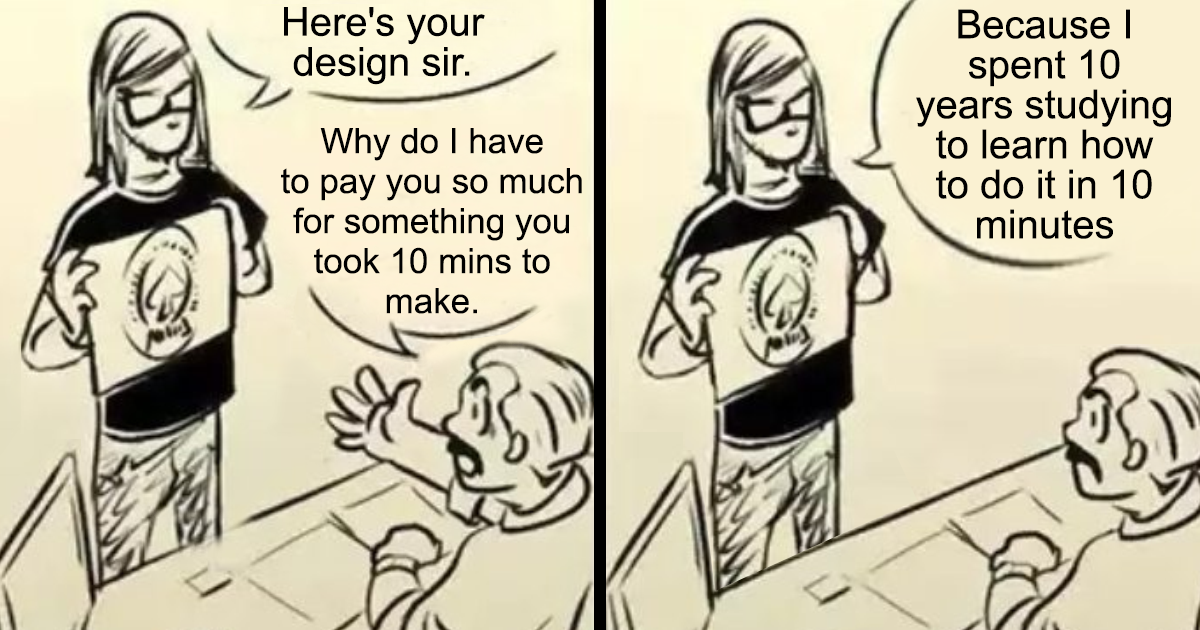
One reason artist-life comics resonate is that they expose the strange way creative skill is sometimes treated. People understand that plumbing, accounting, programming, and construction are professional services, yet artwork can still be approached as if the artist simply waves a pencil and produces finished images through sorcery.
Professional artists, especially freelancers, do much more than create pictures. They may communicate with clients, prepare estimates, research subjects, revise designs, manage portfolios, market their services, send invoices, maintain equipment, organize files, and handle the business responsibilities of self-employment.
So yes, perhaps the actual sketch takes an hour. The years required to learn how to make it look effortless took considerably longer.
The Expensive Hobby That Became an Even More Expensive Career
Art supplies possess an interesting scientific property: artists always need one more.
A drawer can already contain 46 pencils, but clearly pencil number 47 will finally unlock greatness.
Digital artists are not safe either. There are drawing tablets, styluses, replacement nibs, monitors, software subscriptions, storage drives, brushes, fonts, plug-ins, keyboards, ergonomic accessories, and the irresistible possibility that a better computer will somehow fix poor anatomy.
The Supply Store Effect
Walking into an art store is dangerous because every object appears to contain potential creativity.
A new sketchbook represents hundreds of future masterpieces. Premium markers whisper promises of perfect gradients. Beautiful brushes suggest that perhaps the only thing separating the artist from greatness is a slightly more expensive collection of synthetic fibers.
Then comes the greatest tragedy of all: owning a gorgeous new sketchbook and being too afraid to draw on the first page.
It must remain perfect.
Forever.
The Sketchbook Reality Nobody Posts Online
Social media can make artistic development look suspiciously tidy.
You see polished illustrations, carefully photographed sketchbook spreads, beautiful studio desks, and dramatic time-lapse videos. What you rarely see is page 17, where the artist attempted to draw a horse from memory and accidentally invented a previously unknown species.
Real sketchbooks are laboratories.
They contain unfinished ideas, anatomy studies, notes, thumbnails, weird faces, color tests, mistakes, grocery lists, phone numbers, and drawings that should probably remain confidential for national security reasons.
This is exactly why messy sketchbook jokes work. Practice is supposed to contain mistakes. Artists develop through repetition, experimentation, correction, and observationnot by creating portfolio pieces every time a pencil touches paper.
Comparing Your Art With Everyone Else’s Art
Few activities can destroy creative confidence faster than casually browsing another artist’s portfolio at midnight.
You begin innocently.
“I’ll just look for inspiration.”
Ten minutes later:
“This person is 19 years old and already paints like a Renaissance master. I should probably sell my tablet and begin farming potatoes.”
Comparison has always existed in creative communities, but online platforms make extraordinary artwork available continuously. That access can be enormously educational. Artists can discover techniques, movements, creators, references, tutorials, and communities that would once have been difficult to encounter.
It can also create the illusion that everyone else is producing masterpieces every morning before breakfast.
Artist comics puncture that illusion. Behind polished portfolios are discarded drafts, revisions, uncertainty, and years of practice.
Finding an Art Style Without Losing Your Mind
Young artists often worry intensely about “finding a style.”
They search for a visual identity as though somewhere inside the house is a box labeled YOUR OFFICIAL ART STYLE.
In practice, artistic style tends to develop gradually. Repeated preferences accumulate. Certain shapes feel natural. Particular colors keep returning. Artists become interested in specific subjects, line qualities, compositions, techniques, exaggerations, and ways of simplifying reality.
The funny part is that an artist may desperately chase originality for years, then eventually realize other people recognized their style long before they did.
Style Is Usually a Side Effect of Making Lots of Art
Experimentation matters because artists rarely develop in isolation. Museums, comics, animation, illustration, photography, design, movies, nature, architecture, fashion, games, and other artists all feed the visual imagination.
Influence is normal. The challenge is processing those influences through personal observation and repeated practice rather than mechanically reproducing somebody else’s work.
In short, the easiest way to find a style may be to stop staring at the style-searching microscope and make more things.
Digital Artists and the Curse of 47 Layers
Traditional painters can physically see how complicated their workspace has become.
Digital artists hide the chaos inside a file.
Layer 1.
Layer 2.
Layer 2 copy.
Layer 2 copy final.
Layer 2 copy final REAL.
Layer 37, mysteriously labeled “asdfgh.”
Deleting any of them is impossible because perhaps that invisible layer contains something important.
Digital art comics frequently celebrate keyboard shortcuts as if they were supernatural abilities. Undo becomes so automatic that artists sometimes experience the ridiculous urge to use it in real life after dropping something or making a mistake on paper.
Unfortunately, reality has yet to implement Ctrl+Z.
When the Finished Artwork Looks Different the Next Morning
At 1 a.m., the illustration is magnificent.
The composition works. The colors glow. The proportions are elegant. The artist goes to sleep imagining awards and gallery exhibitions.
At 9 a.m., something has happened.
The head is enormous.
One arm belongs to another dimension.
Why is everything purple?
Fresh eyes are surprisingly powerful. After looking at the same image for hours, artists become accustomed to its proportions and relationships. Taking a break can make problems easier to notice. Flipping a canvas horizontally is another popular trick because it changes the familiar visual pattern and can expose imbalances.
Artist comics turn this useful technique into emotional devastation, which is considerably funnier.
Being an Artist Is Also Being a Small Business
The romantic stereotype imagines artists spending every day in peaceful studios waiting for inspiration.
Professional reality often includes invoices.
A large share of working artists operate independently, and many supplement creative income with additional work. Income can vary substantially according to field, reputation, clients, location, demand, and whether art is pursued full time or alongside another occupation.
Freelance artists may therefore occupy several roles simultaneously: creator, marketer, salesperson, customer-service department, project manager, bookkeeper, and the person who remembers where the receipt for those brushes went.
Taxes also exist, despite repeated requests from the artistic community that they be removed from the creative process.
Copyright is another practical concern. In the United States, visual artwork generally begins with the creator as the copyright owner unless circumstances such as qualifying work-made-for-hire arrangements apply. For working illustrators and designers, understanding contracts, licenses, usage rights, and ownership can be nearly as important as understanding brushes and color.
Why Artists Keep Creating Anyway
Considering the deadlines, revisions, difficult clients, creative blocks, expensive supplies, comparison traps, and mysterious inability to draw two matching eyes, why does anyone continue?
Because creating something that did not exist yesterday is enormously satisfying.
There is a moment when a rough idea starts working. Shapes suddenly make sense. A character develops personality. A painting begins to carry atmosphere. A visual joke lands perfectly. Something previously trapped inside one person’s imagination becomes visible to somebody else.
That experience can make ten failed sketches feel worthwhile.
The best comics about artists understand both sides. They tease creative frustration without treating art itself as pointless. The joke works precisely because artists care so much.
What These 87 Hilarious Artist Comics Ultimately Get Right
The details vary from comic to comic, but together they describe a recognizable creative ecosystem: inspiration appearing at inconvenient times, references multiplying across the desktop, drawings refusing to cooperate, artistic confidence rising and collapsing within hours, friends requesting portraits, unfinished files accumulating, and supposedly simple projects becoming complicated adventures.
The humor also makes artistic struggle feel communal. A beginner who believes they are uniquely terrible at drawing hands discovers thousands of experienced artists joking about exactly the same thing. Someone fighting creative block realizes the problem is not unusual. A freelancer tired of revision requests discovers an entire creative population nodding sympathetically.
Sometimes laughing at the process is healthier than expecting the process to become perfect.
500 More Words From the Artist-Life Experience: What the Comics Feel Like in Real Life
Imagine beginning a normal drawing session. Nothing ambitious. You tell yourself you are going to make a quick sketch for fun.
This is your first mistake.
You draw a circle for the head. Excellent. Add the jaw. Still excellent. One eye appears and somehow looks better than anything you have drawn in six months. Confidence surges. Perhaps all those years of practice have finally paid off.
Then you draw the second eye.
The second eye has apparently never met the first one.
You erase it. Draw again. Erase. Draw. Move it. Resize it. Flip the canvas. Now the first eye looks wrong. Forty minutes later, the character has no eyes at all and you are researching whether successful portrait artists technically require them.
This is the experience behind so many artist-life comics: small technical problems become absurdly emotional adventures.
Another familiar situation begins with reference research. You need one photograph of a jacket. You open a browser, find something useful, and notice another interesting image. Twenty minutes later you have 16 tabs containing jackets, lighting references, historical costumes, architecture, unusual clouds, color palettes, and a video explaining medieval sword construction even though nobody in the illustration owns a sword.
Eventually you realize you have done everything except draw.
Then there is the accidental masterpiece problem. During serious work, every line requires effort. Yet while talking on the phone, you casually doodle a tiny character in the corner of a receipt, and it somehow possesses more personality than the illustration you have been developing for three days.
Naturally, attempting to recreate that doodle destroys its magic.
Artists also develop odd physical habits. A stylus remains permanently attached to the hand. Pencils appear behind ears. Paintbrushes migrate dangerously close to coffee cups. Digital artists tap two fingers on paper expecting an undo command. Traditional artists occasionally reach for a nonexistent keyboard shortcut after making an unwanted mark.
Time behaves differently in a studio as well. Five minutes of procrastination can become an hour. Conversely, an artist can begin painting after dinner, look at the clock “a little later,” and discover civilization has advanced to 3 a.m.
Yet perhaps the most recognizable experience comes after finishing something difficult.
For a few minutes, there is genuine satisfaction. The drawing exists. You solved the problems. You survived the anatomy, perspective, colors, revisions, and internal criticism.
Then you notice one tiny mistake.
Every artist knows what happens next.
But something else happens too. A week, a month, or a year later, you create another piece and realize it is better. Maybe the improvement is subtle. Perhaps your lines are more confident, your colors communicate more clearly, or those previously terrifying hands finally resemble human anatomy.
That gradual improvement is why the ridiculous cycle continues.
Artist comics are funny because they exaggerate the failures, but underneath the jokes sits a surprisingly encouraging message: struggling with art is part of making art. The embarrassing sketches, abandoned paintings, ugly drafts, endless revisions, and occasional artistic catastrophes are not interruptions in the creative process.
They are the creative process.
Conclusion
87 Hilarious Comics That Perfectly Describe The Life Of An Artist works as more than a collection of creative inside jokes. The situations represent a shared language among people who make things: fearing blank pages, wrestling with anatomy, buying unnecessary supplies, comparing themselves with other artists, fighting deadlines, revising obsessively, and somehow returning to the desk the next day.
The funniest part of being an artist may be that the problems rarely disappear completely. Skills improve, careers evolve, software changes, and techniques become more sophisticated, but somewhere an experienced illustrator is still staring suspiciously at a badly drawn hand.
And somewhere else, another artist is turning that exact moment into a comic.
Note: This article is original editorial content developed from research into creative practice, professional artist careers, visual-art copyright, studio processes, digital creativity, and commonly documented experiences among working artists. It is written as an independent synthesis rather than a reproduction of any individual comic collection or source.