If the stock market had a personality in 2018, it was the friend who texts “we need to talk” and then goes silent for six hours.
In 2019, it was the same friend showing up with coffee, an apology, and a suspicious amount of optimism.
These two back-to-back years are a perfect reminder that the market doesn’t have one moodit has a whole playlist.
And it’s not shy about hitting shuffle. One year ends with investors bracing for impact; the next ends with confetti,
record highs, and headlines trying to explain why the same world produced wildly different results.
The Two-Year Plot Twist: A Quick Scoreboard
Before we overthink it (we will, because we’re investors), let’s get the basic contrast on the table.
Returns vary slightly by source and whether you’re looking at price-only or total return (with dividends),
but the story stays the same: 2018 was a stumble, 2019 was a sprint.
| Metric | 2018 | 2019 | Why it matters |
|---|---|---|---|
| S&P 500 (total return) | About -4% | About +31% | Same index, two totally different emotional climates. |
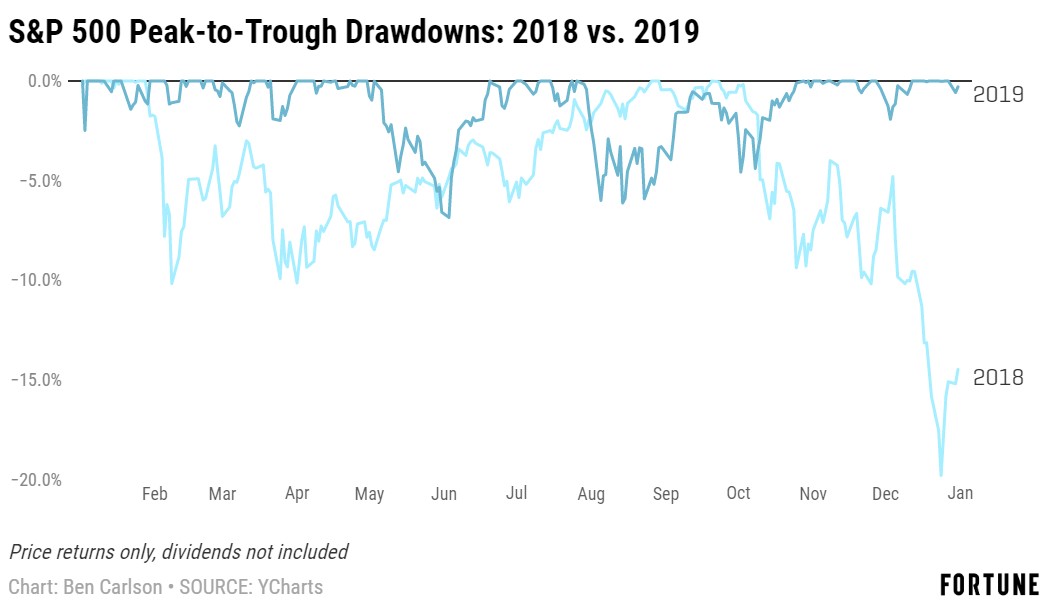
| Max peak-to-trough drawdown (S&P 500) | ~19.8% | ~6.8% | 2018 felt like a near bear market; 2019 felt… oddly calm by comparison. |
| New S&P 500 all-time highs | 18 | 35 | All-time highs happen more often than our nerves want to admit. |
| Dow Jones Industrial Average (annual return) | About -5% to -6% | About +22% | Blue chips didn’t “protect” you in 2018; they partied in 2019. |
| Nasdaq Composite (annual return) | About -4% | About +35% | Tech didn’t just reboundtech carried the parade. |
| Federal Reserve policy vibe | Raising rates | Cutting rates | Markets care about earnings, but they also care about the discount rate. |
2018: The Year the Market Rediscovered Gravity
The numbers were “fine” until they weren’t
The sneaky thing about 2018 is that it wasn’t a straight-line disaster. It was a year of abrupt mood swings:
rallies that felt reassuring, pullbacks that felt temporary, and then a fourth quarter that made everyone suddenly
remember their brokerage password.
By year-end, the S&P 500 finished down for the year on a total-return basis (dividends included), while the Dow and Nasdaq also posted losses.
This was jarring mostly because the prior stretch had trained investors to expect “up and to the right” as the default setting.
Volatility showed up early, like an uninvited guest who never leaves
After a strong start to the year, stocks hit a sharp bout of turbulence in early February.
One of the big sparks was a jump in bond yields and inflation fearstranslation: investors started pricing in more interest-rate pressure,
and the market reacted like you told it the free snacks were canceled.
During that early-2018 wobble, major indexes fell into correction territory (down more than 10% from recent highs).
If you were watching daily moves, it felt like the market had replaced its steering wheel with a Magic 8 Ball.
Then came the late-2018 gut punch
The real defining feature of 2018 wasn’t “down a few percent for the year.” It was the ride.
The S&P 500’s maximum drawdown reached roughly 19.8%a near bear market by the classic 20% rule.
On Christmas Eve, the index was down about 19.8% from its September peak, basically leaning over the bear-market line like it was trying to read the fine print.
That period also delivered some headline-grabbing whiplash:
huge down days followed by huge up days, including the Dow’s record one-day point gain right after the Christmas Eve slide.
If you were trying to “trade the volatility,” 2018 was happy to take your lunch money and then charge you for the bag it came in.
What drove the fear in 2018?
There was no single villain twirling a mustache. It was a stack of anxieties that piled up:
expectations for higher interest rates, ongoing trade tensions, concerns about global growth cooling, and the sense that markets had been too calm for too long.
Rate hikes mattered because higher rates can pressure stock valuations.
In 2018, the Federal Reserve raised the federal funds target range multiple times, ending the year at roughly 2.25% to 2.50%.
Even if you don’t follow monetary policy, markets doand in 2018, they followed it with a worried expression.
2019: The Comeback Tour (With Fewer Costume Changes)
The scoreboard flipped fast
After the late-2018 swoon, plenty of investors entered 2019 expecting more pain.
Instead, the market delivered one of those years that feels obvious in hindsight and unbelievable in real time:
the S&P 500 surged more than 30% on a total-return basis, the Dow gained about 22%, and the Nasdaq jumped about 35%.
The “how” matters as much as the “what.” 2019 wasn’t just a high-return yearit was a smoother year.
The S&P 500’s maximum drawdown was around 6.8%, far smaller than 2018’s near-20% plunge.
It also logged far more new highs than the prior year, which is awkward for the theory that “new highs are a warning sign.”
So why did 2019 work?
First, 2019 began from a different starting point. After the 2018 selloff, valuations were less stretched,
sentiment was more cautious, and expectations were lower. Markets love low expectations. They’re like a student who suddenly looks brilliant
because the teacher thought they forgot their pencil.
Second, the Federal Reserve shifted course. Instead of continuing to tighten, the Fed moved toward easing in 2019,
ultimately cutting rates (including a decision that lowered the target range to about 1.50% to 1.75% later in the year).
Lower rates can support stock valuations by reducing the discount rate investors apply to future earnings.
Third, while trade tensions and global-growth worries didn’t magically disappear, markets got periodic relief from signs of progress,
pauses, or “maybe it won’t be as bad as feared.” Sometimes the market doesn’t need great newsjust “less awful” news.
The Big Lesson: Same World, Different Market
One of the most useful truths from comparing 2018 vs. 2019 is how stubbornly the market refuses to follow our need for neat narratives.
In both years, investors worried about trade policy, growth, the Fed, and politics. The headlines didn’t radically change.
What changed was how prices responded to those headlinesand that’s the part we don’t control.
Another lesson is that returns can cluster. Big down years are often followed by big up years,
not because the market is “making it up to you,” but because prices and expectations reset.
When stocks fall fast, future returns can improve simply because you’re buying the same cash flows at lower prices.
A simple example with real-world math
Imagine you invested $10,000 into an S&P 500 total-return approach at the start of 2018 and did absolutely nothing (a bold strategy).
After a roughly -4% year, you’d be sitting around $9,562 at the end of 2018.
Then 2019 arrives with a roughly +31% total return, and your balance ends 2019 around $12,573.
That’s the punchline: the two-year experience felt brutal and then magical, but the long-term investor who stayed put ended up ahead.
Meanwhile, the investor who bailed near the lows may have “avoided more losses”…
and accidentally avoided the rebound too. The market is very good at punishing the perfectly timed emotional decision.
Three Traps Investors Fell Into in Both Years
1) Confusing volatility with permanent damage
In 2018, volatility screamed “something is wrong.” In reality, volatility often just means “prices are adjusting.”
Corrections are part of investing. They’re not bugs; they’re features.
The problem is that the feature feels like a fire alarm.
2) Treating all-time highs like a cliff edge
2019 delivered lots of new highs, which made some investors hesitate:
“Shouldn’t I wait for a pullback?” But all-time highs are normal in an upward-trending market.
If you refuse to buy at all-time highs, you spend a lot of time sitting in cash, waiting for permission that may not arrive.
3) Over-trading the news cycle
In 2018, reacting to headlines often meant selling after prices already fell. In 2019, reacting to headlines often meant staying out while prices rose.
Either way, the outcome was the same: you did a lot of work to get a worse result.
A Practical Playbook for Your Next “2018” (So You Can Still Enjoy Your Next “2019”)
Keep a plan that’s built for ugly markets
A good investing plan isn’t the one that works when everything is calm.
It’s the one you can follow when the market is acting like it drank three energy drinks and decided to audition for a disaster movie.
That means setting an asset allocation you can actually live withand not just the one that looks heroic on a spreadsheet.
Automate what you can, so your emotions don’t get voting rights
Automatic investing (like regular contributions into diversified funds) can turn volatility into a feature: you buy more shares when prices are lower.
This isn’t a magic trick. It’s just consistency, which is surprisingly rare when headlines get loud.
Rebalance, don’t reinvent
Rebalancing is what disciplined investors do instead of “starting over” every time the market scares them.
In a year like 2018, rebalancing may mean buying what fell. In a year like 2019, it may mean trimming what ran.
Either way, it’s a rule-based way to behave like a grown-up.
Remember that dividends are part of the return
Investors often talk about index “performance” as if it’s only price movement.
But over long periods, dividends have historically been a meaningful share of total return.
It’s one more reason why the long-term view matters: quiet components of return quietly add up.
The 500-Word Experience Add-On: What 2018–2019 Felt Like in Real Life
If you lived through 2018 and 2019 as an investor (or even just watched the headlines), the emotional contrast was sharp enough to give you whiplash.
These are the kinds of “investor experiences” that showed up again and againand they’re still useful because markets recycle human behavior like it’s a subscription service.
The “I’ll just check once a day” experience (spoiler: you did not)
In 2018, people started with healthy intentions: “Long-term investing. Ignore the noise.” Then the volatility hit, and suddenly they were refreshing quotes like it was a sports score.
A 2% down day felt personal. A 4% down day felt like the beginning of the end. And a bounce the next day felt like a relief… until it didn’t last.
The market didn’t need to go down 40% to make investors feel miserable; it just needed to keep them uncertain.
The panic-sale-and-regret loop
A classic 2018 pattern looked like this: “I’m selling to protect what’s left.” The sale happens after a sharp drop, usually near the point where fear is maxed out.
Then the market rebounds (because it often does), and the investor feels stuck: buying back in feels risky, but staying out feels like missing out.
2019 was brutally honest about this. Many investors who sold in late 2018 watched 2019’s rally from the sidelines, waiting for a “better entry” that never came.
It’s not that these investors were unintelligentit’s that stress makes everyone worse at probabilities.
The autopilot investor who quietly “won”
The underrated hero of this two-year stretch was the boring investor.
The one who kept contributing to a 401(k), kept a diversified portfolio, and didn’t try to predict the next tweet, tariff headline, or Fed phrase.
In 2018, this approach didn’t feel cleverit felt stubborn. In 2019, it looked brilliant, even though nothing about it changed.
That’s the uncomfortable truth: the best investing behavior often feels unsatisfying because it doesn’t give you a story to tell at parties.
The “lesson learned” experience
By the end of 2019, a lot of investors walked away with the same realization:
your biggest edge is not your forecast, your chart, or your hot take. It’s your ability to keep showing up.
2018 tested whether you had a plan. 2019 rewarded the people who didn’t abandon it.
And if there’s one “wealth of common sense” takeaway here, it’s that markets don’t just price earningsthey price human patience.
Conclusion: Two Years, One Big Reminder
2018 and 2019 are proof that the market can be terrifying and generous in back-to-back calendar yearssometimes without changing its “reasons” all that much.
The difference-maker wasn’t the investor who predicted the pivot perfectly. It was the investor who stayed diversified, kept a plan, and didn’t let short-term fear write long-term decisions.
If you want a single sentence to carry forward, make it this:
the market’s job is to surprise you; your job is to keep a plan that survives the surprise.