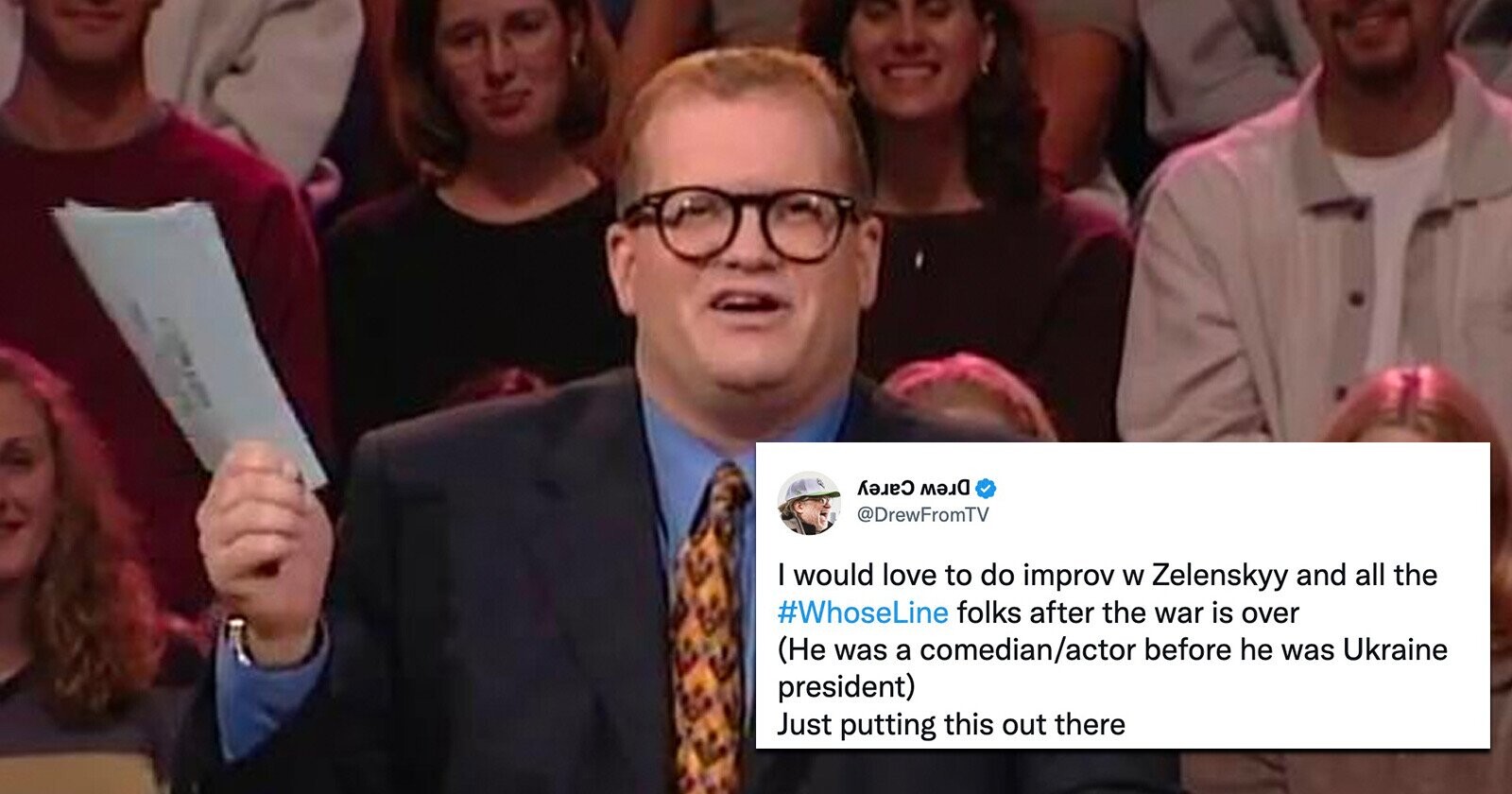
In the grand, glittery museum of sentences nobody expected to read twice, “Drew Carey wants Ukrainian President Volodymyr Zelensky on Whose Line Is It Anyway?” deserves its own velvet rope. It sounds like a comedy sketch, a late-night monologue setup, and a strangely wholesome diplomatic fever dream all at once. Yet the idea is rooted in something real: Carey publicly floated the wish that Zelensky, once known around the world as a comedian and performer before becoming Ukraine’s wartime president, might someday join the legendary improv crew for a round of made-up scenes, musical chaos, and points that famously do not matter.
At first glance, it is a funny celebrity headline. Look again, and it becomes a surprisingly rich pop-culture moment. Drew Carey, the former host of the American version of Whose Line Is It Anyway?, built much of his comedy identity on quick thinking, absurd premises, and performers rescuing a scene with nothing but nerve. Volodymyr Zelensky, long before the presidential podium and olive-green wartime addresses, spent years in entertainment as an actor, producer, writer, and comedian. His most famous role, in the Ukrainian political satire Servant of the People, involved playing an ordinary teacher who unexpectedly becomes president. Reality, apparently, watched the show and said, “Yes, and…”
Why Drew Carey’s Zelensky Wish Became Such a Perfectly Odd Pop-Culture Moment
Drew Carey’s idea resonated because it was not just random celebrity silliness. It connected two worlds that rarely share a stage: sketch comedy and global politics. Carey’s imagined lineup was playful, but the timing gave it emotional weight. Zelensky had become internationally recognized not only as Ukraine’s president but as a communicator who understood timing, tone, camera presence, and audience. Those are political skills, yes, but they are also performer skills. A person who has worked on stage knows that silence can land harder than a punchline, that confidence can stabilize a room, and that a clear message beats a complicated one every time.
That is why the headline works. Carey was not suggesting that geopolitics should be reduced to a comedy bit. Instead, the idea carried a hopeful “someday” energy: after the crisis, after survival, after victory, after the world can breathe again, maybe the former comedian could return to comedy for one bright, absurd, very human moment. It is the sort of idea that makes people smile because it imagines peace not as a press release but as a stage where someone can finally be silly again.
Drew Carey and the Improv Legacy of Whose Line Is It Anyway?
To understand why Carey’s wish landed, you need to understand the cultural magic of Whose Line Is It Anyway?. The American version, hosted by Carey during its original run, turned improv comedy into couch-friendly chaos. The formula was beautifully simple: give talented performers a ridiculous prompt, remove the safety net, and let them sprint. Ryan Stiles, Colin Mochrie, Wayne Brady, Greg Proops, Brad Sherwood, and other guests became masters of turning audience suggestions into instant comedy.
The show’s famous phraseeverything is made up and the points do not mattercaptured its anti-serious charm. It was not about polished sketches or perfect scripts. It was about momentum. If a scene collapsed, the collapse became the joke. If a song went off the rails, Wayne Brady could often make the rails apologize. If Colin Mochrie looked confused, that confusion somehow became a national treasure.
Carey’s role as host was not passive. He functioned as referee, instigator, audience surrogate, and occasionally the guy laughing so hard that the entire room received permission to fall apart. He understood that improv is less about being clever every second and more about trust. The performers trust the format, the host trusts the performers, and the audience trusts that nobody is trying to be perfect. That trust is why a hypothetical Zelensky appearance feels so irresistible. He would not have to be a polished Hollywood guest star. He would only have to show up, listen, respond, and play.
Volodymyr Zelensky: From Comedy Stage to World Stage
Before becoming president of Ukraine in 2019, Volodymyr Zelensky was already one of his country’s best-known entertainers. He performed in comedy competitions, helped build the production company Kvartal 95, acted in films and television, and became deeply associated with political satire. His career gave him an unusual relationship with public life: he had spent years making audiences laugh at the gap between what leaders say and what ordinary people experience.
His sitcom Servant of the People became a cultural landmark because the premise was both comic and oddly prophetic. Zelensky played Vasyl Holoborodko, a history teacher whose anti-corruption rant goes viral and launches him into the presidency. In fiction, the joke was that a regular person might be better suited to leadership than the professional political class. In real life, that satire became part of Zelensky’s public image when he ran for office and won the presidency by a landslide.
That entertainment background matters to the Carey headline because Zelensky is not simply “a president who used to be funny.” He is a leader whose rise cannot be separated from television, performance, satire, digital communication, and public storytelling. Whether people admire him, criticize him, or debate his leadership, his media instincts are central to his global recognition. He understands how images travel. He understands direct address. He understands that a message can become memorable when it feels human instead of manufactured.
Why Zelensky Would Be an Improv Dream Guest
On paper, Zelensky has the resume of a fantasy Whose Line guest. He has acted, written, produced, performed comedy, danced on television, voiced animated characters, and survived the most brutal form of public scrutiny: politics. Improv rewards people who can react quickly, commit to a premise, and stay calm when the room changes direction. Zelensky’s earlier entertainment career suggests he knows that rhythm well.
Imagine, purely as a harmless comedy fantasy, Zelensky entering a game like “Scenes from a Hat.” The audience suggestions would be impossible to keep normal. “Rejected slogans for world peace.” “Things you can say at a peace summit but not at a grocery store.” “Bad times to ask if the points matter.” The cast would probably spend half the segment trying not to break character, while Carey, if he returned as host, would wear the expression of a man who has just realized the booking department has completed television.
Or picture “Props,” the classic game where performers turn strange foam objects into anything except what they obviously are. Zelensky, with his history of physical comedy, might be surprisingly good at it. Comedy fans know that the best guests are not always the loudest; they are the ones who commit. A president on an improv stage would already be surreal. A president who actually understands timing would be something else entirely.
The Serious Side of a Funny Idea
Still, the subject needs balance. Zelensky is not merely a celebrity with an amusing backstory. He is the president of a country at war, and that reality cannot be tossed aside for a punchline. Carey’s wish works only because it is framed as a hopeful future moment, not a current demand. Nobody sensible is asking Zelensky to put national leadership on pause for a comedy taping. The fantasy is meaningful because it imagines a day when the emergency is over and a former performer can step into a studio for laughter instead of another urgent address.
This is where comedy becomes more than entertainment. Humor often becomes a symbol of recovery. After hard seasons, people do not just want safety; they want normal life back. They want music, jokes, crowded theaters, bad puns, and the freedom to laugh without checking the news every five minutes. A future Zelensky appearance on Whose Line Is It Anyway? would not be important because of ratings. It would be important because of what it would represent: a world in which the comedian-president has enough peace around him to play again.
How Comedy and Leadership Unexpectedly Overlap
Improv and leadership share more DNA than people think. Both require listening. Both require fast decisions with incomplete information. Both demand the ability to accept reality and build from it. In improv, the core principle is often described as “yes, and”: accept the premise, then add something useful. In leadership, the stakes are infinitely higher, but the communication challenge can look surprisingly similar. A leader cannot simply deny the scene they are in. They must name it, respond to it, and help others understand what comes next.
Zelensky’s entertainment background helped shape the way international audiences understood him. His direct-to-camera videos, concise speeches, and symbolic use of simple clothing all became part of a communication style that felt immediate. Again, this does not mean politics is theater in a shallow sense. It means public communication requires choices, discipline, timing, and emotional clarity. Comedy trained Zelensky to read a room. History forced him to read the world.
Drew Carey’s career offers a softer version of that same lesson. As an improv host, Carey learned how to create space for other people to succeed. He set up games, clarified rules, encouraged risk, and knew when to get out of the way. The best hosts do not dominate the scene; they make the scene possible. That is why his imagined invitation feels warm rather than attention-seeking. It is a comedian recognizing another performer across an unbelievable life divide.
Could It Actually Happen?
Realistically, a Zelensky appearance on Whose Line Is It Anyway? is unlikely in the near term. The show’s CW revival has already reached its final stretch, and Zelensky’s responsibilities are obviously far beyond the entertainment calendar. There are also security, diplomatic, production, and tone considerations that would make such a booking unusually complex. This is not the same as inviting a movie star to promote a summer blockbuster and pretend to be a confused squirrel in “Party Quirks.”
But television has a long memory, and comedy reunions have a way of appearing when nobody expects them. A special episode, charity event, digital reunion, or postwar cultural celebration would not be impossible in some future world. If it ever happened, it would need careful framing. The episode would have to honor Ukraine’s experience without turning suffering into a prop. It would have to let Zelensky be funny without demanding that he perform cheerfulness. The comedy would need generosity, not gimmickry.
Why Fans Love the Idea
Fans love the concept because it offers emotional whiplash in the best way. Whose Line is nostalgia comfort food for millions of viewers. Zelensky’s story, meanwhile, has become one of the most dramatic public transformations of modern politics: entertainer to president, sitcom premise to real office, comic actor to wartime communicator. Put those elements together and the result feels like a headline written by a screenwriter who had too much coffee but somehow nailed the third act.
The idea also appeals because it humanizes a world leader without trivializing him. Political figures are usually seen behind podiums, surrounded by flags, translated statements, and formal protocol. An improv show strips away formality. It asks people to react, stumble, laugh, and recover. That vulnerability is part of the charm. Viewers are drawn to the possibility of seeing Zelensky not as an icon, not as a headline, but as a person with comic instincts returning to an old language.
What a Zelensky Episode Could Look Like
A respectful version of the episode could lean into universal themes rather than heavy politics. The games might focus on travel, translation mishaps, campaign slogans, awkward press conferences, fictional diplomacy, or absurd historical lectures. Wayne Brady could turn a fake peace summit into a Broadway number. Colin Mochrie could play a confused royal adviser who thinks NATO is a brand of breakfast cereal. Ryan Stiles could become a bodyguard who keeps protecting the wrong person. Carey could award points with the solemnity of a man announcing a treaty between two rival sandwich shops.
The smartest version would avoid making Zelensky the entire joke. Instead, it would let him play within the ensemble. That is the secret of great improv: nobody wins alone. The funniest scenes happen when performers support one another, heighten the premise, and know when to pass the focus. A guest with Zelensky’s background would understand that instinct. He spent years in collaborative entertainment before politics demanded an entirely different stage.
Experience Section: What This Topic Teaches About Humor, Hope, and Public Imagination
The experience of watching this headline travel through pop culture is a reminder that people often process serious times through strange, funny, sideways ideas. On the surface, “Drew Carey wants Zelensky on Whose Line Is It Anyway?” is a novelty item. It is the kind of sentence you send to a friend with no context, followed by, “Well, that was not on my bingo card.” But the reason it sticks is that it gives people a tiny window into a better future. It imagines a day when the urgent tone of wartime news can be replaced, even briefly, by the playful tone of an improv stage.
For longtime Whose Line viewers, the idea feels personal because the show has always been a comfort machine. Many fans discovered it after school, late at night, or during reruns when they needed something light and reliably ridiculous. The games were simple enough to understand instantly, but the performers made them feel fresh every time. There is something deeply reassuring about watching talented people enter chaos and turn it into laughter. That is probably why the Zelensky idea connects so strongly. His public life has been defined by real chaos, not comic chaos, and audiences instinctively understand the difference. They are not laughing at the crisis. They are longing for the day when laughter can safely return.
There is also a useful lesson for writers, creators, and media watchers. The best viral entertainment stories often work because they combine contrast and truth. The contrast here is obvious: an American improv host and a Ukrainian president sound like they belong in different universes. The truth is what makes it meaningful: both men have roots in comedy, performance, timing, and audience connection. Carey’s wish is funny because it is unlikely, but it is appealing because it is not completely random. There is a real bridge between them, built from stages, scripts, live reactions, and the strange courage required to stand in front of people with no guarantee of success.
As a publishing topic, this story also shows why entertainment writing does not have to be shallow. A headline can be amusing and still open the door to deeper analysis about comedy, leadership, media, resilience, and public memory. Readers may arrive for the oddball celebrity angle, but they stay because the story touches something recognizable: the desire to see people return to joy after hardship. That is why the fantasy of Zelensky doing improv with the Whose Line cast is more than a quirky booking idea. It is a tiny cultural postcard from a hoped-for future, stamped with a joke, addressed to everyone who could use a reason to smile.
Conclusion: A Joke, a Wish, and a Surprisingly Moving Possibility
Drew Carey’s wish to see Volodymyr Zelensky on Whose Line Is It Anyway? is funny because it is improbable, but it has lasted in public imagination because it is oddly beautiful. It brings together Carey’s improv legacy, Zelensky’s entertainment past, and the universal hope that one day the president of Ukraine might have the time, safety, and peace to be a comedian again, even for one game, one scene, one ridiculous prompt from a hat.
No, there is no confirmed Zelensky guest appearance. No, fans should not expect a secret episode to drop tomorrow with Ryan Stiles dressed as a confused ambassador and Wayne Brady singing a power ballad about international law. But as a cultural idea, it works. It reminds us that comedy is not the opposite of seriousness. Sometimes comedy is what people dream about when seriousness has taken up too much room.
And if that future episode ever happens, the points still will not matter. But the moment probably would.
Note: This article is written as entertainment commentary and cultural analysis based on real public information. It does not claim that Volodymyr Zelensky has accepted, scheduled, or appeared on Whose Line Is It Anyway?.