What do a pair of royal ravens, a burning lightbulb, a charging team of bulls, the surface of Pluto, and three birds floating through golden mist have in common? Besides sounding like the beginning of a wonderfully confusing dream, they have all earned recognition in the Wikimedia Commons Picture of the Year competition.
The 45-image collection covering 2006 through 2022 is not merely a parade of attractive photographs. It is a visual journey through wildlife, science, architecture, cultural traditions, natural disasters, outer space, and fleeting moments that would have vanished without a patient photographer nearby. Some pictures are technically astonishing. Others are emotionally immediate. A few make you wonder whether nature secretly employs a full-time lighting department.
What Is Wikimedia Commons?
Wikimedia Commons is the Wikimedia Foundation’s free media repository. It hosts photographs, illustrations, maps, audio recordings, videos, diagrams, and other files that can be used across Wikipedia and related Wikimedia projects. Its collection includes work from individual contributors as well as material supplied by major institutions, scientific organizations, libraries, museums, and government agencies.
The repository contains more than 100 million freely licensed media files. However, “free” does not mean “grab it, remove the photographer’s name, and disappear into the Internet wearing sunglasses.” Each file has its own license and attribution requirements. Some are in the public domain, while others use Creative Commons licenses that require credit or require adaptations to be shared under similar terms.
Featured Pictures: The Competition Before the Competition
Before an image can compete for Picture of the Year, it normally must earn Featured Picture status. Community members examine candidates for technical quality, composition, educational value, accuracy, and overall visual impact. The process can involve discussion, criticism, and consensus-building. In other words, a photograph does not receive a tiny digital crown simply because the photographer’s aunt described it as “stunning” on social media.
Featured Pictures represent only a small fraction of all media stored on Wikimedia Commons. Once selected, eligible images enter the annual Picture of the Year competition, where Wikimedia users vote for their favorites.
How the Wikimedia Commons Picture of the Year Works
The annual contest began with the 2006 edition. By 2022, it had reached its seventeenth competition. The voting format has evolved, but recent editions have used an initial round containing eligible Featured Pictures followed by a final round of leading candidates. The result is community-driven rather than decided by one professional jury.
That distinction matters. A community vote can reward technical excellence, but it can also recognize humor, surprise, emotional force, rarity, or educational usefulness. The winners therefore reveal what knowledgeable viewers found memorablenot an eternal mathematical formula for photographic perfection.
Participation can be substantial. The 2014 competition attracted more than 4,500 first-round voters examining 983 files, while the 2016 edition included 1,475 candidates and drew 4,765 voters. The 2022 winner received 335 final-round votes, narrowly leading photographs of Banna children on stilts and the James Webb Space Telescope’s Pillars of Creation.
Why These 45 Wikimedia Commons Pictures Stand Out
The 45-picture roundup draws from first-place winners, runners-up, and other leading images chosen between 2006 and 2022. Together, they demonstrate that a powerful photograph does not need a single subject or style. It needs timing, clarity, meaning, or some magical combination of all three.
Nature With Absolutely No Interest in Being Subtle
Wildlife dominates many memorable selections. Two Julia butterflies calmly drink tears from turtles in Ecuador. A polar bear races after a bearded seal. A kingfisher strikes the water while hunting. Two tree frogs scramble over the same branch like commuters discovering that only one subway seat remains.
The 2012 champion shows European bee-eaters during courtship, with the female awaiting a food offering from the male. The image succeeds because it is colorful, behaviorally informative, and instantly understandable. No speech bubble is necessary. The message is essentially, “I brought you lunch; please consider my application.”
Other animal photographs use scale and atmosphere. Wild elephants walking along a road appear calm yet enormous. Ravens Jubilee and Munin look like dignified officials who have just reviewed your tax return and found it disappointing. The winning 2022 image transforms birds at Taudaha Lake into silhouettes surrounded by glowing mist and reflected light.
Science Made Spectacular
Scientific images repeatedly reached the top because they make complicated subjects emotionally accessible. The 2010 winner shows a laser guide star rising from the European Southern Observatory’s Paranal facility toward the Milky Way. The laser supports adaptive optics by helping astronomers correct atmospheric distortion, but in the photograph it looks as though Earth has finally decided to send the galaxy a strongly worded email.
The official ESO account explains that Yuri Beletsky photographed astronomers using the laser guide star facility at one of the Very Large Telescope units. More than 1,500 Wikimedians participated in that year’s contest, and the Paranal image received 241 votes in the final round.
NASA imagery also made several appearances. A solar filament erupting from the Sun earned second place in 2012. An enhanced-color view of Pluto captured by New Horizons became the 2015 winner. In 2022, Webb’s near-infrared image of the Pillars of Creation finished third. These pictures are not just wallpaper for people who own telescopes. They make enormous distances, violent processes, and unfamiliar worlds feel almost touchable.
New Horizons completed humanity’s first close exploration of Pluto in 2015, revealing a complex world of mountains, plains, craters, and glaciers. Webb, meanwhile, studies cosmic history through highly sensitive infrared observations. Wikimedia voters were responding not only to beauty but also to the astonishing fact that humans built machines capable of recording these scenes.
Human Life, Culture, and History
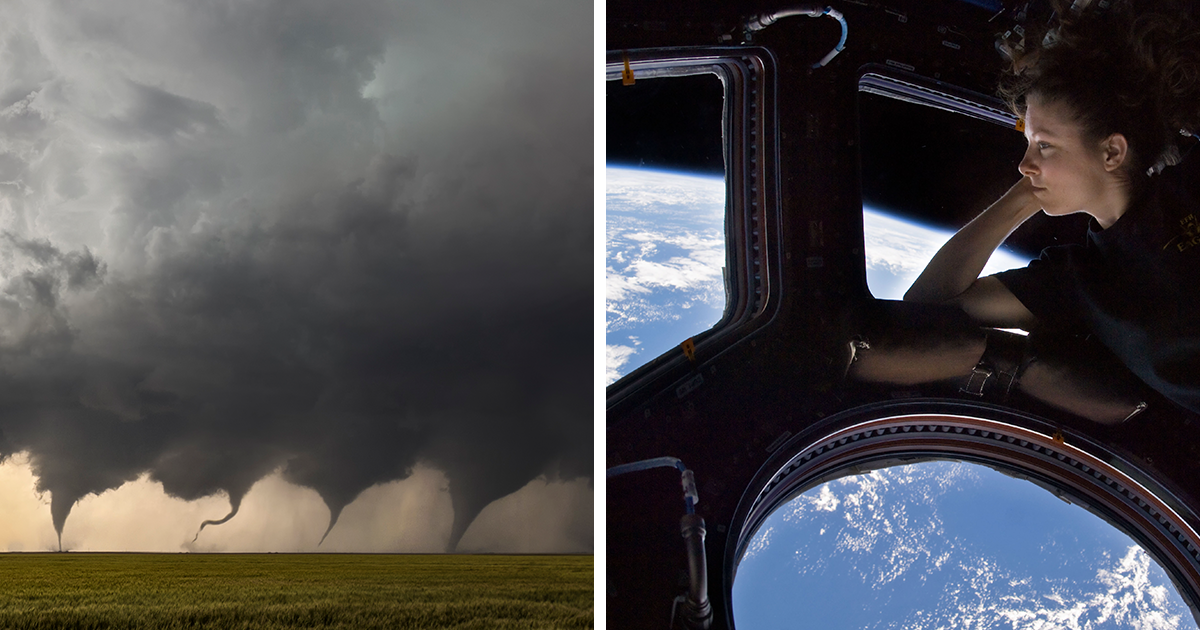
The collection is strongest when it moves beyond postcard beauty. A Sikh pilgrim at the Golden Temple became the 2009 winner. A self-portrait of astronaut Tracy Caldwell Dyson in the International Space Station’s Cupola placed second in 2011. Banna children wearing body paint and playing on wooden stilts finished second in 2022.
Other pictures preserve difficult history. A doctor working during the COVID-19 pandemic placed second in 2020. A photograph of Notre-Dame’s spire during the 2019 fire also earned second place. A firefighter facing a veld fire, a homeless person in Paris, and a village girl in Iranian Kurdistan show how documentary photography can carry emotional weight without becoming theatrical.
These images remind viewers that Wikimedia Commons is not merely a stock-photo warehouse. It is also a growing visual record created by professionals, volunteers, travelers, scientists, archivists, and witnesses who happened to be standing where history unfolded.
The First-Place Winners From 2006 Through 2022
The complete 45-image gallery includes many second- and third-place finishers, but the annual champions provide a useful timeline of how the community’s preferences developed.
- 2006: Aurora Borealis above Bear Lake at Eielson Air Force Base, Alaska.
- 2007: Broadway Tower in the Cotswolds, England.
- 2008: Horses on Bianditz Mountain with Aiako Harria in the distance.
- 2009: A Sikh pilgrim at the Golden Temple in Amritsar, India.
- 2010: A laser guide star pointing toward the center of the Milky Way at Paranal Observatory.
- 2011: Lake Bondhus and the Bondhus Glacier in Norway.
- 2012: European bee-eaters engaged in courtship feeding in France.
- 2013: A tungsten filament burning with a flame inside a lightbulb.
- 2014: Julia butterflies drinking tears from turtles in Ecuador.
- 2015: New Horizons’ enhanced-color image of Pluto.
- 2016: Jubilee and Munin, two ravens of the Tower of London.
- 2017: Two Phyllomedusa rohdei frogs competing for a branch.
- 2018: A composite showing eight stages in the formation of a Kansas tornado.
- 2019: Two bulls running through mud during a pacu jawi race.
- 2020: A common kingfisher striking the water while hunting in Italy.
- 2021: Saint John Church of Sohrol in Iran.
- 2022: A cormorant, little egret, and gadwall at Taudaha Lake near Kathmandu.
The sequence jumps from landscape photography to microscopic detail, from architecture to astrophotography, and from carefully controlled experiments to events no photographer could command. That variety is the gallery’s greatest strength. There is no house style, unless “the world is stranger than you remembered” counts as a style.
What Makes a Community-Voted Picture Memorable?
Timing
The kingfisher’s dive, the exploding lightbulb, the breaching penguin, and the pursuing polar bear depend on fractions of a second. The photographer must understand the subject, anticipate movement, and press the shutter before the moment becomes a story beginning with, “You should have seen it.”
Scale
Pluto, the Milky Way, a solar eruption, a glacier, and a tornado communicate forces larger than ordinary human experience. Successful images provide visual anchorsa telescope, a train, a shoreline, or a recognizable horizonso viewers can understand the scale rather than merely stare at a colorful mystery.
Storytelling
The strongest photographs imply a before and an after. Why are the butterflies drinking turtle tears? Will the male bee-eater’s gift be accepted? Where is the train crossing the desert headed? What happened seconds after the firefighter entered the smoke? A memorable photograph answers enough questions to create meaning while leaving enough unanswered to hold attention.
Educational Value
Wikimedia Commons serves educational projects, so accuracy and context matter. A beautiful image becomes more useful when it is properly identified, dated, categorized, geolocated, and accompanied by reliable information. Metadata may not be glamorous, but neither is losing a scientifically valuable photograph in a folder named “final-final-actual-final-2.jpg.”
How to Reuse Wikimedia Commons Images Responsibly
Anyone planning to reuse one of these photographs should open its individual file page and check the listed license. A public-domain image may permit broad reuse without copyright restrictions. A CC BY image generally requires appropriate creator credit. A CC BY-SA image also requires qualifying adaptations to be distributed under the same or a compatible license.
Good attribution normally identifies the creator, the work, the license, and a source location when required. Editors should also note whether a photograph has personality-rights, trademark, cultural-property, or privacy considerations that exist separately from copyright.
Open access becomes valuable only when reuse remains responsible. The Smithsonian and Library of Congress have similarly expanded access to millions of digitized objects and curated rights-free collections, reflecting a broader effort to make cultural and historical media easier to study, teach with, and creatively transform.
Conclusion
The 45 best Wikimedia Commons pictures selected from 2006 through 2022 form a wonderfully unpredictable portrait of the world. They show that visual excellence can emerge from a spacecraft, a laboratory, a wildlife reserve, an ancient church, a muddy race, or a frozen soap bubble.
More importantly, the collection demonstrates what can happen when talented creators share their work openly and an international community helps identify, describe, preserve, and celebrate it. The results are beautiful, useful, educational, and occasionally weird enough to make a turtle-tear-drinking butterfly seem perfectly reasonable.
The Experience of Exploring All 45 Pictures
Browsing the gallery slowly is a very different experience from flicking through an ordinary social-media feed. The pictures are not competing with dance clips, advertisements, lunch photos, and someone’s urgent theory about why socks vanish in washing machines. Each image has enough space to demand attention.
The first reaction is usually visual. You notice the green sweep of an aurora, the saturated feathers of bee-eaters, the copper-colored surface of Pluto, or the bright laser cutting through the night above Paranal Observatory. Only afterward do you begin reading the caption and understanding what the image actually records.
That sequencewonder first, knowledge secondis one reason the collection works so well. The photographs invite curiosity without requiring viewers to arrive as experts. You do not need to understand adaptive optics to appreciate the observatory image. You do not need to know the physics of tornadogenesis to feel uneasy while watching a funnel take shape across eight consecutive frames.
The animal pictures create another kind of experience. They can be funny for a moment and scientifically fascinating the next. The frogs climbing over one another look like slapstick performers, but the image also documents real behavior. The butterflies sipping turtle tears initially seem like characters from a peculiar children’s book, yet the scene illustrates lachryphagy, a behavior through which insects obtain moisture and dissolved nutrients.
Human-centered images tend to slow the viewing pace. The doctor working during the pandemic carries a different emotional atmosphere from the kingfisher or the frosted bubble. The photograph is not simply about equipment, protective clothing, or hospital architecture. It recalls exhaustion, uncertainty, and the people who continued working while much of the world waited behind closed doors.
The picture of Banna children playing on stilts creates a similarly layered response. It is energetic and joyful, but it also invites questions about culture, representation, and context. A responsible viewer should resist treating people as decorative “exotic” subjects. Captions, creator information, and cultural background matter because photography can preserve human dignity or flatten individuals into visual curiosities.
Moving between the years also reveals changes in photographic technology. Earlier winners include conventional landscapes, wildlife portraits, and documentary scenes. Later selections increasingly feature high-resolution composites, advanced astrophotography, spacecraft data, and images created through specialized scientific instruments. The artistic eye remains essential, but the camera may now be attached to a telescope, orbiting Earth, or traveling billions of miles from home.
One practical way to explore the gallery is to choose personal winners by category rather than forcing every image into a single ranking. The tornado composite may be the strongest technical narrative. The ravens might win best personality. Pluto takes the prize for longest-distance delivery. The frosted bubble deserves recognition for making ordinary soap look like a newly discovered planet.
After spending time with the full collection, the most lasting impression is not that one photograph defeats all the others. It is that the world continuously produces scenes worth preserving. The community’s vote gives those scenes additional visibility, while open licensing allows them to travel into classrooms, articles, documentaries, research projects, and creative works.
The gallery therefore offers more than visual entertainment. It encourages viewers to look carefully, investigate captions, respect creators, and recognize photography as both art and evidence. That may be the most valuable experience of all: leaving the collection slightly more curious about the world than when you entered it.