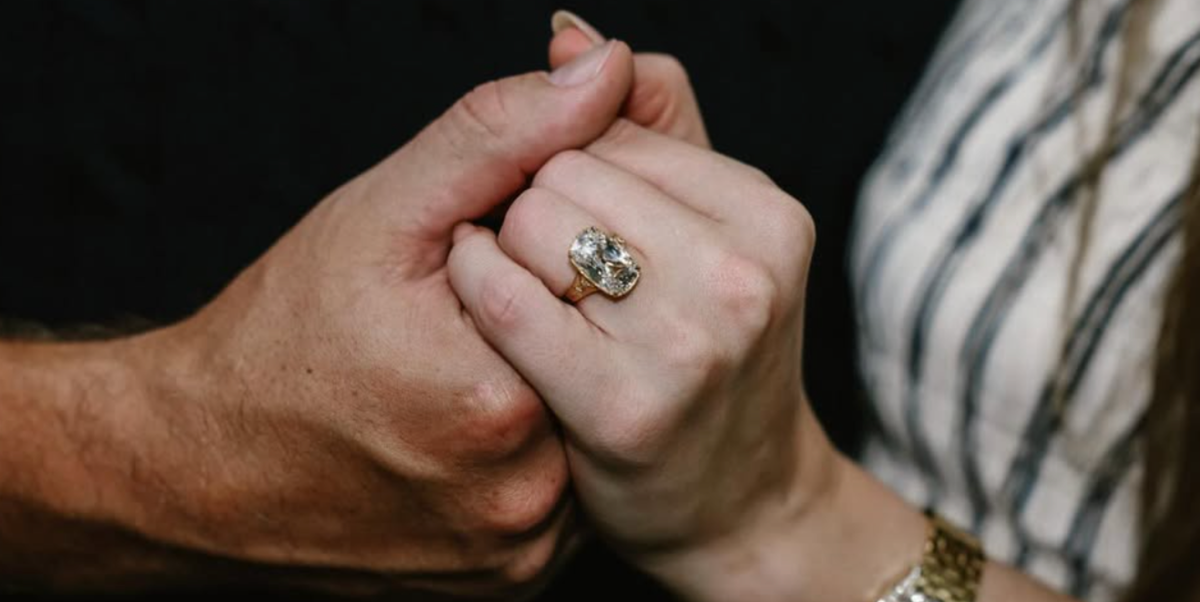
Taylor Swift has never been a person whose details stay small for long. A scarf becomes folklore. A lyric becomes a national group text. So naturally, when her engagement ring entered the chat, the internet did what the internet does best: zoomed in, circled, theorized, compared screenshots, and appointed itself chief gemologist before lunch.
At first glance, the ring looks romantic, vintage, warm, and quietly dramaticbasically a ballad with excellent lighting. But fans quickly noticed something interesting: Taylor Swift’s engagement ring seems to look different from every angle. In one photo, the diamond appears soft and candlelit. In another, it looks brighter, wider, or warmer. Sometimes the center looks darker. Sometimes the gold setting seems to glow. Is this magic? Is this branding? Did the diamond sign an NDA?
The real answer is more fascinating: the ring’s changing appearance comes from a combination of old mine cut diamond geometry, antique-style craftsmanship, yellow gold, lighting conditions, camera angles, and the way diamonds naturally bend and scatter light. In other words, the ring is not changing. Your eyes, the camera, and the light are doing a highly coordinated little dance.
The Ring at the Center of the Sparkle Storm
Public reporting describes Taylor Swift’s engagement ring as a vintage-inspired old mine brilliant-cut diamond set in yellow gold, designed with jeweler Kindred Lubeck of Artifex Fine Jewelry. Several jewelry experts have described the stone as an elongated cushion or antique cushion shape, with estimates often landing somewhere in the 7-to-15-carat range. Because the exact specifications have not been publicly confirmed in a full gemological report, any carat or value number should be treated as an expert estimate, not a receipt from the jewelry gods.
Still, the broad design language is clear: this is not a cold, ultra-modern, laser-perfect diamond meant to look identical in every lighting setup. It leans antique. It has character. It has warmth. It appears to favor romance over mathematical obedience. That is exactly why the ring can seem to change so much depending on where the camera, hand, and light source are positioned.
What Is an Old Mine Cut Diamond?
An old mine cut diamond is one of the most beloved antique diamond styles, popular especially in the 18th and 19th centuries. These stones were typically cut by hand, long before today’s precision equipment could map every angle with computer-level accuracy. Instead of the crisp, machine-like symmetry found in many modern round brilliant diamonds, old mine cuts usually have a softer outline, chunkier facets, a smaller table, a higher crown, and often a visible culet at the bottom.
That may sound like gemology homework, but here is the fun version: modern diamonds often sparkle like a stadium light; old mine cuts glow like a candlelit dinner where someone definitely has a secret. Their beauty is less about constant glitter and more about deep flashes, broad reflections, and a romantic play of light that shifts as the stone moves.
Chunky Facets Create Chunky Flashes
The facets of an old mine cut are usually larger and less uniform than those of many modern cuts. That means the diamond does not break light into tiny, fast sparkles in quite the same way a modern brilliant cut might. Instead, it creates broader flashessometimes white, sometimes rainbow-like, sometimes warm and moody.
This is one reason Taylor Swift’s engagement ring may look bright and icy in one picture but golden and soft in another. Those big antique-style facets act like little mirrors, and each mirror is catching a different piece of the room. Turn the hand slightly, and suddenly the diamond is reflecting a window, a shadow, a camera lens, a garden, or a flash. The ring is not being inconsistent. It is being dramatic, which frankly feels on-brand.
Why the Diamond Looks Different From Every Angle
Diamonds are famous for sparkle because of how they interact with light. Three terms matter here: brilliance, fire, and scintillation. Brilliance is the white light reflected back to your eye. Fire is the rainbow dispersion created when white light splits into colors. Scintillation is the sparkle pattern you see when the diamond, light, or viewer moves.
When people say Taylor Swift’s ring looks different from every angle, they are mostly noticing changes in brilliance, fire, and scintillation. A diamond is not a flat object. It is a tiny architectural structure made to redirect light. Shift it a few degrees, and its entire personality can appear to change.
Angle Changes the Light Return
When a diamond is photographed straight on, the viewer sees one pattern of reflection. When it is tilted, the viewer sees another. This is especially noticeable in antique-style cuts because their facet patterns are often less uniform. Some angles may emphasize the diamond’s table and broad top surface. Other angles may reveal the depth of the pavilion or the open culet. The result is a ring that can look elongated in one photo, squarer in another, brighter in direct sun, and softer indoors.
The Center Can Look Darkerand That Is Not a Flaw
Some close-up images of antique diamonds show a darker area near the center. In old mine cuts, that can happen because of the cut structure, the visible culet, or the way the stone reflects the camera, phone, or viewer. A dark center in a photo does not automatically mean the diamond is poor quality. It may simply mean the diamond is reflecting something darkpossibly the phone taking the picture. Congratulations, your camera made a cameo.
The Yellow Gold Setting Adds Warmth
Another reason Taylor Swift’s engagement ring looks different from photo to photo is the yellow gold setting. Yellow gold can visually warm up the entire ring, especially around the edges of the diamond. In soft lighting, the gold may reflect into the stone and make the diamond appear honeyed, champagne-like, or slightly warmer than it would in platinum or white gold.
This is part of the ring’s vintage charm. Yellow gold has a historic, heirloom feeling, and it pairs beautifully with antique diamond cuts. Rather than fighting the old-world personality of the stone, the metal supports it. The result is a ring that can look luxurious without looking sterile. It sparkles, yes, but it also glows.
Bezel, Prongs, Basket, and the “Framed” Effect
Many reports and jewelry experts have described Swift’s ring as having a bezel or bezel-like setting, while others note that close-up images suggest a more nuanced structure, possibly involving fine prongs and a gold basket that visually frames the diamond. Either way, the important point for appearance is this: metal around a diamond changes how the eye reads the stone.
A slim rim of gold can make the diamond look more defined. It can emphasize the cushion shape and create a frame-like effect, almost like placing a painting in the perfect antique frame. From one angle, that frame may look delicate. From another, it may appear bolder. In photos, especially close-ups, this can make the ring seem to shift between soft, sculptural, and architectural.
Why Photos Make the Ring Look Even More Mysterious
Jewelry photography is tricky even when the subject is not one of the most famous women on Earth. Diamonds are reflective, transparent, and highly sensitive to light. A phone camera may brighten shadows, sharpen contrast, or flatten depth. Social media compression can also change the way tiny details appear. Add outdoor lighting, skin tone, gold reflection, and a massive public zoom-in session, and you get the perfect recipe for ring confusion.
Lighting Makes a Huge Difference
Direct sunlight can make a diamond explode with bright flashes. Indoor lighting can make it look warmer and softer. Candlelight can bring out the romantic glow associated with old mine cuts. Shade can make facets look deeper and more mysterious. A camera flash can create sharp white reflections that are not visible in the same way to the naked eye.
That is why two photos taken minutes apart can make the same ring look like two different diamonds. The ring is simply responding to its environment. It is the jewelry version of changing outfits between eras.
Camera Distance Changes Perception
A close-up photo can exaggerate the stone’s size, facet pattern, and center reflections. A wider image may make the diamond look more balanced with the hand and band. When fans compare screenshots from different distances, they may think the ring has changed shape. In reality, the camera lens is doing what camera lenses do: being a tiny chaos machine.
Old Mine Cut vs. Modern Brilliant Cut
To understand why Swift’s ring feels so different, compare an old mine cut with a modern round brilliant diamond. A modern round brilliant is designed for maximum light performance under contemporary standards. It often has precise symmetry and consistent sparkle. It is polished, predictable, and very good at showing off in jewelry store lighting.
An old mine cut is moodier. It tends to have a higher crown, smaller table, larger facets, and a softer cushion-like outline. It may not sparkle in the same rapid-fire way as a modern brilliant, but it has depth and personality. It does not scream “perfect.” It whispers “I have survived centuries and still look fabulous.”
That difference is central to why Taylor Swift’s engagement ring has become such a conversation piece. It does not behave like the standard celebrity mega-diamond. It feels specific, antique-inspired, and personal. It is less “look how big this is” and more “look how much story this has.” Although, to be fair, it is also big. Let us not pretend our eyes have stopped working.
The Taylor Effect: Why This Ring Became a Trend Signal
Taylor Swift’s style choices often influence broader consumer behavior, and the engagement ring is no exception. After the ring appeared, old mine cut diamonds and antique cushion styles received renewed attention from jewelry lovers, bridal shoppers, and trend watchers. The timing also fits a larger shift in engagement ring preferences: many people now want rings that feel personal, vintage, sustainable, and less mass-produced.
Old mine cut diamonds are especially appealing because no two are exactly alike. Their slight asymmetry is not a defect; it is the point. In a world where so many products look algorithmically optimized, a hand-cut antique diamond feels refreshingly human. It says, “I am rare,” without needing to shout across the room.
Why the Ring Feels So “Taylor”
Part of the fascination is that the ring appears to match Swift’s public aesthetic: literary, nostalgic, feminine, detailed, and full of hidden meaning. The yellow gold feels warm rather than icy. The antique cut feels poetic rather than trendy. The custom design adds intimacy. Even the changing appearance works with her image as an artist who builds eras, symbols, and layered narratives.
Whether or not every detail was chosen for symbolism, the overall effect is unmistakably personal. This is not a generic red-carpet boulder dropped onto a thin band. It looks considered. It looks like someone thought about history, craftsmanship, and the wearer’s style. In celebrity jewelry terms, that is basically a plot twist.
How to Get a Similar Look Without a Superstar Budget
Most people do not have access to a massive antique diamond or a celebrity-level custom design process. Fortunately, the design principles behind Taylor Swift’s engagement ring can be adapted in more realistic ways. The key is not copying the ring exactly. The key is understanding what makes it work.
Choose an Antique-Inspired Cut
Look for old mine cut, antique cushion cut, elongated cushion cut, or vintage-inspired cushion diamonds. Some modern diamonds are cut to mimic antique styles, offering a similar romantic look with more predictable availability. Lab-grown diamonds may also be cut in antique-inspired shapes, though they will not have the same historical provenance as true antique stones.
Consider Yellow Gold
Yellow gold is one of the easiest ways to create warmth and vintage character. It pairs beautifully with antique-style stones and can make the overall ring feel softer and more romantic. A yellow gold band with engraving, milgrain, or hand-finished details can create an heirloom effect even with a smaller center stone.
Focus on Personality Over Perfection
If Swift’s ring teaches shoppers anything, it is that character matters. A slightly irregular antique diamond may feel more alive than a technically flawless stone that leaves you emotionally unmoved. When shopping for old cuts, it is smart to view the diamond in different lighting and angles. Do not judge it from one photo alone. Antique diamonds are performers, and they need a stage test.
Experience-Based Insights: What This Ring Teaches About Seeing Jewelry in Real Life
One of the biggest lessons from the conversation around Taylor Swift’s engagement ring is that jewelry cannot be fully understood from a single image. Anyone who has ever tried on rings in a store knows this. A diamond that looks quiet in the display case may burst to life near a window. A ring that looks huge in a macro photo may feel elegant on the hand. A stone that appears slightly warm online may look perfectly balanced against someone’s skin tone.
That is why real-life viewing matters so much, especially with antique-style diamonds. Old mine cuts are not designed to be perfectly uniform from every angle. They reward movement. Tilt the hand toward a lamp, and the stone may flash white. Turn it toward natural light, and the facets may reveal pastel fire. Move into a dim restaurant, and suddenly the diamond has that old-world glow that makes vintage jewelry lovers weak in the knees.
For shoppers inspired by Taylor Swift’s ring, the best experience is not simply searching for “the biggest old mine cut diamond” and hoping romance arrives by shipping confirmation. The better approach is to try on different shapes, metals, and settings. Compare a modern cushion with an antique cushion. Try yellow gold beside platinum. Look at a bezel-style setting next to a prong setting. Notice how each choice changes the mood of the stone.
Another practical experience: take photos and videos in different lighting before making a decision. Jewelry stores often use lighting designed to make diamonds sparkle like they are auditioning for Broadway. That is fun, but it is not the whole story. Step near a window. Look at the ring under normal indoor light. View it from the side. See whether you still love it when it is not performing under perfect conditions.
The “different from every angle” quality can be a feature, not a flaw. Some people want a diamond that looks crisp, bright, and consistent all the time. Others fall in love with stones that shift, deepen, and surprise them. Taylor Swift’s ring belongs to that second category. It is not trying to be a spreadsheet of perfection. It is trying to be a tiny, wearable love story with excellent production value.
For couples, the takeaway is simple: the most memorable engagement rings often reflect personality. Maybe that means an antique diamond. Maybe it means a colored gemstone, a family stone, a hand-engraved band, or a modest ring chosen with extreme care. The ring does not need to impress the entire internet. In fact, that sounds exhausting. It needs to feel right to the person wearing it every day while typing, waving, holding coffee, and occasionally defending their favorite album online.
So yes, Taylor Swift’s engagement ring looks different from every angle because of diamond optics, antique cutting, yellow gold, camera behavior, and the beautiful unpredictability of handmade-inspired design. But emotionally, it looks different because people are bringing different expectations to it. Some see trendsetting jewelry. Some see vintage craftsmanship. Some see a celebrity love story. Some see a ring they will now describe to a jeweler with seventeen screenshots and a dream.
Conclusion
Taylor Swift’s engagement ring looks different from every angle because it is built around light, history, and character. The old mine brilliant-cut diamond has chunky facets and antique proportions that create shifting flashes instead of uniform sparkle. The yellow gold setting adds warmth. The bezel-like frame emphasizes shape. Photography, lighting, movement, and camera angles add even more variation.
That changing quality is exactly what makes the ring fascinating. It is not a standard celebrity diamond trying to win a brightness contest. It is romantic, distinctive, and alive with visual personality. In a world of polished sameness, Taylor Swift’s ring reminds us that the best jewelry does not always look identical from every angle. Sometimes, the magic is in the change.
Note: Details about Taylor Swift’s engagement ring are based on publicly reported information and expert jewelry analysis. Exact carat weight, value, and technical specifications have not been fully confirmed publicly.