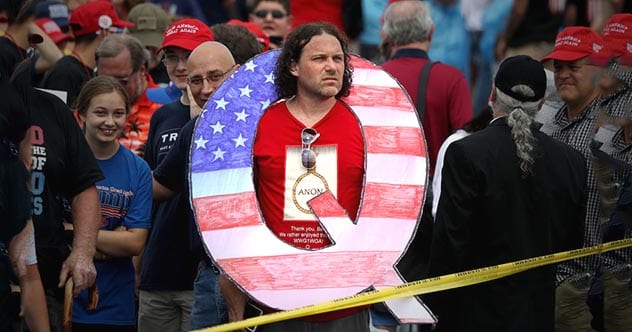
QAnon began with a few cryptic posts on an obscure internet message board. Within several years, it had produced millions of social-media interactions, appeared at political rallies, crossed international borders, inspired congressional candidates, complicated genuine anti-trafficking efforts, and become associated with several criminal and violent incidents. If the internet had a talent show for ideas that escaped their original habitat, QAnon would unfortunately make the finals.
Understanding QAnon does not require memorizing every bizarre claim ever attached to it. In fact, attempting that would be like trying to catalogue every topping at a conspiracy-theory buffet while somebody keeps adding new trays. What matters is understanding how the movement started, what its central mythology claims, why it attracted followers, how social media accelerated its growth, and why its influence matters beyond the internet.
The most important distinction comes first: the extraordinary allegations at the heart of the QAnon conspiracy theory have not been supported by credible evidence. The following guide examines the movement as a documented social and political phenomenon, not as validation of its claims. Research and reporting from U.S. government agencies, academic institutions, fact-checkers, extremism researchers, polling organizations, and major news organizations consistently describe QAnon as a baseless conspiracy movement.
1. QAnon Started With an Anonymous Internet Poster in 2017
The QAnon story begins on October 28, 2017, on 4chan, an anonymous image board known for chaotic discussions and extremely loose moderation. A poster calling themselves “Q” claimed to possess high-level government access and began publishing messages that followers later called “Q drops.”
The name apparently referenced “Q clearance,” a real Department of Energy access authorization associated with certain sensitive nuclear information. There has never been credible evidence, however, that the anonymous poster actually possessed such clearance or worked inside the government.
One of Q’s earliest predictions suggested that Hillary Clinton would soon be arrested. That did not happen. Failed predictions would become a recurring feature of the movement, yet rather than ending the phenomenon, failures were frequently reinterpreted by committed followers as intentional misinformation, hidden strategy, incorrect decoding, or proof that mysterious events were happening behind the scenes.
From 4chan to 8chan and 8kun
Q eventually moved from 4chan to 8chan and later 8kun. Researchers have never conclusively established the identityor identitiesbehind every Q post. Numerous theories have circulated about who controlled the account at different times, but speculation should not be confused with proof.
That uncertainty actually helped the mythology. An anonymous insider is difficult to interview, fact-check, cross-examine, or catch taking an ordinary Tuesday afternoon off.
2. The Core QAnon Story Is a Secret War Between Good and Evil
Although QAnon absorbed hundreds of side theories, its central narrative was relatively simple. Followers were told that a hidden network of powerful political, entertainment, media, and business figures secretly controlled institutions while participating in horrific crimes, including child trafficking and satanic abuse.
Donald Trump was portrayed within QAnon mythology as the central figure fighting this supposed “Deep State” cabal with help from loyal military and intelligence insiders.
No credible evidence has established the existence of the vast secret organization described in QAnon lore.
The simplicity of the underlying story helped make QAnon flexible. Almost any disappointing event could be placed into the same template: hidden villains were responsible, unseen heroes were fighting them, public appearances were deceptive, and definitive victory remained just over the horizon.
That structure turned normal political complexity into something closer to a superhero movieexcept the script could be rewritten every morning by thousands of people online.
3. “The Storm” and “The Great Awakening” Are Central QAnon Concepts
Two phrases appear repeatedly in discussions of QAnon: “The Storm” and “The Great Awakening.”
In QAnon mythology, “The Storm” describes an anticipated moment when alleged members of the hidden cabal would supposedly be exposed, arrested, prosecuted by military tribunals, or otherwise removed from power. Followers repeatedly predicted dramatic mass arrests and revelations that never materialized.
“The Great Awakening,” meanwhile, refers to the imagined moment when the broader public finally recognizes what believers consider the hidden truth.
The movement also popularized slogans including “Trust the Plan” and “Where We Go One, We Go All,” commonly abbreviated as WWG1WGA.
Researchers have noted that this apocalyptic framework can make failed predictions surprisingly durable. If tomorrow’s promised revelation fails to arrive, believers can conclude that the timetable changed rather than reconsidering the entire theory. It is essentially a conspiracy calendar with an unlimited supply of erasers.
4. QAnon Did Not Appear Out of Nowhere
QAnon borrowed heavily from older conspiracy traditions. One important precursor was Pizzagate, the false 2016 allegation that political figures were operating a child-trafficking network connected to a Washington, D.C., pizza restaurant.
The danger of seemingly ridiculous online claims became painfully clear in December 2016 when a North Carolina man arrived at the restaurant armed with firearms because he intended to investigate the fabricated story himself. He fired inside the building before surrendering. No trafficking operation existed there.
QAnon later incorporated similar accusations into a much larger narrative.
Researchers have also identified echoes of earlier Satanic Panic stories, “New World Order” conspiracies, anti-government movements, and centuries-old antisemitic myths. In particular, claims about powerful secret elites abducting or harming children can resemble historic blood-libel narratives used to demonize Jewish communities.
This history matters because conspiracy theories rarely emerge from a completely empty box. They recycle recognizable fears, update the characters, add modern technology, and hit “publish.”
5. QAnon Became a “Big-Tent” Conspiracy Theory
One reason QAnon spread so effectively was its extraordinary ability to absorb unrelated claims.
Over time, QAnon communities incorporated theories about COVID-19, vaccines, elections, celebrities, government agencies, international organizations, mass shootings, technology companies, Jeffrey Epstein, secret military operations, and virtually any major news event capable of generating anxiety.
This adaptability led researchers to describe QAnon as a “big-tent” conspiracy theory or even a conspiracy theory of everything.
That makes the movement different from a single false rumor that can be disproved with one document. QAnon operates more like an expandable fictional universe. A new event does not necessarily replace the old narrative; it becomes another episode.
This flexibility also means someone can adopt QAnon-adjacent beliefs without using the word “QAnon.” By the mid-2020s, researchers and journalists increasingly observed individual themes circulating independently of the original branding. The logo can fade while portions of the storyline remain culturally active.
6. “Do Your Own Research” Was One of QAnon’s Most Powerful Recruiting Tools
Q rarely presented a complete argument. Instead, posts often contained questions, fragments, initials, timestamps, links, ambiguous statements, and hints that followers were encouraged to decode.
The community famously urged people to “do your own research.” On the surface, that sounds perfectly reasonable. Everyone should examine evidence. The problem is that QAnon-style “research” frequently begins with the desired conclusion and searches selectively for material that appears to confirm it.
Followers collectively connected screenshots, dates, speeches, news stories, photographs, symbols, and coincidences into elaborate diagrams. Researchers have compared this process to gamification: participants are not merely consuming a story; they feel as though they are solving it.
Why Gamification Matters
Interactive puzzles provide psychological rewards. Finding a supposed hidden connection can produce excitement and a feeling of discovery. Community members may also receive social recognition for producing compelling interpretations.
The danger is that almost anything can become evidence when the rules of the puzzle allow coincidences to count while failed predictions can be explained away.
Real research tries to disprove its own hypothesis. Conspiracy research too often gives the hypothesis a comfortable chair, a snack, and immunity from cross-examination.
7. Social Media Turned a Fringe Theory Into a Mass Movement
QAnon might have remained an obscure image-board curiosity without mainstream social networks.
Influencers began translating cryptic Q posts into videos, podcasts, memes, Facebook discussions, Twitter threads, livestreams, and digestible explanations. This packaging made a difficult-to-follow message-board phenomenon accessible to people who had never visited 4chan or 8chan.
By 2020, awareness had expanded dramatically. Pew Research Center found that only about 23% of U.S. adults surveyed in February and March 2020 had heard at least a little about QAnon. By September, roughly 47% said they had heard at least a little about it.
Major platforms eventually imposed restrictions. Twitter, Facebook, YouTube, Reddit, and other services removed accounts or communities associated with harmful QAnon activity at different stages.
Deplatforming reduced the movement’s reach on some mainstream services, but it did not erase QAnon. Communities migrated to Telegram, alternative social networks, dedicated forums, and later other platforms where similar material could circulate.
In other words, shutting the front door reduced foot traffic, but plenty of people discovered the side entrance.
8. QAnon Moved From Internet Culture Into American Politics
QAnon symbols began appearing prominently at Trump rallies by 2018. During the 2020 election cycle, numerous candidates for public office expressed varying degrees of support for or familiarity with QAnon narratives.
The issue eventually reached Congress itself.
On October 2, 2020, the U.S. House of Representatives approved a resolution condemning QAnon and rejecting its conspiracy theories. The resolution passed 371-18, with one member voting present. It also warned that QAnon adherents had interfered with legitimate anti-trafficking organizations by flooding resources with false or misleading reports.
That last point deserves attention. QAnon frequently presented itself as a movement concerned about abused children. Protecting children is obviously a legitimate and important cause. But professional anti-trafficking work depends on credible reports, trained investigators, victim services, and evidencenot viral accusations against random celebrities.
When fictional cases consume attention intended for actual victims, the conspiracy can harm the very cause it claims to champion.
9. QAnon Has Been Connected to Real-World Criminal Activity and Violence
It is important not to exaggerate this point: believing or sharing a conspiracy theory does not automatically make someone violent, and the vast majority of people who encounter QAnon content do not commit attacks.
Nevertheless, researchers and law-enforcement officials have documented cases in which QAnon beliefs appeared to influence criminal behavior or threats.
A 2019 FBI intelligence bulletin discussed conspiracy-theory-driven domestic extremists and specifically referenced QAnon among narratives that could motivate some individuals toward criminal or violent acts. That does not mean the FBI formally designated every QAnon follower a terrorist or declared QAnon itself a legally defined terrorist organizationan important distinction sometimes lost in online summaries.
West Point’s Combating Terrorism Center later examined several cases with QAnon connections and concluded that the movement represented a potential public-security threat, particularly where conspiracy narratives interacted with individuals already prepared to act violently.
January 6 Made the Connection Impossible to Ignore
QAnon followers were among the people who participated in the January 6, 2021, attack on the U.S. Capitol. One of the most recognizable participants was Jacob Chansley, widely called the “QAnon Shaman,” who entered the Capitol wearing horns and face paint. He later pleaded guilty to a felony charge connected to obstructing the congressional proceeding.
Researchers studying the attack have also documented overlaps between QAnon beliefs, election conspiracy theories, and segments of the militia movement.
The lesson is not that every conspiracy believer becomes violent. It is that stories portraying opponents as monstrous enemies committing unimaginable crimes can create dangerous moral permission for a small number of people who decide ordinary rules no longer apply.
10. QAnon Did Not Simply Disappear When “Q” Became Quiet
One of the most interesting features of QAnon is how little the movement eventually needed Q.
The anonymous account became largely silent after the 2020 election, apart from a brief return to posting in 2022. Yet QAnon communities continued generating new interpretations, influencers, predictions, and related conspiracy narratives.
This illustrates how decentralized online movements can survive the disappearance of their supposed leader. Once thousands of participants have learned the storytelling system, the original storyteller becomes less essential.
By the 2024 election period, Associated Press reporting described QAnon as having evolved beyond its original culture of riddles and coded “drops.” Some believers had returned to mainstream social platforms, while recognizable QAnon themes continued mixing with election denial, anti-government narratives, health misinformation, and other conspiratorial communities.
So asking, “Is QAnon still around?” can be misleading. The more useful question is whether its narratives, methods, communities, and assumptions continue circulating. In many cases, they doeven when nobody puts a giant letter Q on the packaging.
How to Evaluate QAnon Claims Without Falling Down the Rabbit Hole
QAnon provides a useful case study in digital media literacy because many of its techniques are common to misinformation more broadly.
When encountering an extraordinary claim, start by identifying its original source. A screenshot of a screenshot quoting an anonymous account is not equivalent to a court document, government record, scientific paper, or on-the-record investigation.
Next, ask whether the claim generated a specific prediction. If so, check what actually happened. Failed predictions should count against a theory. A belief system that treats successful predictions as proof but failed predictions as even deeper proof has constructed a game it cannot lose.
Look for independent confirmation from organizations that did not obtain their information from one another. Check dates. Read entire documents instead of isolated sentences. Search for corrections. Separate evidence from interpretation.
And remember that emotional intensity is not evidence. A post may make you furious, terrified, triumphant, or desperate to send it to twelve relatives before breakfast. Those feelings are precisely when checking the source becomes most valuable.
Experiences and Lessons From People Who Encounter QAnon
There is another side to the QAnon story that statistics cannot fully capture: what happens inside families, friendships, workplaces, and communities when someone becomes consumed by conspiratorial thinking. Documented accounts from former believers and their relatives reveal patterns that can be more informative than another thousand screenshots of Q drops.
The Experience Often Begins With Something Reasonable
People rarely wake up and announce, “Today seems like an excellent day to adopt an enormous internet conspiracy.” Entry points can look much more ordinary.
Someone may be concerned about child exploitation, government corruption, pharmaceutical companies, election security, pandemic policies, or media bias. Those are subjects about which reasonable people can ask legitimate questions.
The transition occurs when ordinary skepticism becomes a closed explanatory system. Instead of asking, “Could this institution be wrong?” the question becomes, “How does this new event prove the hidden conspiracy is even larger than we thought?”
That shift can be difficult for relatives to recognize because it happens gradually.
Constant Research Can Become an Identity
Families interviewed about conspiracy involvement frequently describe enormous amounts of time spent watching videos, reading posts, forwarding links, and searching for connections.
From the believer’s perspective, this activity may feel productive and even heroic. They are not scrolling randomly; they believe they are conducting an investigation that other people are too frightened, lazy, or manipulated to attempt.
That sense of mission can make criticism feel personal. Rejecting a claim may be interpreted as rejecting the person, their intelligence, or their moral commitment.
This helps explain why shouting “That’s ridiculous!” across the dinner table is rarely a miracle cure. It often turns Thanksgiving into a competitive event instead.
Failed Predictions Can Create Doubtbut Not Automatically
Documented former-believer accounts show that repeated failed predictions sometimes produce cracks in the worldview. Promised mass arrests fail to happen. Secret revelations never arrive. Dates get moved. Explanations become increasingly elaborate.
For some people, recognizing that pattern becomes an exit ramp.
Others reinterpret the failure as proof that the secret plan changed. This phenomenon illustrates why simply presenting one debunking article may accomplish little. Beliefs tied to identity and community are rarely dismantled by one hyperlink.
Stepping Away From the Information Stream Can Help
Accounts from people who left conspiracy communities sometimes mention reducing social-media exposure as an important turning point. Constant streams of alarming content can create the impression that catastrophic events are occurring every hour.
A period away from that feedback loop gives predictions time to encounter reality without influencers immediately supplying explanations for why the latest failure was secretly a success.
Reconnecting with offline hobbies, work, education, friends, and ordinary routines can also reduce the social isolation that allows online communities to become a person’s primary source of belonging. Harvard’s coverage of families affected by QAnon and AP reporting on former conspiracy believers have highlighted how deeply these movements can affect relationships and how difficult disengagement can be.
Respectful Questions Usually Work Better Than Humiliation
If someone you know is moving deeply into QAnon-style conspiracy thinking, questions may be more productive than an argument about twenty claims at once.
What evidence would change your mind? Which prediction would you consider falsifiable? Where did this information originate? Did several independent sources confirm it? What happened the last time this account predicted something similar?
These questions encourage examination of the reasoning process rather than endless combat over individual rumors.
People can leave conspiracy communities. Documented experiences show that doubt, relationships, time away from high-intensity online spaces, and repeated encounters with failed predictions can all play roles. There is no universal formula, but preserving a route back to ordinary relationships may be more useful than winning the argument of the day.
Conclusion: Why Understanding QAnon Still Matters
QAnon is worth studying not because its extraordinary allegations have been proventhey have notbut because the movement demonstrates how modern conspiracy theories can grow.
It combined anonymous authority, political polarization, genuine social concerns, apocalyptic storytelling, online communities, crowdsourced “research,” puzzle-solving, social-media algorithms, and a narrative flexible enough to absorb almost anything.
The result was something larger than a collection of strange internet posts. QAnon entered political campaigns, strained personal relationships, interfered with legitimate anti-trafficking efforts, appeared in extremist networks, and became visible during one of the most serious attacks on the U.S. Capitol in modern history.
The best defense against the next QAnon-like phenomenon is not memorizing every conspiracy theory currently circulating. It is building better habits for evaluating evidence: identify original sources, distinguish claims from proof, test predictions, seek independent confirmation, resist emotionally engineered sharing, and remain willing to change conclusions when facts change.
Healthy skepticism asks difficult questions. Healthy skepticism also accepts difficult answers.