Some computers are important because they changed the industry. Others are important because they changed how engineers dream. The Cray-1 somehow managed to do both while looking like the world’s most expensive loveseat. Decades after Seymour Cray’s legendary machine became the poster child for high-performance computing, a miniature FPGA-based recreation proved something delightful: great ideas do not really get old. They just get smaller, cheaper, and a lot easier to fit on a desk.
That is why the phrase Tiny Cray-1 Courtesy Of An FPGA lands so well. It is not just a clever headline. It captures a full-circle moment in computing history. A machine that once demanded a dedicated room, serious power, and institutional budgets can now be studied, recreated, and appreciated through a modern programmable chip. That is equal parts engineering achievement, history lesson, and pure geek joy.
This story is about more than nostalgia. It is about architecture, craftsmanship, and the stubbornly human urge to rebuild important machines just to understand them better. And honestly, that urge is one of the best things about computing culture.
Why the Cray-1 Still Has Superstar Status
The original Cray-1 arrived in the mid-1970s and quickly became the machine everybody else had to explain themselves against. It was famous for speed, but speed alone was not the whole story. The real trick was balance. The system combined scalar and vector processing, fast memory, aggressive packaging, and a design philosophy obsessed with reducing distance. Seymour Cray understood a truth that still humbles engineers today: when signals must travel farther, performance gets grumpy.
That is why the Cray-1 looked so unusual. Its distinctive circular form was not a styling accident cooked up by a marketing department after too much coffee. The rounded structure helped shorten wire lengths. The padded bench around the outside was not there to make the machine feel cozy, though it absolutely did. It concealed power supplies and contributed to the machine’s unforgettable silhouette. The result was a computer that looked like modern art and behaved like a scientific battering ram.
Vector Processing, Without the Headache
If you have ever wondered why the Cray-1 mattered so much, vector processing is the heart of the answer. Instead of treating every calculation like a separate little drama, vector hardware allows the machine to apply the same operation across long streams of data. For scientific workloads such as simulations, modeling, weather prediction, aircraft design, and nuclear research, that was a huge advantage. The Cray-1 was built for problems where enormous arrays of numbers needed to move fast and stay organized.
Think of scalar processing as washing dishes one plate at a time, with a dramatic sigh after each one. Vector processing is loading the dishwasher properly and letting the system do what it was built to do. The metaphor is not perfect, but it is emotionally accurate.
The Cray-1 also benefited from pipelined functional units and a technique known as vector chaining. In practical terms, that meant the machine could keep work flowing through its hardware without waiting around like an indecisive intern. That design helped the Cray-1 become a landmark in supercomputing and set expectations for what serious scientific machines should look like in the years that followed.
What Made the Original Machine So Impressive
By the standards of its day, the Cray-1 was outrageous in the best possible way. It ran with a 12.5 nanosecond clock period, used 64-bit words, and supported instructions that were compact but efficient. Its logic was densely packed, its cooling system was carefully engineered, and its wiring was tightly controlled. The machine’s memory architecture and I/O design were built to feed computation instead of starving it. That sounds obvious now, but it was one of the reasons the Cray-1 did not merely look fast. It was fast in the real world.
Computer History Museum materials describe the machine as reigning as the world’s fastest from 1976 to 1982. That kind of dominance does not happen because a system has one clever feature. It happens when dozens of design choices all point in the same direction. The Cray-1 was not a lucky accident. It was disciplined engineering with a flair for theater.
And yes, it was expensive. Yes, it drew serious power. Yes, it needed careful support. That is part of what makes the tiny FPGA recreation so charming. The original machine was built for national laboratories and elite institutions. The miniature version is a reminder that today’s hardware puts astonishing leverage into the hands of individuals.
The FPGA Recreation: A Small Machine With Big Historical Energy
Chris Fenton’s miniature Cray-1 recreation became memorable because it did not settle for being a decorative tribute. It aimed for a nearly cycle-accurate implementation of the original architecture. That phrase matters. Plenty of retro projects borrow the look of a classic system. This one chased the logic, timing, and behavior that made the original meaningful in the first place.
The build was reported as a 1/10-scale reproduction implemented on a Xilinx Spartan-3E 1600 FPGA development board, using most of the available resources. That alone tells you the project was ambitious. An FPGA is not magic dust. It is flexible, but flexibility comes with hard limits in logic, routing, memory, and timing closure. When a designer says the chip is nearly full, what they often mean is: “I have entered the fun house where every additional feature fights me personally.”
Hackaday’s coverage noted that the tiny machine initially ran at 33 MHz and still omitted a few features. Later comments and technical discussion explained that clock speed limits were tied to implementation details, especially around the multiplier and issue logic. In other words, this was not a toy pretending to be a computer. It was a serious hardware design making real tradeoffs, just like the original did, only with fewer cabinets and considerably fewer forklifts.
Miniature Outside, Serious Inside
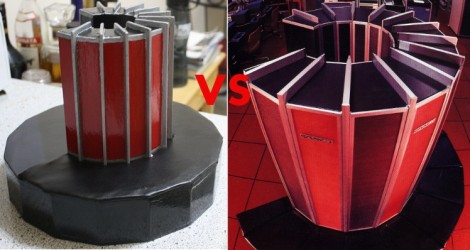
What made the project especially lovable was the refusal to stop at the logic. The builder also created a case that echoed the original Cray-1’s iconic shape. That choice was more than cute. It acknowledged that industrial design was part of the machine’s identity. A Cray without the silhouette is still a computer, but it loses some of the swagger.
There is something almost poetic about an FPGA board sitting inside a tiny version of a system once known for its dense ECL logic, careful cooling, and tightly managed signal paths. It is a museum piece, lab exercise, and fan letter all at once.
The Hard Part Was Not Just Rebuilding the Hardware
One of the best parts of the story is also one of the most revealing. Recreating the processor was only half the battle. Software, storage, and historical artifacts turned out to be their own adventure. Follow-up reports described efforts to obtain and recover Cray software from an old 80 MB CDC disk pack. When the original control electronics proved unreliable, the recovery process reportedly shifted toward capturing analog data directly from the read head and preserving a magnetic image for later decoding.
That development says a lot about retrocomputing in general. Hardware restoration is rarely just about soldering and Verilog. It is also archaeology. You need manuals, operating systems, utilities, interfaces, formats, and a small reserve of emotional resilience. Old systems do not merely hide their secrets. They scatter them across storage media, institutional memory, and forgotten documentation.
In that sense, the tiny Cray-1 project became something larger than a homebrew build. It became a recovery mission for lost computing context. That matters because computing history is not only about famous machines. It is about preserving the knowledge required to make those machines meaningful again.
Why This Project Matters to Modern Engineers
The tiny Cray-1 is fun to look at, but its deeper value is educational. It reminds modern developers that architecture still matters. Clock speed matters, but not by itself. Memory bandwidth matters. Signal delays matter. Packaging matters. Software support matters. Elegant machines are usually built by people who understand that performance is a system property, not a bragging-rights sticker.
That lesson feels timely. Today’s computing world is packed with accelerators, GPUs, AI hardware, vector extensions, and specialized architectures. In other words, the industry never really left the territory the Cray-1 helped define. We just changed the packaging, shrank the process nodes, and gave everything more acronyms. Underneath the buzzwords, engineers are still solving a familiar puzzle: how do you move data efficiently, keep hardware fed, and avoid wasting cycles?
An FPGA recreation of the Cray-1 also demonstrates the value of learning by building. Reading about vector registers is useful. Implementing the behavior in hardware is a completely different level of understanding. A project like this forces the builder to engage with timing, control logic, hazards, arithmetic units, and architectural compromises. That is where abstract admiration turns into practical knowledge.
Moore’s Law With a Wink
Computer History Museum has described the miniature system as a modern reimagining that showcases the power of Moore’s Law. That framing is exactly right. A machine that once represented the edge of institutional supercomputing can now be approximated on a commercial programmable device and displayed beside the original for effect. It is hard not to smile at that. The comparison is both technical and theatrical, which Seymour Cray probably would have appreciated.
The point is not that an FPGA board “beats” the original in some simplistic scoreboard contest. The point is that computing progress can compress entire eras of engineering into something approachable enough for an individual builder to explore. History becomes hands-on. That is a big deal.
What the Tiny Cray-1 Teaches About Great Design
Great designs age better than fashionable ones. The Cray-1 remains compelling because its underlying ideas were strong. It attacked bottlenecks directly. It treated physical layout as part of computational performance. It aligned architecture with real workloads. And it never apologized for looking memorable while doing serious work.
The FPGA recreation highlights those same strengths by recreating them under constraint. You cannot fit every feature. You cannot always reach the original timing. You may have to trim memory, alter I/O, or leave some conveniences for later. But that pressure reveals the essentials. When builders try to recreate a system and still keep running into the same fundamental truths, that tells you the original designers understood the problem deeply.
That is the quiet brilliance of the tiny Cray-1 project. It does not just celebrate old hardware. It validates old ideas by proving they still reward close study.
Conclusion
Tiny Cray-1 Courtesy Of An FPGA is the kind of story that makes computing feel wonderfully alive. It connects the heroic age of supercomputers to the modern maker world without flattening either one. The original Cray-1 remains a monument to vector processing, packaging discipline, and system-level thinking. The FPGA recreation turns that monument into a conversation piece, a teaching tool, and a tribute built with genuine technical respect.
Most of all, the project proves that curiosity scales beautifully. In the 1970s, curiosity helped create one of the most iconic supercomputers ever built. In the FPGA era, curiosity helped shrink that legend to desktop size without shrinking its importance. That is a lovely trick, and not just because it makes the world’s nerdiest loveseat dramatically easier to move.
Extended Experience: What It Feels Like to Engage With a Tiny Cray-1
There is a special kind of thrill that comes from seeing a legendary computer recreated at miniature scale. It is not the same feeling as reading a museum placard, watching a documentary, or skimming a technical manual. A tiny Cray-1 built around an FPGA makes the past feel unexpectedly present. Suddenly the machine is no longer an abstract milestone in computer history. It becomes an object you can imagine debugging, timing, wiring, and maybe talking to after midnight while promising yourself this is definitely the last hardware project before bed.
The experience is powerful because the project sits at the intersection of admiration and problem-solving. On one side, there is reverence for Seymour Cray’s original design: the vector architecture, the compact signal paths, the balance between beauty and function. On the other side, there is the hands-on grind of modern engineering: fitting logic into real hardware, negotiating timing limits, managing memory constraints, and deciding which features must stay and which can wait. That tension is what makes the tiny machine feel alive. It is not a plastic model of greatness. It is greatness translated through constraint.
There is also an emotional dimension that people outside retrocomputing sometimes miss. Recreating a system like the Cray-1 is a way of holding a conversation across generations of engineering. You start to understand why the original builders cared so much about wire length, cooling, packaging, and throughput. You stop seeing those details as trivia and start seeing them as the difference between a respectable machine and a revolutionary one. The project becomes a laboratory for empathy. You are not just learning what the Cray-1 did. You are learning how its designers thought.
Then comes the wonderfully messy part: software, storage, and recovery. The moment you realize that building the hardware is only half the story, the project becomes even more interesting. Recovering old disk data, chasing missing system software, and piecing together operational context adds a detective layer that pure hardware projects rarely have. It feels less like assembling a replica and more like reviving a civilization one artifact at a time.
That is the lasting experience of a tiny Cray-1 courtesy of an FPGA. It inspires awe, yes, but it also invites participation. It tells students, hobbyists, and professional engineers that history is not sealed behind glass. With enough patience, enough documentation, and enough stubbornness, it can be rebuilt, questioned, and appreciated from the inside. And that may be the most supercomputer thing about it.