Some celebrity legends involve wild parties, mysterious feuds, or one suspiciously missing Oscar speech. Dick Van Dyke’s involves walnuts. Lots of walnuts. So many walnuts, in fact, that if you hear someone say, “Never mention walnuts around Dick Van Dyke,” they are not talking about a snack preference, a nut allergy, or a secret Hollywood diet plan. They are pointing to one of the funniest, strangest, and most beloved episodes of The Dick Van Dyke Show: “It May Look Like a Walnut.”
The title sounds innocent enough. A walnut, after all, is a perfectly respectable food. It sits politely in brownies, improves banana bread, and shows up at holiday parties pretending to be fancy. But in the world of Rob Petrie, the quick-witted comedy writer played by Dick Van Dyke, walnuts become tools of alien invasion, psychological panic, and sitcom perfection. The result is a classic television episode that still makes fans laugh, quote, and side-eye a bowl of mixed nuts with mild suspicion.
To understand the joke, you have to step into the stylish, black-and-white universe of The Dick Van Dyke Show, a CBS sitcom created by Carl Reiner and centered on Rob Petrie’s home life with Laura Petrie and his office life as a writer for the fictional Alan Brady Show. The series ran from 1961 to 1966 and helped define the modern workplace-and-family sitcom. It mixed smart writing, physical comedy, romantic banter, and a sense that grown-ups could be silly without becoming cartoonish. Then came the walnuts, and television comedy briefly put on a science-fiction hat.
The Walnut Episode That Became a Sitcom Legend
“It May Look Like a Walnut” aired during the second season of The Dick Van Dyke Show on February 6, 1963. The premise begins with something very ordinary: Rob watches a scary science-fiction program before bed. Laura, played by Mary Tyler Moore, is not thrilled. Rob, being a loving husband in the most mischievous sitcom way possible, describes the terrifying plot anyway. This is where domestic comedy meets outer-space nonsense.
In Rob’s story, an alien named Kolak comes from the planet Twilo. Kolak looks suspiciously like Danny Thomas, which is funny before he even says a word. The aliens use walnuts as their weapon of choice. Their goal is not simply to conquer Earth. That would be too easy, too obvious, and frankly too normal. Instead, they want to remove people’s thumbs and imaginations. Without thumbs, humans cannot grip tools. Without imagination, they cannot create, dream, joke, write, or complain creatively about traffic. It is an absurd threat, but it works because the show treats the absurdity with perfect deadpan commitment.
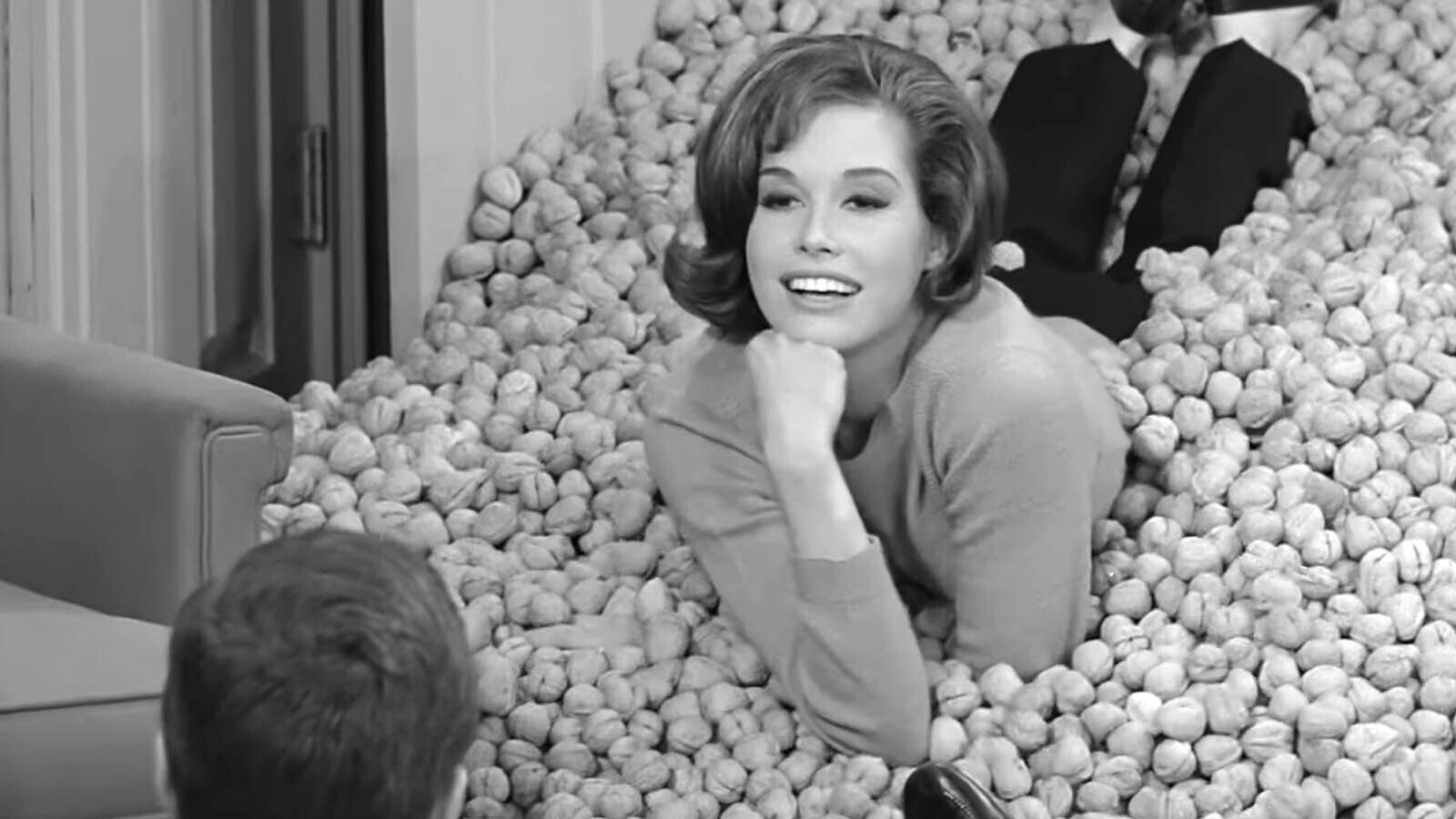
The next morning, Rob wakes up and finds walnuts everywhere. Not a tasteful handful. Not a decorative bowl. Everywhere. The living room is covered. Laura behaves oddly. The office feels wrong. People around Rob seem to know more about Twilo than they should. Even worse, Rob begins to suspect the alien invasion may not have stayed inside last night’s television program. The result is a dreamlike comedy of paranoia, where the audience laughs because Rob is losing his grip on reality while still trying to remain polite about it.
Why Walnuts Became the Perfect Comic Weapon
The brilliance of the episode is that walnuts are not scary. That is exactly why they are funny. A ray gun is expected. A monster is expected. A flying saucer is expected. But a walnut? A walnut looks like something your aunt keeps in a crystal dish next to hard candy that has been there since the Eisenhower administration. Turning that harmless object into a symbol of cosmic terror is the kind of comic reversal that made Carl Reiner’s writing so durable.
The walnut also has a strange visual quality. It looks a little like a tiny brain. It is hard, wrinkled, and oddly secretive. When the episode connects walnuts with imagination, the gag becomes even sharper. The aliens are not just threatening Rob’s body; they are threatening what makes him Rob: his creativity. Rob Petrie is a professional comedy writer. His imagination is his livelihood. Take away his imagination, and he is not just frightened. He is unemployed in the most existential way possible.
Then there are the thumbs. The thumb joke is classic physical comedy because it gives Dick Van Dyke something to act with. Van Dyke’s genius has always involved his whole body: the long legs, the rubbery reactions, the nervous elegance, the way he could fall, bend, dance, or panic and still look charming. A story about losing thumbs gives him a chance to play terror with his hands, his face, his posture, and that wonderful Rob Petrie mix of intelligence and helplessness.
Dick Van Dyke, Physical Comedy, and the Art of Looking Alarmed
Dick Van Dyke’s performance is the reason the walnut joke lands so well. Rob Petrie is not a fool. He is smart, verbal, and usually reasonable. That makes his descent into walnut panic even funnier. If Buddy Sorrell got carried away by an alien conspiracy, viewers might shrug. Buddy was born ready for chaos. But Rob is the audience’s anchor. When he starts looking at walnuts as if they are tiny ambassadors of doom, we feel the ridiculousness through him.
Van Dyke plays fear with precision. He does not simply scream and flail. He calculates, reacts, second-guesses, and then flails. That order matters. Great physical comedy is not random movement; it is emotional logic expressed through the body. Rob sees evidence. Rob doubts himself. Rob tries to act normal. Rob fails to act normal. The comedy grows because every reaction is rooted in a believable human instinct: “Something is wrong, and I would very much like not to be the only person noticing it.”
This is also why the episode remains one of the most discussed installments of the series. It uses surrealism without abandoning character. The audience still recognizes Rob and Laura’s marriage, Rob’s workplace, and the show’s rhythm. The alien plot does not replace the sitcom; it invades it. That is a much funnier trick than simply doing a random spoof.
Carl Reiner’s Sitcom Genius: Make the Weird Feel Domestic
Carl Reiner understood that comedy becomes stronger when it begins with something emotionally familiar. The Dick Van Dyke Show often drew humor from ordinary life: marriage, work pressure, jealousy, embarrassment, social mistakes, and the tiny disasters that happen when people try to appear more composed than they are. “It May Look Like a Walnut” may be the show’s wildest episode, but its foundation is still recognizable: one spouse watches something scary, teases the other, and then pays for it in dream logic.
That domestic foundation keeps the episode from becoming pure parody. Yes, it riffs on science-fiction anxieties of the era, including the style of shows like The Twilight Zone and invasion stories that reflected Cold War nerves. But the real joke is marital. Rob scares Laura, and then the universe seems to scare Rob right back. It is comic justice with snack food.
Reiner and the show’s writers also knew how to balance sophistication with broad laughs. The idea of imagination theft is clever. The mountain of walnuts is wonderfully silly. The alien named Kolak is bizarre. The episode works for viewers who enjoy sharp television satire and for viewers who simply enjoy seeing a living room look like a squirrel had a nervous breakdown.
Mary Tyler Moore’s Laura Petrie Makes the Nightmare Work
It is impossible to talk about the walnut episode without Laura Petrie. Mary Tyler Moore gave Laura a combination of grace, wit, warmth, and playful irritation that made her one of television’s defining sitcom characters. In this episode, Laura’s reactions help set the emotional stakes. She begins as the frightened partner who does not want Rob’s scary story planted in her head. Later, she becomes part of the strange world Rob fears.
That shift is crucial. The episode is funny because Laura is usually Rob’s safe place. When she seems connected to the walnut madness, Rob loses his emotional footing. The home is no longer just the home. The wife is no longer just the wife. Breakfast is no longer just breakfast. Even scrambled eggs cannot be trusted if someone mentions scrambled walnuts.
Moore’s performance makes the surrealism elegant instead of messy. She does not overplay the weirdness. She lets the odd behavior sit inside Laura’s usual charm, which makes Rob’s panic even more understandable. A less controlled performance would have turned the episode into a sketch. Moore helps keep it a sitcom classic.
Danny Thomas as Kolak: The Guest Star Who Made Twilo Famous
Danny Thomas guest stars as Kolak, the alien figure at the center of Rob’s nightmare. Casting Thomas was part of the joke. He was a familiar television face, so seeing him transformed into a strange visitor from Twilo gave the episode an extra layer of comic recognition. The audience did not need a complicated alien costume to understand the gag. The humor came from the collision between a known entertainer and an absurd sci-fi threat.
Kolak’s plan is silly, but the show presents it with enough confidence that viewers accept the rules while laughing at them. Walnuts matter. Thumbs matter. Imagination matters. The planet Twilo matters, at least for the length of the episode. That is one of the great lessons of comedy writing: the more ridiculous the premise, the more seriously the characters must behave inside it.
Why Fans Still Remember the Walnuts
Many classic sitcom episodes are remembered for a line, a kiss, a guest star, or a big emotional reveal. “It May Look Like a Walnut” is remembered for an image: walnuts pouring into Rob and Laura’s world like nature’s least threatening apocalypse. Visual comedy sticks. Once you have seen the Petrie home invaded by walnuts, the image lodges in your brain like a punchline with a shell.
The episode also benefits from being different. The Dick Van Dyke Show was consistently smart, but this installment took a bigger swing than usual. It experimented with genre while still protecting the show’s identity. That kind of creative risk is why fans and critics continue to rank the episode among television’s great half-hours. It is not merely “the one with walnuts.” It is the one that proves a traditional sitcom could become strange, cinematic, and psychologically playful without losing its heart.
Modern viewers may also recognize its DNA in later television. Sitcoms and genre shows have repeatedly used dream episodes, parody episodes, alternate realities, and surreal domestic settings. Even WandaVision, with its love letter to classic TV formats, reminded a new generation how deeply shows like The Dick Van Dyke Show shaped the language of television. When a black-and-white sitcom can still echo through superhero storytelling decades later, that is not nostalgia doing all the work. That is structure, style, and imagination.
So, Should You Really Never Mention Walnuts Around Dick Van Dyke?
Of course, the phrase is a joke. There is no evidence that Dick Van Dyke has spent the last several decades fleeing bakeries, avoiding banana bread, or demanding walnut-free hotel rooms. In fact, Van Dyke has spoken warmly about the episode and its place among his favorites. The warning is fan language. It means: if you bring up walnuts, you are not just talking about food. You are opening a portal to Twilo.
That is the charm of classic television fandom. Ordinary words become secret handshakes. Say “ottoman,” and fans think of Rob Petrie tripping in the opening credits. Say “walnut,” and they think of aliens, missing thumbs, Laura’s eerie calm, and Rob’s increasingly desperate face. The object becomes a memory trigger.
In that sense, walnuts around Dick Van Dyke are like madeleines for sitcom lovers, except crunchier and more likely to suggest an invasion. They call back to a specific moment when television comedy dared to be wonderfully odd. They remind us that a great sitcom does not need expensive effects to create a universe. Sometimes all it needs is a brilliant cast, a fearless script, and enough walnuts to make a grocery manager nervous.
What the Walnut Episode Teaches About Timeless Comedy
1. Start With Real Relationships
The episode works because Rob and Laura feel real. Their teasing, irritation, affection, and timing create a believable base. Once the weirdness arrives, viewers stay invested because the relationship is already strong. This is a lesson modern comedy sometimes forgets: absurdity lands better when the audience cares about the people trapped inside it.
2. Use Absurd Details With Confidence
Walnuts, thumbs, imagination, Twilonone of these elements should fit together. Yet the episode commits to them. The confidence is the joke. Comedy often fails when it apologizes for being silly. “It May Look Like a Walnut” never apologizes. It simply places another walnut on the floor and dares Rob Petrie to deal with it.
3. Let Physical Comedy Tell the Story
Dick Van Dyke’s movement does as much storytelling as the dialogue. His body registers suspicion, fear, confusion, and panic before he fully explains them. That is why his comedy remains so watchable. He does not just deliver punchlines; he becomes the punchline’s architecture.
4. Make the Strange Emotionally Logical
Even in a dream, the episode follows emotional logic. Rob scared Laura. Rob becomes scared. Rob fears losing imagination because imagination defines him. The plot is surreal, but the anxiety is human. That combination is why the episode has aged better than many more “realistic” sitcom plots from the same era.
Experiences Related to “This Is Why You Never Mention Walnuts Around Dick Van Dyke”
Watching “It May Look Like a Walnut” today is a peculiar experience because it feels both old-fashioned and oddly modern. The pacing, wardrobe, and black-and-white photography clearly belong to early 1960s television. Yet the idea of a sitcom bending reality, parodying another genre, and turning a household object into a psychological symbol feels surprisingly current. Many viewers come to the episode expecting a gentle vintage comedy and leave thinking, “Wait, did a classic family sitcom just do a mini science-fiction horror spoof about identity, creativity, and snack-based invasion?” Yes. Yes, it did.
For first-time viewers, the funniest experience is often the slow realization that the episode is not going to behave like a normal installment. At first, Rob and Laura are simply in bed talking about a scary show. That scene feels domestic and familiar. Then Rob’s description becomes too vivid. The alien rules become too specific. The walnuts start to matter too much. By the time Rob wakes to a home full of them, the viewer has already crossed from sitcom comfort into comic unease. It is like realizing your living room rug has joined a cult.
Longtime fans experience the episode differently. They know the walnut avalanche is coming, so the pleasure is in anticipation. Every line becomes part of the setup. Every glance from Laura carries extra flavor. Rob’s confidence early in the episode becomes funnier because viewers know he is about to become the victim of his own imagination. That repeat-viewing quality is one reason the episode remains so beloved. The joke does not depend entirely on surprise; it depends on craft.
There is also a shared cultural experience around the episode. Fans recommend it the way people recommend a classic movie: “You have to see the walnut one.” The phrase sounds ridiculous to outsiders, which makes it even better. It creates a tiny community of viewers who understand that a walnut can be more than a walnut. It can be a reference, a warning, a punchline, and a tribute to one of television’s great comic performers.
For writers, comedians, and TV lovers, the episode offers another experience: admiration. It shows how far a simple idea can go when every part of production supports it. The script has a memorable premise. The cast plays it with conviction. The physical staging gives the comedy scale. The sci-fi parody adds flavor without overpowering the characters. Nothing feels lazy. Even the absurdity is disciplined.
And then there is the personal, almost cozy experience of watching Dick Van Dyke be Dick Van Dyke. His Rob Petrie is nervous, clever, expressive, and deeply human. He can make a small hand gesture funny. He can make fear look like choreography. He can turn a room full of walnuts into a comic landmark. That is why the title “This Is Why You Never Mention Walnuts Around Dick Van Dyke” works so well. It is playful, but it points to something real: a single episode became so vivid that one ordinary word still summons an entire performance.
So the next time you see walnuts on a dessert table, pause for a second. Somewhere in the grand museum of television memory, Rob Petrie is looking worried, Laura Petrie is acting suspiciously calm, and Kolak from Twilo is probably making plans. It may look like a walnut. But if you know your classic sitcoms, you know better.
Conclusion
The reason you “never mention walnuts around Dick Van Dyke” is not scandalous, medical, or mysterious. It is much better than that. It is comedy history. The phrase points to “It May Look Like a Walnut,” the unforgettable Dick Van Dyke Show episode that turned a harmless nut into a symbol of alien invasion, lost imagination, missing thumbs, and Rob Petrie’s beautifully performed panic.
More than sixty years later, the episode still works because it combines smart writing, committed acting, physical comedy, and surreal imagination. Carl Reiner’s creative vision, Mary Tyler Moore’s elegant comic timing, Danny Thomas’s oddball guest role, and Dick Van Dyke’s masterful performance all come together in one gloriously strange half-hour. The walnuts are funny, but the real reason they endure is that the episode understands timeless comedy: make the characters real, make the situation impossible, and let the audience enjoy the collision.
In other words, walnuts are safe to eat. Just do not be surprised if a classic TV fan sees them and immediately starts checking their thumbs.