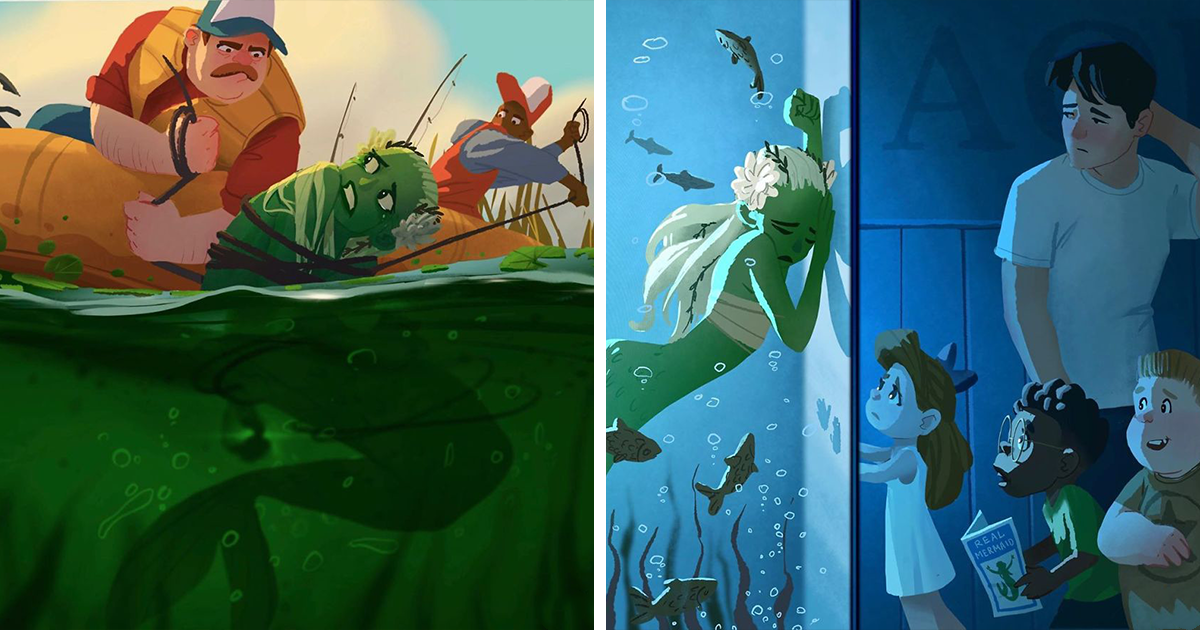
Andy Ivanov’s illustrated tale May, the Mermaid of Lily Lake begins like a charming fantasy romance, swerves into danger, and finishes with an emotional twist involving a magical flower, a selfless sacrifice, and one remarkably persistent villain. Here is how the complete Green Mermaid story unfolds, why its final installment is actually a prequel, and what its ending says about love, freedom, and humanity’s unfortunate habit of touching things after being specifically told not to.
What Is the Green Mermaid Story?
The Green Mermaid is May, the central character in Ukrainian artist Andy Ivanov’s digital illustration series May, the Mermaid of Lily Lake. Ivanov originally developed the story while participating in MerMay, an annual art challenge that encourages artists to create mermaid-themed work throughout May.
Instead of producing a collection of unrelated mermaids, Ivanov connected his images into a continuous narrative. That decision transformed a drawing challenge into a miniature animated movie without the actual animation. Each frame functions like a frozen cinematic moment, using expressive faces, dramatic lighting, carefully placed details, and only a small amount of dialogue.
The story follows May, a green-skinned lake mermaid whose life is magically connected to a white lily. She meets a young human man, falls in love with him, saves his life more than once, and becomes the target of a hunter who views every beautiful living thing as something to capture or possess.
In other words, the hunter is the sort of person who would see a sign reading “Do Not Pick the Enchanted Life-Sustaining Flower” and immediately begin looking for gardening gloves.
The “Final Part” Takes the Story Back to the Beginning
The most unusual feature of the Green Mermaid finale is that it does not continue beyond the previously released ending. Instead, Ivanov went backward and created a prequel showing how May and the young man originally met.
This choice completes the emotional circle. Readers had already seen the couple protect each other, face a hunter, and risk everything for their relationship. The last published installment reveals the innocent encounter that placed all those later events in motion.
May Notices the Stranger
In the prequel, May watches the young man near Lily Lake and wonders who he is. She is curious, shy, and clearly fascinated by him before they have exchanged more than a few startled expressions.
When she finally approaches, the meeting is awkward in the most charming possible way. May is nervous, while the man is surprised to discover that the mysterious figure in the water is not a fish, a reflection, or the result of staying outdoors without enough snacks.
He reassures her that she does not need to be afraid. May decides to trust him, establishing one of the story’s central ideas: meaningful relationships begin not with ownership, but with a willingness to make another person feel safe.
A First Kiss Goes Unexpectedly Wrong
May experiences a powerful new emotion and kisses him. Unfortunately, mermaid biology apparently forgot to consult the romance handbook. Her kiss poisons the human, leaving him unconscious and May horrified by what she has accidentally done.
She rushes to save him with a petal taken from her magical lily. The petal restores his life, but the gift comes at a cost because the flower is connected directly to May. By giving him part of the lily, she is also giving him part of herself.
This scene explains why the Petal of Life appears later and why the young man is able to survive injuries that would otherwise end the story much sooner. More importantly, it establishes May’s instinctive generosity. Her first response to danger is not self-protection. It is sacrifice.
How the Complete Green Mermaid Story Unfolds
Once the prequel is placed before the original chapters, the narrative becomes easier to understand. The couple’s relationship is built through a sequence of exchanged gifts, rescues, and increasingly serious sacrifices.
The Hunter Captures May
After the couple has formed a bond, a hunter discovers May and captures her. The young man initially participates in the encounter but quickly realizes that she will not survive in captivity.
That realization separates him from the hunter. Both men have seen the same extraordinary creature, but they respond in opposite ways. The hunter asks, “How can I possess this?” The young man asks, “How can I return her to where she belongs?”
He chooses to free May and carry her back to the lake. The hunter tries to stop him and shoots him during the escape. The violence is presented briefly rather than graphically, keeping the focus on the emotional consequences.
May then uses the Petal of Life to save him again. The magical object is no longer merely a convenient fantasy device. It becomes a record of everything she is prepared to give for someone she loves.
The Secret of the Lily Is Revealed
In the next chapter, the young man wakes after May has revived him. She leads him to a hidden place where her lily grows and explains that the flower contains her life. The petal she gave him was literally a fragment of her own existence.
For a moment, the secret location appears to offer safety. Naturally, this peaceful interlude lasts approximately as long as peace usually lasts in a fairy tale featuring an armed villain.
The hunter follows them and discovers the lily. May warns him not to touch it, but he sees the flower as another prize. He picks it despite her desperate attempt to stop him.
Because May’s life is bound to the lily, she collapses. The hunter’s mistake is not simply that he ignores a warning. His deeper failure is that he cannot distinguish admiration from entitlement. He sees beauty and assumes that beauty should belong to him.
So, How Does the Green Mermaid Story End?
The young man holds May after the lily has been plucked and realizes that she is dying. At first, the scene appears to deliver a tragic ending. May has repeatedly saved him, but now the magical source of her own life has been destroyed.
Then the meaning of the Petal of Life becomes clear.
The man still carries the life May previously gave him. He returns that gift, using the glowing petal to restore her. The following images show May awakening, confirming that his sacrifice has worked.
Their story ends with May alive and the love between them preserved. The hunter’s attempt to possess the lily nearly destroys everything, but the couple survives because the gift May freely gave is freely returned.
The ending is therefore happy, although it is not carefree. The couple has endured captivity, betrayal, injury, and loss. Their happy ending is earned through reciprocal sacrifice rather than delivered by a random spell arriving five seconds before the credits.
Why the Petal of Life Matters
The Petal of Life is the story’s most important symbol. On the surface, it is a magical object capable of restoring someone who is close to death. Beneath that function, it represents trust, vulnerability, and the part of ourselves we give to people we truly love.
May gives the petal without knowing whether the relationship will last. She does not treat generosity as a transaction. The young man later returns it for the same reason. Neither character keeps a careful emotional receipt.
Their actions create a balanced relationship. May is not merely a magical woman waiting to be rescued, and the human is not a flawless hero charging into danger with perfect hair. Both save the other. Both make mistakes. Both become vulnerable.
That balance gives the fantasy emotional credibility. The audience may not have experience with enchanted lake flowers, but most people understand that healthy love involves mutual care rather than one person permanently acting as the other’s emergency repair department.
The Hunter Represents Possession Without Respect
The hunter is more than a convenient villain. He embodies the attitude that nature exists to be captured, displayed, or consumed.
He wants May because she is rare. He wants the lily because it is beautiful and powerful. At no point does he ask what either one needs in order to survive. His curiosity is separated from empathy, making it destructive.
This supports the environmental message Ivanov has associated with the series: people should love and respect nature rather than trying to own it. The story communicates that lesson through emotion instead of delivering a lecture with twelve charts and a disappointed-looking park ranger.
The young man represents the opposite approach. He initially becomes involved in May’s capture, but he changes when he understands the consequences. His redemption begins when he stops treating her as a discovery and starts recognizing her as a living individual with a home, fears, and choices of her own.
Why the Prequel Works as a Finale
Ending a series with its beginning can be risky. A prequel may feel unnecessary when readers already know what happens later. Ivanov avoids that problem because the new chapter changes the meaning of familiar events.
Before the prequel, the Petal of Life is mysterious. After the prequel, readers understand that May first used it because her own affection accidentally endangered the man. That detail gives her later decision to save him even more weight.
The prequel also makes the final sacrifice feel inevitable rather than convenient. May gave him a part of her life at the beginning. He gives it back at the end. The narrative becomes a circle, with the same magical object passing between them as their relationship develops.
Chronologically, the story ends with May opening her eyes. Emotionally, it ends with the audience finally understanding why the petal was placed in the young man’s hand in the first place.
Visual Storytelling Does Most of the Talking
Ivanov’s illustrations are influenced by modern animated films, and that influence is visible in the expressive character designs. May’s oversized eyes, fluid poses, and changing facial expressions make her emotions readable before any caption appears.
Color also carries narrative meaning. Green connects May to the lake, vegetation, and lily. Warm golden light frequently accompanies affection or healing, while colder shadows appear during captivity and danger.
The composition of each frame guides the viewer’s attention like a film camera. Wide images introduce the lake and establish mood. Close-ups reveal fear, recognition, or hope. The repeated glow of the petal serves as a visual signal that life and love remain present even when the surrounding scene becomes dark.
Dialogue is kept brief, allowing readers from different countries to understand the story easily. The images do not merely decorate the words; they carry most of the plot. Remove the dialogue, and the central emotions would still be recognizable.
How May Fits Into the Long Tradition of Mermaid Stories
Mermaid legends have appeared in folklore for centuries, and they have not always been friendly romances. Older stories frequently portray aquatic beings as warnings, omens, dangerous temptations, or symbols of an unpredictable natural world.
Modern popular culture has gradually made mermaids more sympathetic. Instead of functioning only as mysterious threats to sailors, they are often portrayed as independent characters caught between different worlds.
May continues that development while adding an ecological perspective. She is neither a monster nor a glamorous collectible. She is part of the lake’s living system, so harming her environment harms her directly.
Her green coloring strengthens that connection. Rather than looking like a human who happens to own a tail, she appears to have grown from the water, lilies, moss, and forest surrounding her. She belongs to the lake in the same way that the lake belongs to no single human.
Why the Green Mermaid Story Connected With So Many Readers
The series succeeded partly because it was released one illustration at a time. Readers encountered cliffhangers, waited for the next frame, and discussed possible outcomes. That structure turned passive viewing into a shared online event.
The story is also easy to enter. It does not require a map, a royal family tree, three prequel novels, or the ability to pronounce the name of an ancient underwater kingdom. The audience needs only a lake, two sympathetic characters, one villain, and one extremely important flower.
Beneath that simplicity, however, are universally recognizable concerns: Will someone accept me as I am? Can trust survive betrayal? Is love strong enough to require sacrifice without becoming possession?
Ivanov lets viewers feel those questions rather than explaining every answer. That restraint gives the audience room to participate emotionally and interpret the silent moments for themselves.
Is the Ending Truly Happy?
May survives, so the literal answer is yes. Yet the ending carries a bittersweet quality because the lily has been damaged and the couple’s safety remains uncertain.
The hunter’s presence proves that their world still contains people who will exploit what they do not understand. Surviving one confrontation does not guarantee that the lake will never face another threat.
Nevertheless, the final awakening offers genuine hope. Love does not magically erase every danger, but it gives the characters the courage and generosity needed to face danger together.
The story also avoids suggesting that one character must disappear into the other’s world. May does not need to abandon her identity, lose her tail, or transform into a conventional princess to deserve love. The young man learns to meet her where she belongs.
What the Story Ultimately Teaches
The Green Mermaid story can be read as a romance, an environmental parable, or a compact lesson in visual storytelling. Its strongest message is that love and ownership are not the same.
The hunter wants to keep what fascinates him. The young man eventually wants May to remain free, even when protecting that freedom places him in danger. One attitude destroys; the other heals.
The Petal of Life expresses the same distinction. A gift has power because it is offered voluntarily. Once the characters stop calculating who owes whom, the petal becomes capable of traveling full circle and saving them both.
That is how the story about the Green Mermaid ends: not with conquest, possession, or a perfect world, but with a life freely given and lovingly returned.
The Reader Experience: Why the Green Mermaid Story Stays With You
Experiencing the Green Mermaid story is different from reading a conventional comic all at once. Its individual illustrations encourage the viewer to pause. A facial expression, reflection in the water, or small glowing petal can hold attention longer than an entire page of dialogue.
The first emotional response is often simple curiosity. May looks unusual but approachable, and the peaceful lake creates the impression that this will be a gentle fantasy. The humor and sweetness of her first meeting with the human make it easy to relax into the story.
Then the tone changes. The accidental poisoning introduces the idea that even affection can cause harm when two people come from different worlds. The moment is sad, but it is also strangely relatable. Most relationships include misunderstandings; May’s misunderstanding simply requires magical emergency medicine.
Waiting Between Panels Changes the Impact
Readers who originally followed the images as they were posted experienced the story through anticipation. Each unfinished moment created questions. Would May escape? Would the young man survive? What did the lily represent? Would somebody please keep the hunter at least fifty feet away from the landscaping?
Reading the complete series today is faster, but the emotional rhythm remains. The images still invite viewers to pause before moving forward. Taking that time makes the final return of the Petal of Life more satisfying because its importance has been quietly established across multiple scenes.
The Ending Encourages a Second Reading
After learning how the petal saves May, returning to the prequel changes the experience. Her original gift no longer seems like a single act of rescue. It becomes the beginning of a promise neither character fully understands yet.
The first kiss, the accidental poisoning, and the healing petal all foreshadow the conclusion. The story rewards readers for noticing repeated details, yet it never feels like a puzzle designed only to prove how clever the artist is.
A second reading also makes the young man’s development more visible. He begins as a surprised outsider and becomes someone willing to oppose the hunter, free May, and return the life she once gave him. His growth occurs through decisions rather than speeches.
The Story Makes Nature Feel Personal
Environmental messages sometimes feel distant because they are expressed through statistics or enormous global problems. The Green Mermaid story reduces that distance by connecting the health of one flower to the life of one beloved character.
When the hunter picks the lily, viewers do not merely observe damage to a plant. They immediately see what that careless action costs. The metaphor is straightforward, but the emotional connection makes it effective.
The experience may leave readers thinking differently about the natural places around them. A lake, garden, forest, or wetland is not valuable only because someone can photograph it, sell it, or take something home from it. Its living relationships may be invisible to the casual visitor.
A Small Story Produces a Surprisingly Large Emotion
Perhaps the most memorable aspect of the Green Mermaid series is how much feeling it creates with so little material. There are no lengthy histories of mermaid civilization and no complicated explanation of the flower’s magic. The audience understands what matters through behavior.
May saves the man. He frees May. She saves him again. When her own life fades, he returns the gift. That simple pattern gives the ending its emotional force.
Finishing the story can feel like reaching the end of a short animated film that somehow played entirely inside a series of still images. The final awakening offers relief, but the story’s deeper message remains: the most beautiful things survive through care, not captivity.
And that may be the reason May continues to linger in readers’ memories. She is not simply a green mermaid with an excellent character design. She represents the fragile, living wonder people claim to loveand the responsibility that begins the moment love stops asking, “How can I keep this?” and starts asking, “How can I protect it?”