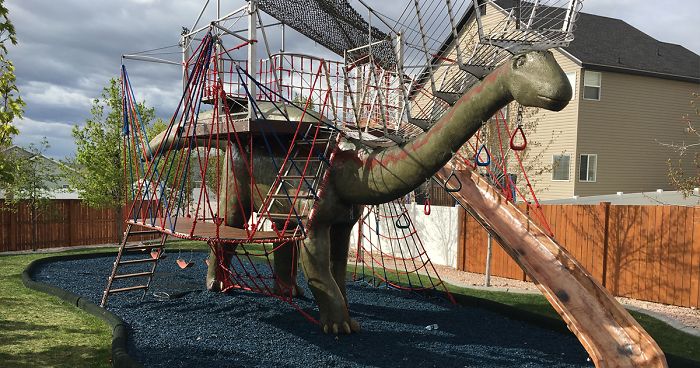
Some parents build a swing set. Some parents assemble a trampoline and spend the rest of the weekend trying to remember where they put the extra bolts. And then there is Matthew Cosman, a dad with a serious talent for fabrication, who built his kids a backyard dinosaur jungle gym so big it looks like it wandered out of Jurassic Park, took a wrong turn, and decided to become playground equipment.
The project is not just cute. It is enormous, wildly creative, and almost suspiciously cool. The dinosaur playground reportedly measures about 48 feet long, or roughly 14.6 meters, and includes swings, climbing areas, rope features, monkey-bar-style handles, a slide, glow-in-the-dark details, LED lighting, and enough “dad energy” to power a small suburb.
Modeled after an Apatosaurus-style long-neck dinosaur, the structure transforms the standard backyard playset into a full-blown adventure zone. It is part sculpture, part engineering project, part childhood dream machine, and part friendly warning to every other parent on the block: the birthday-party bar has officially been raised.
A Backyard Dinosaur Playground That Makes Ordinary Jungle Gyms Look Shy
Most backyard playsets follow a familiar formula: a little tower, a plastic slide, a couple of swings, maybe a rock wall if the kids are persuasive negotiators. Cosman took that formula, fed it protein, sent it to engineering school, and turned it into a 14-meter dinosaur jungle gym.
The body of the dinosaur was built with serious materials, including structural steel, aluminum, wood, foam, chicken wire, fiberglass, epoxy, Kevlar, carbon-reinforced elements, paint, and ceramic fillers. In other words, this was not a weekend project involving two-by-fours, optimistic instructions, and a cordless drill with one bar of battery left.
According to reported build details, the dinosaur itself weighed around 3,500 pounds before the footing. To keep the huge creature stable, Cosman used approximately 24,000 pounds of concrete. That is not a foundation; that is a dinosaur retirement plan. If this thing ever tries to “wander off,” it is going to need a forklift, a crane, and probably a permission slip.
Who Built The 14-Meter Dinosaur Jungle Gym?
The builder behind the project is Matthew Cosman, known online as “thecauseman.” He is a professional fabricator with a background connected to aerospace engineering, which explains why this backyard playground looks less like something bought from a catalog and more like something NASA might approve after checking the snack drawer.
Cosman reportedly built the dinosaur playground for fun, not as a paid commission. The project came from years of planning, collecting materials, and imagining something his kids would love. He had worked around dinosaur-themed attractions as a teenager and saw firsthand how powerfully children respond to giant prehistoric creatures. That early spark eventually turned into a backyard Apatosaurus with a slide attached.
Even better, it was not a completely solo mission. Family members helped with different parts of the work, including artistic touches, assembly, rope work, and finishing details. His kids were also involved, which may be the most meaningful part of the whole story. A playground is fun. A playground you watched your family build is a memory with bolts in it.
Why A Dinosaur Makes The Perfect Jungle Gym
There is something magical about dinosaurs and children. Dinosaurs are giant, mysterious, slightly ridiculous, and conveniently extinct, which makes them perfect for imagination. A long-neck dinosaur, especially one inspired by Apatosaurus, is an excellent shape for a play structure because the body creates a central climbing zone, the tail can support swing features, and the neck naturally leads the eye toward a lookout area.
Apatosaurus was a real sauropod dinosaur from the Late Jurassic period. It was a long-necked plant eater that lived in North America, and some specimens grew to about 69 feet long. That makes Cosman’s 48-foot playground dinosaur smaller than the real animal, but still large enough to make neighborhood squirrels reconsider their life choices.
The dinosaur form also adds story to movement. A regular slide is a slide. A slide coming off a dinosaur is an escape route from a prehistoric expedition. A rope climb becomes a jungle rescue. Swings hanging from the tail become a flying mission. For children, imaginative context changes everything. They are not just exercising; they are narrating, pretending, problem-solving, and turning the backyard into a world.
The Features That Make This DIY Dinosaur Playground So Impressive
1. A Massive Structural Build
The scale alone makes the project remarkable. A 48-foot-long backyard dinosaur is not something a person casually “throws together.” Cosman reportedly needed a crane to move the giant structure from his workshop into place at home. That detail says a lot: this was not only an art project but a logistics puzzle.
2. Climbing, Swinging, Sliding, And Exploring
The finished dinosaur jungle gym includes many of the elements kids love most: swings, climbing holds, rope features, monkey-bar-style handles, a crow’s nest area, and a slide. This matters because great playgrounds offer variety. Some children love climbing. Some love swinging. Some love hiding, pretending, and bossing around imaginary expedition teams. A multi-feature playset gives every kid a doorway into the adventure.
3. Lighting And Glow Details
Cosman also added LED lights and glow-in-the-dark rope clamp details, making the dinosaur playground visually exciting after dark. That does not mean children should play unsupervised at night, but it does mean the structure has a magical “movie set” quality. It is the kind of backyard feature that makes kids press their faces against the window after dinner and ask, with great seriousness, whether the dinosaur is awake.
4. Safety-Minded Choices
One of the most important details is the use of rubber chips for fall protection. Any elevated play structure needs a thoughtful landing surface, especially when climbing, swinging, and sliding are involved. Shock-absorbing surfacing, stable anchoring, maintenance, and active supervision are not optional extras; they are the difference between “epic backyard fun” and “why is everyone suddenly driving to urgent care?”
The Engineering Lesson: Big Dreams Need Boring Details
The funny thing about spectacular projects is that the finished result looks like pure imagination, but the process is usually full of practical decisions. Where will the weight go? What materials can handle weather? How will the structure resist tipping? How can children climb without encountering sharp edges, weak points, or awkward gaps? How will the surface below absorb falls?
Cosman’s dinosaur jungle gym is a great example of creativity meeting discipline. The playful exterior hides a serious skeleton of planning, fabrication, load support, composite work, and installation. It is a reminder that good DIY is not just confidence. It is patience, testing, research, and knowing when a crane is not “overdoing it” but simply the correct tool for moving a backyard sauropod.
For regular parents inspired by the story, the takeaway is not that everyone should build a 14-meter dinosaur. Most of us should probably start with something smaller, like a sandbox, a mud kitchen, or a climbing wall that does not require concrete by the ton. The real lesson is to build with intention. Make it fun, make it durable, and make safety part of the design from the beginning.
Why Outdoor Play Still Matters
Beyond the viral wow factor, this dinosaur jungle gym taps into something deeper: kids need active, imaginative play. Health experts recommend that young children stay active throughout the day, while school-age children and teens need at least 60 minutes of physical activity daily. A backyard play structure can help turn movement into something kids actually want to do, not something that sounds like homework wearing sneakers.
Climbing develops strength, coordination, balance, and confidence. Swinging gives children sensory input and rhythm. Slides encourage repeated movement and risk assessment. Rope features challenge grip strength and planning. Pretend play builds language, cooperation, and problem-solving. When children turn a dinosaur playground into a jungle rescue base, they are doing more than having fun; they are practicing how to think, move, negotiate, and imagine.
Play is also emotional. A child who climbs a little higher than yesterday learns bravery in small, manageable doses. A child who waits for a turn learns patience, at least in theory. A child who invents a dinosaur expedition with siblings or friends learns leadership, compromise, and the noble art of yelling, “No, I’m the paleontologist!” with conviction.
Safety Notes For Anyone Dreaming Of A Backyard Playground
Cosman’s project is extraordinary, but it also highlights why large DIY play structures require real caution. Playground safety organizations consistently emphasize active supervision, shock-absorbing surfaces, age-appropriate design, secure anchoring, and routine inspection. Falls are a major source of playground injuries, so the ground below the equipment deserves as much attention as the equipment itself.
For home playsets, a level base matters. Anchors matter. Protective surfacing matters. Loose-fill materials such as rubber mulch, engineered wood fiber, sand, pea gravel, or wood chips may be used depending on fall height and maintenance needs. Hard surfaces such as concrete, asphalt, bare dirt, or thin grass are not good landing zones under climbing or swinging equipment.
Parents should also inspect for rust, loose hardware, sharp edges, worn ropes, unstable platforms, and places where clothing could get caught. Helmets, drawstrings, scarves, and necklaces can create hazards on playgrounds. And yes, adults should supervise even when the backyard is familiar, because children are adorable little scientists whose main research question is often, “What happens if I jump from here?”
Why The Internet Loved This Dinosaur Jungle Gym
The internet loves a big creative dad project because it combines three irresistible ingredients: wholesome intention, impressive craftsmanship, and a final result that makes everyone say, “Wait, he built that?” Cosman’s dinosaur jungle gym checks every box. It is funny, generous, technically impressive, and built for play rather than profit.
People also responded because the project feels refreshingly physical. In an era when many kids are surrounded by screens, apps, and digital entertainment, a giant backyard dinosaur is a gloriously analog invitation to climb, run, swing, pretend, and get mulch in places mulch was never meant to go.
It also proves that a great family project does not have to be polished in the corporate sense. The charm comes from the human fingerprints: the collected scraps, the family help, the handmade textures, the learning curve, the problem-solving, and the joyful excess of building something “too big” simply because it will make children happy.
Experience Section: What Families Can Learn From A Dinosaur-Sized Project
Most families will never build a 14-meter dinosaur jungle gym, and frankly, most homeowners’ associations would need to sit down with a glass of water before approving one. But the experience behind Cosman’s project is surprisingly relatable. Every family has some version of “the big idea” that starts as a joke at the dinner table and slowly becomes real because someone refuses to stop imagining it.
The best part of a project like this is not only the final structure. It is the shared process. Children remember watching adults measure, cut, paint, repair, test, and try again. They see that creativity is not magic; it is effort wearing a funny hat. They learn that mistakes are normal, that big goals can be broken into small steps, and that grown-ups do not always have everything figured out before they begin.
For parents, the experience is a reminder that play does not have to be expensive to be meaningful. Yes, Cosman’s dinosaur was a major build, but the spirit behind it can show up in smaller ways: painting a cardboard rocket, building a backyard obstacle course, turning a tree stump into a fairy house, or designing a Saturday “dinosaur dig” with sand, toy fossils, and a few dramatic announcements. The size matters less than the invitation to imagine.
There is also a community experience hidden inside projects like this. A remarkable backyard play structure becomes a conversation starter. Neighbors ask questions. Kids gather. Adults smile. Suddenly the yard is not just private space; it becomes a little landmark of generosity and fun. That kind of shared joy is rare, and it is worth protecting with good safety rules, clear supervision, and respectful boundaries.
The emotional experience may be the most powerful of all. A child climbing onto a dinosaur built by a parent is not simply using equipment. That child is stepping into proof of love. The structure says, “I thought about what would make you happy, and then I built it with my hands.” That message lasts longer than paint, longer than rope, and probably longer than the memory of who got the first turn on the slide.
Conclusion
Matthew Cosman’s incredible dinosaur jungle gym deserves all the imaginary trophies the internet can hand out. It is a backyard playground, a work of art, an engineering challenge, and a love letter to childhood rolled into one massive Apatosaurus-shaped adventure. The 14-meter dinosaur reminds us that play is not a small thing. It builds bodies, brains, friendships, confidence, and family stories that get retold for years.
Not every parent can build a giant prehistoric play structure, and that is perfectly fine. The real award-worthy lesson is simpler: make space for wonder. Build something. Invent something. Let kids climb into a story. Whether it is a dinosaur jungle gym or a blanket fort in the living room, the best childhood adventures often begin when an adult says, “You know what would be fun?” and then actually means it.