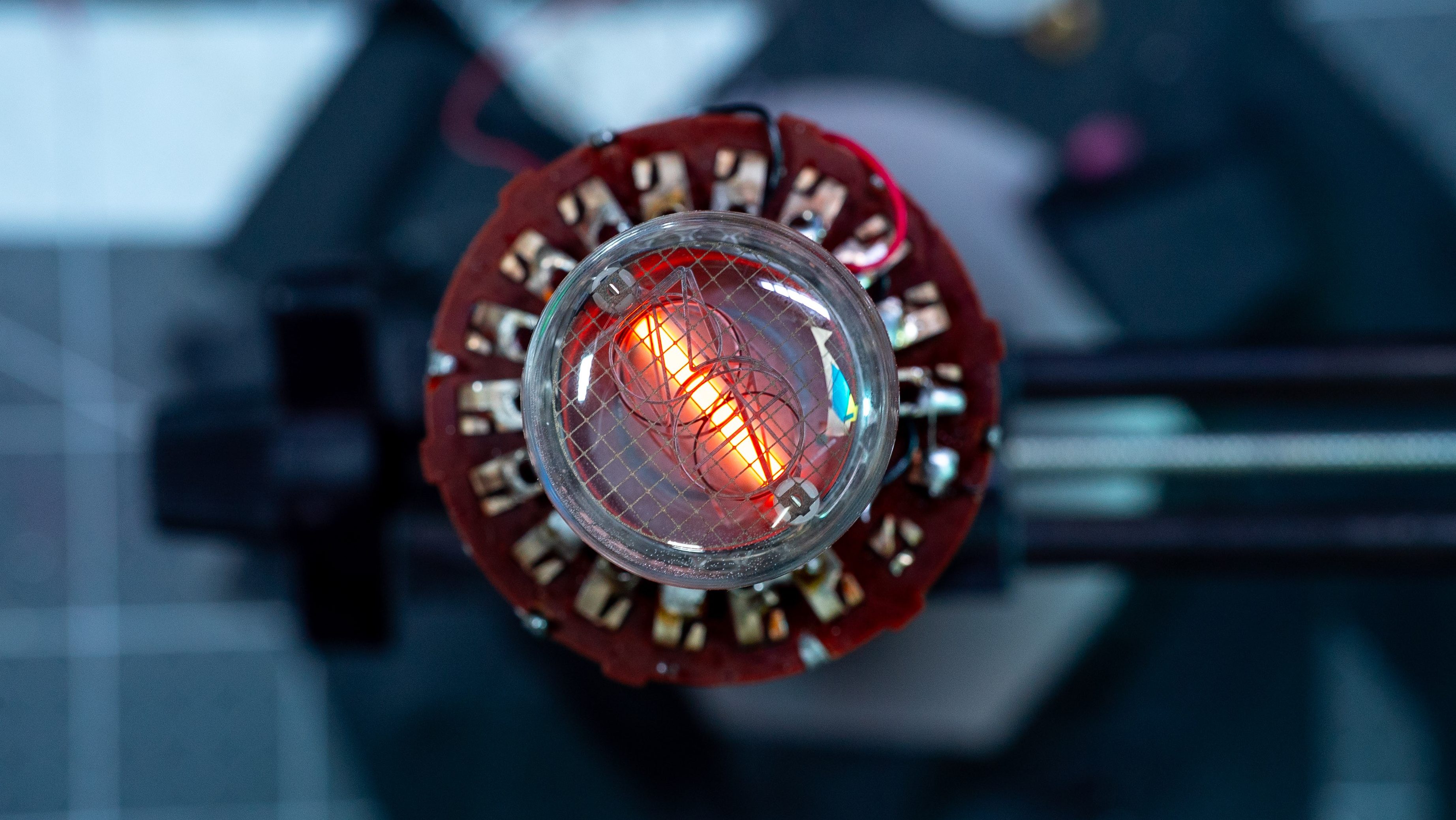
In the grand tradition of hacker conferences, where the badge is never just a badge and the lanyard is merely a suggestion, the 2024 Hackaday Supercon badge has already inspired something delightfully unnecessary: a Nixie tube addon. Yes, a real glowing, high-voltage, retro-futuristic Nixie tube attached to a Supercon badge. Because apparently LEDs were too normal, OLEDs were too polite, and someone looked at a pocket-sized conference badge and thought, “What this needs is 180 volts and vintage glass.”
The project, called NixieSAO, was created by Kevin Santo Cappuccio as a Simple Add-On, or SAO, for the 2024 Supercon badge. It is not a mass-market gadget, not a polished consumer accessory, and absolutely not the sort of thing you would find shrink-wrapped next to phone chargers at a big-box store. That is exactly why it is so charming. It captures the spirit of badge hacking: strange parts, bold ideas, a bit of chaos, and just enough engineering to make everyone nearby lean in and say, “Wait, does that actually work?”
What Is the 2024 Supercon Badge?
The Hackaday Superconference, often shortened to Supercon, is a gathering for people who enjoy making hardware do unusual things. Each year, the event badge becomes part identification card, part electronic playground, and part social icebreaker. The 2024 Supercon badge leaned heavily into the world of add-ons by offering six SAO ports, making it less like a name tag and more like a tiny electronic flower waiting to bloom into absurdity.
At the center of the badge is a Raspberry Pi Pico W, a compact microcontroller board with Wi-Fi and Bluetooth capability. The Pico W is based on the RP2040 chip, which includes dual-core Arm Cortex-M0+ processing, flexible GPIO, I2C, SPI, UART, PWM, and other features that make it popular for small embedded projects. For the badge, that means the hardware is not just decorative. It is a platform for interaction, communication, and experimentation.
The 2024 badge was designed to encourage makers to move beyond “blink a few lights and call it a day.” The SAO standard includes power, ground, I2C data, I2C clock, and two general-purpose input/output pins. In plain English, an addon can do more than glow. It can talk to the badge, respond to inputs, share data, or become part of a larger system. That is where the fun beginsand where the Nixie addon arrives wearing a leather jacket and smelling faintly of warm electronics.
So, What Exactly Is a Nixie Addon?
A Nixie tube is an old-school display tube that lights individual shaped cathodes inside a glass envelope. Instead of drawing numbers on a screen, the tube contains physical numeral shapes, usually stacked inside the glass. When the correct cathode is energized, a glowing digit appears with that unmistakable orange neon-like aura. It is not the most efficient way to display a number, but it may be one of the most dramatic.
The NixieSAO project uses a Burroughs 122P224 Nixie tube, a high-voltage power supply, a selector switch, and a handmade rotating contact arrangement. The basic idea is beautifully ridiculous: the user can spin the tube mechanism to change the displayed number. Is that practical? Not especially. Is it mesmerizing? Absolutely. Some projects solve problems. This one solves the serious modern crisis of not having enough glowing vintage numerals rotating on a conference badge.
The power supply is an important part of the design because Nixie tubes typically need around 180 volts to illuminate properly. That sounds dramatic because it is. The addon uses a small high-voltage supply capable of stepping low voltage up to the level needed for the tube. This is one reason the project feels so wonderfully at odds with modern badge hardware. The SAO ecosystem usually lives in the comfortable world of 3.3-volt logic, microcontrollers, and tiny LEDs. A Nixie tube brings the energy of a 1960s lab bench to a 2024 conference badge.
Why Hackers Love Nixie Tubes
Nixie tubes have a peculiar pull on makers. They are technically obsolete, mechanically delicate, electrically demanding, and often more expensive than modern displays. Naturally, hackers adore them. Their appeal is partly visual: the warm glow looks like something from an alternate timeline where computers stayed analog, calculators had personality, and every desk clock looked like it belonged to a secret government agency.
But the deeper appeal is that Nixie tubes force the builder to care about electronics as physical objects. A modern display can hide complexity behind a tidy module. A Nixie tube does not let you forget that electricity is happening. It has pins, glass, gas, high voltage, and visible structure. It is not just information; it is theater. When a Nixie lights up, it feels less like a pixel changing state and more like a tiny sign from the machine age whispering, “I still got it.”
That makes a Nixie addon for the 2024 Supercon badge a perfect cultural fit. Supercon attendees tend to appreciate projects that are technically clever, aesthetically weird, and slightly impractical in the best possible way. A Nixie SAO is not trying to beat a seven-segment LED display on cost, size, battery life, or simplicity. It wins because it has charisma. In hardware culture, charisma counts.
The Beauty of the SAO Ecosystem
SAO originally emerged from hacker-conference badge culture, where attendees wanted small boards that could plug into larger badges. Over time, the connector and pinout became a loose standard. The common SAO format uses a two-by-three, 0.1-inch header. The pins usually provide 3.3-volt power, ground, I2C data, I2C clock, and two GPIO lines. That small six-pin layout is enough to support anything from a simple LED board to sensors, displays, tiny instruments, interactive toys, and strange glowing artifacts from the parts drawer.
For 2024, Supercon placed SAOs front and center. The badge included six SAO ports and shipped with starter add-ons, including interactive and prototype-friendly petals. The point was clear: the badge was not just a finished object. It was a canvas. Makers could create add-ons that used I2C, GPIO, mechanical controls, displays, or whatever else could be persuaded to behave within the format.
The Nixie addon is especially funny because it almost resists the tidy logic of the standard. The SAO connector is modern, compact, and practical. The Nixie tube is vintage, high-voltage, and proudly extra. Put them together and you get the hardware equivalent of mounting a chandelier on a skateboard. It should not make sense, but once you see it, you understand why someone had to try.
How the NixieSAO Fits the Supercon Spirit
The Supercon Add-On Contest encouraged makers to create SAOs that were more than passive decorations. Categories included functional designs, fine art, fun projects, ambitious builds, strong communication concepts, and even least manufacturable entries. That last category is practically a love letter to projects like the NixieSAO: brilliant, hand-built, charming, and possibly allergic to production scaling.
The Nixie addon may not be the easiest thing to mass-produce. In fact, that is part of its joke and part of its appeal. It uses a real vintage tube, a salvaged selector switch, a handmade contact arrangement, and the kind of mechanical improvisation that makes manufacturing engineers stare silently into the distance. But for a hacker conference, that is not a flaw. It is a personality trait.
Great badge add-ons often work as conversation starters. A tiny multimeter SAO says, “Ask me about measurement.” An Etch-a-Sketch-inspired SAO says, “Ask me about nostalgia.” A Nixie tube SAO says, “Ask me why this badge appears to contain a glowing relic from a submarine control panel.” It invites curiosity, and curiosity is the unofficial currency of events like Supercon.
Not Just Blinky: Why Functional SAOs Matter
For years, many SAOs were essentially beautiful little art boards with LEDs. There is nothing wrong with that. PCB art is a legitimate craft, and a good badge addon can be delightful even if it does nothing more than sparkle. But the 2024 Supercon badge pushed the community toward more interactive designs by exposing useful I2C and GPIO features across its ports.
This matters because hardware communities grow when shared standards become playgrounds. When makers know the connector, pinout, and communication options ahead of time, they can build wild ideas before the event. That shortens the distance between “I wonder if this would work” and “Here, plug this into your badge.” The result is a small explosion of creativity: displays, controls, instruments, sensors, toys, and yes, a Nixie tube contraption that looks like it escaped from a Cold War calculator.
The NixieSAO shows that “functional” does not always mean practical. Function can mean interaction. It can mean motion. It can mean turning a knob and watching a glowing digit change because someone combined old display technology with a modern addon standard. In maker culture, usefulness is not the only metric. Delight is a feature.
Safety, High Voltage, and Common Sense
Because Nixie tubes require high voltage, projects like this deserve respect. A Nixie supply may be current-limited compared with large power systems, but high voltage is still not something to treat casually. The lesson for readers is not “go poke around high-voltage pins.” The lesson is that beautiful electronics often demand careful design, insulation, enclosure thinking, and a healthy dislike of accidental finger-to-circuit events.
That is another reason this addon is such a good teaching object. It reminds modern microcontroller fans that electronics is a broad field. One moment you are writing MicroPython to talk over I2C; the next, you are thinking about voltage conversion, mechanical contacts, vintage tube pinouts, and physical layout. Badge hacking can be whimsical, but it can also introduce serious engineering concepts in a low-pressure, highly memorable way.
Why This Project Gets Attention
The headline “There’s Already A Nixie Addon For The 2024 Supercon Badge” works because it contains three magic ingredients: speed, specificity, and absurdity. “Already” tells us the community is moving fast. “Nixie addon” tells us the hardware is unusual. “2024 Supercon badge” places it in a known maker event where people expect creativity but still enjoy being surprised.
In SEO terms, the topic sits at the intersection of several high-interest niches: Hackaday Supercon, SAO badges, Nixie tubes, Raspberry Pi Pico W, conference badge hacking, retro displays, and DIY electronics. Readers searching for one of those ideas are likely to care about the others. A Supercon attendee may want to understand the badge ecosystem. A Nixie tube fan may enjoy seeing the technology used in a new format. A maker may be looking for inspiration for their own addon. Everyone else may simply want to know why a conference badge needs a glowing orange number wheel. Fair question.
Specific Examples of What Makes It Clever
1. It Uses a Vintage Display in a Modern Format
The contrast is the hook. A Nixie tube belongs to the era of old test equipment, industrial counters, and scientific instruments. An SAO belongs to modern hacker badge culture. Combining them creates instant visual tensionand visual tension gets clicks, comments, and hallway conversations.
2. It Avoids Firmware Complexity
Many SAOs rely on microcontrollers and code. This one leans into physical switching and mechanical interaction. That gives the project a refreshingly direct feel. The number changes because hardware changes the electrical path. No app, no cloud account, no subscription tier named “Nixie Pro Plus.” Beautiful.
3. It Is Handmade in a Way People Can Recognize
The charm is not only in the final glow. It is in the visible improvisation: salvaged parts, manual fitting, rotating contacts, and a design that looks like it was built by someone who understands both electronics and the emotional value of not overplanning every single detail. Precision is wonderful. So is creative momentum.
4. It Fits the “Least Manufacturable” Joke Perfectly
Some projects are born for assembly lines. This one feels born for a workbench covered in wire clippings, coffee, and one suspiciously useful old component box. That makes it ideal Supercon material. It may not scale, but it sparklesliterally.
Experience Section: What This Topic Teaches Makers and Readers
Spending time with a project like the NixieSAO teaches a lesson that is easy to forget in a world of clean dev boards and polished modules: great hardware projects do not always begin with a product roadmap. Sometimes they begin with a weird part sitting on the bench and a question: “Could I make this fit?” That is one of the most valuable instincts a maker can develop.
For beginners, the first takeaway is that constraints can be creative fuel. The SAO connector has only a handful of pins. The badge has a defined format. The addon must be small enough to physically attach. Instead of killing creativity, those limits give the project shape. A blank page can be intimidating. A six-pin connector, a power budget, and a deadline before Supercon? That is a challenge with personality.
The second takeaway is that older technology can still teach modern lessons. Nixie tubes are not efficient displays compared with LEDs or OLED panels. They are not cheap, rugged, or simple. Yet they force a builder to think about voltage, current limiting, mechanical mounting, digit selection, thermal behavior, insulation, and user safety. Those are real engineering topics. The glow is the reward, but the learning happens in the messy middle.
The third experience is social. Badge add-ons are not only electronic accessories; they are wearable conversation engines. At a hacker conference, walking around with a strange addon is like carrying a friendly invitation. Someone notices it. They ask about it. You explain the build. They show you their badge. Suddenly two strangers are discussing I2C addresses, weird old components, and whether a tiny multimeter SAO is more practical than a rotating Nixie digit. This is how communities become real: not through perfect products, but through shared enthusiasm.
For content creators and bloggers, the NixieSAO also offers a strong example of why specificity matters. “Cool electronics project” is vague. “A rotating Nixie tube addon for the 2024 Supercon badge” is instantly vivid. It tells readers what the object is, why it is unusual, and where it belongs. That kind of detail improves search visibility and reader engagement because it gives both humans and search engines clear context.
There is also a useful editorial lesson here: humor works best when the facts are already interesting. You do not need to exaggerate the NixieSAO into something it is not. The truth is already funny enough. A vintage high-voltage display tube on a hacker badge with a handmade selector mechanism? That is premium nerd comedy. The writer’s job is simply to explain why it matters without sanding off the delightful rough edges.
Finally, the project reminds experienced makers not to become too polished for their own good. It is easy to delay a build until the schematic is perfect, the enclosure is elegant, and the firmware architecture has the emotional stability of a bank vault. But playful projects have their own value. A six-hour chaotic build can inspire more people than a flawless device that never leaves the planning stage. The NixieSAO glows because someone let the idea exist before it became sensible. That may be the most Supercon thing about it.
Conclusion
The Nixie addon for the 2024 Supercon badge is not important because it is practical. It is important because it proves the SAO ecosystem is alive, weird, and capable of surprising even people who already expect hacker badges to be strange. By combining a vintage Burroughs Nixie tube, high-voltage display requirements, salvaged mechanical parts, and the modern SAO format, Kevin Santo Cappuccio created a project that feels like a tiny monument to hands-on curiosity.
The 2024 Supercon badge encouraged add-ons that used more of the SAO standard’s potential, especially I2C and GPIO. The NixieSAO answers that challenge in its own wonderfully sideways manner. It may not be the neatest, safest-for-retail, easiest-to-produce badge accessory ever made, but it is memorable. And in the world of hacker hardware, memorable is a serious achievement.
If the future of badge hacking looks like thispart educational platform, part art object, part social ritual, and part “please do not touch the spicy voltage”then the future is glowing orange.