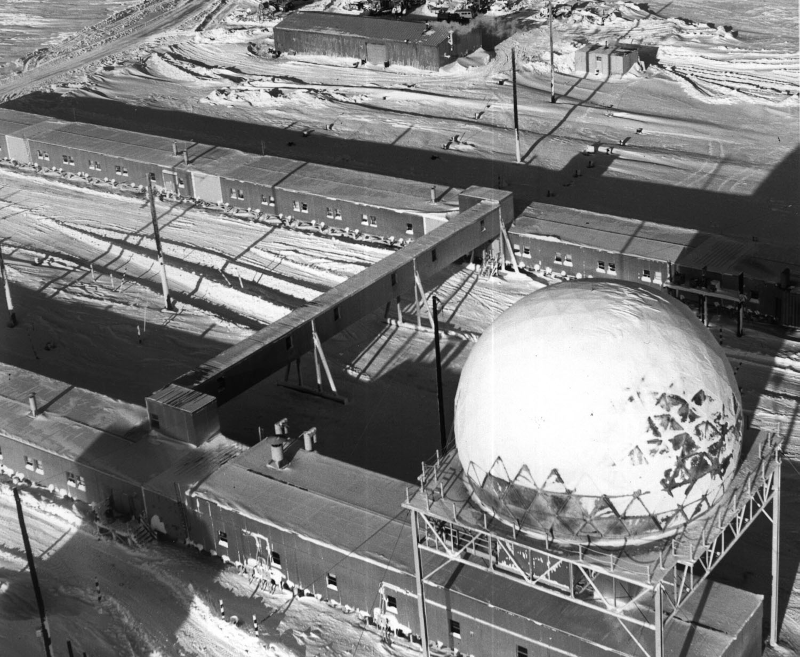
Some Cold War stories arrive with mushroom clouds, presidential speeches, and movie villains stroking imaginary cats. The story of the DEW Line is quieter, colder, and much more mechanical. It is a story of radar domes on frozen horizons, diesel generators growling through polar nights, technicians watching green screens while the wind tried to sandblast the buildings into history, and an entire continent learning that geography could be both a shield and a vulnerability.
The Distant Early Warning Line, better known as the DEW Line, was one of the most ambitious defense infrastructure projects of the twentieth century. Built across the Arctic during the 1950s, it was designed to detect Soviet aircraft approaching North America over the polar region. In plain English, it was a gigantic electronic tripwire stretched across some of the least forgiving terrain on Earth. If an attack came from the north, the DEW Line was supposed to notice first, shout loudly, and give Canada and the United States precious minutes to respond.
Today, the DEW Line is remembered as a Cold War radar network, an engineering miracle, a political symbol, a hard chapter in Arctic environmental history, and for many workers, a strange second home at the top of the world. It was part science fiction, part construction nightmare, part lonely outpost life, and part reminder that even the most advanced technology eventually becomes yesterday’s hardware with snow on it.
What Was the DEW Line?
The DEW Line stood for the Distant Early Warning Line, a chain of radar stations built across the northern edge of North America. Its main route stretched through Alaska, northern Canada, and toward Greenland, forming a defensive screen across the Arctic. The system became operational in 1957 and remained part of North American air defense until it was replaced by the more modern North Warning System in the late twentieth century.
Its mission was simple to describe and extremely difficult to perform: detect incoming Soviet bombers early enough to give North American military commands time to react. During the early Cold War, military planners believed the shortest and most likely route for long-range aircraft from the Soviet Union to North America would pass over the Arctic. The top of the map, which many people treated as empty white space, suddenly became the front porch.
The DEW Line was not the only radar shield on the continent. It worked alongside earlier and more southern systems, including the Pinetree Line and the Mid-Canada Line. But the DEW Line was the farthest north, the most dramatic, and arguably the most symbolic. It pushed electronic surveillance into places where maps looked unfinished and weather behaved like it had a personal grudge against humanity.
Why the Arctic Became the Front Line
To understand the DEW Line, you have to understand Cold War geography. On a flat classroom map, the United States and the Soviet Union seem separated by oceans and continents. On a globe, however, the Arctic route tells a different story. The shortest path between the superpowers ran over the polar region. That made the Arctic not a remote afterthought, but a strategic highway.
By the early 1950s, faster aircraft, nuclear weapons, and growing tensions made early warning a national priority. Radar technology had already proven its value during World War II, but defending an entire continent required something larger than coastal watch posts. North America needed a system that could see far enough north to provide warning before danger reached major cities or military targets.
That urgency shaped the DEW Line. It was not built because life in the Arctic sounded cozy. Nobody looked at a winter temperature chart and said, “Perfect spot for a long-term office campus.” It was built because defense planners believed minutes mattered. In the nuclear age, warning time was not just useful; it could determine whether leaders had any meaningful choices at all.
An Engineering Project With Ice in Its Teeth
The construction of the DEW Line was a massive logistical effort. Building radar stations across the Arctic meant moving people, fuel, steel, food, electronics, vehicles, housing materials, antennas, and communications equipment into regions with little or no existing infrastructure. Roads were rare. Harbors were seasonal. Airstrips had to be built or improved. Sea ice controlled shipping schedules like an extremely stubborn traffic cop.
Workers had to race against short Arctic summers, when ships and aircraft could deliver supplies more easily. In winter, the cold was not merely uncomfortable; it affected machinery, electronics, fuel, batteries, construction materials, and human judgment. Metal became brittle. Engines resisted starting. Simple tasks became theatrical productions involving gloves, tools, heaters, and a vocabulary best not printed in polite company.
The project relied on prefabricated structures, specialized transportation, and careful planning. Buildings needed insulation, heating, and durability. Radar equipment needed protection from wind, snow, ice, and temperature extremes. Communications links had to carry information across great distances. The DEW Line was not just a row of radar dishes; it was a complete operating environment built in places where even a missing spare part could become a crisis.
How the DEW Line Worked
At its heart, the DEW Line used radar to scan the skies for aircraft. Radar systems transmitted radio waves and detected reflections from objects in the air. Operators and automated systems used those returns to identify possible aircraft and track movement. When a suspicious contact appeared, information could be passed through communications networks to military command centers.
The system included different types of stations. Some were larger main stations with more personnel and equipment. Others were smaller auxiliary or intermediate sites designed to fill gaps in coverage. Together, they formed an electronic fence. The fence was not made of wood, wire, or concrete. It was made of signals, screens, antennas, and people trying to stay alert at three in the morning while the Arctic wind performed percussion on the walls.
Communications were just as important as detection. A radar station that spotted danger but could not report it would be about as useful as a smoke alarm sealed inside a refrigerator. The DEW Line depended on radio and long-distance communication systems to move information quickly across remote territory. This made it a true system of systems: radar, power generation, housing, aviation support, supply chains, maintenance, and command networks all had to function together.
Life on the Line
The human side of the DEW Line is one of its most memorable features. The stations were staffed by military personnel, civilian technicians, cooks, mechanics, radio operators, administrators, and maintenance crews. Some stayed for months at a time. Many worked in isolation, separated from family, cities, and ordinary conveniences.
Life at a DEW Line station could be repetitive, tense, boring, beautiful, and absurdsometimes before lunch. Workers dealt with darkness that seemed to last forever, cold that made door handles feel personally hostile, and landscapes so vast they could make a person feel like a comma in a very long sentence. Entertainment mattered. So did mail, food, routines, humor, and the ability to get along with the same small group of people in close quarters.
Yet many former workers remembered the experience with pride. The job required discipline and technical skill. Keeping radar and communications equipment running in the Arctic was no small accomplishment. Every successful shift represented another day the system remained alert. The DEW Line may have been built from metal and electronics, but it survived because people kept fixing it, feeding it, fueling it, and believing the mission mattered.
The DEW Line and NORAD
The DEW Line became closely connected with the broader development of North American air defense. In 1958, the North American Aerospace Defense Command, widely known as NORAD, formalized a binational defense partnership between Canada and the United States. The DEW Line fit into that larger structure as a northern warning network designed to help protect the continent’s airspace.
This partnership was significant. The radar stations sat largely across Canadian Arctic territory, while the perceived threat was continental. The project required cooperation, funding, political negotiation, and operational coordination. It also raised questions about sovereignty, local impact, and how much influence the United States should have in Canada’s North.
In that sense, the DEW Line was more than a military tool. It was also a symbol of how the Cold War reshaped borders, alliances, and remote regions. The Arctic was no longer treated as empty distance. It became monitored, mapped, supplied, staffed, and strategically framed. The North was still remote, but it was no longer ignored.
Impact on Northern Communities
The DEW Line brought jobs, infrastructure, airstrips, transportation links, and outside attention to parts of the Arctic. For some northern communities, the arrival of radar stations changed local economies and movement patterns. Construction and operations created opportunities for wage labor, support services, and contact with southern institutions.
But the impact was complicated. The project was planned primarily for continental defense, not community development. Inuit communities and other northern residents experienced the changes in ways that were not always fully considered by distant decision-makers. The stations introduced new materials, waste, buildings, and social pressures into fragile environments and cultures. Like many large Cold War projects, the DEW Line solved one problem while creating others that would take decades to address.
Remembering the DEW Line honestly means acknowledging both its technical achievement and its human cost. It was an impressive radar network, yes. It was also a reminder that “remote” places are never empty places. People live there. Ecosystems exist there. Decisions made in capital cities can leave footprints in snow that last much longer than expected.
The Environmental Legacy
When the DEW Line was built, environmental standards were very different from today’s expectations. Fuel storage, waste disposal, construction debris, batteries, chemicals, and contaminated soil became major concerns at former radar sites. The Arctic environment is especially vulnerable because cold temperatures slow natural breakdown processes. In other words, the North does not quickly forget what people leave behind.
Cleanup became a major part of the DEW Line’s later history. Former sites required assessment, removal of hazardous materials, demolition of abandoned structures, and containment or treatment of contaminated soil. These projects were expensive, complex, and necessary. They also changed how governments thought about military infrastructure in sensitive environments.
The environmental chapter of the DEW Line is not a side note. It is central to the memory of the system. The same stations that represented vigilance and technological confidence also became reminders of the need for responsibility after the mission ends. A radar dome can be turned off in a moment; cleaning up the site beneath it can take years.
Why the DEW Line Became Obsolete
The DEW Line was designed mainly to detect aircraft, especially long-range bombers. But Cold War technology did not stand still politely. Intercontinental ballistic missiles, submarine-launched missiles, advanced aircraft, and later cruise missiles changed the warning problem. A radar network built for one kind of threat could not fully answer every new one.
By the 1980s, the DEW Line was aging. Many sites required modernization, and new radar technology offered better performance with fewer people. Canada and the United States eventually moved toward the North Warning System, which replaced much of the original DEW Line with more modern and automated radar installations. The transition reflected both technological progress and a changing strategic environment.
Still, calling the DEW Line obsolete misses part of the point. All defense systems age. What matters is what they teach. The DEW Line proved that large-scale surveillance infrastructure could be built across extreme terrain. It showed the importance of integrated warning systems. It also showed that technology must be maintained, updated, and eventually cleaned up. Even the most futuristic equipment eventually becomes a historical artifact with a maintenance file.
The DEW Line in Memory and Culture
The DEW Line occupies a distinctive place in Cold War memory because it combines high strategy with everyday endurance. It was connected to nuclear anxiety, continental defense, and superpower rivalry, but it was also connected to coffee in remote kitchens, frozen machinery, supply flights, and lonely shifts under fluorescent lights.
That combination makes the DEW Line fascinating. It was both enormous and intimate. On one level, it belonged to presidents, prime ministers, generals, engineers, and defense planners. On another level, it belonged to the cook making meals during a storm, the technician replacing a part in bitter cold, the pilot landing supplies on a remote strip, and the local residents watching the modern world arrive in metal crates.
Remembering the DEW Line also helps modern readers understand today’s Arctic. The region remains strategically important. Climate change, shipping routes, resource development, sovereignty debates, and renewed geopolitical competition have again placed the North in global conversations. The DEW Line may be history, but the questions it raised are still very much alive: Who watches the Arctic? Who benefits from northern infrastructure? Who pays for the cleanup? Who gets heard when decisions are made?
Lessons From the DEW Line
1. Geography Still Matters
The DEW Line proved that geography can shape strategy even in an age of advanced technology. The Arctic’s position made it central to North American defense. Today, satellites, drones, cyber systems, and modern radar may dominate the conversation, but physical geography still influences security decisions.
2. Technology Needs People
The DEW Line was a technological system, but it depended on human labor. People built it, operated it, repaired it, supplied it, and lived with its consequences. Machines may scan the horizon, but humans decide what the horizon means.
3. Remote Does Not Mean Empty
One of the most important lessons is that remote regions are not blank spaces. The Arctic has communities, histories, wildlife, and ecosystems. Infrastructure projects must consider local realities from the beginning, not after the grand opening ceremony and the first round of official photographs.
4. Cleanup Should Be Part of the Plan
The environmental legacy of the DEW Line shows why modern projects need full life-cycle planning. Building is only the first act. Maintenance, modernization, closure, and restoration matter just as much. Otherwise, the final invoice arrives years later with interest.
Experiences Related to the DEW Line Remembered
To experience the DEW Line today is not necessarily to stand inside a humming radar station as operators once did. For most people, the experience is historical, emotional, and imaginative. It begins with trying to picture the Arctic not as a scenic backdrop, but as a workplace. Imagine arriving by aircraft into a world of white distance and hard wind, stepping down into air so cold it feels less like weather and more like a committee decision against your face. The station is warm inside, but outside the landscape keeps reminding everyone who is really in charge.
Former workers often described northern service as a mixture of hardship and strange beauty. There were long shifts, technical routines, and the constant awareness that the mission was serious. But there were also moments of wonder: auroras moving across the sky, silence so complete it seemed engineered, and the peculiar friendship that develops among people who share discomfort, responsibility, and limited entertainment options. A person might go north for a paycheck and return with stories that sounded exaggerated until another veteran nodded and said, “Yes, that happened.”
For researchers and visitors studying the DEW Line’s remains, the experience can feel like walking through a Cold War time capsule. A rusting fuel tank, a weathered building foundation, or an old airstrip can say more than a polished museum display. These remains show the physical scale of the project. They also make the past feel less abstract. The Cold War was not only speeches and policies; it was lumber, steel, diesel, antennas, canned food, paperwork, and people trying to keep equipment alive in places where a dropped wrench could disappear into snow until spring.
For northern communities, remembering the DEW Line can be more personal and complicated. The radar sites brought jobs and connections, but also disruption and contamination. Some families remember employment and new access to goods or transportation. Others remember decisions made without enough local voice. These experiences do not cancel each other out. They sit together, which is often how real history behaves: untidy, layered, and resistant to easy slogans.
There is also a modern experience in looking back at the DEW Line from the digital age. Today, people carry more computing power in a phone than many Cold War systems could dream of, then use it to forget passwords and photograph lunch. Yet the DEW Line still impresses because it solved a massive problem with the tools available at the time. It reminds us that innovation is not always sleek. Sometimes innovation wears a parka, smells faintly of diesel, and requires a supply plane.
The DEW Line remembered is not just nostalgia for old radar domes. It is an invitation to think about vigilance, responsibility, and the hidden costs of security. It asks us to respect the workers who endured isolation, the communities who lived with the consequences, the engineers who pushed technology into extreme conditions, and the Arctic itself, which bore the weight of decisions made far to the south. The line may have faded from active duty, but its story still sends a signal.
Conclusion: Remembering the Signal in the Snow
The DEW Line was one of the defining Arctic projects of the Cold War. It turned the far north into a monitored frontier and helped shape the defense relationship between Canada and the United States. It represented fear, ingenuity, cooperation, ambition, and the belief that technology could buy time in an age when time felt dangerously short.
But the DEW Line should not be remembered only as a military success story. It should also be remembered as a human and environmental story. The radar stations changed northern landscapes and communities. Their cleanup became part of their legacy. Their replacement by the North Warning System showed that even the most impressive infrastructure must evolve.
In the end, the DEW Line was a warning system in more ways than one. It warned of possible aircraft approaching over the pole. Later, it warned future generations about the responsibilities that come with building in fragile places. And today, it warns us not to treat history as something frozen in the past. Like the Arctic itself, the story is still moving beneath the surface.
Note: This original article synthesizes real historical information from public defense history, encyclopedia, museum, Arctic research, and environmental cleanup sources. It is written for web publication without embedded source links.