Note: This article is written for web publication in standard American English and is based on real product-testing patterns, cooking use cases, and current kitchen-timer features.
A good kitchen timer is not the flashiest tool in your drawer. It does not sear steak, froth milk, sharpen knives, or make your relatives stop “just checking” the turkey every seven minutes. But when the holidays arrive, the oven is packed, the stovetop looks like a tiny airport runway, and someone asks whether the cookies are supposed to be that color, a dependable kitchen timer suddenly becomes the quiet hero of the room.
The best kitchen timers for holidays, baking, and everyday cooking do one thing beautifully: they protect your food from forgetfulness. They help you pull shortbread before it turns into edible drywall, simmer rice without mystery smoke, proof dough without guessing, and coordinate multiple dishes without turning your phone into a greasy, flour-dusted panic button.
Yes, your smartphone has a timer. It also has texts, weather alerts, recipe tabs, social media, fingerprints, and the incredible ability to disappear under a dish towel right when the roast needs attention. A dedicated kitchen timer is simpler, louder, easier to read, and designed to live where the cooking chaos happens. Below is a practical guide to choosing the best timer for your kitchen, whether you are hosting Thanksgiving, baking cookies, meal-prepping on a Tuesday, or reheating soup with more ambition than usual.
Why a Dedicated Kitchen Timer Still Matters
Modern kitchens are full of “smart” tools, but timing is one place where simple often wins. A good digital kitchen timer gives you direct buttons, visible numbers, and an alarm you can actually hear over the vent fan, dishwasher, family conversation, or your own dramatic internal monologue.
The biggest advantage is focus. When you set a phone timer, you often have to unlock the screen, avoid notifications, switch between apps, and hope the device is not charging in another room. A kitchen timer stays in the kitchen. It does not tempt you into reading one message and accidentally giving your garlic bread a charcoal career.
Dedicated timers also work better for multi-step cooking. Holiday meals and baking projects rarely involve one countdown. You may need 15 minutes for pie crust chilling, 22 minutes for cookies, 45 minutes for roasted vegetables, and 10 minutes before the turkey needs basting. A timer with multiple channels lets you track several jobs at once without mental gymnastics.
What to Look for in the Best Kitchen Timers
1. Easy-to-Read Display
The best kitchen timer should be readable from across the counter. Large digits, strong contrast, and backlighting are especially helpful when your hands are covered in dough or you are squinting from the other side of the kitchen. Angled displays are useful on countertops because they face you instead of staring sadly at the ceiling.
2. Loud, Clear Alarm
A timer that whispers is not a timer; it is a suggestion. Look for adjustable volume if your kitchen changes from quiet weekday breakfast mode to full holiday command center. Loud timers are especially helpful for big kitchens, open floor plans, outdoor grilling, and cooks who wander away to “just fold laundry for one minute,” which is how muffins become fossils.
3. Multiple Timers
Single timers are fine for boiling eggs or steeping tea. For baking, holiday cooking, and meal prep, multiple timers are a major upgrade. Three- and four-channel timers let you track several dishes at once. The best models use separate buttons or distinct alarm sounds so you know which countdown finished.
4. Simple Controls
A full numeric keypad is faster than repeatedly pressing up and down buttons. Direct-entry controls let you type 25:00 or 1:15:00 quickly. During holiday cooking, every saved second counts, especially when one hand is holding a spoon and the other is defending the gravy.
5. Mounting Options
Magnets, stands, hooks, clips, and lanyards all matter. A magnetic kitchen timer can live on the fridge, range hood, or metal backsplash. A stand works well on counters. A lanyard or clip is great for cooks who move between kitchen, grill, pantry, and dining room.
6. Durability and Cleanability
Kitchen timers face steam, splashes, flour, oil, and the occasional emotional cranberry sauce incident. Smooth buttons, sealed keypads, splash-resistant construction, and easy-wipe surfaces are worth considering. Tiny crevices may look harmless until cookie dough moves in and signs a lease.
Best Kitchen Timer Types for Different Cooks
Best Overall: A Triple Digital Kitchen Timer
For most home cooks, the best all-around choice is a digital triple timer. Models like the OXO Good Grips Triple Timer are popular because they can run three countdowns at once, offer a large display, and use a full keypad for quick input. This type of timer is ideal for everyday cooking and serious holiday multitasking.
A triple timer shines when you are juggling pasta, sauce, and garlic bread; or cookies, cooling time, and melted chocolate. It reduces the need to remember which timer belongs to which dish. If the timer also counts up after reaching zero, you can see how much time has passed since the alarm sounded. That feature is very useful when life interrupts, because life absolutely will interrupt.
Best for Loud Kitchens: An Extra-Loud Timer
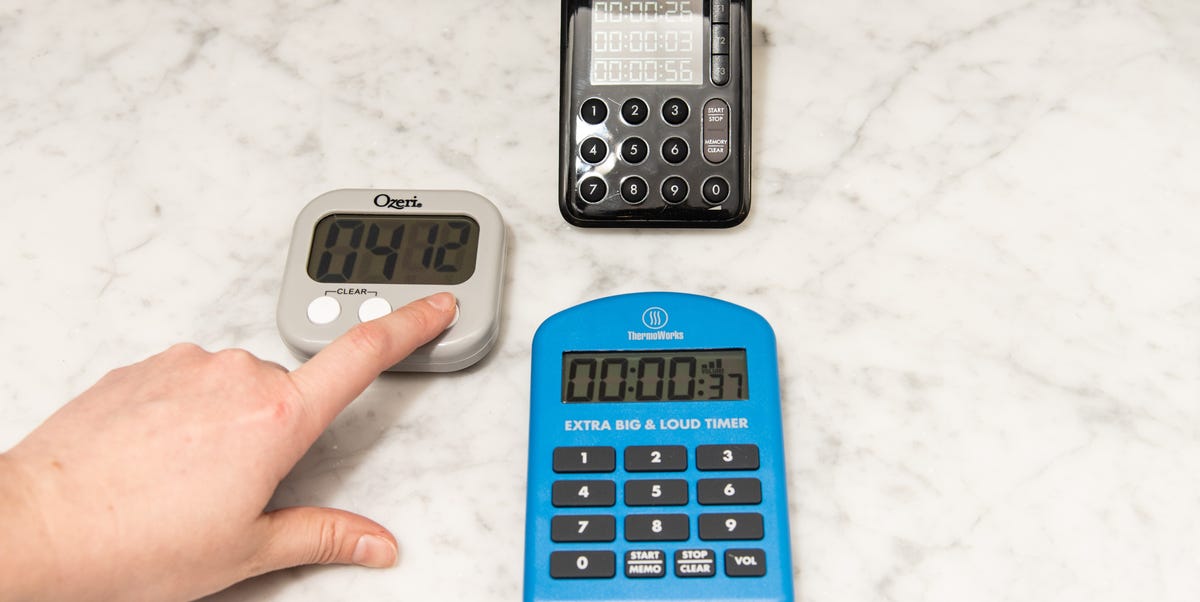
If your kitchen includes a roaring vent hood, clattering pans, guests, kids, pets, music, or all of the above, choose an extra-loud kitchen timer. Timers such as the ThermoWorks Extra Big & Loud Timer or Taylor Super Loud Digital Timer are designed for visibility and serious sound. These are great for holiday roasts, long bakes, and cooks who leave the kitchen often.
The trade-off is size. Extra-loud timers are usually larger and less pocket-friendly. But when you need an alarm that cuts through the sound of a busy kitchen, bigger is not a flaw. It is a public service announcement for your lasagna.
Best for Serious Multitasking: A Four-Channel Timer
For big holiday meals, batch baking, meal prep, or advanced home cooking, a four-channel timer is a powerhouse. The ThermoWorks TimeStack is an example of this category, offering multiple independent timers, a large display, and separate alerts. Some models even allow custom tones or voice-style reminders, which can make it easier to know whether the potatoes, rolls, or green beans need attention.
This style is best for cooks who regularly manage several dishes. If your normal dinner involves one pan and optimism, a four-channel timer may be more than you need. But if your holiday menu includes turkey, stuffing, casseroles, rolls, pies, and a side dish someone “just brought over,” four timers can feel like having an assistant who never steals a deviled egg.
Best Portable Timer: A Wearable or Pocket Timer
A portable timer is perfect for cooks who do not stay in one place. The ThermoWorks TimeStick Trio, for example, is designed around portability, one-handed use, multiple timers, a backlit display, and options such as a lanyard or magnetic mounting. This style is especially helpful for grilling, smoking, outdoor cooking, catering, or moving between rooms while food cooks.
Portable timers are also good for small kitchens. Instead of taking up counter space, they can clip to an apron, sit in a pocket, or attach to a metal surface. If you are the type of cook who sets something in the oven and immediately starts cleaning the garage, a wearable timer may save dinner from becoming a cautionary tale.
Best Budget Timer: A Simple Magnetic Digital Timer
Budget kitchen timers are often small, simple, and surprisingly useful. Many basic models include large digits, a loud enough alarm, a magnet, and a kickstand. They are excellent for boiling eggs, timing coffee, steaming vegetables, baking frozen pizza, or keeping kids on schedule during family cooking projects.
The downside is that budget timers may have shorter maximum countdowns, fewer channels, less durable buttons, or quieter alarms. Still, having two inexpensive timers can be smarter than owning one fancy timer if you often cook multiple dishes. A two-pack can be a practical choice for apartments, dorm kitchens, or anyone who wants one timer for cooking and one for laundry, workouts, or homework sessions.
Best Analog Timer: A Visual Countdown Timer
Analog and visual timers are great for people who prefer seeing time pass instead of reading numbers. Products like the Time Timer MOD use a visual disk that gradually disappears as time runs out. This can be useful for families, kids, neurodivergent cooks, or anyone who wants a calmer way to track short tasks.
Visual timers are not always ideal for long recipes or multiple dishes because many are limited to 60 minutes and only track one countdown. But for baking cookies, timing cleanup, managing homework breaks, or keeping an eye on short cooking tasks, they are simple and friendly. They also look nicer on the counter than a phone with sauce fingerprints.
Best Kitchen Timers for Holiday Cooking
Holiday cooking is where timers earn their keep. A regular weeknight dinner may tolerate a little improvisation. Thanksgiving does not. One forgotten tray can throw off the entire rhythm of the meal. The best kitchen timer for holidays should offer at least three countdowns, a loud alarm, a readable display, and stable placement.
For holiday hosting, choose a timer with separate channels for major dishes. For example, use one timer for the turkey, one for rolls, one for vegetables, and one for resting time. If your timer allows distinct alarm sounds, assign them in a way you remember. High beep means oven, low beep means stovetop, frantic beep means “why did we invite twelve people?”
Holiday kitchens also benefit from a timer that can count up after the alarm. If you miss the alert by a minute or two, the count-up feature tells you exactly how much extra time has passed. That matters for cookies, broiled dishes, and anything that changes from perfect to “interesting” in under 90 seconds.
Best Kitchen Timers for Baking
Baking rewards precision. A minute or two can change texture, color, moisture, and structure. Cakes, cookies, bread, pie crusts, macarons, and meringues all benefit from accurate timing. For bakers, the best timer should be easy to set, easy to reset, and loud enough to hear from another room.
Multiple timers help with staged baking tasks. You might time dough resting, oven preheating, baking, cooling, and decorating. For sourdough or enriched dough, a long-range timer is useful because fermentation can stretch over hours. For cookies, a timer with memory recall is handy when you bake tray after tray at the same interval.
For serious bakers, a triple timer or four-channel timer is usually better than a single analog dial. However, a visual timer can be helpful for short tasks like chilling pastry, resting batter, or keeping children involved in cookie decorating without asking “Is it done yet?” every eleven seconds.
Best Kitchen Timers for Everyday Cooking
Everyday cooking does not always require a high-end timer. For rice, pasta, hard-boiled eggs, oatmeal, tea, roasted vegetables, and weeknight sheet-pan dinners, a simple digital timer is enough. The key is convenience. If the timer is easy to see, easy to set, and easy to keep nearby, you will actually use it.
For daily use, a magnetic timer on the fridge or range hood is wonderfully practical. It has one home, so it does not vanish into a drawer. If your household has multiple cooks, choose a timer with obvious buttons and a display that does not require a user manual. A kitchen tool should not need a dramatic onboarding process.
Everyday timers also help outside cooking. Use them for steeping tea, timing French press coffee, managing lunchbox prep, tracking cleaning tasks, or reminding yourself to check the oven before the smoke alarm joins the conversation.
Digital vs. Analog Kitchen Timers
Digital timers are best for precision, multiple countdowns, long timing ranges, and loud alarms. They usually offer count-up and count-down modes, memory recall, clocks, backlights, or separate alert tones. If you cook often, bake regularly, or host big meals, digital is the safer choice.
Analog timers are best for simplicity and visual awareness. They do not always require complicated controls, and some mechanical models need no batteries. However, many analog timers are limited to 60 minutes and may be less precise. They are great for short tasks, but less ideal for layered holiday cooking.
The right answer depends on your cooking style. A busy home cook may want one multi-channel digital timer and one simple visual timer. That combination covers both serious cooking and casual everyday use.
Kitchen Timer Buying Guide: Match the Timer to the Task
- For holiday meals: Choose a three- or four-channel digital timer with a loud alarm and large display.
- For baking: Look for accuracy, memory recall, long timing range, and easy reset controls.
- For small kitchens: Pick a magnetic or wearable timer that does not steal counter space.
- For noisy homes: Choose an extra-loud timer with adjustable volume.
- For kids and visual learners: Try a visual analog timer with a clear countdown disk.
- For everyday meals: A simple magnetic digital timer is usually enough.
Common Mistakes When Choosing a Kitchen Timer
Buying the Quietest Cute Timer
A cute timer is charming until you cannot hear it. Looks matter, but sound matters more. If the timer will be used for baking or holiday meals, check whether the alarm is loud enough for your kitchen.
Ignoring the Display
Tiny numbers are annoying when you are busy. Choose a display you can read at a glance. Backlighting helps if your kitchen lighting is uneven or if you cook at night.
Choosing One Timer for Every Job
A single timer is fine for simple cooking, but it can become frustrating during multi-dish meals. If you often cook several things at once, invest in multiple channels.
Forgetting About Placement
A timer that slides around the counter or hides behind a mixing bowl will not help much. Look for magnets, a stable stand, or a lanyard depending on where you cook.
Real-Life Experience: What Using Kitchen Timers Actually Teaches You
After using different kinds of kitchen timers for baking, holiday cooking, meal prep, and ordinary weeknight dinners, one lesson becomes obvious: the best timer is the one that removes tiny decisions. Cooking already asks enough of your brain. You are measuring, tasting, stirring, adjusting heat, checking texture, reading recipes, cleaning spills, answering questions, and wondering why every measuring spoon has vanished except the tablespoon. A good timer quietly takes over one job and does it consistently.
For holiday meals, the biggest benefit is confidence. When multiple dishes are running at once, a timer keeps the kitchen from becoming a guessing game. Instead of opening the oven every few minutes, you can assign specific countdowns: one for basting, one for checking vegetables, one for rolls, and one for resting meat. The meal feels less chaotic because every task has a signal. That does not mean the kitchen becomes peaceful. It just means the chaos wears a name tag.
For baking, timers teach discipline. It is tempting to rely on smell or color, but many baked goods are sneaky. Cookies keep cooking on the hot tray after they leave the oven. Cakes can look fine on top while still needing a few minutes inside. Bread may require separate timing for proofing, baking, and cooling. A timer helps you build repeatable habits. When a batch turns out perfectly, you know what timing worked and can repeat it next time.
A dedicated timer is also surprisingly helpful for cleaning as you cook. Set a five-minute countdown after putting something in the oven and use that time to wash bowls, wipe counters, or prep the next step. This makes cooking feel less like a disaster documentary. Short timers can turn overwhelming cleanup into small, manageable sprints.
Everyday cooking benefits too. A timer makes rice more consistent, keeps boiled eggs from becoming rubber balls, and reminds you to flip roasted vegetables before one side becomes “deeply caramelized,” also known as burned with confidence. It is especially useful for people who multitask. If you start dinner and then check email, help with homework, or take a phone call, the timer becomes your kitchen’s polite but firm supervisor.
The best experience comes from placing the timer where you naturally look. A fridge magnet works well for many kitchens. A countertop timer is better if the display angles upward. A wearable timer is excellent if you move around. The goal is not to own the fanciest gadget. The goal is to make timing so effortless that you stop thinking about it.
One more practical lesson: use names or patterns when running multiple timers. If your timer has three channels, always assign them the same way. For example, Timer 1 is oven, Timer 2 is stovetop, Timer 3 is resting or cooling. This habit prevents confusion when alarms start beeping during a busy meal. Without a system, every beep becomes a tiny mystery novel.
In the end, a kitchen timer is less about counting minutes and more about protecting attention. It lets you cook with fewer interruptions, fewer mistakes, and fewer dramatic rescue missions. Whether you are baking sugar cookies, roasting a holiday turkey, or making Tuesday pasta, the right timer gives you one simple luxury: you do not have to remember everything yourself.
Final Verdict: Which Kitchen Timer Should You Buy?
If you want one timer for almost everything, choose a triple digital kitchen timer with a large display, clear buttons, and distinct alarms. It will handle everyday meals, baking projects, and most holiday cooking with ease. If your kitchen is loud or you often leave the room, choose an extra-loud model. If you cook elaborate meals or bake in batches, a four-channel timer is worth considering. If you prefer simplicity, a budget magnetic timer or visual analog timer may be enough.
The best kitchen timers are not complicated. They are visible, audible, reliable, and easy to use when your hands are busy. In other words, they do not ask for attention; they give it back. And during the holidays, that might be the most underrated kitchen gift of all.