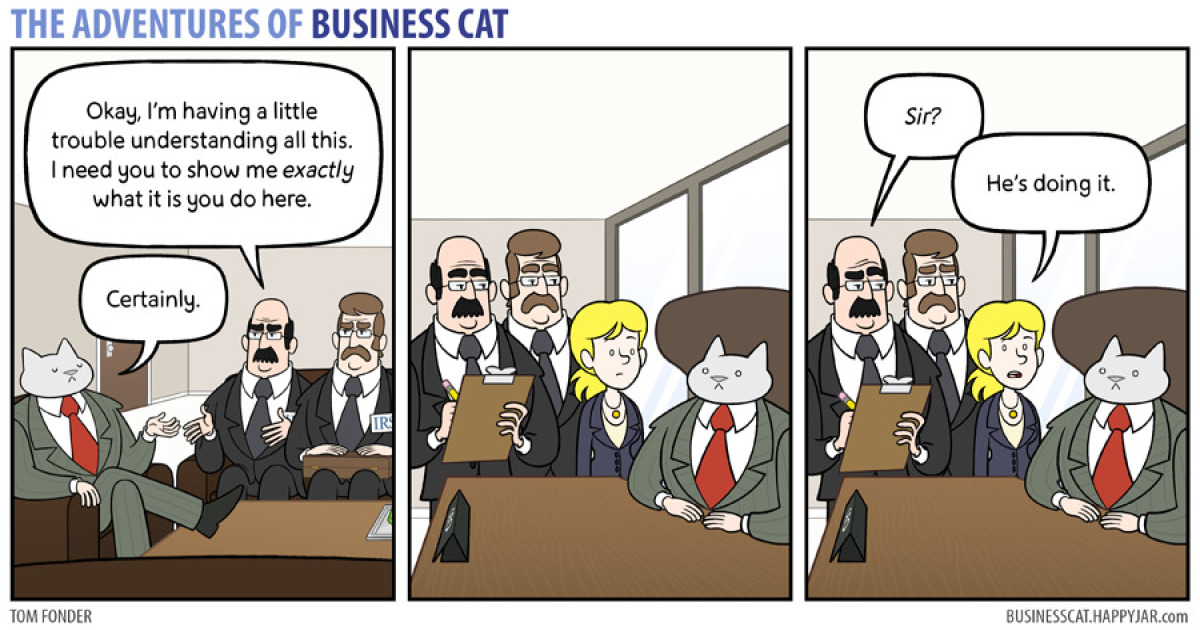
Note: This is an original, unaffiliated editorial feature inspired by workplace satire and feline behavior. It does not reproduce, adapt, or continue any published comic strip dialogue or artwork.
There are CEOs who lead with vision. There are CEOs who lead with spreadsheets. Then there is Business Cat: the kind of executive who can stare at a wall for forty minutes, knock a pen onto the floor, and still somehow make everyone feel like they have missed an important quarterly objective.
The Adventures of Business Cat is known for blending office absurdity with very recognizable cat behavior: the confidence of a corporate titan, the priorities of a household pet, and the mysterious ability to treat a cardboard box like premium real estate. The original series by Tom Fonder turns the workplace into a feline-powered satire, where ambition, meetings, snacks, and suspiciously expensive furniture all collide.
In this fourth installment-style reflection, the focus is not on copying the comic’s jokes. Instead, it explores why the idea of a cat in a boardroom remains funny, relatable, and oddly useful. Because beneath the whiskers, luxury office chair, and questionable expense reports lies a familiar truth: modern work can be ridiculous, stressful, theatrical, and occasionally improved by a well-timed nap.
Business Cat Returns to the Office
Monday began at 8:03 a.m., which was already unacceptable.
Business Cat arrived at headquarters seventeen minutes late, although nobody could prove it. He had technically been in the building since dawn. He had simply spent the first hour sitting in the lobby window, watching pigeons make what he considered several poor strategic decisions.
“The market is unstable,” he announced as he entered the executive conference room.
“Which market?” asked Janet from finance.
Business Cat looked at her with slow, deliberate disappointment.
“The bird market.”
No one spoke for a moment. Then Janet quietly wrote avian competitor analysis into the meeting notes.
This is the magic of Business Cat. He does not merely misunderstand office culture. He exposes how strange office culture already is. Humans often tolerate phrases such as “circle back,” “move the needle,” and “synergize our core competencies” without blinking. But when a cat asks for a strategic tuna forecast, suddenly everyone discovers the limits of corporate language.
The joke works because workplaces are full of rituals that can look completely irrational from the outside. A ten-person meeting to schedule another meeting? Perfectly normal. A cat demanding a sunbeam near the printer? Apparently outrageous. Yet one of those things may actually improve morale.
Why Business Cat Still Feels So Relatable
He Understands the Importance of Boundaries
Business Cat does not believe in open-door policies. He believes in closed-door policies, preferably with a locked office, a velvet chair, and a sign that says: Do Not Disturb Unless You Have Salmon.
That sounds selfish until you remember how many people work in a constant state of interruption. Notifications arrive. Emails multiply. Someone sends a message marked “quick question,” and suddenly you are rebuilding a slideshow that began during a different presidential administration.
Business Cat’s boundary-setting style may be dramatic, but the lesson is useful. Not every message requires an immediate response. Not every request deserves a meeting. And not every person who says “Can I grab five minutes?” should be trusted with a calendar invitation.
Workplace stress can affect focus, engagement, performance, and physical health, which is why organizations increasingly emphasize clearer roles, supportive leadership, and healthier work conditions.
Business Cat would probably summarize this research with one instruction: “Protect your nap time.”
He Knows That Rest Is Not a Character Flaw
One reason cats seem qualified to run companies is that they have no guilt about resting. They do not answer emails while eating. They do not apologize for taking a break. They do not call a three-hour nap “deep-focus recovery optimization.” They simply sleep, wake up refreshed, and demand lunch as if they have just returned from a diplomatic mission.
Humans, meanwhile, often act as though exhaustion is proof of importance. The busier someone appears, the more impressive they seem. But being busy is not always the same as being effective. A calendar filled with meetings can hide a complete absence of meaningful progress.
Business Cat’s philosophy is wonderfully simple: conserve energy for the moments that matter. Chase the laser pointer when it appears. Ignore the spreadsheet when it does not. This is not a complete management strategy, but it is arguably more honest than pretending every task deserves equal urgency.
Research and clinical guidance on stress management consistently support practical habits such as prioritizing tasks, moving the body, using relaxation techniques, and taking deliberate moments to reset.
The Boardroom Lessons of a Cat CEO
Lesson One: Simplify the Agenda
Business Cat’s ideal meeting agenda contains three items:
- Food.
- Window access.
- Why the printer has betrayed him again.
While this may not satisfy a publicly traded corporation, it does highlight an important leadership habit: focus on what actually matters. Teams become less effective when every conversation turns into a giant, shapeless pile of priorities. When everything is urgent, nothing is truly urgent.
A strong meeting should have a purpose, a decision to make, and a clear next step. If it has none of those things, it may be better as an email. Or, in Business Cat’s preferred format, a note slipped under the office door.
Lesson Two: Reward Good Behavior
Business Cat is not motivated by vague praise. “Great job this quarter” will not move him. He wants visible evidence: a treat, a warmer chair, a promotion to Chief Executive Purrson, or at minimum a new box with his name on it.
Employees are not cats, despite what some managers may suspect after a difficult Monday. Still, people do respond better when recognition is specific, timely, and sincere. A generic “thanks, team” sent at 11:58 p.m. on a Friday does not feel especially meaningful. Recognition works best when leaders explain what someone did well and why it mattered.
Business Cat would never say, “I appreciate your cross-functional contribution to the deliverable.” He would stare at your desk until you understood that he approved of you. Frankly, some managers could learn from the efficiency.
Lesson Three: Create a Safe Environment
Even the most powerful feline executive needs a place that feels secure. Cats generally do better with predictable routines, clean resources, opportunities for play, and spaces that allow them to express natural behaviors such as hiding, climbing, observing, and hunting-style play. Changes in routine or environment can contribute to stress for many cats.
People are not so different. Teams perform better when they know what is expected, have permission to ask questions, and can raise concerns without being punished for it. A workplace does not need a giant beanbag chair or a neon sign that says “Innovation Zone” to feel safe. It needs respectful communication, realistic workloads, and leaders who listen before they react.
Business Cat might express psychological safety by allowing employees to sit within three feet of him without hissing. In human terms, it means creating a culture where people can contribute ideas, report problems, and admit mistakes before a small issue becomes a five-alarm disaster with a slide deck.
Could a Real Office Have a Business Cat?
Before anyone attempts to appoint Mr. Whiskers as Vice President of Sales, it is worth remembering that pet-friendly offices require more than a cute mascot and a company-branded bandana.
Animals may help some people feel calmer, more connected, or less lonely, but the evidence around human-animal interaction is still developing and effects can vary from person to person.
A workplace pet policy should also consider allergies, employee comfort, hygiene, safety, animal temperament, and the needs of people who do not want a surprise Labrador attending the budget meeting. HR guidance recommends flexibility and thoughtful accommodation when pet-friendly policies affect employees with allergies or other concerns.
Cats, especially, are not automatic office animals. Some are confident and curious. Others would consider an open-plan office to be a horrifying maze of fluorescent lights, unfamiliar smells, loud keyboards, and people asking, “Why is he under the copier?” every fifteen minutes.
If a business ever includes an animal in the workplace, the animal’s welfare has to come first. A cat should have access to calm spaces, water, food, litter facilities, hiding areas, and the freedom to avoid interactions. Forcing a nervous cat to become the company’s unofficial morale ambassador is not leadership. It is just a very strange form of branding.
The Real Genius of Business Cat Humor
Business Cat is funny because cats already behave like tiny executives. They inspect rooms before entering. They reject proposals without explanation. They occupy the best chair in the house. They expect food to arrive on schedule. And when a decision goes poorly, they look directly at you as though you were responsible for the entire collapse of civilization.
The corporate setting simply gives those instincts a suit, a conference table, and an expense account.
But the humor lands for another reason: it gives people permission to laugh at work. Work matters. Bills matter. Projects matter. Deadlines matter. Yet not every email needs to be treated like a national emergency. Sometimes the healthiest response to a chaotic day is to notice how absurd it has become and imagine a cat in a necktie trying to solve it with a laser pointer.
Humor does not eliminate stress, but it can create breathing room. A funny moment can interrupt a tense pattern, help colleagues connect, and remind a team that they are made of humans rather than calendar notifications wearing shoes.
Business Cat’s Final Quarterly Address
At the end of the day, Business Cat climbed onto the conference table and reviewed the company’s performance.
Revenue was acceptable.
Morale was questionable.
The intern had failed to open the tuna tin.
“We must innovate,” Business Cat said.
“What does that mean?” Janet asked.
Business Cat pushed a water glass onto the floor.
Everyone stared.
“Disruption,” he said.
And somewhere in the corner, the marketing department began building a campaign around it.
The enduring charm of The Adventures Of Business Cat P.4 is that it turns corporate pressure into something playful. It reminds us that office culture is often stranger than anyone admits, that rest is productive when it helps us return with energy, and that a little humor can make a long workday feel less like a cage and more like a sunny windowsill.
Extended Experiences: What Business Cat Teaches Us About Work and Life
The first Business Cat experience is the “important-looking pause.” Imagine a manager walking into a meeting, saying nothing, gazing out the window, and then finally declaring that the team needs a new direction. Everyone assumes a major strategic insight is about to arrive. In reality, the manager may simply be thinking about lunch. Business Cat teaches us that silence can look powerful, but substance still matters. A thoughtful pause is useful when it leads to a better question, a clearer decision, or a calmer response. It is less useful when it is merely dramatic staring with no follow-up.
The second experience is the “territory dispute.” In every office, someone has a favorite chair, a preferred parking spot, or an emotional attachment to a coffee mug that says World’s Okayest Accountant. Cats understand territory deeply. They also understand that sitting directly on the document you need is an effective way to gain attention. In workplaces, territory conflicts often appear as arguments over ownership, authority, or credit. The smarter move is not to claw the furniture. It is to clarify responsibilities before confusion turns into resentment.
The third experience is the “treat economy.” Business Cat expects rewards because, in his mind, every successful action deserves recognition. He sat in a chair? Reward. He looked handsome? Reward. He tolerated a meeting? Immediate reward. Humans may laugh at that attitude, but many workplaces forget that effort deserves acknowledgment. A thoughtful thank-you, useful feedback, development opportunities, and fair compensation all tell people that their work is seen. Recognition is not fluff. It is part of building trust.
The fourth experience is the “unexpected box.” Cats may ignore expensive toys and become completely obsessed with a plain cardboard box. The lesson is not that companies should replace strategy with packaging materials, although someone in procurement may be tempted. The lesson is that value is not always where we expect it. A simple tool, a clearer process, or one respectful conversation can solve a problem that a large, expensive initiative failed to fix. Business Cat would call this “lean operations.” Everyone else would call it sitting in a box.
The fifth experience is the “window-seat perspective.” Cats spend time watching the outside world because observation is part of how they understand it. Leaders need their own version of a window seat. They need time to notice what customers are saying, what employees are struggling with, what competitors are doing, and what problems are quietly growing in the background. Constant activity can create the illusion of progress, but observation often reveals what needs attention next.
Ultimately, Business Cat’s greatest lesson is simple: do not let work strip away your personality. Take your responsibilities seriously, but do not take every corporate ritual too seriously. Protect your energy. Give credit when it is deserved. Create room for people to speak honestly. And when the day becomes absurd, remember that somewhere, in a better universe, a cat CEO is probably solving the same problem by sitting on the keyboard.